You are writing CSS and you type color: papayawhip as a joke. It works. That is a real CSS color. So is blanchedalmond. So is lemonchiffon. And if you have ever looked at the full list of 140 CSS named colors, you have probably stopped and wondered how any of these names got into a web standard.
Cool color names are scattered throughout the CSS specification in ways that make no immediately obvious sense. Some came from food. Some came from fabric. One is named after a French monastic liqueur that has been brewed since 1737. One is named after a six-year-old girl who died in 2014. The color name finder lets you look up any of the 140 CSS named colors by hex code or name, but the tool does not tell you where the names came from. That is what this article covers.
The interesting CSS color names are not evenly distributed. Most of the 140 named colors are predictable: red, blue, green, darkblue, lightgreen. The weird and funny color names cluster almost entirely in a zone of pale, near-white, warm tones. That zone has a history, and it leads back to X11, Netscape, and a set of naming decisions made in the 1980s and 1990s that nobody has cleaned up since.
Why Some CSS Color Names Are So Much More Interesting Than Others
The 140 CSS named colors did not come from a single consistent naming process. They came from multiple sources across several decades, and the names reflect the era and context in which they were added.
The HTML 3.2 standard in 1996 included 16 basic named colors: black, white, red, green, blue, yellow, cyan, magenta, silver, gray, maroon, olive, purple, teal, navy, lime. These names are plain and functional, exactly what you would expect from a technical standard.
The larger set of 140 names came primarily from the X11 color list, a collection of named colors used in the X Window System for Unix and Linux graphical interfaces. X11 colors were defined in the 1980s, and the names were chosen by various contributors without a consistent policy. When Netscape adopted these colors for HTML support in the early 1990s, the full list, including all the unusual food and fabric names, carried over into the web.
CSS inherited the X11 names without revision. That is why papayawhip and lemonchiffon are in the same specification as royalblue and mediumslateblue. One group came from technical contributors picking descriptive names in the 1980s. The other group came from the same tradition, but the descriptive territory they chose was food and textiles rather than standard color terminology.
The full set of CSS named colors by family is covered in the color families reference, which groups the 140 names by hue range and shows where the unusual names cluster.
rebeccapurple: The Only CSS Color Named After a Real Person
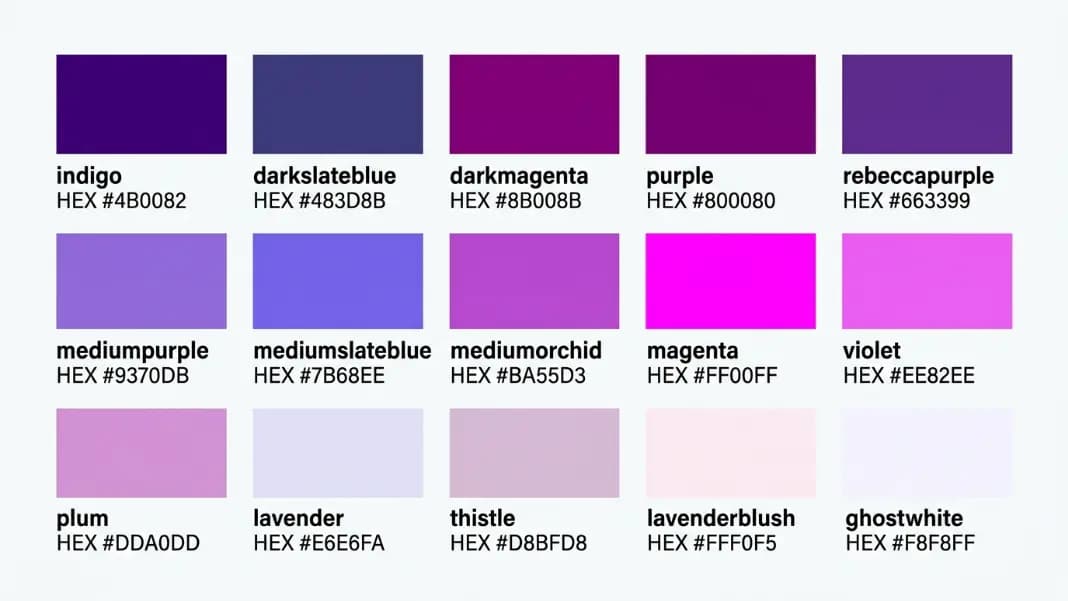
Rebeccapurple (#663399) is a medium-deep purple. The CSS color name is the only one in the entire specification named after a real, named individual, and the story behind it is genuinely moving.
Rebecca Alison Meyer was the daughter of Eric Meyer, a prominent web standards author known for his extensive writing on CSS. Rebecca died from brain cancer on June 7, 2014. She was six years old. June 7 was her sixth birthday.
Within hours of her death, members of the web standards community began discussing naming a CSS color in her memory. The color #663399, a shade of purple that was one of Rebecca's favorites, was proposed. The CSS Color Level 4 working group added the name rebeccapurple to the specification. Eric Meyer wrote about the process publicly, including his request that the color be named rebeccapurple rather than rebeccasmeyer or another variant, because Rebecca had recently started asking to be called Rebecca rather than Becca.
The name carries weight that no other CSS color name does. Every stylesheet that uses rebeccapurple references a specific person, a specific date, and a specific community decision. For a technical standard usually concerned with rendering consistency across browsers, this is an unusual thing.
This is the most direct answer to what the story behind rebeccapurple is: it is a tribute color, added in 2014, named after a child who died on her sixth birthday, proposed by the web community within hours of her death, and approved by the CSS working group as a permanent part of the CSS color specification.
Food-Inspired Names: papayawhip, peachpuff, blanchedalmond, and cornsilk
The food-named colors are the ones that generate the most confused reactions when people see the full CSS color list for the first time. These are the unique color names that appear in design discussions as examples of how the CSS standard has some genuinely odd corners.
papayawhip (#FFEFD5) is a very pale peachy-cream. The name describes the color of papaya fruit flesh blended with cream. It was added during the Netscape era of the 1990s as part of a batch of food-inspired names. On most screens it is barely distinguishable from white, carrying only the faintest warm tint. It is one of the most commonly used examples of a funny CSS color name precisely because the word itself sounds invented.
peachpuff (#FFDAB9) refers to the color of peach fuzz: the soft, slightly orange-pink of a ripe peach's exterior. It is warmer and more saturated than papayawhip, sitting clearly in the soft peachy-orange range rather than the near-white zone. The name is a compound of the fruit and the soft surface texture.
blanchedalmond (#FFEBCD) combines French and English in a single color name. "Blanched" comes from the French word meaning to whiten by brief boiling, a cooking technique used to loosen the skin of almonds. "Almond" is the nut itself. Blanchedalmond is the pale ivory-cream color of an almond after its brown skin has been removed by blanching. The X11 color list included this name in the 1980s, making it one of the older entries in the CSS named color set.
cornsilk (#FFF8DC) describes the silky threads found inside a corn cob, the pale yellow filaments that run the length of the ear of corn. It is one of the palest named CSS colors, nearly indistinguishable from white on most screens but carrying a slight warm yellow tint. If you use the tints and shades generator on cornsilk, the darkest shades reveal its yellow character clearly, but the lightest end blends almost entirely with white.
Fabric and Texture Names: lemonchiffon, oldlace, and floralwhite
Alongside the food names, the X11 list included several colors named after fabrics and textile textures. These sit in the same near-white warm zone as the food names and carry similar naming logic: the color is named after a material whose natural tone it approximates.
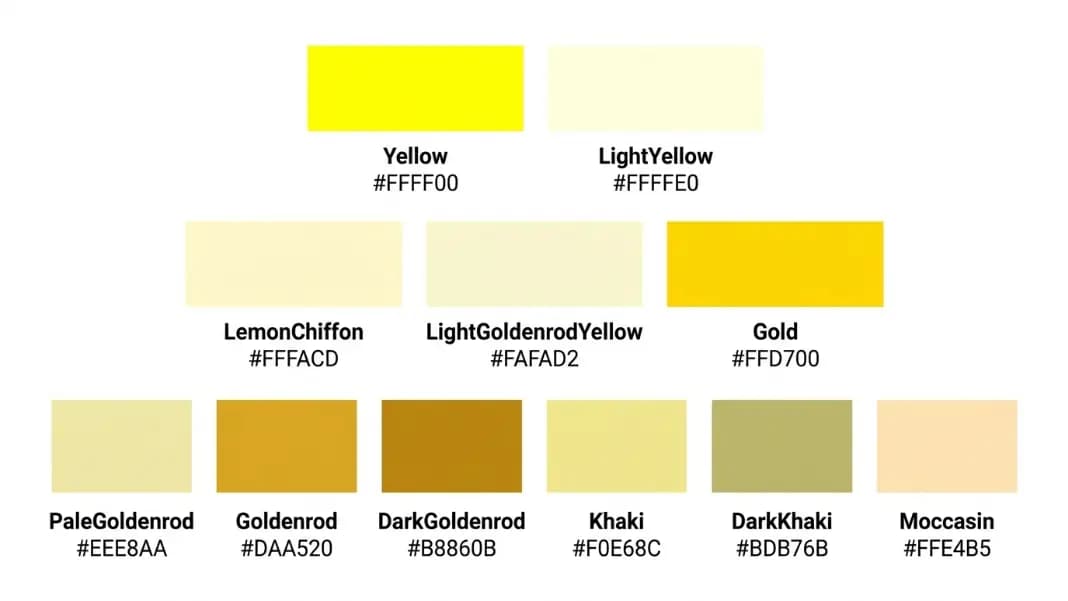
lemonchiffon (#FFFACD) takes its name from chiffon, a lightweight sheer fabric. Lemon chiffon fabric would be a pale yellow chiffon cloth, and the color approximates how such fabric looks held up to bright light: a very pale, barely-there yellow with warm undertones. At full brightness on a white background, lemonchiffon reads almost as white, but its yellow character is visible on gray or dark backgrounds.
oldlace (#FDF5E6) describes the yellowed off-white of aged lace. Lace fabric that has been stored for decades takes on a warm, slightly amber tone from oxidation. Oldlace in CSS approximates this antique ivory rather than the original crisp white of new lace. It is a warm white useful in design contexts that want an aged, vintage, or handmade feel without moving into full beige territory.
floralwhite (#FFFAF0) is a warm white with a very slight yellow tint suggesting the color of white flower petals rather than pure white. White flowers, particularly roses, gardenias, and lilies, are not pure white in the way that a white wall is. Floralwhite approximates this slightly warm, organic white.
These fabric and texture names reflect a specific design sensibility from the X11 naming period. The contributors were reaching for precise descriptive language to distinguish very similar near-white tones, and the names they chose came from the physical world of materials they worked with.

Plant and Nature Names: honeydew, chartreuse, and coral
Several CSS named colors take their names from plants, fruits, and natural phenomena. These span a wider range of the color spectrum than the food and fabric names, which clustered in the near-white warm zone.
honeydew (#F0FFF0) is named after the pale green interior flesh of a honeydew melon. The CSS color is a near-white with a very faint green tint. The gap between its name and its appearance is striking: "honeydew" suggests something full of color and melon-like, but the CSS color is almost imperceptibly pale. Place honeydew next to white (#FFFFFF) and the green undertone becomes visible, but only barely. It is one of the more unusual color-name pairings in the full CSS set.
chartreuse (#7FFF00) has the most specific origin story of any plant-named CSS color. The color is named after Chartreuse liqueur, produced by Carthusian monks at the Grande Chartreuse monastery in the French Alps. The monastery has produced this herbal alcohol since 1737 using a recipe containing 130 herbs, plants, and flowers. The liqueur has a distinctive, bright yellow-green color. CSS chartreuse is exactly that: #7FFF00, a fully saturated yellow-green at maximum brightness. The monks still produce the liqueur today.
coral (#FF7F50) is named after the color of coral reef organisms. CSS coral leans more orange than pink, sitting closer to a warm orange on most calibrated screens. The word "coral" in design vocabulary often describes a broader range that extends more toward pink, but the CSS named color is specific: a warm orange-leaning tone.
The color families reference groups these nature-named colors alongside their hue family relatives, which makes it easier to see how they relate to the broader color spectrum rather than treating each name in isolation.
Historical and Institutional Names: cadetblue, gainsboro, and navajowhite
A small number of CSS color names come from historical institutions, professions, and people. These are scattered through the color list and easy to miss without knowing what to look for.
cadetblue (#5F9EA0) takes its name from the grey-blue shade of 19th century US military cadet uniforms. The color is a muted teal-blue, noticeably more gray than the blues most people associate with military dress. The word "cadet" in color naming refers to a tradition of naming institutional uniform shades rather than to any individual cadet.
gainsboro (#DCDCDC) is named after Thomas Gainsborough (1727-1788), the English portrait painter. The spelling in CSS drops the final h from Gainsborough. Gainsborough was one of the most prominent British painters of the 18th century, known particularly for his portraits and landscapes. Gainsboro in CSS is a light neutral gray, and the connection to the painter is not immediately obvious: the name likely refers to the gray tones characteristic of Gainsborough's paintings or the grayed pigments of the era. Along with rebeccapurple, gainsboro is one of the very few CSS named colors derived from a person's name.
navajowhite (#FFDEAD) is named after the Navajo Nation. The color is a warm, slightly orange-tinted white. The naming has been questioned in modern discussions of color naming conventions for its use of the name of an Indigenous people as a color descriptor. The name originated in the X11 color list and was carried into CSS without revision. This is worth knowing when discussing unusual color names because it illustrates that not all the strange CSS color names are strange in the same way: some are strange because they are odd, others because they raise questions that the original naming process did not consider.
How to Find the Official Name for Any Color Using Its HEX Code
If you have a specific hex code and want to know the closest CSS named color, or if you want to explore the full list of 140 CSS named colors grouped by tone and hue, the color name finder handles both tasks.
The tool converts any hex code to CIE Lab color space and measures the Delta-E perceptual distance to all 140 named colors, returning the closest match. The side-by-side preview shows both the input color and the matched CSS named color so you can see how close the match is.
For the near-white zone where most of the unusual CSS names live, the perceptual differences between papayawhip, blanchedalmond, cornsilk, oldlace, lemonchiffon, and floralwhite are real but subtle. The tool makes these distinctions visible by returning the specific named color with the smallest perceptual distance rather than the closest hex value numerically, which gives better results for the human eye.
If you want to work with tints and shades of a specific named color, the tints and shades generator takes any hex input and generates an 11-step scale from near-white to near-black through that color. This is particularly useful with the more saturated CSS named colors like chartreuse or rebeccapurple, where the middle tones reveal character that is invisible at full saturation. The full set of color tools is in the color section, including format conversion, palette generation, and contrast checking.
The CSS color specification is not a curated design system. It is an accumulation of decisions made by different people across several decades, and the names reflect that. Some are practical. Some are poetic. One carries a story that has nothing to do with color at all, and everything to do with a community deciding to remember someone.