Free Yes or No Wheel Online
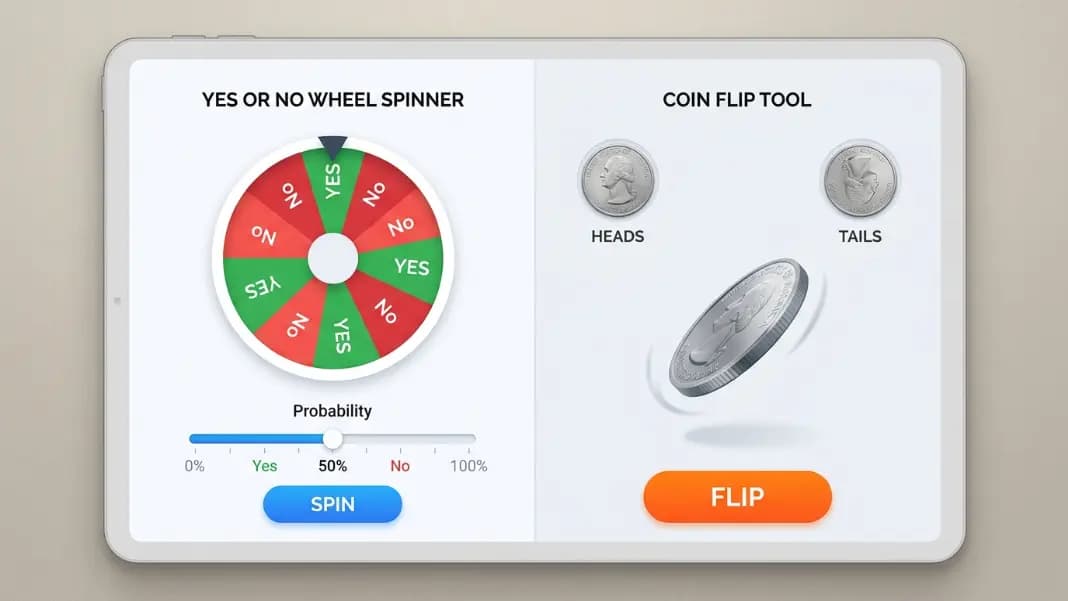
Spin the wheel yes or no and get an instant, impartial random decision. This free yes or no wheel is split 50/50 by default but lets you adjust the probability so one outcome is more likely than the other. Use it as a yes or no decision wheel for personal choices, group disagreements, classroom activities, or games. No signup required, runs entirely in your browser.
👆 Tap wheel or press the button
How to spin the wheel yes or no
- The wheel is ready to spin at a default 50/50 probability split between yes and no.
- Adjust the probability slider if you want an uneven split, for example 70% yes or 30% yes.
- Click Spin or tap the wheel to start the animation.
- The wheel slows and lands on Yes or No with a clear, prominent result display.
- Spin again for a new independent result at any time.
Yes or no wheel to decide: when to use it
The yes or no wheel to decide is most useful when you have already considered a decision and genuinely cannot choose. Deliberation has its limits: overthinking a low-stakes choice wastes time and energy. Spinning the wheel yes or no commits you to a random outcome in under five seconds, which often reveals how you actually feel about the result the moment it lands. If the wheel says yes and you feel relieved, you already knew your answer. If it says yes and you feel disappointed, that tells you something too.
For group decisions, the yes or no spin wheel works best when both parties agree in advance to accept the outcome. Spinning a fair wheel yes or no is a neutral arbitration method that removes any sense of one person imposing their preference on the other. This is why it is popular in classrooms, game nights, and team settings where a quick, uncontested result is more valuable than extended discussion.
Yes or no wheel spinner vs coin flip
A physical coin gives a fixed 50/50 result and requires a physical object. The yes or no wheel spinner has three advantages over a coin flip. First, the probability is adjustable: you can set any split from 1/99 to 99/1 rather than being locked to equal odds. Second, the animated spin is visible on any screen, which makes it better for group decisions on shared displays or video calls. Third, the result stays visible on screen until you spin again, whereas a coin result disappears the moment it is picked up.
For a strict 50/50 with a physical feel, the coin flip tool provides a focused, familiar experience. For any binary decision where probability adjustment or screen visibility matters, the yes or no wheel spinner is the better choice.
Adjusting probability on the yes or no picker wheel
The yes or no picker wheel lets you weight the outcome before spinning. Drag the probability slider to any percentage. The yes segment grows or shrinks on the wheel face in real time to reflect the split you set. At 70% yes, the yes segment takes up 70% of the wheel and the no segment takes up 30%. Over many spins, yes will appear approximately 70% of the time.
Adjustable probability makes this random yes or no wheel generator more flexible than a coin or a basic random boolean. Use it to model real-world probabilities: if something has a 75% chance of success and you want a quick random check against that probability, set the wheel to 75/25 and spin. Use it to create a challenge mode in games where yes is harder to land. Or use it to give someone a fighting chance when one outcome is clearly more likely.
Yes or no wheel for classrooms and games
Teachers use the online yes or no wheel for warm-up activities, comprehension checks, and classroom games. Project the wheel on a classroom display, ask the class a yes or no question, and spin to reveal a random "official" answer to debate against. Use it for true/false flashcard games where the spin decides which side to quiz first. The animated spin holds student attention better than a verbal answer and makes the activity feel more engaging.
For game nights and party activities, the decision wheel yes or no adds a random binary element to any game format. Use it to determine turn order, assign challenge categories, decide which team goes first, or add random yes/no consequences to game actions. For picking among more than two options, the wheel spinner handles custom lists of any size.
Yes or no wheel vs other random decision methods
Not every binary decision tool works the same way. The table below shows how the yes or no wheel compares to the most common alternatives so you can pick the right tool for your situation.
| Method | Probability | Visual | Works for groups | Needs object |
|---|---|---|---|---|
| Yes or No Wheel | Adjustable (10% to 90%) | Animated spin | Yes, on any screen | No object needed |
| Coin Flip | Fixed 50/50 | Flip animation | Yes, on any screen | No object needed |
| Physical coin | Fixed 50/50 | None | Only in person | Coin required |
| Magic 8-Ball | Fixed (12 yes, 5 no, 3 maybe) | None | Only in person | Object required |
| Random number 0 or 1 | Fixed 50/50 | Number only | Yes | No object needed |
The key advantage of the yes or no wheel over a physical coin or a Magic 8-Ball is the adjustable probability. When you genuinely want one outcome to be more likely than the other, no physical object lets you set that cleanly. The wheel does. For a strict 50/50 with a coin-flip feel, the coin flip tool is the faster option.
Using the wheel to stop overthinking small decisions
Decision fatigue is real. When your brain has been making choices all day, even trivial decisions start to feel heavy. Research on decision overload shows that more options and longer deliberation do not improve outcomes on low-stakes choices. They just delay the result and drain mental energy.
A yes or no spin wheel short-circuits the loop. You set a time limit: if you cannot decide in two minutes, you spin. The spin externalizes the choice and removes you as the decision-maker. A known pattern in decision research is that people often feel immediate clarity once a random outcome lands. The feeling of relief or disappointment you get in that first second is useful information. If you feel relieved the wheel said YES, you wanted yes all along. Trust that signal.
This is not the right approach for consequential decisions that deserve real thought. But for low-stakes everyday choices where you are going in circles, the wheel gives a clean exit. Commit to the outcome before you spin. That commitment is what makes the result feel final. For a deeper look at how random decision tools help cut through indecision, read our guide on yes or no random decisions.
How the random yes or no wheel generator works
Each spin uses the browser's crypto.getRandomValues() API to generate a cryptographically secure random number. This number determines the spin duration and the final stopping angle. The stopping angle is then compared against the probability threshold you set: if the angle falls within the yes segment, yes wins; if it falls within the no segment, no wins.
The wheel has no memory. Each spin is fully independent of all previous results. A streak of five yes results in a row does not make no more likely on the sixth spin. This is identical to the statistical behavior of a fair physical coin. For scenarios that need more than two outcomes or a numbered draw, the random number generator is the appropriate tool.
Frequently asked questions
Yes, at the default setting. The stopping position is determined by the browser's crypto.getRandomValues() API, which produces cryptographically secure random outcomes. Each outcome has exactly the probability shown on the wheel. If you set the slider to 70/30, yes will appear approximately 70 percent of the time over many spins.
Yes. Use the probability slider to set any split between yes and no before spinning. The wheel segments resize visually to match the probability you set. This is useful when you want a leaning result rather than a strict 50/50 outcome, or when modeling a decision where one outcome is naturally more likely than the other.
A yes or no wheel generator is a tool that produces a random yes or no outcome using a spinning wheel animation. Unlike a simple random boolean flip, a yes or no wheel generator provides a visual spin that builds anticipation and makes the result feel fair and transparent. This free online yes or no wheel generator runs in your browser with no signup, no download, and adjustable probability.
A physical coin gives a fixed 50/50 result. The yes or no wheel lets you adjust the probability freely, provides an animated visual result on screen that everyone in the room or on a call can see, and runs on any device without a physical object. The spin animation also makes the result feel more deliberate and final than a coin toss, which helps groups commit to the outcome.
Common uses include breaking personal decision deadlocks, settling friendly disputes, deciding between two equally valid options, adding randomness to games or trivia activities, running quick yes/no classroom questions, and making a committed random choice when deliberation is not reaching a conclusion. The yes or no decision wheel is especially useful when both parties agree to accept the outcome in advance.
Yes. The yes or no wheel works well as a game mechanic for truth or dare (where a spin decides which category), penalty decision wheels, random task assignment games, and any activity that needs a binary random outcome with a visible, animated result. Adjust the probability if you want one outcome to be rarer or more dramatic than the other.
Yes. This is a completely free yes or no wheel with no signup, no account, no ads blocking the spin button, and no download. It runs entirely in your browser. You can spin as many times as you want with no limits or paywalls.
The yes or no wheel is purpose-built for binary decisions with adjustable probability between exactly two outcomes. The full wheel spinner lets you add any number of custom entries, names, or options for decisions with more than two choices. Use the yes or no wheel when the question has exactly two answers. Use the wheel spinner when you need to pick from a list of three or more options.
Yes. When a decision is genuinely low-stakes and deliberation has already gone on too long, a random outcome can end the loop. Spinning the wheel externalize the choice and often reveals how you feel about the result the moment it lands. If the wheel says YES and you feel disappointed, you already knew your preference. The wheel does not replace serious decisions but it ends paralysis on minor ones fast.
Yes. The yes or no wheel is useful for fair, impartial answers to everyday child requests where a parent genuinely has no strong preference either way. Spinning the wheel removes the parent from the decision so the child experiences a neutral outcome rather than a parental verdict. It is also useful for settling sibling disputes, assigning chores randomly, or adding randomness to family game activities.
No. The spin history shown below the wheel tracks your results during the current session only. Nothing is stored to a server or saved in your browser after you leave the page. Each new session starts with a blank history.
Leave the slider at the default center position, which gives exactly 50% yes and 50% no. The wheel face is divided equally between the two outcomes. Over many spins, each outcome will appear approximately half the time. For a single spin, either outcome is equally likely on every independent draw.
Related articles
Yes or No Spinner vs Coin Flip: Which Tool Fits Your Decision?
Compare the yes or no spinner and coin flip tool for binary decisions. Covers probability settings, use cases, and when each tool gives you a better result.
9 min read
Yes or No Generator: Make Instant Random Decisions Online
How a yes or no generator works, when to use one, and how adjustable probability settings change the outcome for real decision-making situations.
9 min read
Yes or No Wheel Spinner: Random Answer in One Spin
Spin the yes or no wheel for a random answer to any decision. No setup, no account needed. Picks fairly every time and shows the result in under a second.
8 min read