Flip a Coin Online (Free)
Flip a coin online and get an instant heads or tails result. This free coin flip simulator uses cryptographic randomness for a genuine 50/50 outcome every time. Use it as a virtual coin flip for quick decisions, a random coin flip for games, or a coin flip generator to track results across multiple flips. No signup, no download, runs entirely in your browser.
👆 Tap the coin or click the button to flip
How to flip a coin online
- Click or tap the Flip button to flip the virtual coin.
- The result, heads or tails, appears immediately with a clear visual.
- Each flip is recorded in the session history with running totals.
- Flip again for a new independent result at any time.
- Reload the page to clear the history and start a fresh session.
Flip a coin for me: instant random decision
When you need a random coin flip right now, this tool gives you a result in one click with no setup. The coin flip online result is determined the moment you click Flip, using a cryptographic random source that produces a genuinely unpredictable outcome. There is no delay, no animation waiting period, and no account required. Flip the coin, get the result, done.
The coin flip random result is independent of all previous flips. A streak of five heads in a row does not make tails more likely on the next flip. This is the same statistical behavior as a fair physical coin. The random coin flip has no memory and applies no correction to balance results in real time. For a full guide to using a coin flip online, see our random coin flip guide.
Flip a coin multiple times: 3, 5, 10, and 100 flips
The session history lets you flip multiple coins in sequence and track every result. Flip a coin 3 times for a best-of-three tiebreaker. Flip a coin 5 times for a best-of-five series result. Flip a coin 10 times or flip a coin 100 times to observe how the distribution of heads and tails converges toward 50/50 over many trials. The running totals update after each flip so you always have a live count without tracking manually.
Each individual flip is fully independent. The tool does not batch multiple flips into a single click, which means you see each result separately and can stop at any point. This is more useful than tools that flip 10 or 100 coins simultaneously, because real decision scenarios happen one flip at a time with a result between each one.
Flip a coin yes or no for decision making
The most common use of a coin flip for decision making is treating one side as yes and the other as no. Heads means yes, tails means no, or reverse the assignment. This works for any binary decision where both outcomes are acceptable and you want an impartial external tie-breaker. The virtual flipping coin removes any sense of personal bias from the result since neither party controls the outcome.
A physical coin fixes the probability at 50/50. If you want an uneven split, for example a 70% chance of yes, the yes or no wheel lets you adjust the probability slider before spinning. For decisions with more than two options, the wheel spinner handles any number of choices with equal or weighted probability.
Online coin flip vs Google coin flip
Searching "flip a coin" or "Google flip a coin" in a browser shows a built-in coin animation directly in the search results. This is convenient for a single quick flip. The difference is that the Google coin flip has no history, no running totals, and no multi-flip tracking. Each search wipes the previous result. This online coin flip simulator keeps a full session history, updates running totals automatically, and is designed for scenarios where you need to flip more than once and track what happened.
For a single quick result, both tools work equally well. For a coin flip game, a multi-round decision series, a classroom activity with recorded outcomes, or any use where history matters, this dedicated coin flip online tool gives you the data you need without switching contexts between flips.
Common coin flip use cases
The coin flip is one of the oldest fair-decision tools in use. Here are the most common situations where a virtual coin flip works as well as or better than a physical coin.
| Scenario | Example | Participants |
|---|---|---|
| Sports tie-breaker | Football kickoff, cricket toss, tennis serve order | 2 teams or players |
| Best-of-three series | Game night, contest, remote decision between two people | 2 people, 3 flips |
| Quick yes / no | Should we order pizza? Do we go now or wait? | 1-2 people |
| Classroom fairness | Who presents first, who gets the last seat, group picks | Teacher + class |
| Remote group decision | Video call tiebreaker visible to all participants | Any group online |
| Probability experiment | Law of Large Numbers demo, statistics class exercise | Students |
The Gambler's Fallacy: why streaks don't predict the next flip
One of the most common mistakes people make when watching coin flips is expecting the next result to balance out the previous ones. After four heads in a row, it feels like tails is overdue. It is not. Each flip is fully independent of every flip before it. The coin has no memory. The probability of heads on the next flip is exactly 50%, whether the last four flips were all heads or perfectly alternating.
This mistake is known as the Gambler's Fallacy, and it shows up in real decisions all the time. The session history in this tool lets you flip 30 or more times and observe your own reaction to streaks. Notice when you start expecting the other side to land soon. That expectation is the fallacy in action. The distribution does converge toward 50/50, but only over a very large number of independent flips, and no individual flip is influenced by what came before it.
Physical coin bias: why digital flips are fairer
Stanford mathematician Persi Diaconis studied the physics of real coin flips and found that physical coins land same-side-up approximately 51% of the time. The reason is precession: a coin spun into the air tends to rotate around its axis in a way that slightly favors the side that was facing up when the flip started. The effect is small but measurable across many trials.
A digital coin flip using crypto.getRandomValues() has none of this bias. The result is drawn from hardware entropy, not from the physics of a spinning object. For high-stakes decisions where strict fairness matters, a digital flip is actually more reliable than a physical one. For the random number generator and other tools on this site, the same cryptographic source is used for every result.
How the coin flip generator randomness works
This coin flip generator uses the browser's crypto.getRandomValues() API to determine each result. This draws from operating system entropy sources, making each digital coin flip cryptographically unpredictable. It is a fundamentally stronger random source than Math.random(), which produces deterministic sequences when given the same seed.
The result cannot be predicted in advance, reverse-engineered, or manipulated. Over many flips the head or tails distribution converges statistically toward 50/50, matching the theoretical probability of a fair coin. This is what makes it appropriate for real decisions between two parties who agree to accept the outcome.
Frequently asked questions
Click or tap the Flip button on this page. The result, heads or tails, appears immediately. This is a free online coin flip that runs entirely in your browser with no signup, no app, and no loading time. The result is determined by a cryptographic random number generator so it is a genuine random coin flip every time.
Yes. The tool records every flip result in your session and shows running totals for heads and tails. You can flip a coin 10 times, 100 times, or as many times as you want. The history accumulates so you can observe how the distribution converges toward 50/50 over a large number of flips. The history clears when you reload the page.
Yes. The coin flip result is determined by the browser's crypto.getRandomValues() API, which produces cryptographically secure random values drawn from system entropy. Each coin flip heads or tails result has exactly 50% probability. No result is weighted. Short streaks of repeated outcomes are statistically normal and do not indicate any bias.
Google flip a coin shows a single animated coin result directly in the search results page. This coin flip online tool gives you persistent history tracking across multiple flips, running totals, and a dedicated interface designed for repeated flipping. When you need to flip a coin 10 times or track a session of results, this tool is more useful than the Google coin flip which resets on every search.
Yes. Treat heads as yes and tails as no, or vice versa. The flip a coin yes or no use case works well for any binary decision where both outcomes are equally acceptable. If you want a dedicated yes or no tool with a larger result display and adjustable probability, the yes or no wheel is purpose-built for that use case and lets you weight the probability toward yes or no before spinning.
A coin flip simulator is a digital tool that replicates the statistical behavior of a physical coin toss using a random number generator. An online coin flip simulator like this one produces a fair 50/50 binary result, displays it instantly, and tracks results over multiple flips. Unlike a physical coin, a coin flip simulator works on any screen, is visible to remote participants on a video call, and keeps a record of every result.
Yes. Simply click the Flip button repeatedly. Each click produces a new independent result. Flip a coin 3 times to break a best-of-three tie. Flip a coin 5 times to decide a best-of-five series. The running totals update automatically so you always know the current head or tails score without counting manually.
This coin flip generator uses the browser's crypto.getRandomValues() API to produce each result. This draws randomness from operating system entropy sources, making it a true digital coin flip rather than a predictable pseudo-random sequence. It is the same API used for cryptographic key generation. The result cannot be predicted, reversed, or manipulated.
The Gambler's Fallacy is the mistaken belief that past coin flip results affect future ones. After five heads in a row, many people expect tails to be more likely next. It is not. Each flip is fully independent. The coin has no memory. The probability stays at exactly 50/50 regardless of what came before. Streaks are a normal feature of random sequences, not evidence of any pattern or bias.
Not quite. Stanford researcher Persi Diaconis found that physical coins land same-side-up about 51% of the time due to a physics effect called precession during the spin. The side facing up when you start the flip has a slight edge. A digital coin flip using cryptographic randomness is a true 50/50 with no physical bias.
Yes. A virtual coin flip works for any sports coin toss situation where both parties can see the screen, including football kickoffs, cricket toss decisions, tennis serve order, and any game where one team or player must choose first. Share the screen or show the result to both sides before flipping to keep it transparent and accepted by all participants.
Several notable decisions came down to a coin flip. The city of Portland, Oregon got its name after founders Amos Lovejoy and Francis Pettygrove flipped a coin in 1845. The Wright Brothers decided who would attempt the first powered flight by coin toss. The NFL has used a coin flip to determine playoff seeding in tied records. In 1968, NFL teams were awarded by coin flip, including the Miami Dolphins to Joe Robbie.
Related articles
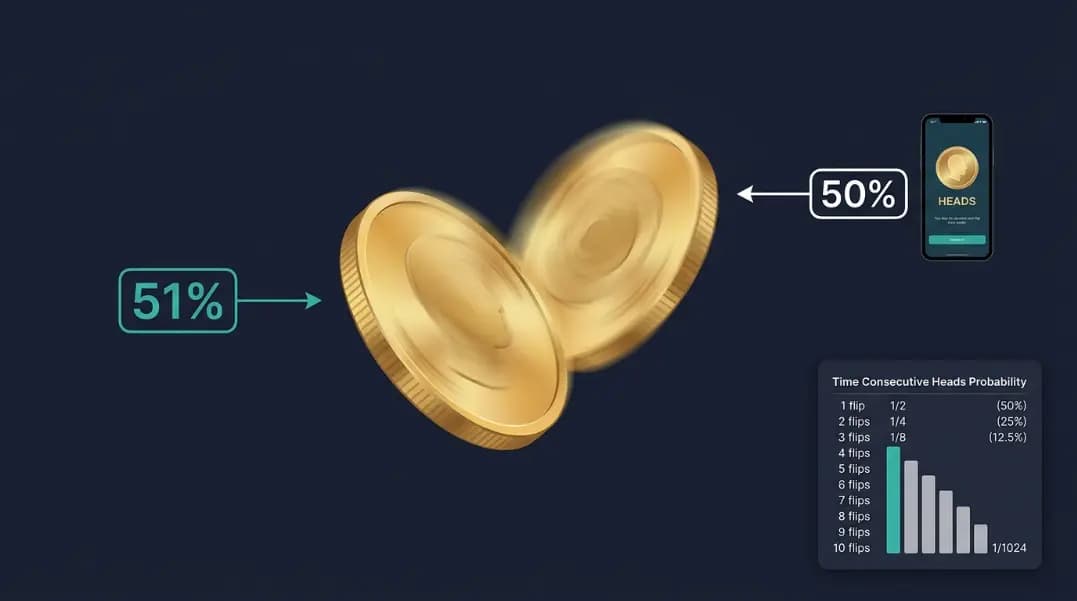
Heads or Tails Probability: Is a Coin Flip Really 50-50?
A physical coin flip is not exactly 50-50. How same-side bias works, what the Diaconis research found, and why digital coin flips are fairer.
10 min read
Random Coin Flip Online: Heads or Tails Generator Guide
How to use an online coin flip for fair binary decisions. Covers probability, history tracking, multiple flips, and when a digital coin beats a physical one.
7 min read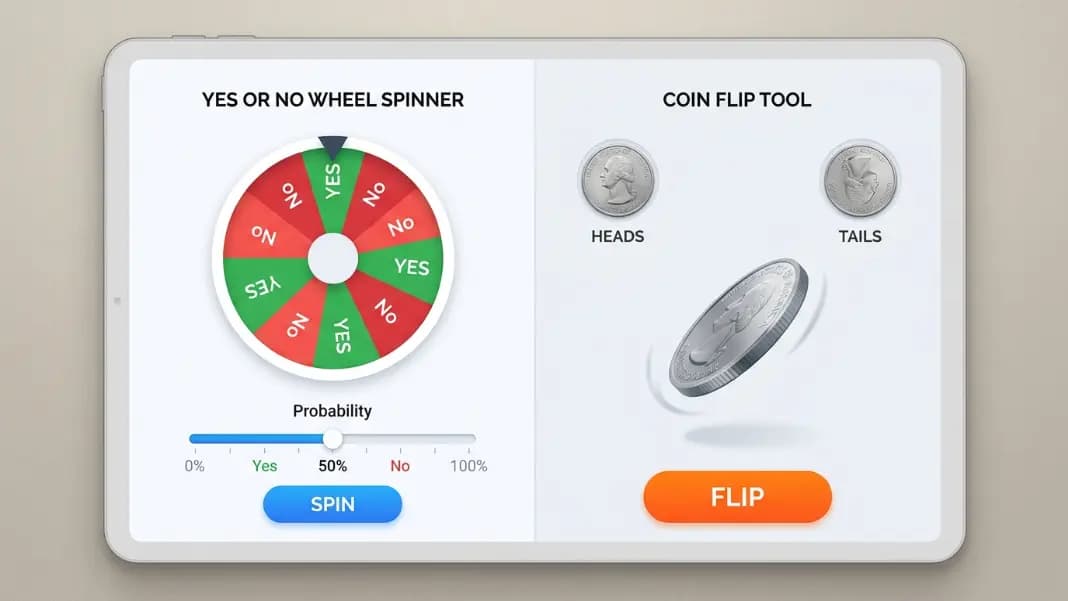
Yes or No Spinner vs Coin Flip: Which Tool Fits Your Decision?
Compare the yes or no spinner and coin flip tool for binary decisions. Covers probability settings, use cases, and when each tool gives you a better result.
9 min read