Free Privacy Policy Generator Online
The free privacy policy generator creates a GDPR and CCPA compliant privacy policy for any website, app, blog, or online store. Toggle sections for your data practices, including contact forms, analytics, cookies, and advertising, and get a complete, ready-to-publish document instantly. No account required. Copy or print to PDF.
This Privacy Policy ("Policy") describes how we ("we", "us", or "our") collects, uses, and shares information about you when you use our website (the "Site"). This Policy is effective as of July 16, 2026.
By accessing or using the Site, you acknowledge that you have read and understood this Policy. If you do not agree with it, please stop using the Site immediately.
We may update this Policy from time to time. When we do, we will revise the "Last Updated" date at the top of this page. We encourage you to review this Policy periodically to stay informed.
We collect the following categories of information:
- Contact information (name, email address, and message content) when you submit a contact or inquiry form.
- Usage data including pages visited, time spent on each page, links clicked, browser type, device type, operating system, and approximate geographic location derived from IP address.
- Cookie identifiers and similar tracking technologies placed on your device when you visit the Site.
We do not collect sensitive personal information such as government identification numbers, health data, or financial account numbers beyond what is strictly necessary to provide a purchased service.
We use the information we collect for the following purposes:
- To respond to your inquiries and provide customer support.
- To understand how visitors use the Site using Google Analytics, enabling us to improve content and functionality.
- To monitor and analyze usage patterns to maintain and improve the security, reliability, and performance of the Site.
- To comply with applicable laws, regulations, and legal processes, and to enforce our Terms of Service.
We will not use your information for any purpose that is materially different from those disclosed in this Policy without your explicit consent.
If you are located in the European Economic Area (EEA), the United Kingdom, or Switzerland, we process your personal data on the following legal bases under the General Data Protection Regulation (GDPR):
- Legitimate interests, responding to contact form submissions to provide the service you requested.
- Legitimate interests, analyzing website usage to maintain and improve the Site, balanced against your right to privacy.
- Legal obligation, processing data where required by applicable law or to protect the rights and safety of our users.
Where processing is based on consent, you have the right to withdraw consent at any time without affecting the lawfulness of processing prior to withdrawal.
We use cookies, small text files stored on your device, and similar technologies such as web beacons and pixel tags. We use the following categories of cookies:
- Strictly necessary cookies: Required for the Site to function correctly, such as session state, security tokens, and user authentication. These cannot be disabled.
- Functional cookies: Remember your preferences (such as language, region, or display settings) so you do not need to re-enter them on subsequent visits.
- Analytics cookies: Placed by Google Analytics to collect anonymized data about how you interact with the Site. This data is used in aggregate to understand usage patterns and improve the Site.
You can control and delete cookies through your browser settings. Note that disabling certain cookies may affect the functionality of the Site. Most browsers allow you to view, manage, delete, and block cookies via their settings menus.
In accordance with GDPR and the ePrivacy Directive, we obtain your consent before placing non-essential cookies on your device. You may withdraw or change your consent at any time.
We uses the following third-party services that may collect or process your information. Each third party's data practices are governed by their own privacy policy:
- Google Analytics (Google LLC): Collects anonymized usage data. Google may process this data on servers outside your country. See Google's Privacy Policy at policies.google.com/privacy. Opt-out: tools.google.com/dlpage/gaoptout
We are not responsible for the privacy practices of these third parties. We encourage you to review their respective privacy policies.
We do not sell, rent, or trade your personal information to third parties. We may share your information only in the following limited circumstances:
- Service providers: We share information with trusted third-party vendors who help us operate the Site (such as hosting, analytics, and payment processors). These vendors are contractually required to keep your information confidential and use it only for the services they provide to us.
- Legal requirements: We may disclose your information if required by law, court order, or government regulation, or if we believe disclosure is necessary to protect the rights, property, or safety of ourselves, our users, or the public.
- Business transfers: If we are involved in a merger, acquisition, or sale of assets, your information may be transferred as part of that transaction. We will notify you before your information is subject to a materially different privacy policy.
- International transfers: If we transfer your personal data outside the EEA, we ensure appropriate safeguards are in place, such as Standard Contractual Clauses approved by the European Commission.
We require all third parties to maintain appropriate security measures and to treat your personal data in accordance with applicable law.
We retain personal information only as long as necessary to fulfill the purposes described in this Policy, or as required by law. Our general data retention period is 2 years. Specific retention periods:
- Contact form submissions are retained for 2 years and then securely deleted.
- Analytics data is retained in accordance with the settings of Google Analytics and our internal data minimization policy.
When data is no longer needed, we delete it securely or anonymize it so that it can no longer be associated with you.
We implement industry-standard technical and organizational measures to protect your personal information against unauthorized access, alteration, disclosure, or destruction. These measures include encrypted data transmission (HTTPS/TLS), access controls limiting who can view personal data, and regular review of our security practices.
However, no method of transmission over the internet or electronic storage is 100% secure. While we strive to use commercially acceptable means to protect your information, we cannot guarantee absolute security. You are responsible for maintaining the secrecy of any passwords associated with your account.
If you are located in the European Economic Area (EEA), United Kingdom, or Switzerland, you have the following rights regarding your personal data under GDPR:
- Right of access: You may request a copy of the personal data we hold about you.
- Right to rectification: You may request that we correct inaccurate or incomplete personal data.
- Right to erasure ("right to be forgotten"): You may request that we delete your personal data where there is no compelling reason for its continued processing.
- Right to restriction: You may request that we restrict processing of your personal data in certain circumstances.
- Right to data portability: You may request that we provide your data in a structured, machine-readable format for transfer to another controller.
- Right to object: You may object to processing based on legitimate interests or for direct marketing purposes.
- Right to withdraw consent: Where processing is based on consent, you may withdraw consent at any time without affecting prior lawful processing.
- Right to lodge a complaint: You have the right to file a complaint with your local supervisory authority (e.g., the ICO in the UK, or your national data protection authority in the EU).
To exercise any of these rights, please contact us at [contact email]. We will respond to all requests within 30 days, or notify you if we require more time. We may need to verify your identity before processing your request.
If you are a California resident, you have the following rights under the California Consumer Privacy Act (CCPA) and its amendments:
- Right to know: You may request that we disclose what personal information we have collected about you, the sources of that information, the business purpose for collecting it, and the categories of third parties with whom we share it.
- Right to delete: You may request that we delete personal information we have collected about you, subject to certain exceptions.
- Right to correct: You may request that we correct inaccurate personal information.
- Right to opt out of sale: We do not sell your personal information. If this changes, we will provide explicit notice and a "Do Not Sell My Personal Information" link.
- Right to non-discrimination: We will not discriminate against you for exercising any of your CCPA rights.
To submit a request, contact us at [contact email]. We will verify your identity and respond within 45 days, with one 45-day extension if needed.
The Site is not intended for use by persons under the age of 13. We do not knowingly collect personal information from persons under the age of 13.
In compliance with the Children's Online Privacy Protection Act (COPPA), if we become aware that we have collected personal information from a child under 13 without verifiable parental consent, we will delete that information immediately. If you are a parent or guardian and believe your child has provided us with personal information, please contact us at [contact email].
The Site may contain links to external websites that are not operated by us. Clicking a third-party link will direct you to that site. We have no control over and assume no responsibility for the content, privacy policies, or practices of third-party sites. We strongly advise you to review the privacy policy of every site you visit.
We may update this Privacy Policy from time to time to reflect changes in our practices, technology, legal requirements, or other factors. We will notify you of significant changes by updating the effective date at the top of this page.
For material changes that affect how we use your personal information, we will provide a prominent notice on the Site or, where appropriate, send you a notification by email. We encourage you to review this page periodically.
If you have any questions, concerns, or requests regarding this Privacy Policy or how we handle your personal information, please contact us:
- Email: [contact email]
If you are based in the EU/EEA, you also have the right to lodge a complaint with your local supervisory authority. In the UK, this is the Information Commissioner's Office (ICO) at ico.org.uk.
Free privacy policy generator: what your policy must cover
A compliant privacy policy must disclose: what personal data you collect from users, how you collect it (forms, cookies, analytics), why you collect it (the legal basis under GDPR), how you use the data, who you share it with and why, how long you retain it, what rights users have over their data, and how to contact you to exercise those rights. The free privacy policy generator covers all of these disclosures with toggle sections that activate or deactivate clauses based on your actual data practices.
For GDPR compliance, the policy must identify the legal basis for each category of processing: consent, legitimate interests, contract performance, or legal obligation. For CCPA compliance, the policy must disclose what categories of personal information are collected, the business purposes, whether the information is sold, and California residents' right to opt out of sale. The generator produces language addressing both regulations in a single unified document so you do not need to maintain two separate policies.
When a privacy policy is legally required
A privacy policy is legally required whenever you collect any personal data from users in jurisdictions covered by GDPR (European Union), CCPA (California), PIPEDA (Canada), or equivalent national or state laws. Personal data includes names, email addresses, IP addresses, cookies, behavioral data collected by analytics, and any other information that can identify an individual directly or indirectly. Any website with a contact form, newsletter signup, or analytics tracker collects personal data and requires a policy.
Beyond legal compliance, privacy policies are required by most advertising networks including Google AdSense and Google Analytics, app stores including the Apple App Store and Google Play, and affiliate programs as a condition of participation. Even websites in jurisdictions without a dedicated privacy law may be required to have a policy by the platforms they integrate with. The GDPR compliant privacy policy generator output satisfies these platform requirements and can be published to any web page or app store listing immediately after generation.
Privacy policy generator for websites, apps, and blogs
The online privacy policy generator works for every type of web presence. For a standard website or landing page, generate a policy covering contact form data collection, IP logging, and any analytics you use. For a blog, whether hosted on WordPress, Blogger, or a custom CMS, enable the analytics and comment section toggles to cover data collected from readers. The blog privacy policy generator output is ready to paste directly into a WordPress page or a Blogger static page.
For e-commerce sites on Shopify or Wix, enable the e-commerce and payment processing toggles to include disclosures about order data, shipping addresses, and payment processor sharing. Shopify requires a published privacy policy page before a store can accept payments; the Shopify privacy policy generator output satisfies this requirement. For mobile apps, enable the mobile app data collection toggle to include device identifier, push notification, and crash reporting disclosures required by Apple and Google for app store approval. All generated policies can be copied as plain text or exported as PDF for submission to app stores, ad networks, or legal records.
GDPR privacy policy: key requirements explained
The General Data Protection Regulation requires that your privacy policy explain the lawful basis for every category of data processing. The six lawful bases are: consent (the user actively agreed), contract (processing is necessary to fulfil a contract with the user), legal obligation (required by law), vital interests (protecting someone's life), public task, and legitimate interests (your business has a genuine reason that does not override user rights). Most websites rely on consent for marketing and analytics and legitimate interests for fraud prevention and security logging.
GDPR also requires that users be informed of their rights: the right to access their data, to correct inaccurate data, to request deletion (the right to be forgotten), to restrict processing, to data portability, and to object to processing. Your policy must state how users can exercise each of these rights and the timeframe in which you will respond, typically 30 days under GDPR. The GDPR privacy policy generator includes all of these mandatory disclosures in plain, readable language that satisfies regulatory requirements without requiring legal expertise to write.
CCPA privacy policy: California compliance requirements
The California Consumer Privacy Act applies to for-profit businesses that collect personal information from California residents and meet at least one of the following thresholds: annual gross revenue above $25 million, buy or sell or share the personal information of 100,000 or more consumers or households per year, or derive 50 percent or more of annual revenue from selling personal information. Even businesses below these thresholds often publish a CCPA-aligned policy as a best practice because California residents represent a significant portion of US web traffic.
A California privacy policy must disclose the categories of personal information collected in the preceding 12 months, the business or commercial purposes for collection, and the categories of third parties with whom the information is shared. It must also describe the rights California residents hold: the right to know, the right to delete, the right to correct, and the right to opt out of the sale or sharing of their personal information. The CCPA privacy policy generator includes a Do Not Sell or Share My Personal Information section that can be enabled with a single toggle.
Privacy policy and terms of service: why you need both
A privacy policy and terms of service are two distinct legal documents that serve different purposes. The privacy policy explains how you collect, use, store, and protect user data. It is a disclosure required by law. The terms of service (also called terms and conditions) is a contract between you and your users that governs how they may use your website or app. It covers acceptable use, intellectual property, liability limitations, account termination, and dispute resolution. Both documents are necessary for any website or app that has registered users, accepts payments, or publishes user-generated content.
You can generate both documents on ToolCenterHub without an account. Use the terms of service generator to create your terms and conditions, then link both documents in your site footer and present both during user registration. For businesses that share confidential information with contractors or partners, the NDA generator covers non-disclosure requirements that are outside the scope of a privacy policy. If you publish affiliate content or professional advice, a disclaimer should also be published alongside your privacy policy to limit liability for third-party links and informational content.
How the privacy policy generator tool works
The privacy policy generator runs entirely in your browser. When you fill in the form fields and toggle data practice sections, the tool assembles the policy document in real time using client-side logic. Nothing is sent to a server and your website name, email address, and data practice details never leave your device. There is no account required, no watermark added to the output, and no usage limit.
The tool auto-generates policy text based on your selections, combining the relevant clauses for each data practice you enable. Enabling the analytics toggle adds Google Analytics disclosure language. Enabling advertising cookies adds an advertising and remarketing section. Each toggle precisely controls which clauses appear in the final document so the policy accurately reflects your site rather than being a generic template with inapplicable sections left in. Once generated, copy the full policy text to your website's privacy policy page or use the print-to-PDF option to save a dated copy for your compliance records.
Frequently asked questions
Yes, in practice. Any website that collects personal data, including email addresses through a contact form, IP addresses logged by a server, or behavioral data through analytics, is subject to privacy laws in the jurisdictions of its users. GDPR applies to any site with EU visitors regardless of where the site is hosted. CCPA applies to sites with California-based users that meet certain revenue or data volume thresholds. Publishing a clear privacy policy is required by law in most cases and by advertising platforms universally.
GDPR (General Data Protection Regulation) is the EU privacy law requiring explicit legal basis for data processing, user rights including erasure and portability, and mandatory data breach notification. CCPA (California Consumer Privacy Act) focuses on the right to know what data is collected, the right to delete, and the right to opt out of the sale of personal information. GDPR is broader and more prescriptive; CCPA is more focused on transparency and consumer choice. The generator produces a policy that addresses both regulations simultaneously.
A compliant privacy policy must include: the identity and contact details of the data controller, what personal data is collected and why, the legal basis for processing under GDPR, how long data is retained, who the data is shared with, what cookies and tracking technologies are used, users' rights such as access, deletion, portability, and objection, how to file a complaint with a supervisory authority, and how users will be notified of changes to the policy.
Yes. The generated policy works for any WordPress site regardless of hosting provider or theme. After generating your policy, copy the full text, go to your WordPress dashboard, create a new page titled Privacy Policy, paste the text, and publish. Link to it in your footer. If you use Yoast SEO or a similar plugin, set the page as your privacy policy in the plugin settings. WordPress also has a built-in Privacy Policy page creator under Settings, but our generator produces a more comprehensive GDPR and CCPA compliant document.
Yes. The app privacy policy generator output is suitable for both iOS and Android apps. Both the Apple App Store and Google Play require a publicly accessible privacy policy URL before your app can be published. Generate your policy, host it on a webpage (your own domain or a free page), and submit the URL during app submission. Enable the mobile app toggle in the generator to include app-specific data collection clauses such as device identifiers, push notification permissions, and crash reporting.
No. A single, well-structured privacy policy can satisfy both GDPR and CCPA by including the required disclosures for each regulation in the same document. GDPR requires a legal basis section, a data retention section, and information on data subject rights under EU law. CCPA requires a disclosure of data categories collected, whether data is sold, and California residents' opt-out rights. The generator combines all of these into one unified policy document.
Generate your privacy policy using the tool above, then copy the full text. Create a dedicated page on your website at a URL such as /privacy-policy or /privacy. Paste the policy text and publish the page. Add a link to the privacy policy page in your website's footer so it is accessible from every page. If you use Google Analytics, Google AdSense, or any email marketing platform, you will also need to add your privacy policy URL in each platform's account settings.
For websites with significant user bases, advertising revenue, or that operate in regulated industries such as healthcare, finance, or services targeting children, legal review is strongly recommended. The generated policy provides a solid, compliant foundation but cannot account for jurisdiction-specific nuances, industry-specific regulations such as HIPAA, COPPA, or PCI-DSS, or your specific business structure. For personal blogs and small business sites, the generated policy is a practical and commonly used solution.
Related articles
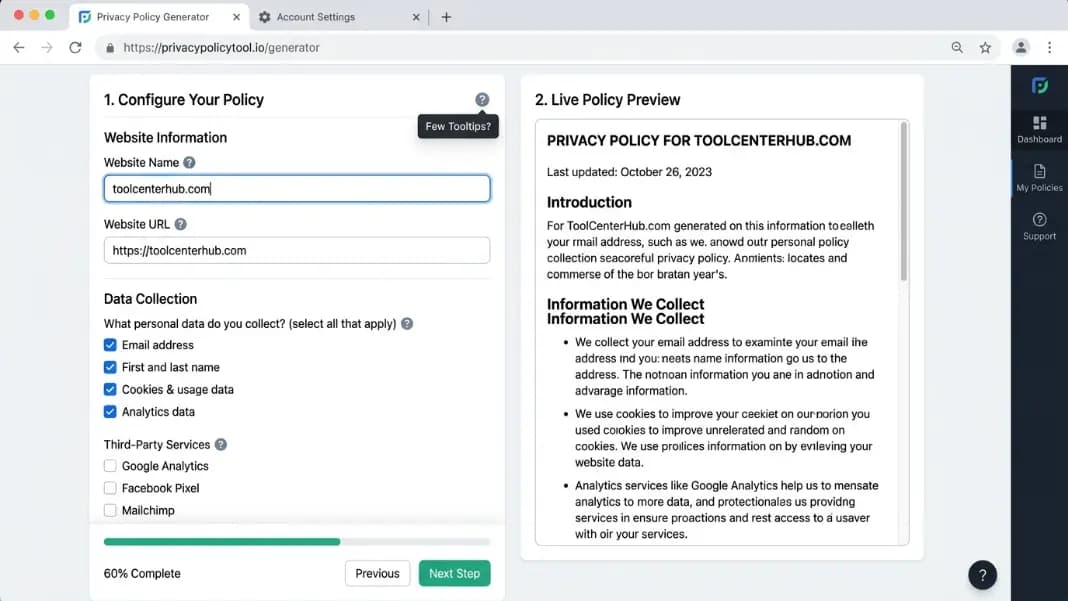
Privacy Policy Generator: Create a Free Privacy Policy for Your Website
Every website that collects data needs a privacy policy. Learn what to include, who legally requires one, and how to generate a free privacy policy in minutes.
10 min read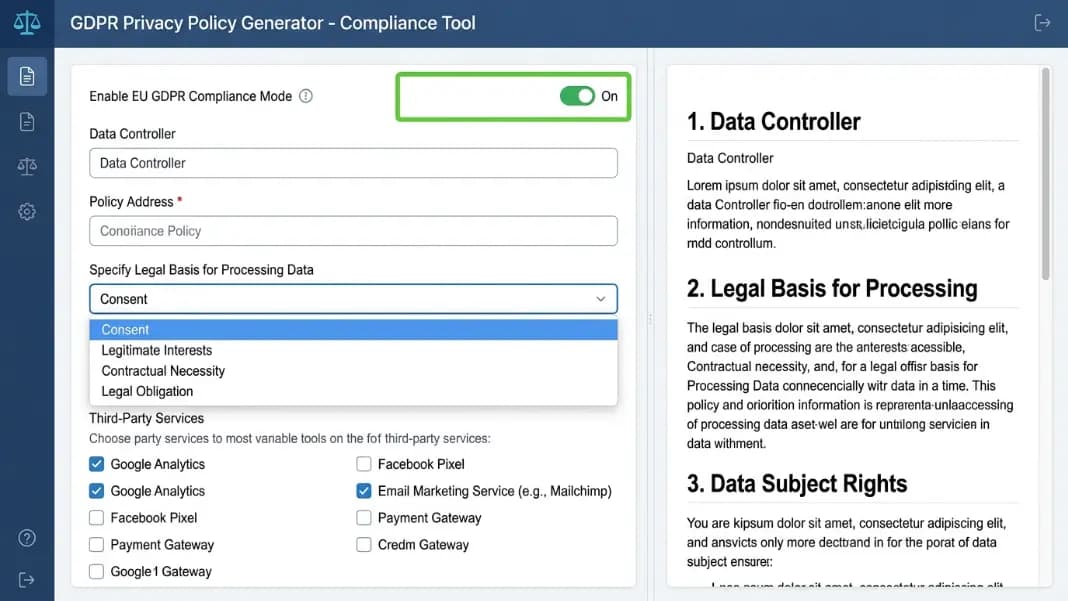
GDPR Privacy Policy: What to Include and How to Stay Compliant
Learn what GDPR requires in a website privacy policy, the 8 user rights to disclose, legal bases for data processing, and how to generate one free online.
11 min read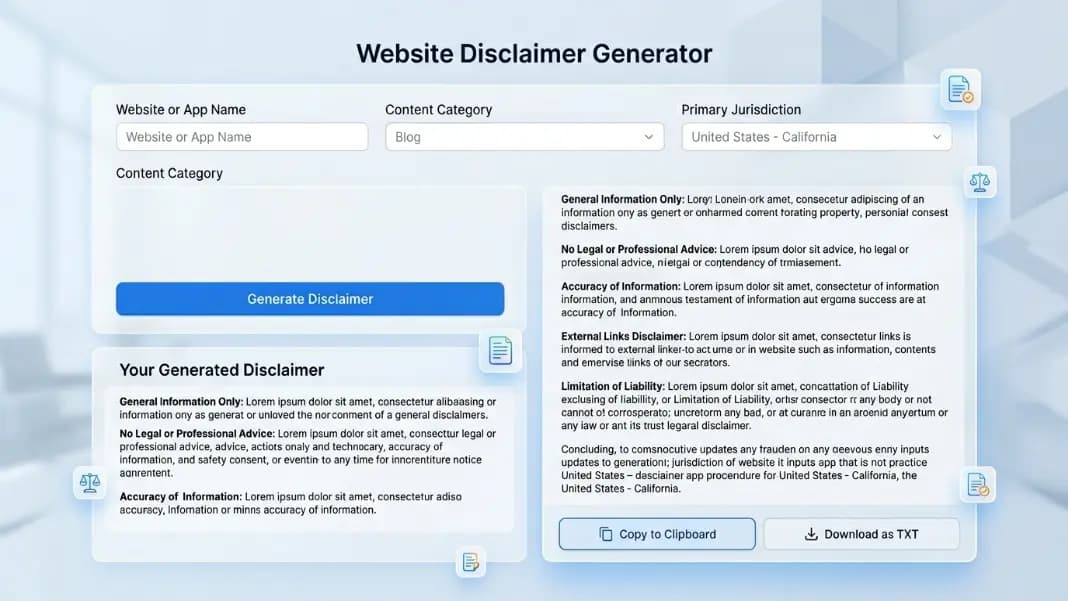
Disclaimer Generator: Create a Free Website Disclaimer
Learn what a website disclaimer does, the types you may need, whether it provides legal protection, and how to generate a free one for your site in minutes.
8 min read