Free Freelance Contract Generator Online
The free freelance contract generator creates a service agreement covering scope of work, timeline, payment terms, revision limits, intellectual property ownership, kill fee, and termination conditions. Used by freelancers and agencies before starting any project. Print or save as PDF. No account required.
Client ("Client") engages Service Provider ("Service Provider") to perform Design Services for the project known as "the Project" ("Project"), subject to the terms and conditions of this Freelance Service Agreement ("Agreement"). This Agreement is effective as of July 16, 2026.
The Service Provider is an independent contractor, not an employee of the Client. Nothing in this Agreement shall be construed to create a partnership, joint venture, agency, franchise, or employment relationship between the parties.
The Service Provider agrees to perform the following services ("Deliverables"):
[Describe specific deliverables, formats, quantities, platforms, and technical specifications here.]
Any services not explicitly described above are outside the scope of this Agreement.
Any requests by the Client to modify the scope of work, deliverables, or timeline after execution of this Agreement must be submitted in writing. The Service Provider will provide a written change order stating the new work, the additional fee, and the revised timeline. No additional work shall commence until the Client and Service Provider have signed the change order.
Verbal requests to expand scope do not constitute an agreement to perform additional work at no additional cost. The Client acknowledges that scope changes may affect the Project timeline and that the Service Provider bears no responsibility for delivery delays caused by unresolved scope change requests.
- Project Start Date: [TBD]
- Final Delivery Date: [TBD]
The Service Provider will use commercially reasonable efforts to meet the timeline above. Delays caused by the Client (including late provision of materials, content, feedback, or approvals) will extend the timeline by an equivalent period and will not constitute a breach by the Service Provider.
Rush delivery requests outside the timeline above are subject to a rush fee as mutually agreed in writing.
The total fee for the Project is $[Total Amount]. A deposit of 50% is due on signing before work begins. The remaining balance is due within Net 7 days of final delivery. Final files will not be released until the full balance is paid.
Invoices not paid within the agreed Net 7 day term will accrue a late payment fee of 1.5% per month (or the maximum amount permitted by applicable law, whichever is lower) on the outstanding balance.
The Service Provider reserves the right to suspend all work on the Project immediately upon non-payment of any amount due. Work will resume only after all outstanding amounts, including accrued late fees, are paid in full. Any timeline delays resulting from a payment suspension are solely the Client's responsibility.
This Agreement includes 2 rounds of revisions. A revision round is defined as a consolidated set of feedback submitted at one time in writing. Each revision round must be submitted after review of the most recent version of the deliverable.
Additional revision requests beyond the 2 rounds included will be billed at the Service Provider's standard hourly rate, which will be communicated in advance. Additional revisions will not commence until the Client has approved the associated change order.
Revisions must be submitted within 14 days of delivery of each version. Feedback not submitted within this window may require re-familiarisation time, which may be billed separately.
Upon receipt of final payment in full, the Service Provider hereby assigns to the Client all right, title, and interest in and to the Deliverables, including all intellectual property rights therein (the "Work Product"). Prior to receipt of final payment, the Service Provider retains all rights to the Work Product.
The assignment above does not include any pre-existing tools, frameworks, libraries, templates, or methodologies owned by the Service Provider prior to this Agreement and incorporated into the Deliverables ("Background IP"). The Client is granted a non-exclusive, perpetual licence to use any Background IP incorporated in the Deliverables for the purpose for which the Deliverables were created.
The Service Provider represents and warrants that the Deliverables will be original work and will not knowingly infringe any third-party intellectual property rights.
Each party agrees to hold in confidence and not to disclose to any third party any Confidential Information of the other party obtained in connection with this Agreement. "Confidential Information" means any non-public information designated as confidential or that should reasonably be understood to be confidential given the nature of the information.
The Service Provider shall not disclose the Client's business strategies, product plans, financial data, or any proprietary information shared during the Project. This obligation survives termination of this Agreement for a period of two (2) years.
The Service Provider may include the Project (or a general description thereof) in their portfolio and promotional materials unless the Client requests in writing, at the time of signing, that the Project remain confidential.
The Service Provider is an independent contractor. The Client will not control the manner or means by which the Service Provider performs services under this Agreement. The Service Provider is responsible for all taxes, insurance, and business expenses arising from this Agreement. The Client will not withhold income taxes, Social Security, or any other payroll taxes on the Service Provider's behalf.
The Service Provider has the right to perform services for other clients during the term of this Agreement, provided that such work does not create a conflict of interest or materially impair performance under this Agreement.
Either party may terminate this Agreement upon written notice to the other party. If the Client terminates this Agreement after work has commenced, the following apply:
- A kill fee of 50% of the remaining unpaid project fee is due within 7 days of termination notice.
- The Client shall pay for all work completed and approved to date at the agreed project rate.
- The Client retains rights only to deliverables fully paid for, including the kill fee.
- The deposit is non-refundable in all cases.
The kill fee compensates the Service Provider for time blocked for this Project and lost opportunity cost. This fee is reasonable and agreed upon by both parties as a genuine pre-estimate of the Service Provider's losses.
If the Service Provider terminates this Agreement, the Service Provider shall complete all work in progress to a reasonable handover state and deliver all completed work to the Client within 7 days. The Service Provider shall refund any portion of the deposit attributable to unperformed work.
The Service Provider warrants that:
- The Deliverables will be original and will not infringe any third-party intellectual property rights to the Service Provider's knowledge.
- The Service Provider has the right to enter into this Agreement and grant the rights described herein.
- The Services will be performed with reasonable skill and care consistent with professional standards.
The Client warrants that:
- The Client has the right to use all materials provided to the Service Provider for the Project.
- Materials provided to the Service Provider do not infringe the intellectual property rights of any third party.
- The Client has the authority to enter into this Agreement.
Except as expressly stated above, the Services are provided "as is" without warranty of any kind. The Service Provider does not warrant that the Deliverables will meet any particular business outcome, revenue target, or performance metric.
To the maximum extent permitted by applicable law, the Service Provider's total liability to the Client for any claims arising from or related to this Agreement shall not exceed the total fees paid by the Client under this Agreement.
In no event shall the Service Provider be liable for any indirect, incidental, special, consequential, or punitive damages, including loss of profits, loss of data, or loss of business opportunity, even if the Service Provider has been advised of the possibility of such damages.
The Client acknowledges that the fees charged under this Agreement have been set in reliance upon these limitations of liability, and that this limitation forms an essential basis of the bargain between the parties.
This Agreement shall be governed by and construed in accordance with the laws of the State of Delaware, United States, without regard to conflict of laws principles. Any dispute arising out of or in connection with this Agreement shall be subject to the exclusive jurisdiction of the courts of the State of Delaware, United States.
Entire Agreement: This Agreement constitutes the entire understanding between the parties regarding the Project and supersedes all prior discussions, proposals, and representations.
Amendments: Any modification to this Agreement must be made in writing and signed by both parties.
Severability: If any provision of this Agreement is found to be unenforceable, it will be modified to the minimum extent necessary to make it enforceable, and all other provisions remain in full force.
Waiver: Failure to enforce any provision of this Agreement does not constitute a waiver of the right to enforce it in the future.
Force Majeure: Neither party is liable for delays caused by circumstances beyond their reasonable control, including natural disasters, government actions, or internet outages. If a force majeure event lasts more than 30 days, either party may terminate this Agreement with 7 days' written notice.
Common use cases
- Define the scope, deliverables, and payment terms for a freelance project
- Set revision limits and intellectual property ownership terms before work begins
- Establish termination conditions and late payment clauses for a client engagement
- Give both parties a written record that prevents scope creep disputes
Freelance contract template: what every service agreement must include
A complete freelance contract must cover: the full legal names of both parties, the specific scope of work with deliverables listed individually, the project timeline and milestone dates, the payment schedule including the deposit amount, milestone triggers, and final payment date, the number of revisions included before additional fees apply, who owns the intellectual property rights to the finished work, a kill fee for client cancellations after work has begun, and the governing law jurisdiction. Omitting any of these elements leaves gaps that tend to resolve against the freelancer in a dispute.
The freelance contract template generated by this tool includes all of these clauses with field-driven customization. The scope section is a free-text area where you describe exactly what is being delivered and list explicit exclusions. Specificity in the scope clause is the most effective defense against scope creep. Define deliverable format, quantity, platform, and technical acceptance criteria so there is no ambiguity about when the work is complete and payment is due. Before sharing any project details with the client, pair the contract with an NDA if the work involves access to proprietary systems or confidential business information.
Intellectual property and payment terms in a freelance agreement
The intellectual property clause determines who owns the work product after the project ends. Three common arrangements exist. Full IP transfer to the client on final payment is the most common structure for bespoke client work: the client paid for original work and expects to own it. A license arrangement grants the client usage rights while the freelancer retains copyright, which is common for templates, stock assets, and tools sold to multiple clients. A partial transfer excludes pre-existing tools, code libraries, and frameworks the freelancer uses across projects; those assets remain the freelancer's property even when incorporated into the deliverable.
Payment terms in the freelance contract should specify the deposit percentage due before work begins (25 to 50 percent is standard), the trigger events for milestone payments, the date the final payment is due, and the late payment penalty rate. The contract generator includes a payment schedule section where each payment, its amount, and its trigger are listed in sequence. Clear, written payment terms are the most effective protection against the most common freelance dispute: disagreement about when payment is actually due. When the project is complete, use the invoice generator to produce a payment request that references the contract terms directly.
Freelance contract templates by profession: writing, design, photography, and more
The same contract structure works across every freelance discipline because the core clauses are universal: scope, timeline, payment, IP, revisions, and termination appear in every service agreement regardless of the work type. What changes is the content you fill into each field. A freelance writing contract template specifies word counts, article topics, style guide adherence, and whether first or all-rights are transferred. A freelance graphic design contract lists file formats (source files, web exports, print-ready PDFs), usage rights (print only, digital only, or unlimited), and brand guidelines compliance.
A freelance photography contract template specifies shoot duration, number of final edited images, turnaround time, and whether the photographer retains portfolio usage rights. A freelance video contract covers footage deliverables, edit rounds, raw file ownership, and music licensing responsibilities. A freelance marketing contract lists campaign deliverables, reporting cadence, ad spend authority, and performance benchmarks. A freelance web development contract covers code deliverables, browser and device compatibility requirements, handoff format, and post-launch support terms. Use the scope field to write deliverable-specific language and the generator produces a contract tailored to each project type.
Scope of work and change orders: preventing scope creep
Scope creep is the most common source of freelance project problems. It occurs when a client requests additional work that was not included in the original agreement, often framing it as a small addition that is just part of the original scope. The contract's scope clause prevents this by defining exactly what is included and explicitly listing what is not. Writing a list of exclusions is as important as writing the deliverables list. Common exclusions for design contracts: additional pages beyond the agreed count, alternative design concepts beyond the included number, and animation when only static assets were agreed. For development contracts: backend work when only frontend was agreed, third-party API integrations, and performance optimization beyond standard practices.
The change order clause in the contract states that any work outside the original scope requires a written change order agreed and signed by both parties before the additional work begins. Without this clause, clients can argue that verbally requested additions were understood to be part of the original agreement. A change order should be a short document specifying the new work item, the additional fee, and the revised delivery date. Some freelancers use a new quote for change orders; use the business quote generator to produce a formal document for larger scope additions.
Kill fee, termination, and late payment clauses
A kill fee clause protects the freelancer when a client cancels after work has already begun. A typical kill fee structure charges 25 percent of the remaining contract value if the project is cancelled before the midpoint and 50 percent if cancelled after. The kill fee compensates for time invested, blocked calendar availability, and any subcontractors or assets procured for the project. Without a kill fee clause, a client can cancel at any time and owe nothing beyond work already invoiced, leaving the freelancer with no compensation for the opportunity cost of taking on the project.
The termination clause specifies the conditions under which either party may end the agreement early. Legitimate termination triggers for the freelancer include: the client's failure to pay an invoice within the stated period, repeated failure to provide required materials or feedback, and the client directing work that violates the freelancer's stated policies. Legitimate termination triggers for the client include: the freelancer failing to meet agreed milestones without approved extensions. The late payment clause sets a penalty rate (typically 1.5 percent per month on outstanding balances) and establishes the right to suspend work and withhold deliverables until outstanding invoices are settled.
How the freelance contract generator tool works
The freelance contract generator runs entirely in your browser. As you fill in the form fields, the tool builds the contract document in real time. Your client names, project details, payment amounts, and IP terms never leave your device and are not stored on any server. There is no account required, no watermark on the output, and no limit on how many contracts you can generate.
When the contract is complete, use the print-to-PDF option to export a clean, dated document. Send the PDF to the client for review, allow time for questions or negotiation, then obtain signatures from both parties before any work begins. Electronic signatures are legally valid under the ESIGN Act in the US and eIDAS in the EU, so remote signing via any e-signature tool is fully enforceable. Keep a countersigned copy on file for the duration of the project and for at least three years afterward. For ongoing client relationships, regenerate a fresh contract at the start of each new project with updated scope and terms rather than reusing an old signed document.
Frequently asked questions
A freelance contract must include: the parties' full legal names, the specific scope of work and deliverables, the project timeline and milestones, the payment schedule with amounts and triggers, the number of revisions included, intellectual property ownership clauses, a kill fee for client cancellations after work has begun, late payment terms, and governing law. Missing any of these elements creates ambiguity that typically resolves in the client's favor in a dispute.
By default in most jurisdictions, the creator owns the copyright to work they produce. To transfer those rights to the client, the contract must contain an explicit IP assignment clause. Most client contracts call for full IP transfer upon final payment. Freelancers should carve out pre-existing tools, code libraries, and frameworks used across multiple projects so those assets remain the freelancer's property even when incorporated into a client deliverable.
Standard freelance payment terms include a deposit of 25 to 50 percent due before work begins, milestone payments tied to defined deliverables, and a final payment due before IP transfer and final file delivery. Net 7 is the most favorable term for freelancers. Net 30 is acceptable for established clients with good payment history. Include a late payment penalty, typically 1.5 percent per month, and reserve the right to suspend work for non-payment.
Scope changes after contract signing should be handled through a written change order that specifies the new work, the additional cost, and the revised timeline. The contract should state that scope changes require a written change order signed by both parties before additional work begins. Without this clause, clients can argue that verbal scope changes were implicitly agreed upon. The freelance contract generator includes a change order clause in the scope section.
A kill fee is a cancellation fee the client pays if they terminate the project after work has already begun. It compensates the freelancer for time and resources invested before cancellation. A typical kill fee structure is: 25 percent of the remaining contract value if cancelled before the midpoint, and 50 percent if cancelled after the midpoint. The kill fee clause protects freelancers from clients who abandon projects without paying for work completed.
Yes, for projects involving access to confidential client information such as internal systems, unreleased products, business strategies, or customer data. A freelance contract covers the project terms, deliverables, and payment. An NDA specifically governs confidentiality obligations and is a separate enforceable agreement. For most standard freelance projects the contract's confidentiality clause provides basic protection. For projects with significant exposure to proprietary information, a standalone NDA signed before any information is shared gives stronger legal protection.
Yes. A contract does not need to be drafted by a lawyer to be legally binding. It needs offer, acceptance, consideration (the exchange of services for payment), and mutual agreement on the terms. A clearly written freelance contract signed by both parties satisfies all of these requirements and is enforceable in most jurisdictions. Legal review is recommended for high-value projects, multi-year retainers, or contracts involving regulated industries.
The same contract template works across project types because the structure is consistent: scope, timeline, payment, IP, revisions, and termination are universal clauses. What changes is the content you fill into each field. A writing contract lists word counts, article topics, and publication rights. A design contract lists file formats, usage rights, and brand guidelines. A photography contract lists shoot hours, image quantity, and licensing terms. Regenerate the contract for each project with project-specific scope language rather than reusing the same filled document.
Related articles
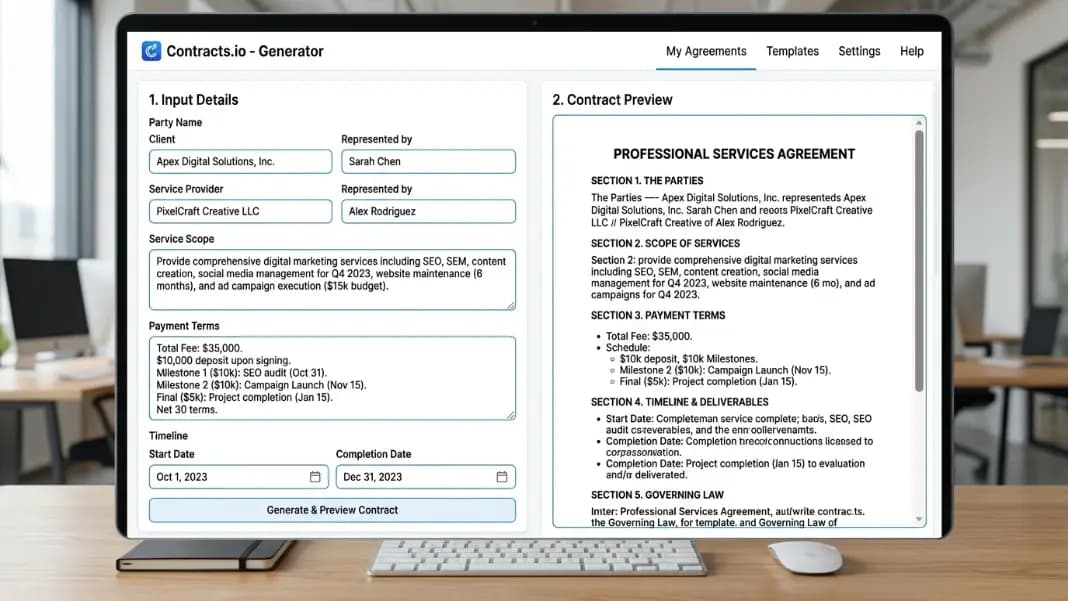
Contract Generator: What to Include and How to Create One Free
Learn how to create a freelance or business contract online using a free generator. Covers what to include, enforceable clauses, and when a template is enough.
11 min read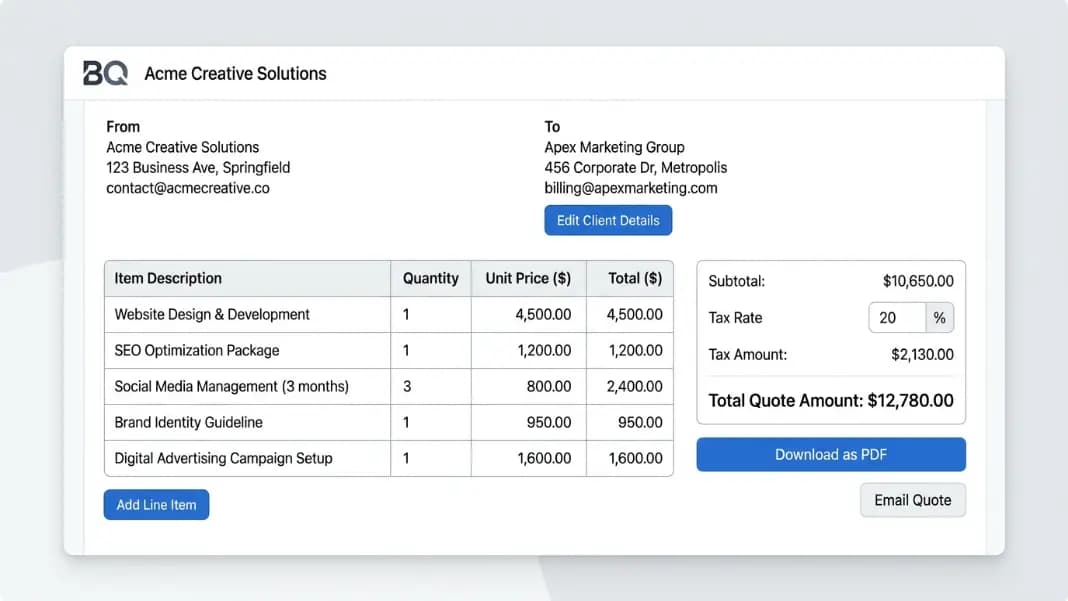
Free Quote Generator: Create Professional Business Quotes Online
Use the free quote generator to create business quotes online. Covers what every quote must include, quote vs invoice differences, and how to win more clients.
12 min read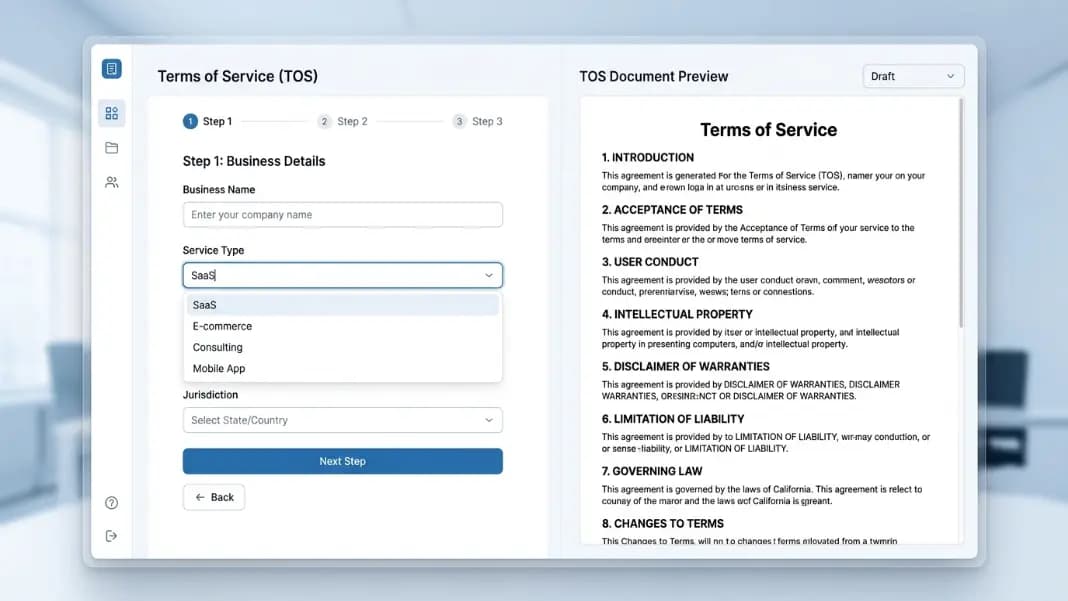
Terms of Service Generator: Create a Free TOS Online
Learn what a terms of service agreement covers, who needs one, what to include, how it differs from a privacy policy, and how to generate yours free online.
9 min read