Free Calorie Calculator Online
Free online calorie calculator. Enter your age, sex, height, weight, and activity level to instantly calculate your daily calorie needs for weight loss, maintenance, or muscle gain. This calorie intake calculator uses the Mifflin-St Jeor equation, the most accurate formula for estimating daily calorie requirements. Works in metric and imperial units, no account required.
| Day | Schedule 1 | Schedule 2 |
|---|---|---|
| Sunday | 2,655 | 2,580 |
| Monday | 2,171 | 2,647 |
| Tuesday | 2,171 | 2,459 |
| Wednesday | 2,171 | 2,159 |
| Thursday | 2,171 | 1,971 |
| Friday | 2,171 | 2,038 |
| Saturday | 2,655 | 2,309 |
| Day | Schedule 1 | Schedule 2 |
|---|---|---|
| Sunday | 2,360 | 2,293 |
| Monday | 1,929 | 2,352 |
| Tuesday | 1,929 | 2,186 |
| Wednesday | 1,929 | 1,918 |
| Thursday | 1,929 | 1,752 |
| Friday | 1,929 | 1,811 |
| Saturday | 2,360 | 2,052 |
TDEE = BMR × 1.55 (Moderately Active)
How to calculate calories: the formula explained
Calculating daily calorie needs starts with your Basal Metabolic Rate (BMR), the calories your body burns at complete rest. The Mifflin-St Jeor formula gives the most accurate BMR estimate for most adults. For men: BMR = (10 × weight in kg) + (6.25 × height in cm) - (5 × age) + 5. For women: BMR = (10 × weight in kg) + (6.25 × height in cm) - (5 × age) - 161. Your BMR is then multiplied by an activity factor to get your TDEE (Total Daily Energy Expenditure), which is your true maintenance calorie level.
Activity multipliers range from 1.2 for a sedentary lifestyle with little movement to 1.9 for an extremely active person with a physical job and daily intense training. Your daily calorie requirement is the product of these two values. The calorie needs calculator on this page handles the full calculation instantly, returning your BMR, TDEE, and ready-to-use targets for every goal.
How to use the calorie calculator online
- Enter your age, sex, height, and current body weight.
- Select your daily activity level from sedentary to extra active.
- Choose your goal: weight loss (deficit), maintenance, or muscle gain (surplus).
- Read your BMR, maintenance calories (TDEE), and daily calorie target instantly.
- Use the result as your daily nutrition budget, then track food intake against it.
Calorie deficit calculator: how many calories to eat for weight loss
A calorie deficit occurs when you eat fewer calories than your body burns. This is the only mechanism through which fat loss happens. The calorie deficit calculator on this page computes the exact deficit needed based on your personal TDEE. A deficit of 500 calories per day below your maintenance level produces approximately 0.45 kg (1 lb) of fat loss per week, since one pound of fat stores roughly 3,500 calories. A 250-calorie daily deficit gives slower, easier-to-sustain loss; a 750-calorie deficit gives faster results but requires more dietary discipline.
The most important rule for weight loss calorie targets: never eat below your minimum safe calorie floor. For most women this is 1,200 kcal per day; for most men it is 1,500 kcal per day. Below these levels, it becomes difficult to meet protein, vitamin, and mineral needs from food alone, and the risk of lean muscle loss rises significantly. Once you have your calorie target, pair it with the macro calculator to set your protein, carbohydrate, and fat targets, since a high-protein intake preserves muscle during a calorie deficit.
Maintenance calorie calculator: finding your baseline
Your maintenance calories, also called TDEE, are the number of calories that keep your body weight stable. Knowing this number is essential whether you want to lose fat, build muscle, or simply eat in a way that sustains your current weight. The maintenance calorie calculator uses your personal data and activity level to estimate this baseline. Eating at maintenance means no intentional weight change; it is the reference point from which all deficit or surplus targets are built.
For the most accurate maintenance calorie figure, track your body weight and actual calorie intake for two to four weeks without changing anything. If your weight stays constant, your average daily intake equals your true maintenance. The formula-based estimate from this calculator is a reliable starting point, but individual metabolic variation means the real number may be 5 to 15 percent higher or lower. For a deeper analysis of your energy expenditure, use the TDEE calculator, which also shows your BMR broken out separately.
Calorie surplus calculator: calories to gain weight and build muscle
If your goal is to gain weight or build muscle, you need a calorie surplus, eating more than your TDEE. A lean bulk typically uses a surplus of 100 to 250 calories per day above maintenance, which minimises fat gain while providing enough energy for muscle protein synthesis. A more aggressive bulk uses 300 to 500 calories above TDEE and produces faster weight gain but with a higher ratio of fat to muscle. The calorie calculator to gain weight shows these surplus targets directly in the results panel.
Gaining weight without enough protein undermines muscle growth even when the calorie surplus is adequate. Most research supports a target of 1.6 to 2.2 grams of protein per kilogram of body weight per day during a muscle-building phase. After calculating your calories to gain weight here, use the macro calculator to set a specific protein target and split the remaining calories between carbohydrates and fat.
Calories burned through exercise and daily activity
Your activity level multiplier already accounts for exercise calories in your TDEE calculation. As a guide to the magnitude of exercise calorie burn: a 70 kg person burns approximately 280 to 350 calories per hour walking at a moderate pace (5 km/h), making a walking calorie calculator estimate straightforward. Running at 10 km/h burns roughly 600 to 700 calories per hour for the same person. Cycling at moderate intensity burns 400 to 500 calories per hour, and strength training burns 200 to 300 calories per hour depending on intensity and rest periods.
Heavier individuals burn more calories for any given activity because more mass requires more energy to move. Conversely, as you lose weight through a calorie deficit, the same exercise burns fewer calories than before. This is one reason why recalculating your calorie needs every four to six weeks is important: both your resting calorie burn and your exercise calorie burn decrease as your body weight falls. If your current BMI puts you in the obese range, a moderate calorie deficit combined with regular low-impact exercise such as walking is the evidence-based starting point recommended by most clinical guidelines.
Daily calorie calculator for men vs women
Men and women have different daily calorie requirements even at the same body weight, height, and activity level. The key reason is body composition: men typically carry more skeletal muscle, which burns more calories at rest than fat tissue. The Mifflin-St Jeor formula reflects this with sex-specific constants that typically produce a 100 to 250 calorie per day difference in BMR. As a result, the daily calorie calculator for women will return a lower maintenance and deficit target than the same calculator used by a man of identical size and activity.
Women also experience hormonal fluctuations across the menstrual cycle that cause natural variation in appetite and energy expenditure of around 100 to 300 calories per day. A single daily calorie estimate does not capture this variation, but it remains the most practical starting point. For a sex-specific breakdown of your body composition alongside your calorie needs, pair this calculator with the body fat percentage calculator.
Frequently asked questions about calorie intake
To calculate your daily calorie intake, first determine your Basal Metabolic Rate (BMR) using the Mifflin-St Jeor formula: for men, BMR = (10 × weight in kg) + (6.25 × height in cm) - (5 × age) + 5; for women, BMR = (10 × weight in kg) + (6.25 × height in cm) - (5 × age) - 161. Multiply your BMR by your activity factor (1.2 for sedentary to 1.9 for very active) to get your TDEE. Your target calorie intake is then your TDEE minus a deficit for weight loss, equal to TDEE for maintenance, or TDEE plus a surplus for muscle gain.
The number of calories you should eat per day depends on your age, sex, height, weight, activity level, and goal. Most moderately active adults need between 1,800 and 2,500 calories per day to maintain their weight. For weight loss, eating 300 to 500 fewer calories than your maintenance level (TDEE) per day produces steady, sustainable fat loss of 0.3 to 0.5 kg per week. The calorie calculator on this page computes your personal daily target from your actual measurements, which is more accurate than generic advice.
To calculate your calorie deficit, subtract your target daily calorie intake from your TDEE (maintenance calories). A deficit of 500 calories per day produces roughly 0.45 kg (1 lb) of fat loss per week, since one pound of fat stores approximately 3,500 calories. A 250-calorie deficit gives slower but easier-to-sustain loss of around 0.25 kg per week. Deficits above 1,000 calories per day increase the risk of muscle loss and nutritional deficiency and are not recommended without medical supervision.
Maintenance calories equal your TDEE. Calculate it by multiplying your BMR (from the Mifflin-St Jeor formula) by your activity multiplier: 1.2 for sedentary, 1.375 for lightly active, 1.55 for moderately active, 1.725 for very active, and 1.9 for extra active. The maintenance calorie calculator on this page does this automatically. For the most accurate result, track your weight and actual calorie intake for two to four weeks: if your weight is stable, you are eating at your true maintenance.
To lose approximately one pound (0.45 kg) per week, create a daily calorie deficit of 500 calories below your TDEE. One pound of body fat contains approximately 3,500 calories, so a 500-calorie daily deficit creates a 3,500-calorie weekly deficit, equivalent to roughly one pound of fat loss. This is a sustainable rate that minimises muscle loss. Higher deficits are possible but increase the risk of losing lean mass alongside fat.
Yes. Men typically have higher calorie requirements than women at the same height, weight, and activity level because men carry more lean muscle mass on average, which burns more calories at rest. The Mifflin-St Jeor formula applies a different constant by sex: +5 for men and -161 for women after accounting for weight, height, and age. This typically produces a 100 to 200 calorie per day difference in BMR between men and women of similar body size.
Calories burned during exercise depend on body weight, speed, duration, and terrain. As a rough guide, a 70 kg person burns approximately 280 to 350 calories per hour walking at a moderate pace (5 km/h), and 500 to 700 calories per hour running at a moderate pace (8 to 10 km/h). Heavier individuals burn more calories for the same activity because more mass requires more energy to move. The activity level multiplier in this calorie calculator already accounts for your regular exercise when computing your daily calorie target.
As you lose weight, your TDEE decreases because a lighter body requires fewer calories to maintain. Recalculate your calorie needs every four to six weeks using your current weight. This prevents the deficit from shrinking to near zero as you lose weight, a pattern called metabolic adaptation that causes weight loss plateaus. Updating your calculation regularly keeps your deficit calibrated and your progress consistent.
Related articles
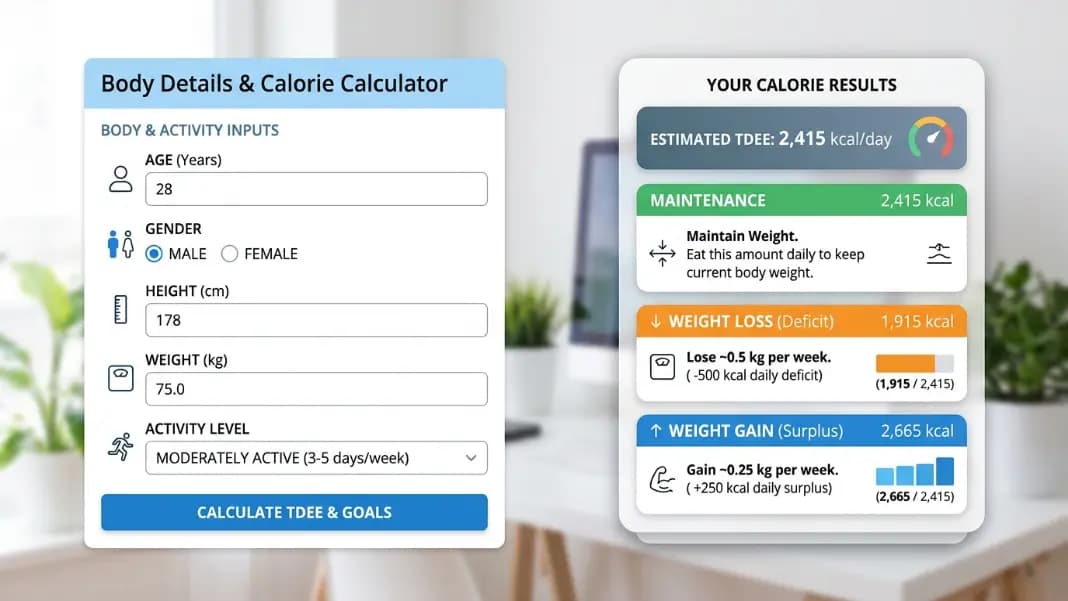
Calorie Calculator: How Many Calories a Day Do You Actually Need?
Your daily calorie needs depend on your age, sex, height, weight, and activity level. Learn how calorie calculators work, what formula they use, and how to apply the result to your diet goals.
10 min read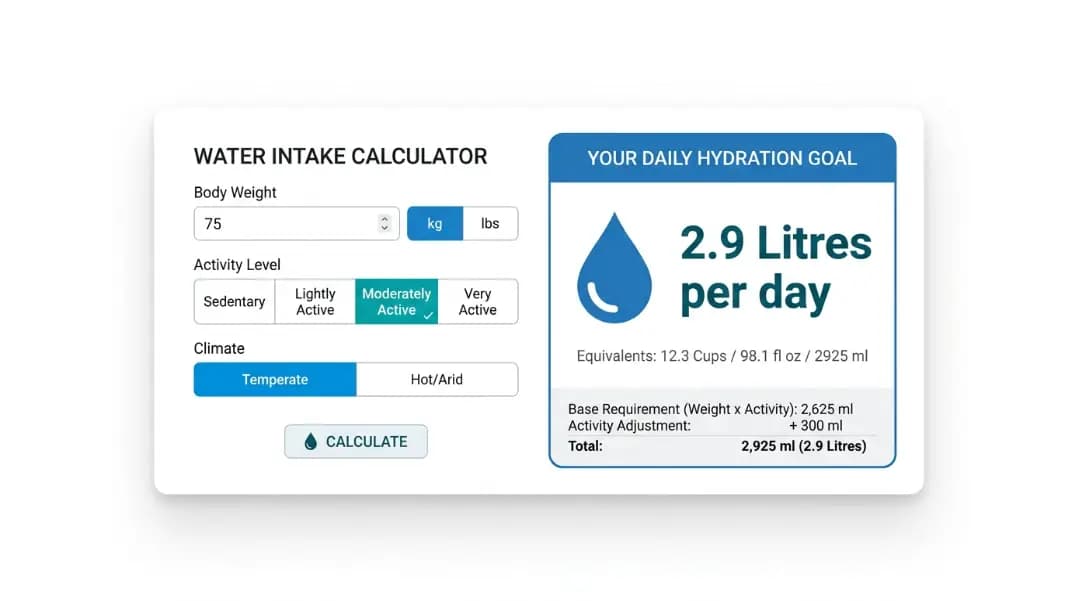
Water Intake Calculator: How Much Water Should You Drink Per Day
Calculate how much water you need per day based on body weight and activity. Covers the 35 ml per kg formula, exercise adjustments, and the hydration myth.
13 min read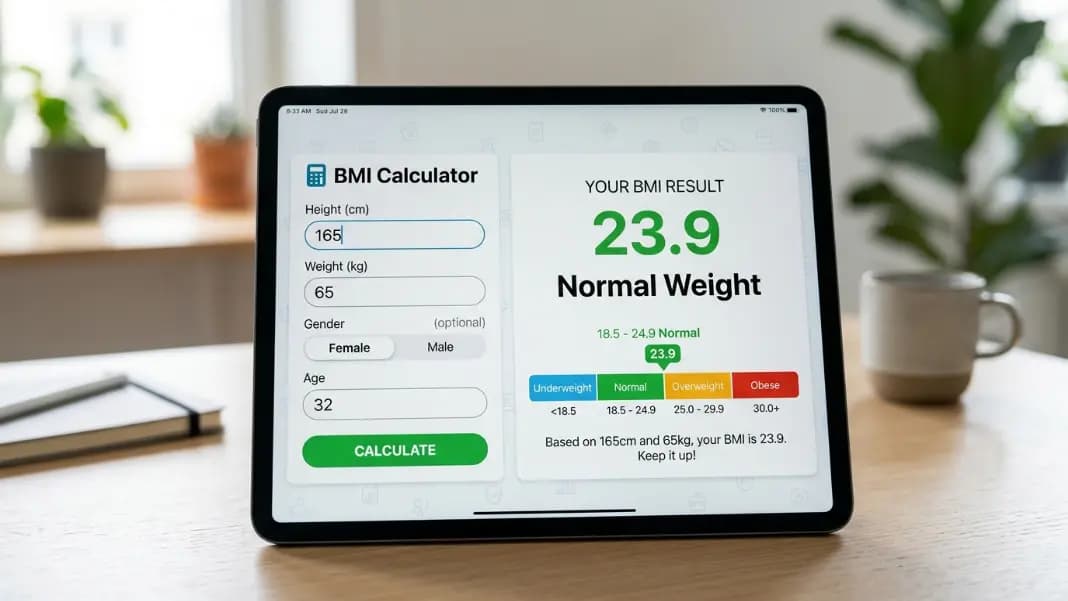
BMI Calculator for Women: Healthy Ranges by Age and What the Numbers Mean
BMI calculator for women: find your healthy range by age, understand your result in kg, and learn what the numbers mean for your body and health goals.
12 min read