A BMI of 24.8 is classified as normal. A BMI of 25.2 is classified as overweight. That 0.4-point difference represents a fraction of a kilogram at most heights, and it is the line millions of women cross in both directions depending on whether they weighed themselves before or after breakfast. It gets treated as a meaningful health distinction.
The BMI calculator for women gives you a number in seconds. What that number actually means for your specific body, age, and goals takes more context than the category label provides. This post covers how to use the calculator with kg and cm inputs, what the healthy range looks like for women at different ages, what the formula does not measure, and what to do with a result that falls outside the standard categories.
BMI is a useful screening tool. It was never designed to be a diagnosis, and reading it as one leads to the confusion most people experience when they get a result they did not expect.
How to use the BMI calculator with kg and cm inputs
The BMI calculator accepts both metric and imperial inputs. For kilograms and centimeters, select the metric option and enter your weight in kg and your height in cm.
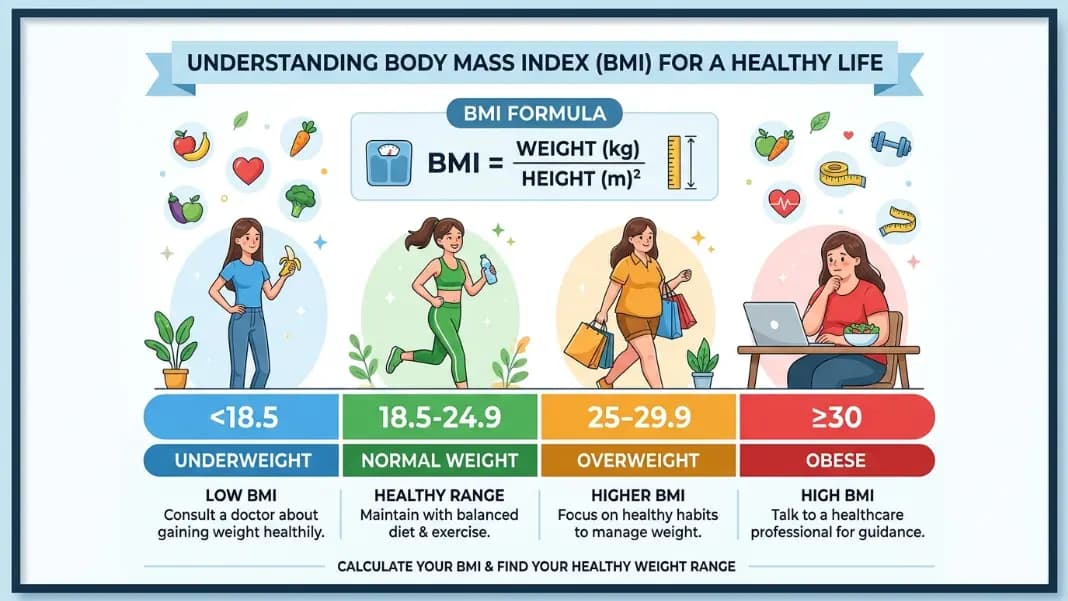
The formula is: BMI = weight (kg) / height (m)^2.
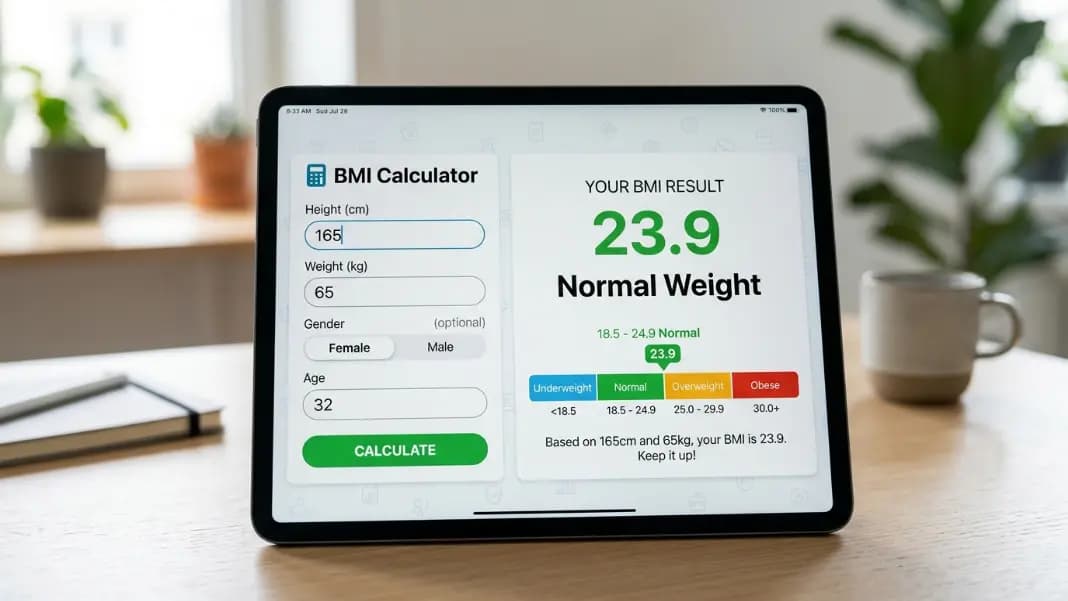
A woman who is 165 cm tall and weighs 65 kg has a BMI of 65 / (1.65 x 1.65) = 65 / 2.7225 = 23.9. That result falls in the normal range of 18.5 to 24.9.
Use your current measurements, not targets. The calculator tells you where you are, and that is the only starting point worth working from. If you plan to track changes over time, calculate on the same day of the week and at the same time of day. Body weight fluctuates by 1 to 2 kg across a single day depending on hydration, food, and timing, and that fluctuation is enough to push the BMI number across category lines even when nothing meaningful has changed.
The health tools collection has related calculators including body fat percentage, ideal weight range, and TDEE that add context beyond a single BMI result.
What a healthy BMI looks like for women
The World Health Organization's standard BMI categories apply to adult women:
| BMI Range | Category |
|---|---|
| Below 18.5 | Underweight |
| 18.5 to 24.9 | Normal weight |
| 25.0 to 29.9 | Overweight |
| 30.0 and above | Obese |
These categories are population-level risk indicators. They were built from data associating BMI ranges with increased risk of cardiovascular disease, type 2 diabetes, and all-cause mortality across large groups. They describe statistical tendencies, not individual health status.
For women, the normal range of 18.5 to 24.9 covers a significant variation in body size. At 165 cm, that range corresponds to weights from approximately 50 kg to 68 kg. Two women at opposite ends of that range can have meaningfully different body compositions and both be in the same "normal" category. The number is a screen, not a verdict.
How BMI ranges shift with age for women
The standard BMI categories do not officially change with age for adult women. In practice, the interpretation shifts.
Women naturally lose lean muscle mass beginning in their 30s and accelerating after menopause. This process, called sarcopenia, means the body composition behind a BMI number changes over time. A BMI of 22 in a 30-year-old woman may reflect substantially higher lean mass than the same BMI in a 60-year-old woman, even though the number is identical.
Some research published in the American Journal of Clinical Nutrition suggests the optimal BMI range for older women shifts slightly upward. In women over 65, the 23 to 27 range may be associated with lower mortality than staying below 25. The underlying finding is that some fat mass serves a protective function in older age, particularly as a buffer against illness-related weight loss. This directly contradicts the standard advice, which is to stay below 25 at any age.
For women under 40, the standard ranges apply without significant adjustment. For women between 40 and 65, the top of the normal range becomes less meaningful as a standalone health indicator. For women over 65, BMI alongside bone density, muscle mass testing, and other markers gives a more useful picture than the category label alone. For a detailed look at how healthy BMI ranges shift across each decade and why the standard thresholds become less reliable after 50, the BMI by age guide covers the full picture.
Why women and men have different body composition at the same BMI
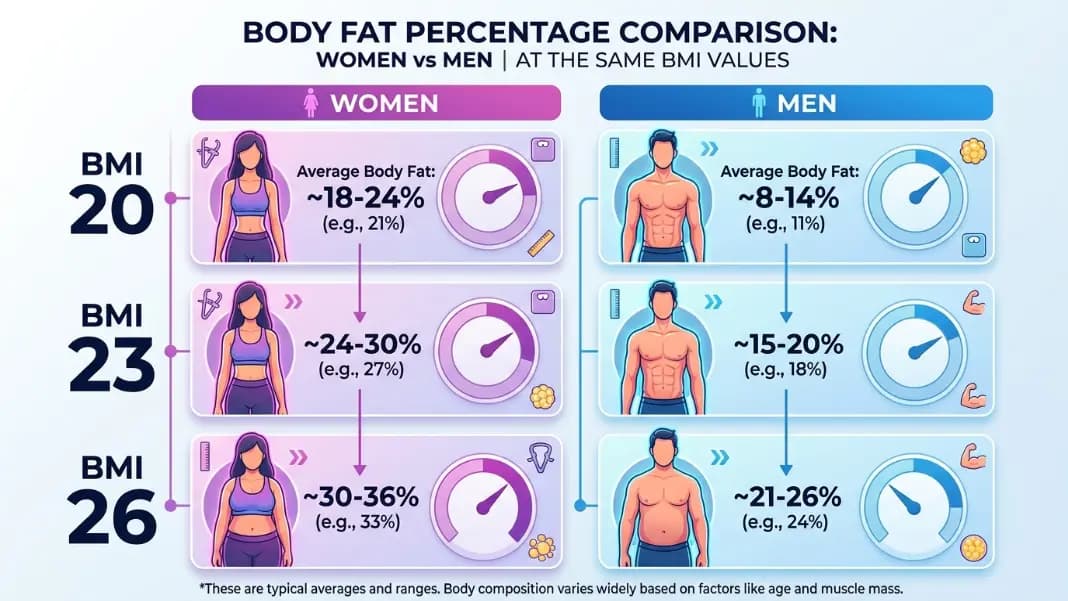
The BMI formula is the same for everyone. The healthy range is the same. But the body composition behind the same number differs significantly between women and men.
Women's bodies require more adipose tissue than men's for hormonal function and reproductive health. The American Council on Exercise estimates essential body fat at 10 to 13 percent for women and 2 to 5 percent for men. A woman with 25 percent body fat is within a healthy range for her sex. A man with 25 percent body fat is in the overweight zone by fitness standards.
This means BMI underestimates relative body fat for women compared to men. Two people at the same BMI, one male and one female, are not at equivalent fat levels. The woman will almost always carry a higher fat percentage, which is normal and not a health concern at moderate levels. The formula does not account for this difference.
For a direct comparison of how BMI works across sex-specific body compositions and what the numbers mean for men, the BMI calculator for men covers male-specific ranges and body composition context in detail.
BMI in kg: reference points for metric users
If you measure in kilograms and centimeters, your result is expressed in kg/m2, the standard scientific unit for BMI. The number is identical to what you would get entering the same measurements in pounds and inches. The formula normalizes the units internally.
Reference points for women in common height ranges:
For a woman who is 155 cm tall:
- Normal range: 44 kg to 60 kg
For a woman who is 160 cm tall:
- Normal range: 47 kg to 64 kg
For a woman who is 165 cm tall:
- Normal range: 50 kg to 68 kg
For a woman who is 170 cm tall:
- Normal range: 53 kg to 72 kg
For a woman who is 175 cm tall:
- Normal range: 57 kg to 76 kg
These are the boundaries of the statistical normal range, not targets to aim for. A woman at 50 kg and 165 cm sits at the bottom edge of normal. A woman at 67 kg and 165 cm sits near the top edge. Both are in the same category despite a 17 kg difference.
What your BMI result does not tell you
BMI measures the ratio of weight to height. It does not measure body fat percentage, muscle mass, bone density, fat distribution, cardiovascular fitness, or any metabolic marker.
Two women with the same BMI of 24.0 can have radically different health profiles. A woman who strength trains regularly may carry substantial lean muscle and have 22 percent body fat. A sedentary woman at the same BMI may have 35 percent body fat and below-average cardiovascular capacity. The BMI number gives no indication of which is which.
This matters particularly for women who lift weights or play sports. Muscle is denser than fat, so a well-muscled woman weighs more than a less-muscled woman of the same height and body fat level. BMI will push the stronger woman toward the top of the normal range or into the overweight category despite better health markers on every meaningful test.
The formula was developed in the 1830s by Belgian mathematician Adolphe Quetelet as a way to describe population-level weight distributions. It was not designed as a clinical tool for individual health assessment. That original purpose is worth remembering when your result doesn't match how you feel or what other health tests show.
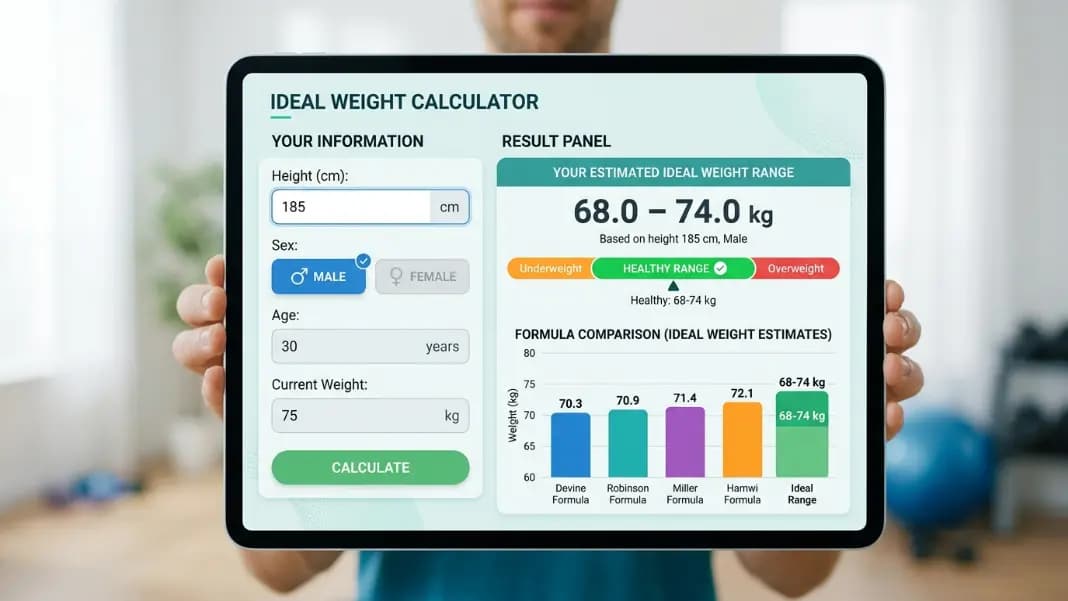
For a more complete picture, the ideal weight calculator uses several reference methods including Hamwi, Devine, and Robinson formulas and returns a range rather than a single number, which better reflects the genuine variation in healthy weights.
BMI during and after pregnancy
BMI is not a useful health metric during pregnancy. Weight gain throughout a healthy pregnancy ranges from approximately 11 to 16 kg depending on pre-pregnancy weight, and that gain is expected, healthy, and necessary. Applying standard BMI categories to a pregnant woman produces a number that reflects the pregnancy, not her underlying health status.
Healthcare providers track pregnancy weight differently: they use your pre-pregnancy BMI as a baseline and monitor whether weight gain through each trimester falls within guidelines set by organizations like the Institute of Medicine. If you are currently pregnant, record your pre-pregnancy BMI as a reference point and rely on your provider's trimester-by-trimester tracking for weight monitoring during the pregnancy itself.
Postpartum BMI becomes relevant again once weight has stabilized after delivery and any breastfeeding period. Many women see significant weight changes across the first 12 months postpartum. Checking BMI during active change tells you less than checking it once the body has settled into a more stable pattern.
What to do when your BMI falls outside the normal range
A BMI outside the 18.5 to 24.9 range is a flag, not a conclusion. It signals that your weight-to-height ratio sits outside the statistical zone associated with lowest population-level health risk. It does not tell you why, how significant the deviation is, or what it means for your individual situation.
If your BMI is above 25, the more useful questions involve other health markers. Blood pressure, fasting glucose, cholesterol values, and cardiovascular fitness are all more directly predictive of disease risk than BMI alone. Someone with a BMI of 27, good blood pressure, normal cholesterol, and consistent physical activity is not in the same risk category as someone with a BMI of 27 and multiple elevated metabolic markers. The number alone does not distinguish between them.
If your BMI is below 18.5, the same logic applies. Low BMI may reflect genuinely low muscle and bone mass, which carries real health risk. Or it may reflect a naturally lean body type with no associated deficiency. Lab work and a physical exam add precision that a height-weight formula cannot provide.
The most useful thing you can do with an out-of-range BMI result is bring it to a primary care appointment as one data point in a broader conversation, not treat it as a problem requiring immediate action.
Use the BMI calculator to track your number over time alongside your actual habits. A trend over months is more meaningful than any single reading. And the general BMI guide covers the history and methodology behind the formula, including the most common ways it is applied beyond its original research design.