A woman can weigh exactly what she did in her 20s and have a completely different body composition by her 40s. Weight stayed the same. Muscle decreased. Fat increased. The scale gives no indication that anything changed, but the body fat percentage tells a different story.
Body fat percentage for women is a more informative measure than weight or BMI alone, and it works differently for women than for men. Women require more fat for hormonal function, bone health, and reproductive physiology. Understanding what healthy ranges look like, how they shift with age, and what your number actually means in context is more useful than comparing yourself to a single population-wide average that ignores all of this.
The body fat calculator estimates your body fat percentage using the US Navy method, which requires only a tape measure and takes about two minutes. This guide explains the healthy ranges that apply specifically to women, how age adjusts those ranges, what menopause does to fat distribution, and how to set a realistic goal based on your result.
Why women need more essential fat than men
Essential fat is the minimum fat the body requires to function. For men, essential fat is around 2 to 5 percent of body mass. For women, it is around 10 to 13 percent.
This is not a difference in standards. It reflects the underlying biology.
Women need substantially more essential fat for estrogen and progesterone production, both of which are partly synthesized in and regulated by fat tissue. Adipose tissue plays an active role in hormonal signaling that affects bone density, cardiovascular function, and reproductive health. Women who drop below essential fat levels often see menstrual disruption as the first visible sign because the hormonal signals that regulate the cycle become insufficient.
Fat also cushions and protects reproductive organs, forms part of breast tissue, and contributes to the normal fat deposits around the hips and thighs that are normal and healthy in women. This gynoid fat distribution is not excess. It is physiologically expected.
The practical consequence is that direct comparisons between men's and women's body fat percentages produce wrong conclusions. A woman at 22 percent body fat is in the fitness category. A man at 22 percent is in the acceptable category. The same number means different things. Any goal that targets a body fat percentage appropriate for a male physiology is misaligned for a woman.
Healthy body fat percentage ranges for women
The American Council on Exercise (ACE) classification is the most widely cited framework for adult body fat categories.
| Category | Body fat range for women |
|---|---|
| Essential fat | 10 to 13 percent |
| Athlete | 14 to 20 percent |
| Fitness | 21 to 24 percent |
| Acceptable | 25 to 31 percent |
| Obese | 32 percent and above |
The athlete range applies to women who compete in sports or train at high volume as a primary activity. Visible muscle definition is typical at these levels, and the body is running close to minimal fat reserves beyond essential. This range is not necessary or appropriate for most women to target, and it can be difficult to maintain without structured athletic training and careful nutritional management.
The fitness range is achievable for women who exercise consistently, several times per week, without being competitive athletes. The acceptable range covers a substantial portion of healthy adult women and is associated with generally normal metabolic function.
The obese category signals elevated cardiovascular and metabolic risk. Above 32 percent, the health data consistently shows higher rates of insulin resistance, hypertension, and cardiovascular disease. But a single body fat number does not tell you everything. A woman at 28 percent who exercises regularly, has normal blood glucose, and has no cardiovascular risk markers is in a different position than a sedentary woman at the same percentage who has elevated triglycerides.
When body fat is too low: the female athlete triad
Most conversations about body fat for women focus on the upper end. The lower end carries real risks that are less discussed outside sports medicine.
The female athlete triad is a well-documented pattern that occurs when three conditions coincide: low energy availability (consuming too little for the training load), menstrual dysfunction, and decreased bone density. Body fat dropping below essential levels is often the trigger.
At the athlete end of the range (14 to 20 percent), most women are healthy and hormonally normal. Below that, particularly below 10 to 13 percent, the body begins to prioritize essential functions by suppressing others. Reproduction becomes one of the first things the body deprioritizes when energy is insufficient. Menstrual irregularities, and in more severe cases amenorrhea (complete cessation of menstruation), are the visible result.
The bone density consequences are the more lasting concern. Estrogen has a direct protective effect on bone. Women who maintain very low body fat for extended periods, including some aesthetic athletes, gymnasts, long-distance runners, and those in weight-restricted sports, are at significantly elevated risk for stress fractures and early-onset osteoporosis.
The athlete category (14 to 20 percent) is the reasonable lower target for most women. Going below it requires specialist monitoring, not just a calorie deficit and more training. If you are working with a sports medicine physician who is tracking hormonal and bone health markers alongside training metrics, lower ranges can be managed safely. Without that support, they are not a sensible goal.
Body fat percentage for women by age group
The ACE categories describe the full adult population. Body fat percentage changes predictably with age, even when total body weight stays the same, because muscle mass decreases while fat mass tends to increase as part of the normal aging process.
Research published in the American Journal of Clinical Nutrition found that women gain body fat progressively across decades, independent of weight change, because lean mass loss is a consistent feature of aging without targeted resistance training to counter it. A woman at 30 and a woman at 55 can weigh exactly the same while differing by 8 to 12 percentage points in body fat.
Age-adjusted healthy body fat ranges for women:
| Age group | Healthy body fat range |
|---|---|
| 20 to 29 | 16 to 24 percent |
| 30 to 39 | 17 to 25 percent |
| 40 to 49 | 20 to 28 percent |
| 50 to 59 | 22 to 31 percent |
| 60 and above | 22 to 33 percent |
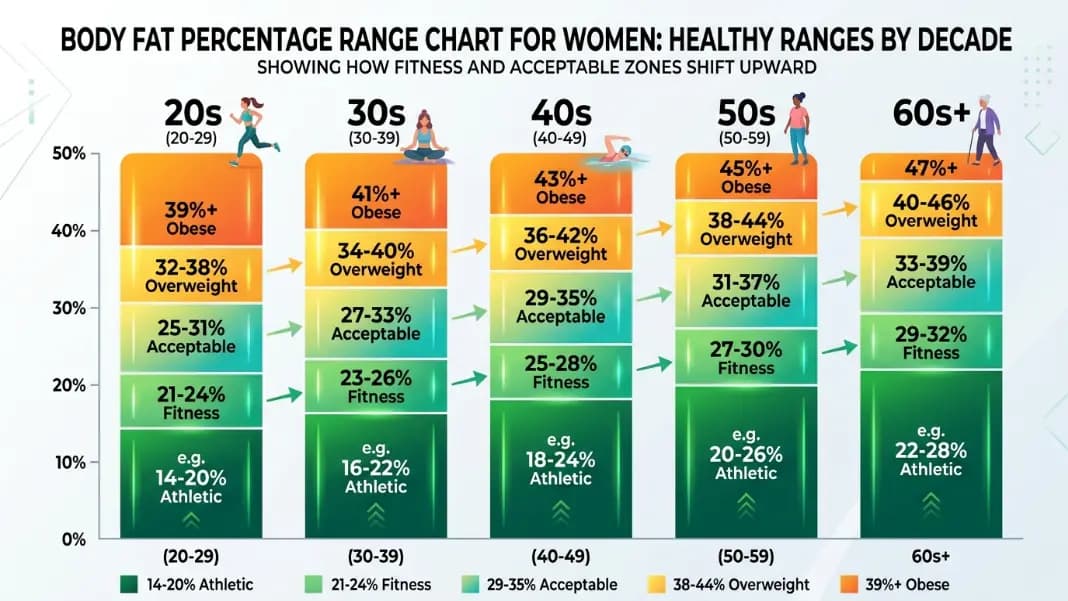
These ranges reflect the reality that some increase in body fat is a normal part of aging, not a sign of something gone wrong. A woman at 45 comparing her body fat to ranges designed for a 25-year-old will consistently find herself outside the range even if she is in excellent health for her age and fitness level.
The practical goal as you age is not maintaining a specific number but maintaining the habits that slow lean mass loss: resistance training, adequate protein intake (the American College of Sports Medicine recommends 1.2 to 1.6 grams per kilogram of body weight per day for active older adults), and consistent physical activity.
How menopause shifts body fat distribution
Body fat percentage is a single number. Where that fat sits in the body is a separate question, and it matters considerably for postmenopausal women.
Before menopause, estrogen promotes fat storage in the hips, thighs, and gluteal region. This is gynoid distribution. Fat stored in these areas has a lower association with cardiovascular and metabolic risk than fat stored centrally.
After menopause, estrogen levels decline sharply and fat redistribution shifts toward the abdominal area. Visceral fat, the fat that accumulates around internal organs in the abdominal cavity, increases during and after menopause independently of how much total body fat a woman carries. A woman whose overall body fat percentage stays stable through menopause can still see her metabolic risk profile change significantly because the same fat is now stored in a more dangerous location.
Waist circumference above 88 cm (35 inches) for women is associated with elevated cardiovascular and metabolic risk according to the American Heart Association, regardless of total body fat percentage. This is why healthcare providers often add waist circumference to the assessment specifically for postmenopausal women. Tracking both the body fat percentage and the waist circumference gives a more complete picture during and after this transition than either number alone.
The other change worth noting: the rate of lean mass loss accelerates after menopause. Women who were not doing resistance training before this transition often see body composition shift more noticeably in a shorter period. Starting resistance training before or during perimenopause has meaningfully better outcomes than starting well after.
Body fat percentage vs BMI: which tells you more
BMI is faster to calculate and requires no measurements beyond height and weight. But it cannot tell you anything about body composition, which is what matters for understanding health risk at the individual level.
BMI measures weight relative to height. It treats all weight the same regardless of whether it comes from fat or muscle. A woman who is sedentary, has lost significant muscle through inactivity, and has gradually accumulated fat while maintaining a stable weight can have a BMI in the healthy range while carrying a body fat percentage in the obese category. This is called normal weight obesity. Her health risk is similar to that of conventionally obese women, but BMI misses it completely.
The reverse is also true. A muscular woman with high lean mass may push her BMI toward the overweight range despite having an excellent body fat percentage and low health risk. BMI classifies her as borderline overweight while her actual composition tells the opposite story.
Body fat percentage is the more direct measurement for women who want to understand their actual body composition. The BMI calculator for women explains where BMI is genuinely useful and where it produces misleading results for female body composition specifically. The body fat percentage calculator guide covers all the measurement methods in detail, including how they compare for accuracy.
Using both measurements together is more informative than either alone. BMI gives you the weight-to-height context; body fat percentage tells you what is driving that weight.
How to measure body fat percentage at home using the Navy method
The US Navy method is the most practical approach for measuring body fat at home. It uses circumference measurements and applies a validated formula that produces consistent results across measurements.
For women, three measurements are required:
- Neck: Measured just below the larynx at the narrowest point
- Waist: Measured at the narrowest point, typically just above the navel, not at the widest
- Hips: Measured at the widest point of the hips and buttocks
Use a soft cloth or flexible measuring tape. Measure at the same time of day each time you track, ideally in the morning before eating. Take two readings at each site and average them if they differ.
The Navy formula processes these three circumferences alongside your height to estimate total body fat percentage. It is less precise than a DEXA scan, which can measure to within 1 to 2 percent, but it is accurate enough to identify your category and track progress over time. Consistency matters more than single-measurement precision when you are tracking changes across weeks and months.
The body fat calculator handles the formula automatically. Select female, enter your height and the three circumference measurements, and the result appears with your category labeled.
Setting a realistic body fat goal for women
If your result falls in the athlete or fitness range, the goal is maintenance. Continue the training and nutrition approach that got you there, with attention to whether the range is sustainable for your age and activity level without signs of hormonal or bone health stress.
If your result falls in the acceptable range and your other health markers are good, there is no urgent need to change. If you want to move toward the fitness range, the mechanism is adding lean mass through resistance training while running a modest caloric deficit. This combination reduces fat and builds muscle simultaneously, which produces better body composition outcomes than dieting alone.
If your result falls in the obese range, the approach is the same but the urgency is higher. The TDEE calculator calculates your total daily energy expenditure based on your weight, height, age, and activity level. That number gives you the starting point for a caloric deficit that leads to fat loss without going so low that muscle mass is sacrificed. The ideal weight calculator can give you a healthy weight range for your height, which combined with your body fat percentage, helps set a goal that accounts for composition rather than just total weight.
One thing worth knowing: if you are doing resistance training while in a caloric deficit, the scale may not move much even as your body composition improves. You are losing fat and building muscle at the same time. Body fat percentage tracked over weeks gives a better view of actual progress than weight for women who include strength training in their routine. A body fat percentage dropping from 30 to 27 percent is meaningful progress even if the scale barely moved.