Free Body Fat Percentage Calculator Online
The body fat percentage calculator estimates your body fat using the US Navy circumference method, the same approach used by the US military for fitness assessments. Enter your neck, waist, and hip measurements (women only for hip) along with your height to calculate body fat percentage online. Returns body fat percentage, fat mass, lean mass, and your ACE health category. Metric and imperial supported.
How to use the body fat calculator
- Select your sex: the formula uses different inputs and constants for men and women.
- Choose metric (cm) or imperial (inches) units.
- Enter your height, neck circumference, and waist circumference.
- Women: also enter hip circumference at the widest point.
- Your body fat percentage, fat mass, lean mass, and health category appear instantly.
How to calculate body fat percentage: the Navy circumference formula
The US Navy body fat percentage calculator uses a logarithmic formula developed by Hodgdon and Beckett that correlates circumference measurements with body composition validated against hydrostatic weighing. The formulas (all measurements in inches):
- Men: Body Fat % = 86.010 x log10(waist - neck) - 70.041 x log10(height) + 36.76
- Women: Body Fat % = 163.205 x log10(waist + hip - neck) - 97.684 x log10(height) - 78.387
Measurement technique directly affects accuracy. Use a flexible non-stretch measuring tape. Measure the waist at the narrowest visible point (typically at or just above the navel, not at the hip-bone level used for clothing sizing). Measure the neck just below the larynx, angled slightly downward at the front. Women measure the hip at the widest point around the buttocks. Take each measurement twice and average. Consistent technique matters more than a single precise reading.
For metric input, the calculator converts centimeters to inches automatically before applying the formula. Results are then converted back to your selected unit for display. This accurate body fat percentage calculator produces results within 3 to 4 percentage points of DEXA scanning for most individuals with normal body proportions.
US Army body fat calculator: standards and formula
The US Army body fat calculation uses the same circumference-based formula as the Navy method. Soldiers are measured at the neck and abdomen (men) or neck, waist, and hips (women) during the Army Body Composition Program (ABCP) assessment. To calculate body fat percentage army-style, the same three or four measurements are entered into the formula above. The difference between Navy and Army body fat standards lies in the passing thresholds rather than the formula itself.
Army maximum allowable body fat standards by age group:
- Men ages 17 to 20: 20% | Ages 21 to 27: 22% | Ages 28 to 39: 24% | Ages 40+: 26%
- Women ages 17 to 20: 30% | Ages 21 to 27: 32% | Ages 28 to 39: 34% | Ages 40+: 36%
Navy standards are slightly stricter: men are limited to 22 to 26% depending on age, and women to 33 to 36%. Use this calculator to check your result against whichever standard applies to you.
Body fat percentage calculator for women vs men
The female body fat percentage calculator adds hip circumference as a required measurement because women naturally carry more subcutaneous fat around the hips and thighs (gynoid fat distribution). The male formula uses only waist and neck because men tend toward central (android) fat distribution. This is why the two formulas use structurally different logarithmic constants.
Women's healthy body fat percentage ranges are significantly higher than men's at every fitness level:
- Women essential fat: 10 to 13% | Men essential fat: 2 to 5%
- Women athletic: 14 to 20% | Men athletic: 6 to 13%
- Women fit: 21 to 24% | Men fit: 14 to 17%
- Women acceptable: 25 to 31% | Men acceptable: 18 to 24%
- Women obese: 32%+ | Men obese: 25%+
A body fat result of 22% for a woman places her in the fit category. For a man, 22% sits at the upper edge of the acceptable range. Always compare your result against the sex-appropriate reference column. The male body fat percentage calculator and female body fat percentage calculator produce very different numbers for the same fitness level, and that is correct.
Body fat percentage vs BMI: which matters more?
BMI and body fat percentage measure fundamentally different things. BMI is a ratio of weight to height squared and makes no distinction between fat and muscle. A 175 cm man weighing 85 kg with 12% body fat has a BMI of 27.8 (overweight) but an athletic body fat percentage. Conversely, a sedentary person can have a normal BMI while carrying excess visceral fat (a condition sometimes called "normal weight obesity").
For most people, body fat percentage is a more accurate picture of health and fitness status than BMI. That said, BMI is a useful screening tool when circumference measurements are not available. Using both together gives the most complete picture: if BMI and body fat percentage agree (both healthy or both elevated), the signal is strong. If they diverge, body fat percentage is generally more meaningful since it directly measures body composition.
How to lose body fat percentage: what the numbers tell you
Reducing body fat percentage requires losing fat mass while preserving or building lean mass. The two levers are caloric deficit and adequate protein intake. A deficit of 300 to 500 calories per day below your total daily energy expenditure (TDEE) produces approximately 0.3 to 0.5 kg of fat loss per week without significant lean mass loss.
Example: a 75 kg man at 20% body fat has 15 kg fat mass and 60 kg lean mass. To reach 15% body fat while maintaining lean mass, he needs to lose roughly 4.4 kg of fat. At 0.4 kg per week that takes about 11 weeks. In practice, body fat percentage also falls as lean mass increases through resistance training, even without significant fat loss, which is why tracking circumference measurements over time is more informative than tracking weight alone.
For goal-setting, pair your body fat percentage result with your daily calorie intake calculator to find the right deficit size. Protein intake of 1.6 to 2.2 g per kg of body weight preserves lean mass during a fat-loss phase.
Limitations of the circumference body fat method
The Navy circumference method is practical and accessible, but has known limitations worth understanding:
- Measurement error: Small inconsistencies in where measurements are taken can shift results by 2 to 4 percentage points. Always use the same landmarks and average two measurements.
- Atypical fat distribution: The formula assumes standard fat distribution patterns. People with unusual proportions (very narrow waist with large limbs, or high visceral fat with low subcutaneous fat) may get less accurate results.
- Extreme leanness or obesity: Accuracy decreases at the tails of the distribution. Below 10% body fat (men) or 15% (women) and above 35%, DEXA scanning or hydrostatic weighing gives more reliable results.
- No age adjustment: Body fat distribution shifts with age. Older adults tend to accumulate more visceral fat that is not well captured by waist circumference alone.
For a full breakdown of healthy ranges by sex and age, how measurement methods compare in accuracy, and how to use your result to set a realistic fat loss goal, read the body fat percentage guide.
Frequently asked questions
The most accessible way to calculate body fat percentage at home is the US Navy circumference method. For men: measure neck circumference (just below the Adam's apple) and waist circumference (at the narrowest point). For women: also measure hip circumference (at the widest point). Then apply the formula: Men: Body Fat % = 86.010 x log10(waist - neck) - 70.041 x log10(height) + 36.76. Women: Body Fat % = 163.205 x log10(waist + hip - neck) - 97.684 x log10(height) - 78.387. All measurements in inches, height in inches. This body fat % calculator does the calculation instantly.
You can calculate body fat percentage at home using only a soft measuring tape. Take three measurements: neck, waist, and height (women also measure hips). Enter them into the body fat percentage calculator using height and weight above. No calipers, no smart scale, and no gym equipment needed. The US Navy circumference method was specifically designed to be a practical field assessment tool requiring only a tape measure. Measurement accuracy is the main variable, so take each measurement twice and use the average.
The US Navy method uses circumference measurements and height in a logarithmic formula to estimate body fat percentage. For men it uses neck, waist, and height. For women it adds hip measurement. The formula was developed through correlation studies with underwater weighing (hydrostatic weighing), which is a gold-standard measurement. The Navy method is a validated and widely used field alternative to DEXA scanning or hydrostatic weighing.
For men: essential fat 2 to 5%, athletic 6 to 13%, fit 14 to 17%, acceptable 18 to 24%, obese 25% and above. For women: essential fat 10 to 13%, athletic 14 to 20%, fit 21 to 24%, acceptable 25 to 31%, obese 32% and above. Women require significantly more essential fat than men due to hormonal and reproductive functions. These ranges follow the American Council on Exercise (ACE) classification system.
The US Army body fat calculation uses the same circumference formula as the US Navy method. Soldiers are measured at the neck and abdomen (men) or neck, waist, and hips (women). The Army maximum body fat standards by age group for men are: ages 17 to 20 = 20%, ages 21 to 27 = 22%, ages 28 to 39 = 24%, ages 40 and over = 26%. For women: ages 17 to 20 = 30%, ages 21 to 27 = 32%, ages 28 to 39 = 34%, ages 40 and over = 36%. Soldiers who exceed these thresholds are enrolled in the Army Body Composition Program (ABCP).
The US Navy circumference method has a margin of error of approximately 3 to 4 percentage points compared to DEXA scanning (the clinical gold standard). Hydrostatic weighing and air displacement plethysmography (Bod Pod) are more accurate but require specialized equipment. Bioelectrical impedance (BIA scales) has similar or greater error margins and is highly sensitive to hydration levels. For tracking trends over time, the circumference method is reliable and consistent if measurement technique stays the same.
The body fat percentage calculator female formula adds hip circumference as a required measurement because women naturally carry more fat mass around the hips and thighs (gynoid fat distribution). The female formula also uses different logarithmic constants, producing higher baseline body fat results than the male formula at equivalent fitness levels. This is expected: women's healthy essential fat range (10 to 13%) is much higher than men's (2 to 5%) due to hormonal and reproductive biology. A result of 22% for a woman places her in the fit category; the same result in a man falls at the upper edge of athletic.
Losing body fat percentage requires losing fat mass while preserving lean mass. A deficit of 300 to 500 calories per day below your TDEE (total daily energy expenditure) produces roughly 0.3 to 0.5 kg of fat loss per week. At this rate, a 10 kg person who is 25% body fat (2.5 kg fat mass) could reduce body fat by approximately 1 to 2 percentage points over 4 to 8 weeks with consistent training and adequate protein intake (1.6 to 2.2 g per kg of body weight). Aggressive deficits above 750 calories per day tend to accelerate lean mass loss, which can paradoxically worsen body fat percentage.
Related articles
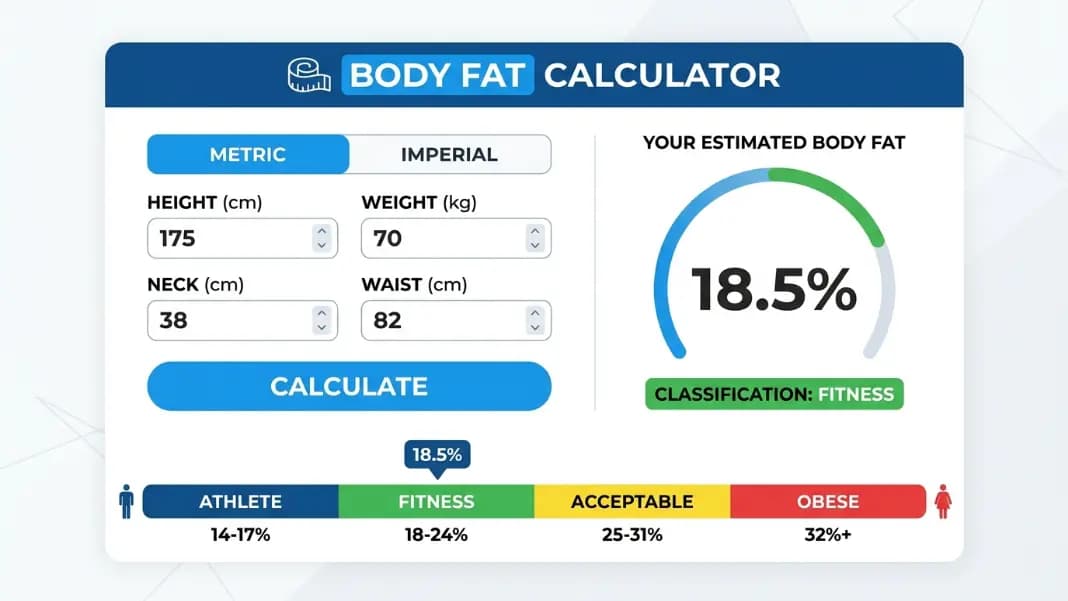
Body Fat Percentage Calculator: What Your Number Means
Learn what your body fat percentage means, healthy ranges for men and women, how it differs from BMI, and how to use a free calculator to measure yours.
9 min read
Body Fat Percentage for Women: Healthy Ranges by Age Explained
Understand healthy body fat percentage ranges for women by age, why women carry more essential fat than men, and how to measure yours with a free calculator.
11 min read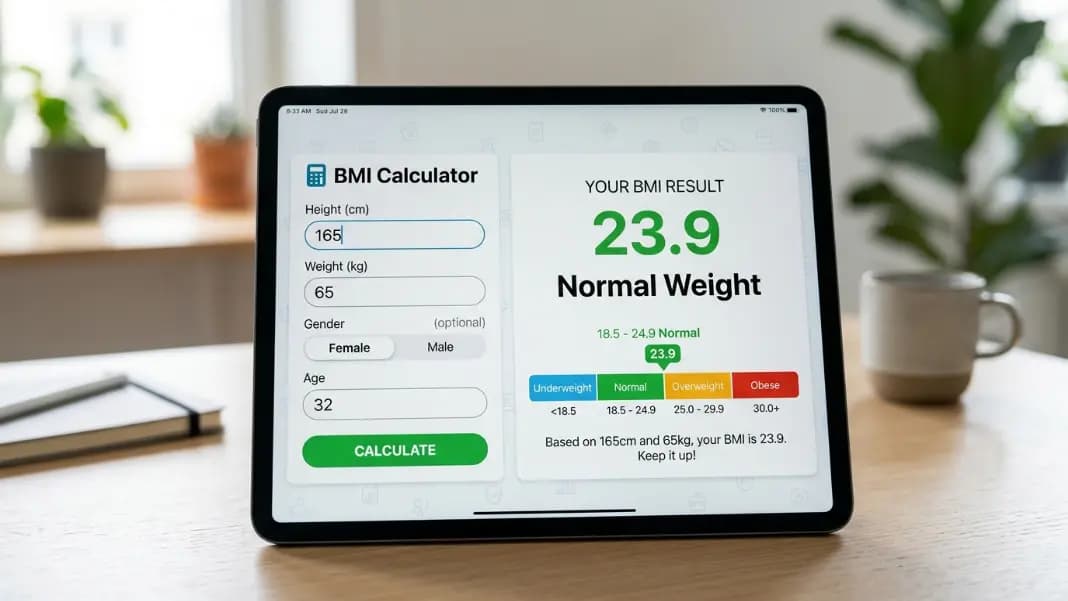
BMI Calculator for Women: Healthy Ranges by Age and What the Numbers Mean
BMI calculator for women: find your healthy range by age, understand your result in kg, and learn what the numbers mean for your body and health goals.
12 min read