Free Water Intake Calculator Online
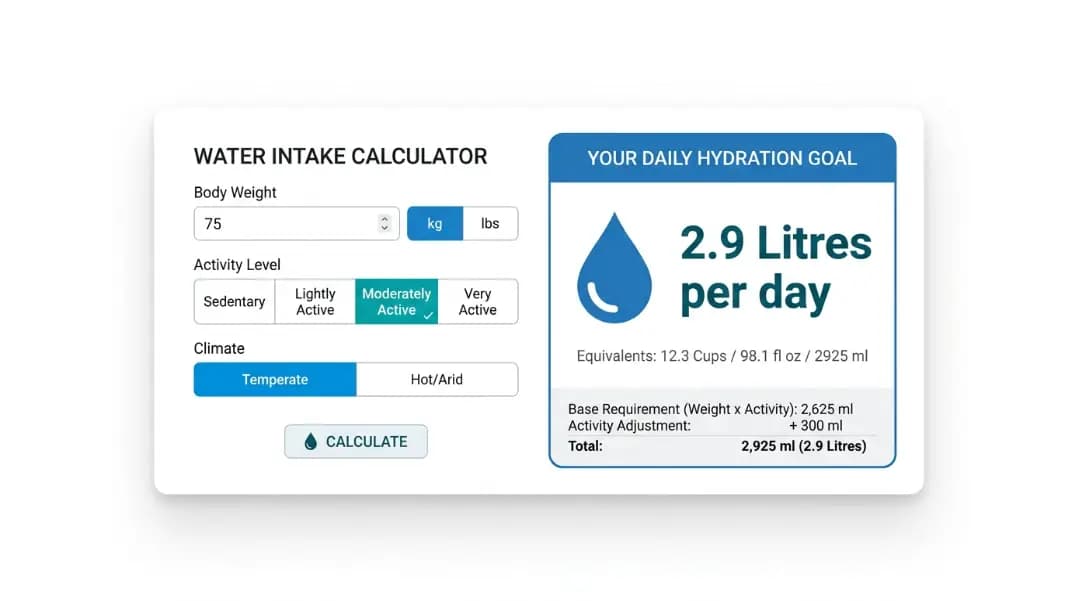
The water intake calculator computes your personalized daily hydration target based on body weight, activity level, and climate. Calculate your recommended daily water intake in litres, cups, and ounces. Supports kg and lbs. Free, no account needed.
How to use the water intake calculator
- Enter your body weight and select kg or lbs.
- Select your daily activity level: sedentary, lightly active, moderately active, or very active.
- Choose your climate: temperate or hot and humid.
- Your recommended daily water intake calculates instantly in litres, cups, and ounces.
- Adjust inputs to see how exercise and climate change your hydration target.
How to calculate water intake by weight: the formula
The standard formula to calculate daily water intake is based directly on body weight:
Daily water intake (ml) = Body weight (kg) x 35
For imperial: Daily water intake (oz) = Body weight (lbs) x 0.5. Example: a 70 kg person needs 70 x 35 = 2,450 ml (2.45 litres) per day at a sedentary activity level. A 90 kg person needs 3,150 ml (3.15 litres). The water intake calculator kg litre conversion is handled automatically for both input units.
Activity and climate adjustments applied on top of the base formula:
- Light exercise (30 to 60 min/day): add 350 ml
- Moderate exercise (60 to 90 min/day): add 500 to 700 ml
- Intense exercise or very active job: add 750 to 1,000 ml
- Hot or humid climate: add 500 ml to any activity level
The water intake by weight calculator approach is more scientifically grounded than the generic "eight glasses a day" guideline, which does not scale with body size and was never intended as a standalone recommendation. The 35 ml/kg formula closely matches the Institute of Medicine Adequate Intake figures when applied to adult weight ranges.
Water intake calculator for weight loss
Water intake and weight loss are directly linked through several mechanisms. Drinking 500 ml of water 30 minutes before meals has been shown in randomized controlled trials to reduce meal calorie intake by approximately 13% by increasing gastric fullness. Over a 12-week period, participants who drank water before meals lost on average 2 kg more than those who did not.
To calculate water intake for weight loss, use the weight-based formula with a slightly higher multiplier: Body weight (kg) x 40 ml instead of the standard 35 ml. This provides an extra 350 ml per day above the maintenance target for a 70 kg person. The additional water supports the liver's fat metabolism function, as the liver requires adequate hydration to convert stored fat into usable energy. Dehydration redirects some liver capacity away from fat oxidation to assist the kidneys.
Pairing optimal hydration with a calorie deficit produces better fat loss outcomes than caloric restriction alone. Water has no calories, suppresses appetite, improves workout performance, and supports the metabolic processes that mobilize stored fat.
Daily water intake for men vs women
The daily water intake for men calculator produces higher absolute targets than the female water intake calculator because men are on average heavier and carry more muscle mass (muscle tissue holds approximately 75% water by weight, compared to roughly 10% for fat tissue). The per-kg formula is the same for both sexes at the baseline level.
Reference targets at average adult weights:
- Average woman (65 kg, sedentary): approximately 2.3 litres per day from beverages
- Average woman (65 kg, moderately active): approximately 2.8 to 3.0 litres per day
- Average man (80 kg, sedentary): approximately 2.8 litres per day from beverages
- Average man (80 kg, moderately active): approximately 3.3 to 3.5 litres per day
Pregnancy increases water needs by approximately 300 ml per day above baseline. Breastfeeding increases needs by 700 to 1,000 ml per day above non-pregnant baseline to support milk production.
Bodybuilding and keto water intake
Bodybuilding water intake requirements are significantly higher than general population guidelines. During strength training, muscle tissue breaks down and rebuilds, a process that requires water for protein synthesis, glycogen storage, and joint lubrication. A practical bodybuilding water intake target is 45 to 50 ml per kg of body weight on training days. A 90 kg athlete training intensely needs 4.0 to 4.5 litres per day, considerably more than the standard formula suggests.
Keto water intake is uniquely elevated because the ketogenic diet reduces glycogen stores. Each gram of glycogen is stored with approximately 3 to 4 grams of water. When glycogen is depleted on a keto diet, this water is excreted, increasing daily urination and significantly raising hydration requirements. Keto dieters should add 500 to 1,000 ml above the standard weight-based target and also increase electrolyte intake (sodium, potassium, magnesium) to replace what is lost with the additional fluid output.
Both bodybuilding and keto water intake needs are closely tied to your total daily energy expenditure. Higher TDEE from intense training means more metabolic heat production, more sweat, and greater water needs.
Signs of dehydration and how to stay on track
Mild dehydration (1 to 2% of body weight in fluid loss) impairs cognitive performance, reduces physical endurance, increases perceived effort during exercise, and triggers headaches. Thirst is a late indicator: by the time you feel thirsty, you are already mildly dehydrated. Urine color is a more reliable real-time indicator: pale straw yellow indicates good hydration; dark yellow or amber indicates you need more fluids.
Practical strategies to consistently reach your daily water intake target:
- Drink 500 ml immediately upon waking before coffee or food.
- Carry a fixed-size water bottle and track refills rather than counting individual glasses.
- Drink a glass of water with every meal and every caffeinated drink.
- Set recurring reminders every 2 hours if you consistently forget to drink.
- Eat high-water-content foods: cucumber (96% water), watermelon (92%), strawberries (91%), and cooked oatmeal all contribute meaningfully to hydration.
Poor sleep increases cortisol and disrupts the hormonal signals that regulate fluid balance. If you track your sleep cycles and notice that poor nights correlate with increased thirst and lower energy, the connection between hydration and sleep quality is worth addressing on both fronts simultaneously.
Water intake calculator vs generic hydration apps
Many hydration reminder apps use a flat 2-litre or eight-glass daily target regardless of the user's body weight, activity level, or climate. This is inaccurate for anyone above or below average weight or with active lifestyles. The accurate water intake calculator on this page scales your target to your actual weight and adjusts for activity and environment. For weight management, the target also connects directly to your BMI and body composition: as your weight changes, recalculate your water intake target since the per-kg formula means your hydration needs shift with your body size.
Frequently asked questions
The standard formula to calculate water intake by weight is: Daily water intake (ml) = Body weight (kg) x 35. For pounds: Daily water intake (oz) = Body weight (lbs) x 0.5. Example: a 70 kg person needs approximately 70 x 35 = 2,450 ml (2.45 litres) per day at a sedentary activity level. Add 500 ml for each hour of moderate exercise and 500 ml more for hot or humid climate conditions. This water intake by weight calculator applies this formula automatically.
To calculate water intake for weight loss, start with the standard weight-based formula (35 ml per kg body weight) and add 500 ml above baseline. Studies show that drinking 500 ml of water 30 minutes before meals reduces calorie intake by 13% on average by increasing satiety. Adequate hydration also supports fat metabolism: the liver converts stored fat to energy and requires sufficient hydration to do so efficiently. A practical daily water intake for weight loss is your bodyweight in kg multiplied by 40 ml, versus the standard 35 ml maintenance figure.
The recommended formula to calculate daily water intake is: Base intake (ml) = Body weight (kg) x 35. Then add activity adjustments: light exercise (30 to 60 min) add 350 ml; moderate exercise (60 to 90 min) add 500 to 700 ml; intense exercise or hot climate add 750 to 1,000 ml. The Institute of Medicine baseline targets are 3.7 litres total water for men and 2.7 litres for women from all sources including food. The 35 ml/kg formula closely approximates these when applied to average adult weights.
The Institute of Medicine recommends approximately 3.7 litres (125 oz) of total water per day for men and 2.7 litres (91 oz) for women from all sources including beverages and food. Roughly 20% of water intake comes from food. This translates to approximately 3.0 litres of beverages for men and 2.2 litres for women as a daily drinking target. These are averages; individual needs vary significantly with activity level, climate, health status, and body size.
Yes, significantly. During exercise, the body loses water through sweat at rates of 0.5 to 2.0 litres per hour depending on intensity and temperature. For every hour of moderate exercise, add approximately 500 ml to your baseline water intake target. For intense exercise or exercise in hot weather, add 750 to 1,000 ml per hour. Drink water before, during, and after exercise rather than waiting until you feel thirsty, as thirst lags behind actual dehydration by the time you notice it.
Yes. Men generally require more water than women due to greater average body weight, higher muscle mass (which holds more water), and typically higher activity levels. At the same body weight, men and women have similar per-kg water needs (approximately 35 ml/kg), but the daily water intake for men calculator will produce higher totals because men are on average heavier. The female water intake calculator produces lower absolute targets for the same reason. Both use the same per-kg formula; the difference is body weight, not sex-specific physiology at the cellular level.
Yes. In hot and humid environments, sweat rate increases to facilitate body temperature regulation through evaporative cooling. A person living in a hot climate or working outdoors in summer requires substantially more water than the same person in a temperate environment. Altitude also increases water needs because breathing rate is higher, increasing respiratory water loss. The calculator adds approximately 500 ml per day for hot or humid climate conditions.
Yes. Current evidence shows that caffeinated beverages including coffee and tea contribute to your daily fluid intake. While caffeine has a mild diuretic effect, the fluid gained from drinking coffee or tea more than offsets it at normal consumption levels. The British Dietetic Association and other major health organizations confirm that all non-alcoholic beverages count toward your daily fluid intake. Alcohol causes net fluid loss and should not be counted toward hydration targets.
Related articles
Water Intake Calculator: How Much Water Should You Drink Per Day
Calculate how much water you need per day based on body weight and activity. Covers the 35 ml per kg formula, exercise adjustments, and the hydration myth.
13 min read
Calorie Calculator: How Many Calories a Day Do You Actually Need?
Your daily calorie needs depend on your age, sex, height, weight, and activity level. Learn how calorie calculators work, what formula they use, and how to apply the result to your diet goals.
10 min read
BMI Calculator for Women: Healthy Ranges by Age and What the Numbers Mean
BMI calculator for women: find your healthy range by age, understand your result in kg, and learn what the numbers mean for your body and health goals.
12 min read