The standard advice is 2,000 calories a day. That figure has appeared on food labels, in dietary guidelines, and in countless nutrition articles for decades. It has also told most people almost nothing useful about how much they specifically should eat.
A 5-foot-4 sedentary woman in her 50s and a 6-foot-2 construction worker in his 30s can have calorie needs that differ by more than 1,200 calories per day. Giving both of them the same target is too much for one and not enough for the other. The generic number was never intended as individual advice. It is a rough population average designed for food labeling purposes.
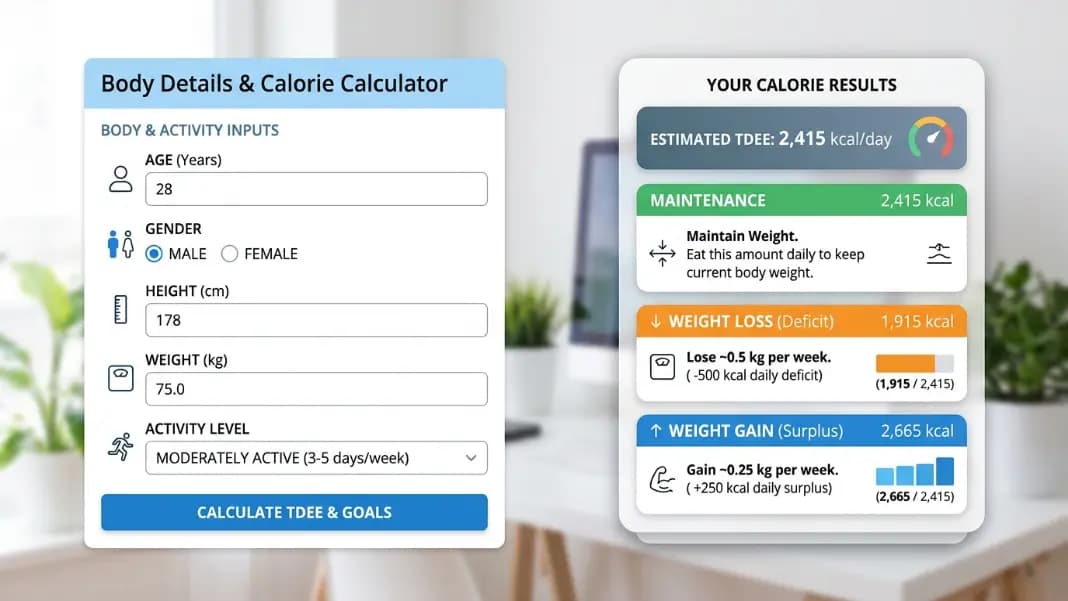
Your actual calorie needs come from five specific inputs: your weight, height, age, sex, and activity level. A calorie calculator that uses all five produces a personalized estimate that is far more useful than any generic recommendation. Understanding how that calculation works, and what to do with the result, is what this guide covers.
What a calorie is
A calorie is a unit of energy. In nutrition, the term technically refers to a kilocalorie: the amount of energy needed to raise the temperature of one kilogram of water by one degree Celsius. When food labels say a product contains 250 calories, they mean 250 kilocalories. The distinction rarely matters for practical purposes because nutrition consistently uses the larger unit, but it explains why a small amount of food can contain a large number of "calories."
Energy in food is stored in macronutrients. Carbohydrates provide 4 calories per gram. Protein provides 4 calories per gram. Fat provides 9 calories per gram. Alcohol provides 7 calories per gram. Your body extracts this energy through digestion and uses it to power everything from cellular repair to muscle contraction to keeping your body at a stable temperature.
When you consume more energy than you use, the surplus is stored, primarily as body fat. When you consume less than you use, your body draws on stored energy to make up the difference. This fundamental relationship between intake and expenditure is the basis of all calorie-based dietary approaches.
How calorie needs are calculated
Most calorie calculators work in two steps, and understanding each step helps you interpret the result correctly.
The first step is calculating your basal metabolic rate (BMR). This is the number of calories your body needs at complete rest to maintain basic biological functions: breathing, circulation, hormone production, cell repair, and maintaining body temperature. Your BMR represents your minimum energy requirement. Even if you did nothing but lie still for an entire day, your body would burn calories equal to your BMR just to stay alive.
The second step is adjusting BMR for activity. Your BMR captures resting needs only. Actual daily energy expenditure is higher because of movement, exercise, and the energy cost of digestion (called the thermic effect of food). Multiplying BMR by an activity factor produces total daily energy expenditure (TDEE), which is the number relevant for dietary planning. Our TDEE calculator guide explains how to find your exact maintenance number.
The Mifflin-St Jeor formula
The Mifflin-St Jeor equation is the most widely validated formula for estimating BMR from basic physical characteristics. It was published in the American Journal of Clinical Nutrition and is the formula underlying most reputable calorie calculators, including the one on ToolCenterHub.
The equations are:
For men: BMR = (10 × weight in kg) + (6.25 × height in cm) – (5 × age) + 5
For women: BMR = (10 × weight in kg) + (6.25 × height in cm) – (5 × age) – 161
As a worked example: a 32-year-old woman who weighs 68 kg and is 168 cm tall.
BMR = (10 × 68) + (6.25 × 168) – (5 × 32) – 161 BMR = 680 + 1,050 – 160 – 161 BMR = 1,409 calories
That is her resting daily calorie requirement. Her actual need depends on how active she is.
For a man of the same age, weight, and height:
BMR = (10 × 68) + (6.25 × 168) – (5 × 32) + 5 BMR = 680 + 1,050 – 160 + 5 BMR = 1,575 calories
The difference between the male and female formulas comes from average differences in lean muscle mass and metabolic rate between sexes. Individual variation within each sex can be as large as the difference between them, which is why even the best formula produces estimates rather than exact values.
Activity multipliers explained
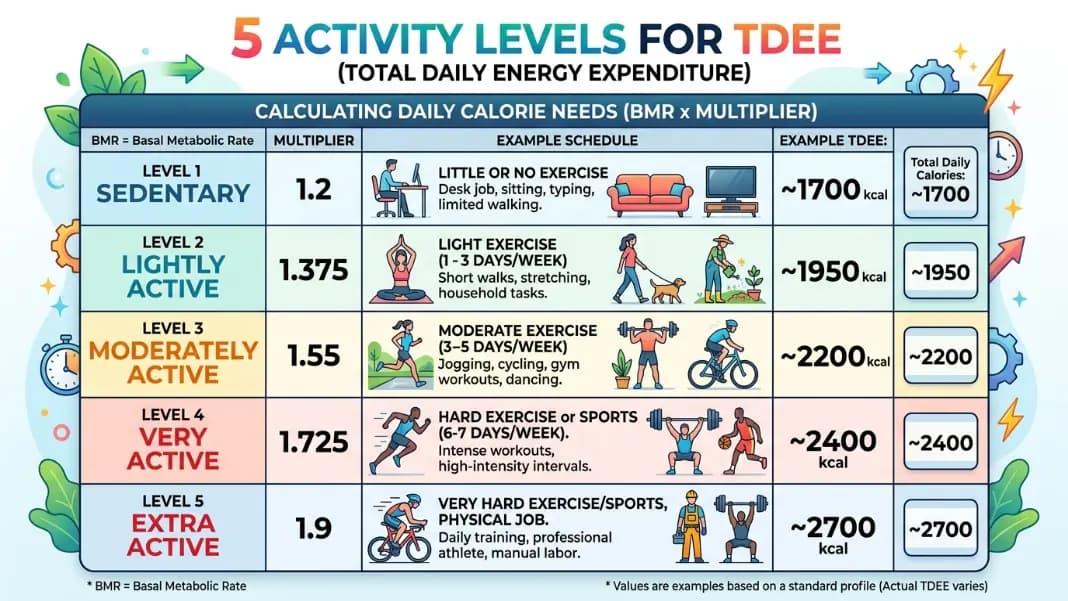
After calculating BMR, the activity factor converts it to TDEE. Choosing the right factor is as important as the BMR calculation itself. A wrong activity level inflates or deflates the result by several hundred calories.
Sedentary (×1.2): Primarily desk-based work, minimal structured exercise, limited daily movement. If most of your day is spent sitting and you do not exercise regularly, this is your category.
Lightly active (×1.375): A desk job with light exercise two to three times per week: a short walk daily, occasional gym sessions, or a light fitness routine. Most office workers who exercise occasionally fall here.
Moderately active (×1.55): Moderate exercise four to five days per week. Regular gym training, active commuting, or a job that involves standing and moving for significant portions of the day.
Very active (×1.725): Hard exercise six to seven days per week or a physically demanding job. Runners training for distance events, people in physical trades, or fitness professionals training clients and training themselves.
Extra active (×1.9): Twice-daily training, high-volume athletic programs, or jobs involving extremely heavy physical labor for extended periods. Athletes in intensive training blocks or manual workers with long, physically demanding shifts.
Using the woman from the earlier example at moderate activity: 1,409 × 1.55 = 2,184 calories per day to maintain her current weight.
At sedentary activity: 1,409 × 1.2 = 1,691 calories.
A single activity level category changes the result by 400 to 500 calories. Choosing honestly, and conservatively when unsure, produces a more accurate starting estimate.
Calorie targets for different goals
Once you have your TDEE, translating it into a daily dietary target depends on what you are trying to achieve.
Maintenance. Eat approximately your TDEE. If your weight is stable over two to three weeks at this intake, the estimate was accurate for you. If you are gaining weight despite targeting maintenance, your actual TDEE is somewhat lower than calculated. Adjust down by 100 to 150 calories and re-evaluate.
Weight loss. Eat below your TDEE consistently. A deficit of 300 to 500 calories per day is a practical starting point for most people. At 500 below TDEE, the expected rate of loss is approximately 0.45 kg (1 lb) per week when sustained over time. A deficit of 1,000 calories approaches 0.9 kg (2 lbs) per week, which most evidence-based guidelines treat as an upper limit for sustainable fat loss without excessive muscle loss.
Larger deficits produce faster initial results but increase metabolic adaptation, hunger, and the risk of muscle loss. A moderate, sustained deficit tends to produce better body composition outcomes than aggressive restriction.
Muscle building. Eat slightly above your TDEE. A modest surplus of 200 to 300 calories combined with progressive resistance training provides the energy needed for muscle synthesis without excessive fat accumulation. Large surpluses accelerate fat gain more than muscle gain and are usually counterproductive for body composition goals.
Using the calorie calculator
The Calories Calculator takes your age, sex, height, weight, and activity level and returns your estimated TDEE. Enter your current weight and the activity level that accurately describes your daily life. The result is your maintenance calorie target.
Use that number as your starting point for two to three weeks before adjusting. Track your actual intake against the target and compare against changes in your body weight. If your weight is not changing when your deficit suggests it should be, your actual TDEE is lower than the estimate; reduce the calculated target by 100 to 200 calories and observe for another two weeks.
If you are losing weight faster than expected and feeling fatigued or depleted, your TDEE may be higher than calculated, or your deficit is larger than intended. Increase intake slightly and monitor.
Why the calculator is an estimate, not a prescription
Calorie calculators apply population-level equations to individuals. The Mifflin-St Jeor equation was derived from studies of large groups and produces a good average estimate, but individuals vary from that average in ways no formula fully captures.
Metabolic rate varies with genetics. Two people of identical age, sex, height, and weight can have metabolic rates that differ by 15 to 20%. Hormonal factors, thyroid function, insulin sensitivity, and gut microbiome composition all influence how efficiently the body extracts and uses energy from food.
Metabolic adaptation adds further complexity. When calorie intake drops significantly below maintenance, the body reduces energy expenditure over time by decreasing non-exercise activity and lowering thyroid hormone activity. This is why the same deficit that produces rapid early results slows down as the weeks pass. It is not a failure of the approach; it is a predictable physiological response that requires periodic recalibration of your target.
The practical implication is to treat your calculated TDEE as a starting hypothesis, test it against real results over several weeks, and adjust based on what you observe.
Practical calorie tracking without obsession
Tracking calories precisely for every meal indefinitely is neither necessary nor sustainable for most people. A more practical approach is a structured tracking period followed by periodic check-ins.
During an initial two-to-three-week tracking period, measure portions by weight rather than estimating by volume. Most people significantly underestimate portion sizes when eyeballing, particularly for calorie-dense foods: nuts, oils, cheese, grains, and sauces. A week of weighing builds the reference points that make estimation more accurate afterward.
Log everything including drinks, cooking oils, condiments, and incidental snacking. These categories are most often omitted in casual tracking and can account for several hundred undocumented calories per day.
After the initial tracking period, the goal is awareness rather than precision. Knowing roughly how many calories are in your typical meals, recognizing when a day is running above or below your target, and periodically weighing food to recalibrate is a sustainable long-term practice.
Calories and macronutrients
Calorie counting treats all calories as equivalent, which is accurate for energy balance but incomplete for body composition and satiety.
Protein has a higher thermic effect than carbohydrates or fat, meaning more energy is used in digesting it. Higher protein intake also supports muscle retention during a calorie deficit and increases satiety relative to equivalent calories from carbohydrates or fat. For most people targeting weight loss, keeping protein intake at a minimum of 1.6 to 2.2 grams per kilogram of body weight produces better results than simply cutting calories without attention to the macronutrient split. Use the macros calculator to turn your calorie target into specific protein, carb, and fat targets.
The Macros Calculator takes a calorie target and breaks it into specific protein, carbohydrate, and fat targets based on your goals. For anyone focused on body composition rather than just weight, using the calorie calculator and the macros calculator together provides a more complete dietary framework than calories alone.
For a broader view of energy balance, the TDEE Calculator provides a detailed breakdown of how your daily expenditure is distributed across basal metabolism, activity, and the thermic effect of food. The full set of health tools for weight management, body composition, and fitness planning is in the Health section.