Calling on the same handful of students every lesson is a pattern that develops without intention. The students who raise their hands get called. The ones who do not, do not. Over a semester, some students answer questions dozens of times and others answer zero.
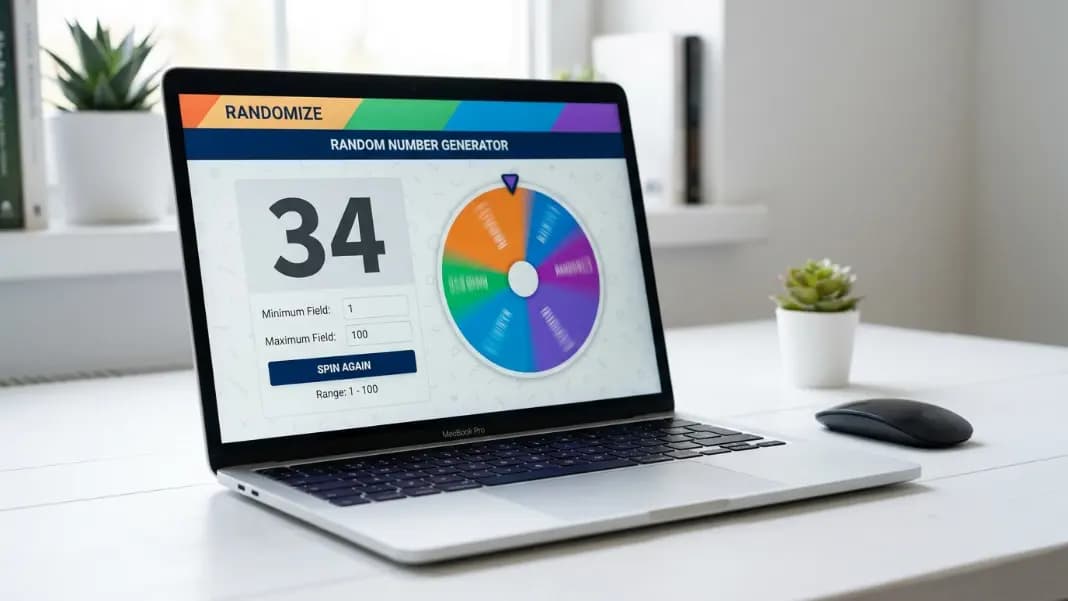
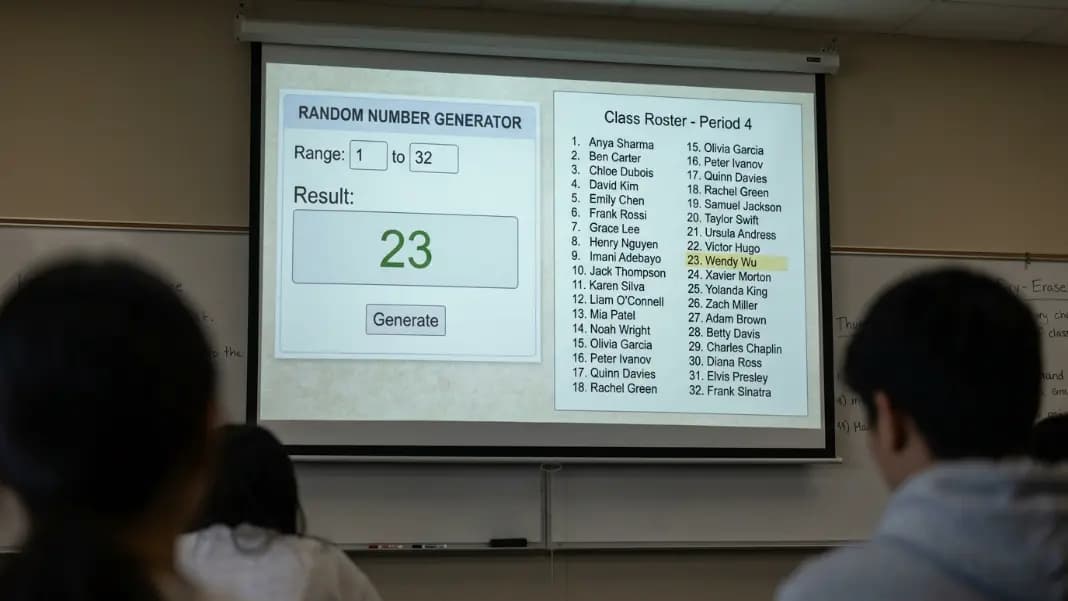
A random number generator breaks that pattern cleanly. Number your roster, run the generator, call on whoever's number appears. Every student knows they might be next, which changes how they engage with material even before they are selected.
That is the simplest classroom use. There are dozens more, from forming groups and assigning seats to creating math practice problems and demonstrating probability. This guide covers the most practical ways to use a random number generator in your teaching.
Why Randomness Works in the Classroom
Teachers who use random selection consistently report two effects: higher student attention and less resentment.
Higher attention because students cannot predict when they will be called. When selection follows a visible pattern (hand-raisers only, front-row first, alphabetical order), students who are not "next" disengage. When any student might be selected at any moment, attention holds across the room.
Less resentment because random selection removes the appearance of favoritism. Students are acutely aware of which peers receive more teacher attention. When selection is demonstrably random, complaints about fairness have nowhere to land. The number came up. That is the full explanation.
There is also a benefit for the teacher. Removing the cognitive task of choosing who to call on in the moment frees attention for the content of the lesson rather than the management of participation.
Education researcher Dylan Wiliam has described random cold calling as one of the most significant single changes a teacher can make to classroom participation. His analysis of voluntary hand-raising identifies a compounding problem he calls the "Matthew Effect," a term borrowed from sociology for systems where early advantage accumulates over time. In a hand-raising classroom, students who participate early receive more feedback, which builds their preparation and confidence, which makes them more likely to participate again. Students who do not raise their hands miss that feedback loop entirely, and the gap between the two groups widens across the term. Random selection interrupts the cycle by removing voluntary participation as the deciding variable. The result is a more accurate sample of what the class actually understands, rather than a sample of which students were already confident enough to raise their hands.
Calling on Students
The most direct classroom application. Number your class roster from 1 to the total number of students. Keep the list accessible during class, either on your desk or projected for the room to see.
When you want to call on a student, run the generator within that range and call on the student whose number appears.
A few practical decisions for this method:
With replacement vs without replacement. With replacement, every student is eligible every time. Some students may be drawn multiple times in a session while others are never drawn. Without replacement, you remove each drawn number from the eligible pool until everyone has been called once, then reset. No-replacement guarantees everyone participates at least once per cycle but requires tracking who has already been drawn.
For short activities covering five to ten questions, replacement is simpler to manage. For participation tracking across a full week or term, no-replacement with a simple checklist produces more even distribution.
Show the draw. Project the generator on screen when drawing a number, or at minimum let students see the result. When students can see the draw happen, they accept the outcome more readily. A hidden draw still looks like a teacher choice to students watching from their seats.
Think time. Some teachers give students 30 seconds to think before drawing the number. Others draw first to test immediate recall rather than reward preparation. Either approach is defensible depending on whether the goal is encouraging preparation or assessing understanding in the moment.
Forming Random Groups
Group formation by teacher selection creates social friction. Students interpret their placement as a judgment about status, ability, or friendship. Random formation sidesteps all of that and produces groups that students find harder to argue with.
For a class of 30 students divided into 6 groups of 5:
Option 1 (draw in sequence): Number students 1 to 30. Generate all 30 numbers without repeats. Assign the first five to Group 1, the next five to Group 2, and so on.
Option 2 (assign group numbers): Go down your roster in order. For each student, generate a number between 1 and 6 to assign their group. Adjust at the end if any group is significantly uneven by moving one student from the largest group to the smallest.
Option 3: Use the Teams Generator on ToolCenterHub, which divides a named list into equal groups automatically without manual number assignment.
Random groups work well for most project types. For activities that require specific skill balance (a debate, a mixed-ability task), assign groups manually and use random selection for the secondary decisions: which group presents first, which topic each group gets.
Seating Assignments
Random seating at the start of a term, or at defined intervals such as every half term, removes social clustering without the appearance of teacher interference in student friendships.
Assign each seat a number. Generate a number for each student in roster order and seat them accordingly. Post the map before students enter the classroom.
Rotating seats at regular intervals, rather than every single class, reduces the disruption of constantly re-learning proximity while still preventing the same social pairings from solidifying all term.
Random seating also gives you observational data. Students behave differently when they are not next to their social group. Some students who appear disengaged in their chosen seat become noticeably more focused when seated elsewhere.
Random Number Generator in Math Lessons
When the random output becomes the subject of the lesson rather than just a management tool, a number generator becomes genuinely instructional.
Arithmetic practice. Generate two numbers within a range matched to the skill level: 1 to 10 for basic addition facts, 1 to 12 for multiplication tables, 1 to 50 for mixed operations. Use the two generated numbers as operands for the practice problem. Every student gets different numbers, which prevents answer-sharing without requiring separate worksheets.
Statistics and data analysis. Generate 20 or 30 numbers within a set range. Have students record the results and calculate mean, median, mode, and range. Repeat with a different range and compare the statistical properties. This connects abstract formulas to actual generated data that students gathered themselves.
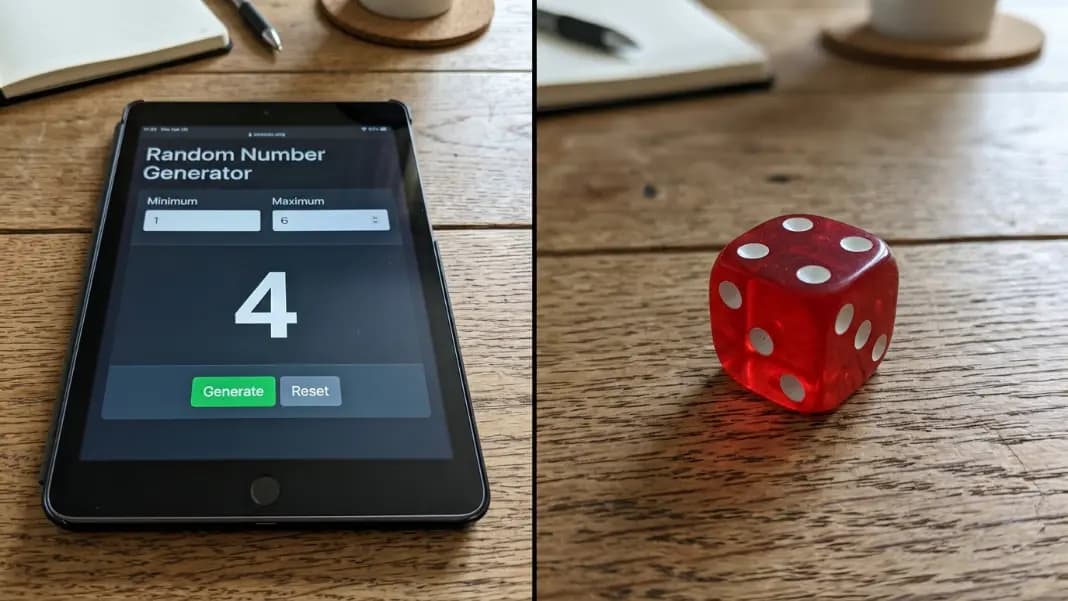
Probability demonstrations. Set the generator to a range of 1 to 2 to simulate a coin flip, or use the dedicated coin flip tool for a more visual binary outcome students can relate to immediately, or 1 to 6 to simulate a die. For classroom games involving physical dice, the dice roller makes individual die rolls more engaging with a tactile interface. Generate results 50 to 100 times and record each outcome. Graph the distribution and compare it to the theoretical probability. Students see directly how observed frequency approaches theoretical probability as sample size increases.
Number line and place value. Generate a random number and have students place it on a number line, round it to the nearest 10 or 100, or identify its digits in expanded form. Works as a quick mental math starter at the beginning of any lesson.
Factor and divisibility work. Generate a random number and have students identify its factors, determine if it is prime, find the next prime above it, or check divisibility by specific numbers. A reliable warm-up activity that takes two to three minutes and requires no preparation.

Presentation and Assessment Order
The order of student presentations affects perceived grades more than most teachers account for. Sequential evaluation causes judges (and teachers) to adjust their standards after each presenter, meaning early presenters are evaluated against a different baseline than later ones.
Random assignment of presentation order removes this bias from the process. Draw the order at the start of the presentation week rather than allowing sign-ups. Sign-up systems reliably produce the most prepared students going first and least prepared going last, reinforcing existing performance gaps.
For peer review and written work, the same principle applies. If you are assigning which student reviews which piece of work, a random draw prevents students from reviewing their close friends and from the social dynamics that follow when they do.
Games and Review Activities
Many classroom games benefit from random input as a structural element rather than just a teacher management tool.
Relay problem chains. Generate a starting number for each team. Teams perform a chain of arithmetic operations, each step building on the previous result. The random starting number means teams cannot share answers even if they are using the same operation sequence.
Review category selection. For quiz-style review, number your revision topics or categories. Generate a number to select which topic each round covers instead of letting teams choose strategically. This forces coverage of all material rather than allowing students to repeatedly choose their strongest topics.
Vocabulary practice. Number the vocabulary list. Generate a number to select which word a student must define, use in a sentence, or spell during a quick oral round.
Random story parameters. Generate a number to select a story starter, a character type, a setting, or a conflict from numbered prompt cards. Useful for creative writing tasks when students resist choosing their own starting point and need an external constraint to begin.
Managing Student Reactions
Most students accept random selection without objection, especially when the process is visible and consistent from the start of the term. The common responses worth having a ready answer for:
"I wasn't ready." This is the expected response, not a problem. Being called when not fully prepared is part of the learning function. A consistent reply that normalizes uncertainty as classroom participation keeps the lesson moving without singling the student out.
"You always pick me." With genuine random selection over many draws, some students will appear more often by chance over short periods. If this becomes a consistent pattern over weeks, switching to no-replacement sampling resolves it. The random number generator guide covers sampling approaches and how distribution evens out over larger numbers of draws.
Passes. A consistent policy applied to everyone works better than case-by-case judgment. Either passes are available to all students (with a follow-up requirement later in the lesson) or they are not available. Random selection loses its participatory function if students can consistently opt out.
For activities that extend beyond single number generation, such as picking names from a list or assigning a sequence of students to tasks, the name wheel spinner provides a visual alternative where names spin on screen. Some students respond better to the visual element than to a number appearing. Both tools serve the same purpose and the Random section on ToolCenterHub has the full set available without any setup.