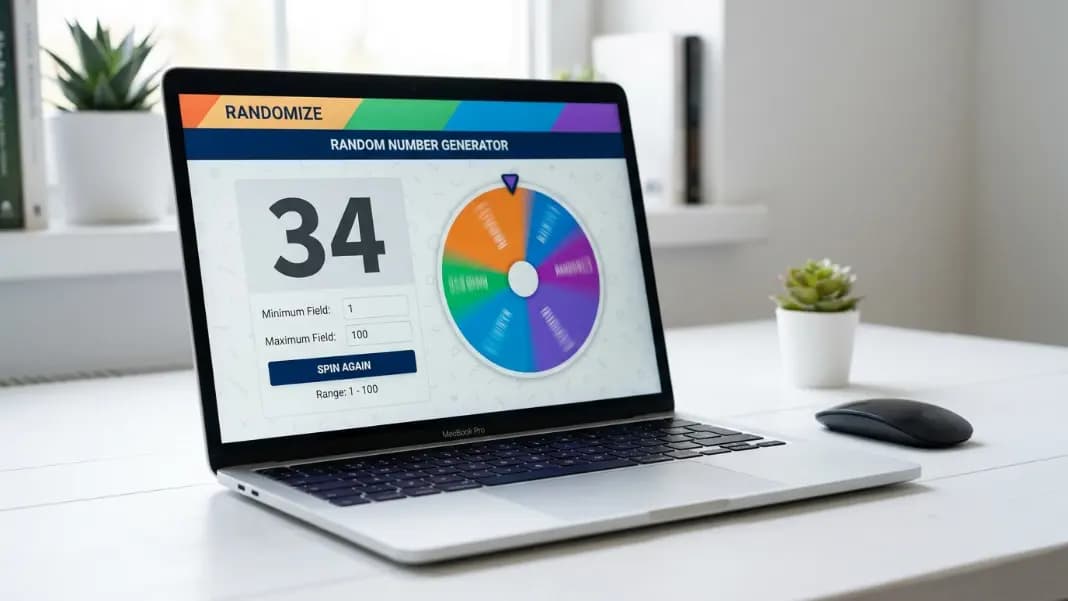
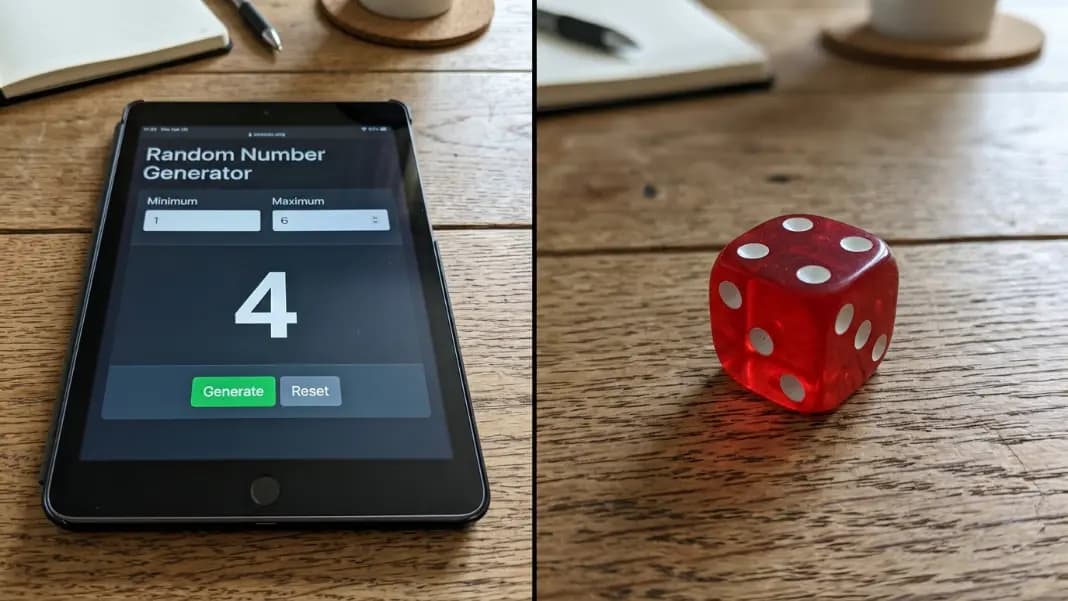
When you type "random number generator" into Google, the built-in result gives you one number at a time with no batch mode, no no-repeat option, and no results history. That is fine for a single one-off pick. It is the wrong tool for a classroom where you need fifteen unique student draws, a raffle where each ticket number must appear exactly once, or a weekly giveaway that needs a documented audit trail.
The random number generator handles any range, supports no-repeat mode, and uses crypto.getRandomValues() for cryptographically random output — the same entropy source browsers use for security operations.
This guide covers how random number generators actually work, the practical difference between pseudo-random and true random generation, and which situations each type is right for.
What is a random number generator
A random number generator is a system that produces numbers that cannot be predicted in advance. Each number in the output has an equal chance of appearing, with no relationship to what came before it and no pattern that an observer could use to guess what comes next.
The applications span a wide range. In statistics, random numbers are used to select unbiased samples from populations. In cryptography, they protect encryption keys, session tokens, and passwords. In games and simulations, they determine outcomes that no player can influence or predict. In everyday life, they pick giveaway winners, assign draft positions, settle disputes, and handle any situation where someone needs a fair result that no person chose.
The word "random" in everyday language means something feels unpredictable. In mathematics, it has a stricter meaning: every possible outcome must have an equal and independent probability of occurring, with no correlation between consecutive results. A properly built random number generator produces sequences that pass statistical tests designed to detect any hidden pattern, regularity, or bias.
How random number generators work
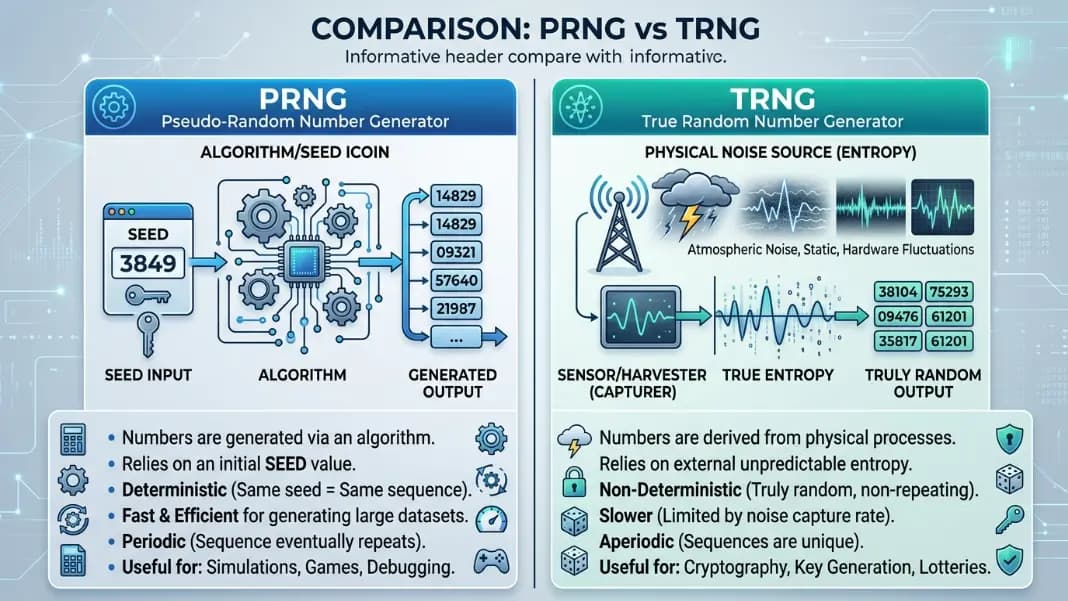
Most random number generators you encounter online are pseudo-random number generators, referred to as PRNGs. They use a deterministic mathematical algorithm to produce sequences of numbers that appear random but are actually determined entirely by a starting value called a seed.
The process works like this:
- A seed value is chosen, typically from a source like the current system time in milliseconds
- The algorithm applies a mathematical transformation to the seed
- The transformation produces a number, which is mapped to the desired range
- The output becomes the new seed for the next calculation
- The process repeats for each number requested
Common PRNG algorithms include the Mersenne Twister, which produces sequences of over 10^6000 numbers before repeating, and linear congruential generators, which are simpler and faster but have shorter periods. Both produce sequences that pass most statistical tests for randomness.
The fundamental limitation of a PRNG is that it is deterministic. If you know both the algorithm and the seed, you can reproduce every number in the sequence in order. This makes PRNGs unsuitable for cryptographic applications where security depends on unpredictability, but perfectly fine for games, simulations, statistical sampling, and any everyday decision.
Modern browsers provide crypto.getRandomValues(), which uses a cryptographic PRNG seeded from multiple hardware entropy sources including system event timing, thermal noise from hardware components, and operating system-level randomness. This produces numbers that are computationally indistinguishable from true random output for all practical applications.
True random vs pseudo-random number generators
The distinction between true and pseudo-random generation matters in specific contexts and is irrelevant in others.
Pseudo-random number generators (PRNGs):
- Use mathematical algorithms starting from a seed value
- Deterministic: the same seed always produces the same output sequence
- Extremely fast, producing millions of numbers per second
- Statistically uniform across the output range
- Suitable for: games, simulations, statistical sampling, giveaways, education, software testing
- Not suitable for: cryptographic key generation, secure session tokens, gambling systems with regulatory requirements
True random number generators (TRNGs):
- Draw entropy from physical phenomena: atmospheric noise, radioactive decay, thermal noise in electronic components
- Non-deterministic: no algorithm could reproduce or predict the output
- Slower and sometimes slightly biased, requiring statistical correction
- Suitable for: cryptographic key generation, regulated gambling, high-security applications
- Services like random.org use atmospheric radio frequency noise measured by radio receivers as their entropy source
For the large majority of everyday uses, a cryptographic PRNG with hardware-derived entropy is more than sufficient and practically identical to true random output. Picking lottery numbers, assigning classroom seats, choosing a draft order, simulating dice rolls: all of these work correctly and fairly with a high-quality PRNG.
The random number generator uses crypto.getRandomValues(), giving you cryptographic-quality randomness for any range you set.
What people use random number generators for
The practical uses for a random number generator are broader than most people expect.
Classroom and education: Teachers use random number generators to call on students without bias, assign presentation order, pick random groups, randomize quiz question order, and determine seating arrangements. A random generator removes any appearance of favoritism and makes the selection process transparent.
Giveaways and contests: Assigning each entry a number and then generating a random result within that range is the simplest and most defensible way to select a winner. It is reproducible, explainable, and leaves no room for the selection to be questioned.
Games and entertainment: Board game mechanics that require dice, card draws, or random events work directly with a number generator when physical components are not available. Fantasy sports leagues use random number generators to determine draft order. Escape room designers use them to generate puzzle codes.
Statistical sampling: Researchers selecting a representative sample from a larger population use random numbers to determine which individuals or records to include. This eliminates selection bias and makes the sample statistically valid. Survey organizations, academic researchers, and quality control processes all depend on this.
Software development and testing: Developers use random numbers to populate test databases with sample data, generate unpredictable input for stress testing, simulate realistic user behavior in load testing, and create mock data that looks realistic without using real personal information.
Security applications: Cryptographic systems use random number generation to create encryption keys, password salts, session tokens, one-time codes, and other values where predictability would be a security vulnerability. The randomness of these values is often the only thing standing between a secure system and a compromised one.
Draft and tournament order: Sports leagues, fantasy drafts, and tournament brackets use random number generators to assign positions fairly before the competition begins. Random seeding removes any advantage from knowing your position in advance.
For general decisions and selections, the free number generator handles any range instantly. When the decision happens in front of an audience and the theatrical element matters, the wheel spinner delivers the same random result with more visual engagement.
Random number generator without repeats
Standard random number generators produce each result independently, meaning the same number can appear multiple times in a sequence. This is correct and expected behavior for independent random draws.
When you need each number to appear at most once across a set of results, you need a no-repeat random number generator. This works by shuffling all numbers in the defined range into a random order and returning them one by one, ensuring each appears exactly once before any value is reused.
No-repeat generation matters in these situations:
- Assigning each person in a group a unique number or position
- Generating a random schedule where each time slot is used exactly once
- Creating a randomized order for a playlist, reading list, or presentation queue
- Running a raffle where each ticket number should only win once
- Setting up a tournament bracket where each seed position is unique
When the range is small and you need all values in a random sequence (for example, shuffling numbers 1 through 10), a no-repeat generator gives you a complete randomized list rather than a series of independent picks that might leave some numbers unused.
Random number generators in Google and other tools
Typing "random number generator" or "roll a dice" into Google returns a built-in random number generator directly in the search results. Google's generator lets you set a minimum and maximum and generates a single number. It is quick for one-off uses.
The limitations of the Google random number generator:
- One number at a time with no batch generation
- No no-repeat or multiple generation option
- No history of recent results
- Basic interface with no range presets
A dedicated browser-based generator gives you more control: generate multiple numbers at once, set any range, use no-repeat mode, and see a clear result without navigating away from what you are working on.
Excel also has a RAND() function that generates decimals between 0 and 1, and RANDBETWEEN(min, max) for integers. These work for spreadsheet tasks but recalculate every time the file changes, which makes them unreliable for capturing a fixed random result. A browser-based generator is simpler for any use case that does not already live in a spreadsheet.
Use a free online random number generator
The free random number generator runs directly in your browser. Set the minimum and maximum values, choose how many numbers to generate, enable no-repeat mode if you need unique results, and click generate.
The tool handles all standard use cases:
- A single number within any range
- Multiple numbers from the same range with or without repeats
- Any range from 0 upward, including large ranges for lottery-style picks
The generation uses crypto.getRandomValues(), drawing from hardware entropy sources. Nothing is sent to a server and no results are stored or logged.
The random tools section also includes a wheel spinner for visual selections, a yes/no wheel for binary decisions, a dice roller for standard gaming dice, a coin flip for two-outcome decisions, and a team generator for splitting groups. All tools are free, require no account, and run entirely in the browser.
Random number generators solve a specific problem: producing a fair, unbiased result that no one can predict or dispute. For that purpose, a quality online generator is as reliable as any physical method and considerably faster.