A non-disclosure agreement is one of the most commonly signed legal documents in business. Startups use them before pitching investors. Companies require them when bringing on employees who will access sensitive systems or data. Freelancers sign them before beginning client projects. Businesses exchange them before entering partnership negotiations.
Despite how frequently NDAs appear, many people are unclear on what they actually protect, what they do not cover, and what an agreement needs to include to hold up. This guide covers what an NDA is, the different types, the key elements every agreement must have, how employee and mutual NDAs work, and how to generate one for free when you need a straightforward template.
This article is for informational purposes only and does not constitute legal advice. For agreements involving significant intellectual property or complex legal requirements, consult a qualified attorney.
What is an NDA
NDA stands for non-disclosure agreement. It is a legally binding contract between two or more parties that creates an obligation to keep specified information confidential. The party receiving confidential information agrees not to share it with third parties, not to use it for purposes outside the agreement, and to protect it with reasonable care.
NDAs are also called confidentiality agreements, secrecy agreements, or confidential disclosure agreements. All of these terms describe the same fundamental document: a contract that defines what information is protected, who is protected by it, and what happens if someone breaks the agreement.
The core purpose of an NDA is to allow parties to share sensitive information with each other while maintaining legal protection if that information is later disclosed improperly. Without an NDA, sharing trade secrets, business plans, or proprietary processes creates no legal obligation for the recipient to keep that information private. The NDA generator creates a complete agreement from a short form without needing to draft anything from scratch.
NDAs are used in a wide range of situations:
- Before business negotiations where both sides share strategic or financial information
- When hiring employees who will access trade secrets, client data, or product development plans
- When engaging contractors or freelancers who will work with proprietary systems or information
- Before pitching a business idea or invention to investors or potential partners
- When discussing a potential acquisition or merger between companies
- Before sharing product prototypes, formulas, or unreleased technology
What an NDA covers and what it does not
An NDA protects information that is specifically defined as confidential within the agreement. The definition of confidential information is one of the most important parts of any NDA because courts interpret it narrowly: if information is not clearly covered by the definition, it may not be protected.
Information typically covered by an NDA:
- Trade secrets: proprietary processes, formulas, methods, or techniques
- Business strategies: expansion plans, pricing strategies, acquisition targets
- Financial information: revenue figures, costs, profit margins, financial projections
- Client and customer lists and related data
- Product development plans, unreleased designs, and technical specifications
- Software code, algorithms, and system architectures
- Employee compensation and HR data
- Marketing strategies and campaign plans
Information that NDAs typically cannot protect:
Information already in the public domain. If the information becomes publicly available through means other than the receiving party's breach, it loses its protected status. An NDA cannot prevent someone from discussing information they learned from a public source.
Information the receiving party already knew. If the recipient can demonstrate they already possessed the information before the NDA was signed, the agreement cannot restrict their use of it.
Information independently developed. If the receiving party develops the same information on their own without using the disclosed information, the NDA does not restrict that independent development.
Information required to be disclosed by law. If a court order, regulatory requirement, or legal obligation requires the receiving party to disclose information, the NDA cannot override that legal requirement. Most NDAs include a carve-out for legally compelled disclosure.
Types of NDA agreements
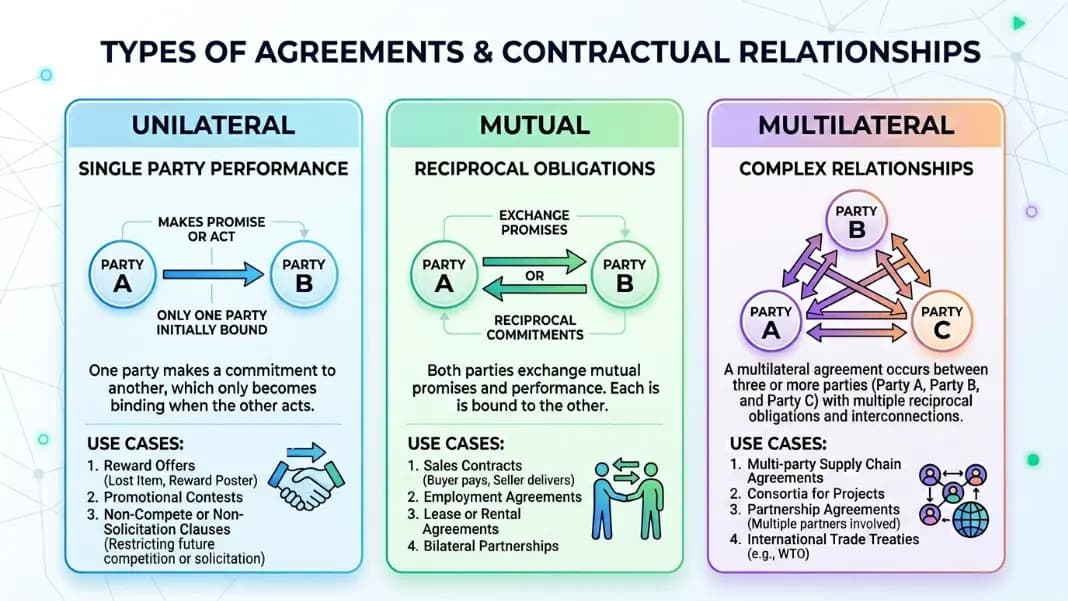
Not all NDAs work the same way. The structure of the agreement depends on how information is flowing between the parties.
Unilateral NDA (one-way)
In a unilateral NDA, only one party discloses confidential information and only the other party is bound by the confidentiality obligation. The disclosing party shares information; the receiving party promises not to share it.
This is the most common structure for:
- Employer-to-employee NDAs where the employer shares proprietary information
- Contractor NDAs where a client shares project-specific confidential information
- Inventor-to-investor NDAs where a person shares an unreleased idea
- Vendor NDAs where a company shares pricing or product information with a supplier
Mutual NDA (two-way)
In a mutual NDA, both parties disclose confidential information to each other, and both are bound by the same obligations. Each party is simultaneously a disclosing party and a receiving party.
Mutual NDAs are common in:
- Business partnership negotiations where both sides share strategic information
- Joint venture discussions
- Merger and acquisition due diligence
- Technology licensing negotiations
Multilateral NDA
A multilateral NDA covers three or more parties and eliminates the need for separate bilateral agreements between every combination of parties. One document covers all confidentiality obligations across the group.
This is used in:
- Consortium agreements between multiple companies
- Multi-party research and development projects
- Large business transactions involving several stakeholders
Key parts of a non-disclosure agreement
Every NDA has several standard sections. Each serves a specific purpose, and leaving any of them out can create gaps that make the agreement harder to enforce.
Parties: The full legal names of everyone involved in the agreement. For companies, the legal entity name (not just a trade name) should be used.
Definition of confidential information: A precise description of what is covered. This can define information by type (written, oral, electronic), by subject matter, or by a combination. Many NDAs include a statement that information must be marked or identified as confidential at the time of disclosure to be covered.
Exclusions: The categories of information not covered by the agreement, typically including information already public, independently developed, or already known to the recipient.
Obligations of the receiving party: What the recipient must do: keep the information secure, not share it with third parties, not use it for purposes outside the agreement, and limit internal access to only those who need it.
Permitted disclosures: Circumstances where disclosure is allowed, such as disclosure to lawyers or accountants bound by their own professional confidentiality obligations, or disclosure required by law.
Duration: How long the obligations last. Many NDAs run for two to five years. Trade secret protections sometimes run indefinitely.
Consequences of breach: What remedies are available if the agreement is violated. Most NDAs allow for injunctive relief (a court order to stop the disclosure) and monetary damages.
Governing law: Which state or country's laws govern the agreement, and where disputes will be resolved.
Employee NDA agreements
Employee NDAs are a standard part of employment agreements in most industries. When employees access trade secrets, client information, product plans, or proprietary systems as part of their job, a written NDA creates a clear legal record of the confidentiality obligation.
Employee NDAs typically cover:
- Trade secrets and proprietary processes
- Client and customer information
- Business strategies and financial information
- Product development and unreleased features
- Internal pricing and compensation data
- Any other information the employer designates as confidential
A key question in employee NDAs is how long the obligation extends after employment ends. For general confidentiality, most NDAs run for a fixed period after termination, typically two to three years. For trade secrets, the obligation often continues indefinitely, since trade secret protection does not expire as long as the information remains secret.
Employee NDAs are distinct from non-compete agreements, which restrict where an employee can work after leaving. Non-competes have varying enforceability across different jurisdictions. An NDA does not restrict where someone can work; it only restricts what information they can share after they leave.
Many companies include the NDA as part of a broader employment agreement or have it signed separately during onboarding. Either approach is valid as long as both parties sign and the employee receives something of value in return, typically the job offer itself.
Mutual non-disclosure agreements
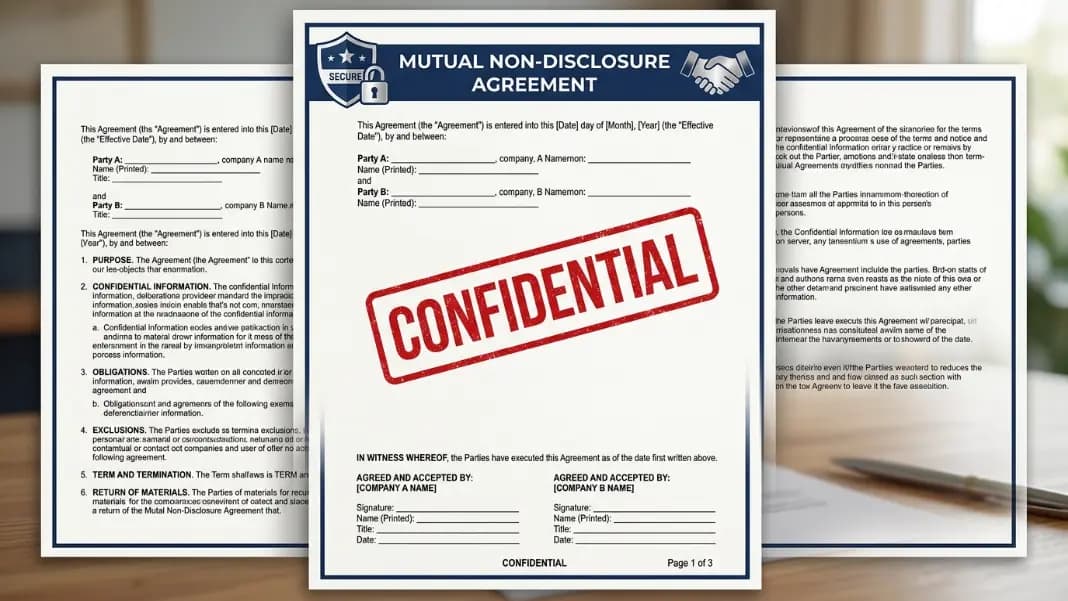
A mutual NDA is appropriate when both parties will be sharing confidential information with each other during a discussion or collaboration. Rather than signing two separate unilateral NDAs, one mutual agreement covers the obligations of both parties.
In a mutual NDA:
- Both parties are simultaneously the disclosing party and the receiving party
- Both parties owe the same confidentiality obligations to each other
- The definition of confidential information applies equally to both sides
- Duration and consequences of breach apply equally
The structure mirrors a standard NDA but uses symmetric language. Instead of "the Receiving Party agrees not to disclose..." the agreement says "each party agrees not to disclose the other party's confidential information..."
Mutual NDAs are common in early-stage business discussions where both sides need to share sensitive details to determine whether a partnership makes sense. Neither party wants to be the one without protection, and a mutual agreement puts both on equal footing.
One practical difference: mutual NDAs can be slightly more complex to draft because they need to work symmetrically, and in some cases the two parties may have different categories of information they want to protect. In these situations, the confidential information definition can be customized for each party while keeping the obligations the same.
How to write an NDA
For most standard situations, writing an NDA starts with a template and customizes it to the specific parties and information involved.
The process:
Step 1: Identify the parties. Determine who is signing: individuals, companies, or both. Get full legal names and confirm whether signatures will represent a company or an individual.
Step 2: Decide on the type. Is information flowing one way (unilateral) or both ways (mutual)? This determines the overall structure.
Step 3: Define the confidential information. Be specific enough to cover what you actually want protected, but not so broad that the definition becomes unenforceable. Overly broad definitions (such as "all information exchanged between the parties") can be challenged.
Step 4: Set the duration. Choose a timeframe that matches how long the information is actually sensitive. Two to three years covers most business negotiations. Longer terms or indefinite protection should be reserved for genuine trade secrets.
Step 5: Specify the obligations. State what the receiving party must do to protect the information: reasonable security measures, limiting access, no unauthorized use.
Step 6: Include the standard clauses. Governing law, dispute resolution, severability (so one invalid clause does not void the whole agreement), and the integration clause (stating this is the complete agreement on the subject).
Step 7: Get both parties to sign. An NDA is only binding when signed by all parties. Keep a copy of the signed agreement.
For routine situations involving standard confidentiality obligations, a template-based NDA covers all of these elements. Enter the party details, select the type, and the generator produces a complete agreement ready to review and sign.
Create a free NDA with an online generator
Hiring a lawyer to draft an NDA is appropriate for high-stakes situations: significant intellectual property, complex multi-party arrangements, or jurisdictions with specific legal requirements. For the majority of routine NDA situations, a properly structured template covers everything needed.
The documents section on ToolCenterHub includes a freelance contract generator, a privacy policy generator, and other business document tools alongside the NDA generator. If your business collects data from clients or website visitors, the privacy policy generator guide covers the legal documents you need to protect both yourself and your users. All are free, run in the browser, and require no account.
For situations that go beyond a standard template, including agreements involving significant intellectual property, international parties, or complex ongoing relationships, having a lawyer review the final document before signing is worthwhile. A generator gives you a solid starting point and makes the process significantly faster than drafting from scratch.
A non-disclosure agreement does not have to be complicated to be effective. A clear definition of what is protected, a reasonable duration, and signatures from all parties create a binding obligation. The free NDA generator handles the structure so you can focus on the details specific to your situation. For the other side of client work, billing your clients once the project is underway, the free invoice generator guide makes it straightforward.