BMI is the most widely used number in weight and health assessments. Doctors use it, fitness trackers display it, and public health agencies track it across entire populations. Understanding what your BMI means and how to calculate it accurately is the starting point for any honest conversation about weight, health, and where you sit relative to the standard ranges.
This guide covers the BMI formula in both metric and imperial, what the standard categories mean, how the number is interpreted differently for men and women, how age affects the reading, and where BMI falls short as a health measure. You can also use a free online BMI calculator to get your result in seconds without doing the math yourself.
What is BMI
Body mass index is a number calculated from your height and weight that places you within a standard weight category. The World Health Organization and the US Centers for Disease Control and Prevention use it as a primary screening tool for underweight, normal weight, overweight, and obesity in adults.
The key word is screening. BMI was designed as a population-level tool, not a diagnostic measure for individuals. At the population level it predicts health risk well. At the individual level it has real limitations, particularly for athletes, older adults, and people with body compositions that differ significantly from the population averages the formula was built on.
BMI does not measure body fat directly. It measures the relationship between your height and weight. Two people with the same BMI can have entirely different body fat percentages, muscle mass levels, and health profiles. That said, for most adults in most situations, BMI provides a useful and reproducible starting point.
How to calculate BMI
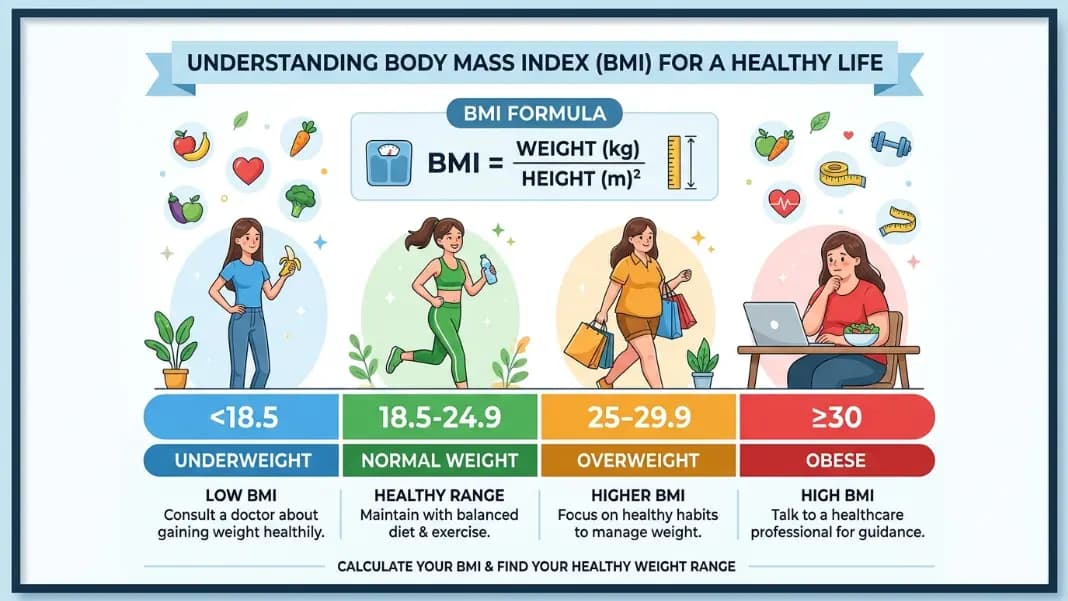
BMI uses one of two formulas depending on whether you measure in metric or imperial units.
Metric formula:
BMI = weight (kg) / height (m)²
A person weighing 70 kg with a height of 1.75 m: BMI = 70 / (1.75 × 1.75) = 70 / 3.0625 = 22.9
Imperial formula:
BMI = 703 × weight (lb) / height (in)²
A person weighing 154 lb with a height of 69 inches (5 ft 9 in): BMI = 703 × 154 / (69 × 69) = 108,262 / 4,761 = 22.7
Both formulas produce the same result when units are applied consistently. The 703 factor in the imperial formula is the conversion constant that accounts for the difference between unit systems.
To calculate BMI manually:
- Convert height to meters if using metric (divide centimeters by 100)
- Square that height value
- Divide your weight by the squared height
- The result is your BMI
The BMI calculator handles both metric and imperial automatically. Enter your height and weight and the result appears instantly, placed within the standard weight categories.
BMI chart and weight categories
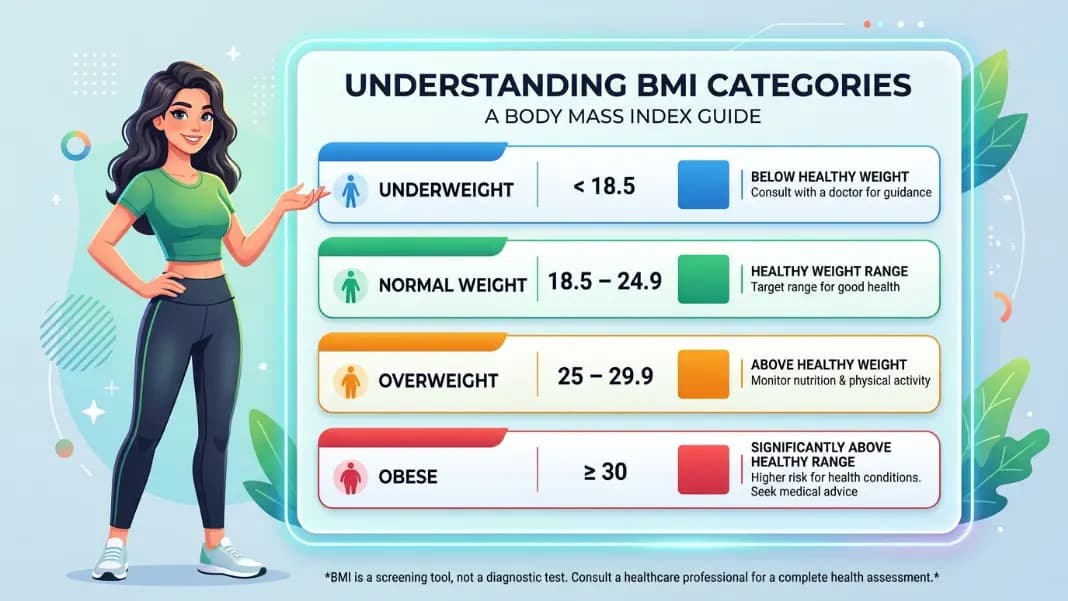
The standard BMI categories defined by the WHO and adopted by the CDC for adults 20 and older are:
| BMI Range | Category |
|---|---|
| Below 18.5 | Underweight |
| 18.5 to 24.9 | Normal weight |
| 25.0 to 29.9 | Overweight |
| 30.0 and above | Obese |
The obese category is sometimes broken down further:
| BMI Range | Obesity Class |
|---|---|
| 30.0 to 34.9 | Class 1 |
| 35.0 to 39.9 | Class 2 |
| 40.0 and above | Class 3 (severe) |
A BMI in the normal weight range (18.5 to 24.9) is associated with the lowest rates of weight-related health complications in large-scale studies, according to WHO and CDC population research. Overweight and obese ranges are associated with higher risk for type 2 diabetes, cardiovascular disease, hypertension, sleep apnea, and certain cancers. Below 18.5 is associated with nutritional deficiency, immune system impairment, and reduced bone density.
These are statistical associations at a population level. An individual with a BMI of 26 may be in excellent health. An individual with a BMI of 23 may have metabolic issues that BMI does not capture. The number tells you where you sit relative to the standard ranges; a healthcare provider can interpret what that means for you specifically.
BMI calculator for women
The BMI formula and category ranges are identical for women and men, but the interpretation carries meaningful differences.
Women naturally carry a higher percentage of body fat than men at the same BMI. This is not a health issue; it reflects essential fat that is hormonally necessary, including fat around reproductive organs and in breast tissue. At a BMI of 22, a woman typically has a higher body fat percentage than a man at the same BMI, and that difference is physiologically normal.
Research shows that women begin to see elevated cardiovascular risk at BMI levels starting around 25, which aligns with the standard overweight cutoff. For women specifically, waist circumference is often measured alongside BMI, because fat stored around the abdomen carries different health implications than fat stored in the hips and thighs.
What the ranges mean for adult women in practice:
- BMI below 18.5: Underweight. May indicate insufficient nutrition, hormonal disruption, or low bone density risk.
- BMI 18.5 to 24.9: Normal weight. The range most associated with healthy metabolic function in women.
- BMI 19 to 24: Many practitioners consider this the optimal range for most adult women.
- BMI 25 to 29.9: Overweight. Worth discussing with a healthcare provider alongside other health markers.
- BMI 30 and above: Obese. Associated with significantly elevated health risks across multiple systems.
BMI in postmenopausal women may need to be interpreted carefully, as body composition shifts significantly after menopause even when weight stays stable.
If you are tracking weight goals alongside your BMI, the calorie calculator provides daily calorie targets based on your height, weight, age, and activity level. Our daily calorie calculator guide walks through exactly how those targets are calculated.
BMI calculator for men
Men carry less essential body fat than women and typically have more muscle mass at any given weight. This creates one of the most commonly discussed limitations of BMI: muscular men with low body fat percentages can fall into the overweight category despite being in excellent physical condition.
A male athlete weighing 220 pounds at 6 feet tall has a BMI of 29.8, placing him in the overweight category. If that weight is primarily muscle, his actual body fat percentage could be around 12 to 15 percent, well within a healthy athletic range. BMI cannot tell the difference between a kilogram of muscle and a kilogram of fat.
For most non-athletic men, however, BMI remains a useful screening number. Large population studies consistently show that men with BMIs in the overweight and obese ranges have higher rates of cardiovascular disease, type 2 diabetes, and hypertension than men in the normal range.
BMI ranges for adult men:
- BMI below 18.5: Underweight. In men this can indicate low muscle mass, inadequate nutrition, or underlying health issues.
- BMI 18.5 to 24.9: Normal weight. Associated with the lowest health risk in most population studies.
- BMI 25 to 29.9: Overweight. For men without significant muscle mass, this range warrants attention.
- BMI 30 and above: Obese. Strongly associated with elevated metabolic and cardiovascular risk.
For men who want to check their target weight range in addition to their current BMI, the ideal weight calculator uses four established formulas to return a healthy weight range based on height and frame.
BMI by age
For adults 20 and older, the same BMI thresholds apply regardless of age. A 25-year-old and a 65-year-old use the same categories: below 18.5, 18.5 to 24.9, 25 to 29.9, and 30 and above.
In practice, age affects how the number should be read. After 40, most adults lose muscle mass progressively even if total body weight stays the same. This means a 60-year-old at a BMI of 23 likely has a higher body fat percentage than a 30-year-old at the same BMI. The BMI numbers are identical but the body compositions are different.
Some research suggests that slightly higher BMI values (up to 27) may not carry the same health risks for adults over 65 that they do for younger adults, and that being underweight in older age is associated with worse outcomes than being mildly overweight. The evidence here continues to develop and varies by individual health context.
For children and teenagers, the calculation works differently. BMI is calculated using the same formula, but the result is interpreted using age- and sex-specific percentile charts rather than fixed cutoffs. A BMI number that would be healthy for an adult can fall in a very different category for a 10-year-old. The standard adult ranges (18.5, 25, 30) do not apply to anyone under 20.
What BMI does not measure
BMI is widely used because it is free, quick, and reproducible. It is also genuinely limited as a measure of individual health. Understanding those limits helps you use it accurately.
It does not measure body fat. BMI measures the relationship between height and weight. A pound of muscle and a pound of fat weigh the same. BMI cannot distinguish between them. For this reason, an athlete with 15% body fat and a sedentary person with 35% body fat can have the same BMI.
It does not account for fat distribution. Visceral fat stored around internal organs in the abdominal region carries much higher cardiovascular and metabolic risk than fat stored in the hips and thighs. Two people with identical BMIs but different fat distribution patterns have different risk profiles. Waist circumference is a useful additional measure here.
It was developed from European population data. The standard thresholds do not apply equally across all ethnic backgrounds. Research has shown that people of Asian descent tend to carry higher body fat at the same BMI, which is why some health organizations use adjusted cutoffs: 23.0 for overweight and 27.5 for obese when applied to Asian populations.
It misses muscle mass entirely. Any person with above-average muscle development, whether through sports, manual labor, or strength training, will see an inflated BMI relative to their actual body fat and health status.
Use BMI as a starting point. Pair it with waist circumference, body fat percentage, blood markers, and clinical assessment for a complete picture.
Use a free online BMI calculator
Calculating BMI by hand means converting your height to the right units, squaring it, and doing the division. Most people do not want to do that every time they want to check their number. An online BMI calculator does the math in one step.
The free BMI calculator accepts height and weight in both metric and imperial units and returns your BMI alongside your weight category. No account required, no data stored, and the calculation runs entirely in your browser.
It is useful for:
- Checking your current BMI before a health appointment
- Tracking changes as you work toward a weight goal
- Quickly understanding where you fall in the standard categories
- Checking BMI for a family member using their height and weight
The health tools section also includes a TDEE calculator for daily energy needs (the TDEE calculator guide for a full breakdown of how total daily expenditure works), a body fat percentage estimator, a macros calculator, and a sleep cycle calculator. All tools are free, require no signup, and run client-side with no data transmitted.
BMI is a number, not a verdict. It tells you where you sit in the standard weight classification and gives you a starting point for a health conversation. What you do with it beyond that depends on your full health picture, your goals, and ideally input from a healthcare provider who knows your history.