Open any movie or TV show where a character is described as a hacker. Within seconds, you will see the same visual language: a dark terminal, cascading green text, scrolling code, and someone typing furiously while looking intensely concentrated. The hacker aesthetic is one of the most recognizable visual shorthand codes in popular culture, and it has remained essentially unchanged for thirty years.
Where did it come from, why does it persist, and what does actual hacking look like compared to the Hollywood version? This article covers all of it.
The origins of the green screen terminal
The green text on black background was not invented for dramatic effect. It is a direct reference to real technology from the 1970s and 1980s.
Early computer terminals used phosphor-coated cathode ray tube displays. The phosphor that produced the sharpest and most legible text at the time glowed green. These terminals, called green phosphor monitors or simply green screen terminals, were the standard computer interface before color displays became affordable and widespread.
The IBM 3270, the VT100, the Televideo 925, and dozens of other terminal models from this era all used green phosphor. If you worked with computers in the late 1970s or early 1980s, a black screen with green text was simply what a computer looked like.
By the time color monitors became standard in the mid-1980s, the green terminal had become associated specifically with serious, professional computing. It was the look of mainframes, business systems, and technical work. That association between green terminals and "real" computing became embedded in cultural memory.
How The Matrix fixed the visual language
While the green terminal aesthetic existed before 1999, The Matrix gave it a global cultural moment that cemented it permanently.
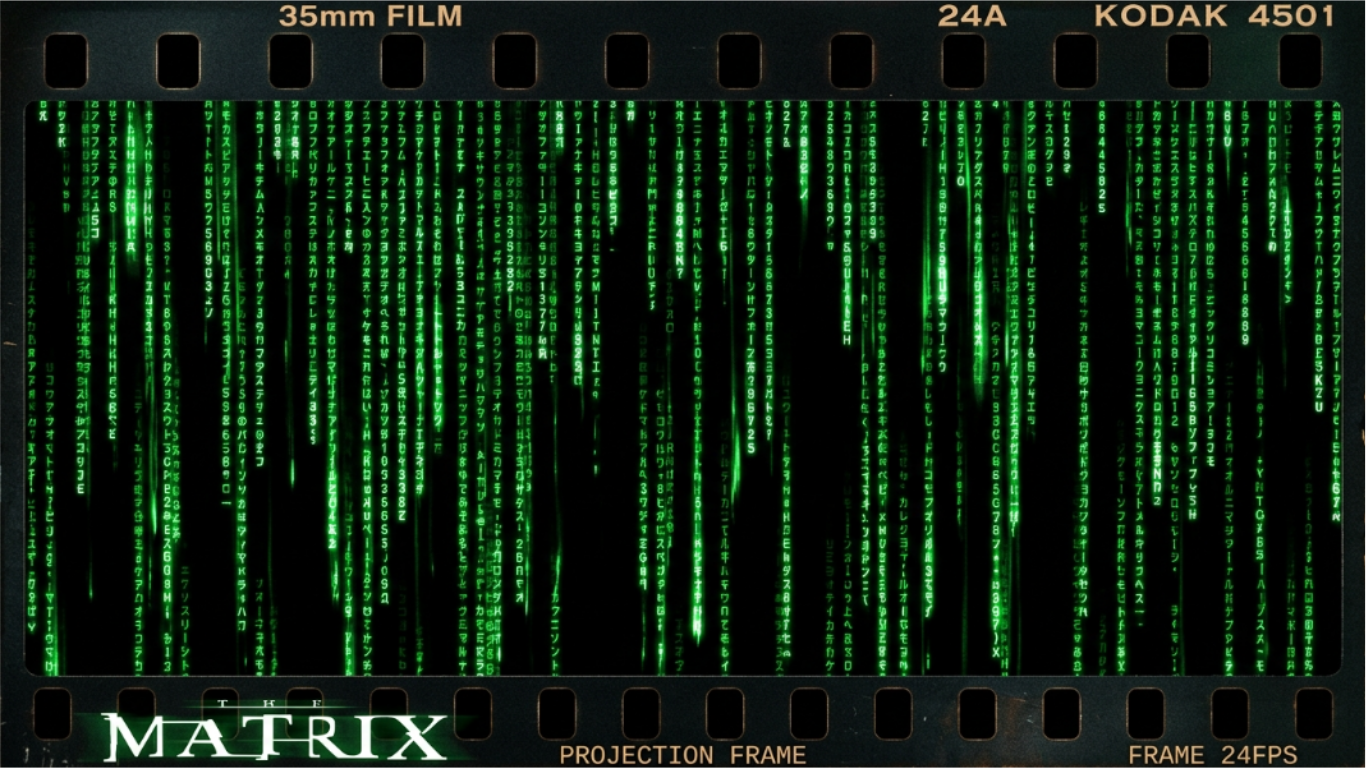
The film opens with cascading green characters on a black background, a visual that runs throughout the movie as a representation of the simulated reality that the story takes place in. The specific characters used in the cascade were a combination of katakana, half-width variant katakana, and numerical digits, creating a texture that read as simultaneously digital and exotic to Western audiences.
The visual effects team for The Matrix did not design this from scratch. They drew on the existing cultural association between green terminals and computers, then pushed it toward something more abstracted and dramatic. The falling character effect, which has no direct precedent in actual computer interfaces, became the defining image of the film.
After The Matrix, this visual language spread everywhere. The "matrix code background" became a screensaver, a stock image category, a wallpaper genre, and a Halloween costume accessory. More importantly for filmmakers, it became a reliable shorthand. Show a character in front of green cascading code and the audience immediately reads "hacker."
Why Hollywood keeps using this aesthetic
The persistence of the green code aesthetic in film and television is partly about cultural shorthand and partly about practical filmmaking.
Audience recognition: Viewers have been trained over decades to associate this visual with hacking and technical expertise. A filmmaker who wants to establish quickly that a character is a hacker can use three seconds of green terminal footage and the audience understands. This is efficient storytelling.
Visual contrast: Dark backgrounds with bright text are cinematically interesting. They create strong contrast, they read clearly on camera, and they look intentional rather than mundane. A realistic terminal showing a Python debugger or a Kubernetes cluster configuration is harder to film in a way that looks dramatic.
Plausible deniability: Generic-looking code and terminal output is difficult for general audiences to evaluate for accuracy. A filmmaker showing a real network intrusion tool might face scrutiny from technical viewers. Stylized, abstracted "hacker code" is obviously fictional, which paradoxically makes it easier to use without misrepresenting real tools.
Stock footage availability: There is an enormous library of matrix code, falling text, and hacker terminal stock footage available for productions that cannot afford custom effects. This availability reinforces the visual because it keeps appearing everywhere, which keeps audiences recognizing it, which keeps demand for the stock footage high.
Hacker aesthetics across different eras of film
The visual language has evolved even while the core elements have remained constant.
| Era | Dominant aesthetic | Example films |
|---|---|---|
| 1980s | Neon wireframe graphics, blinking cursors | Tron (1982), WarGames (1983) |
| 1990s | Green text terminals, 3D data visualization | Hackers (1995), The Net (1995) |
| 2000s | Matrix-style falling code, dark interfaces | The Matrix trilogy, Swordfish (2001) |
| 2010s | Stylized dashboards, holographic UI | Mr. Robot, Black Mirror |
| 2020s | Dark terminals mixed with real-looking tools | Zero Day, various streaming shows |
Mr. Robot (2015-2019) stands out as a significant departure. The show hired actual security researchers as consultants and depicted real tools: Kali Linux, actual exploit frameworks, genuine network monitoring output. The hacker aesthetic in Mr. Robot looks like a real terminal because it mostly is one. The show is an exception precisely because most productions do not invest in that level of technical accuracy.
What real hacking actually looks like
The gap between the Hollywood version and actual security research is significant.
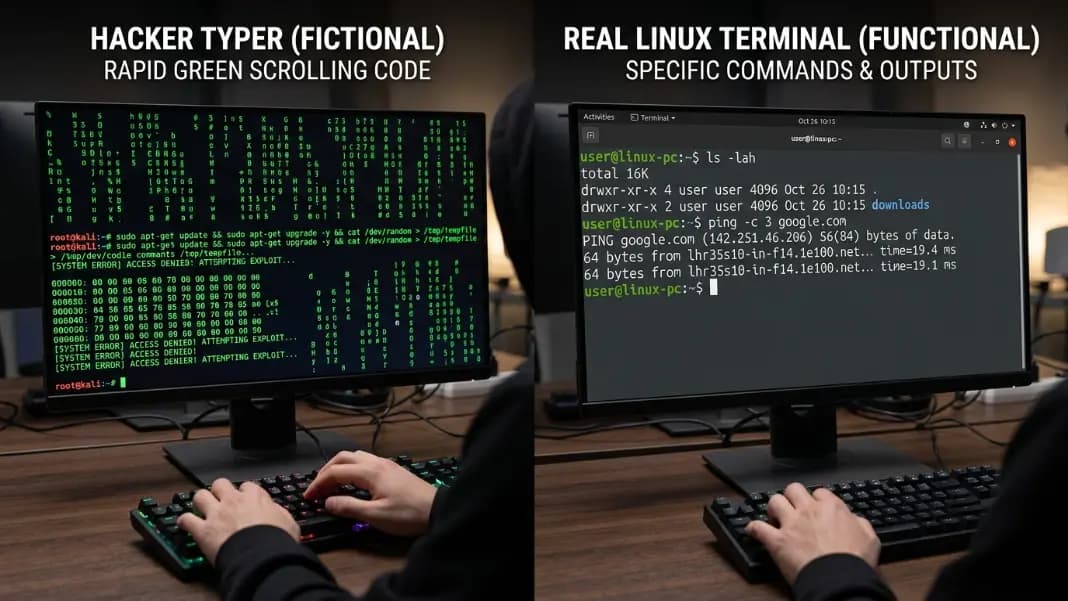
Real penetration testing and security research work happens primarily in terminals, but the output looks nothing like falling code or dramatic status messages. It looks like documentation, log files, command outputs, and error messages.
A typical session might involve running nmap to scan network ports, reviewing the output, looking up the software versions found against known vulnerabilities, writing or adapting exploit code, and carefully reviewing the results. The process is methodical, often slow, and requires careful reading of dense technical output.
The typing is not furious. Security researchers type carefully and deliberately because mistakes in a real engagement can have consequences. The dramatic, rapid typing of the Hollywood hacker is the opposite of good security practice.
The screens are often well-lit, with multiple documentation tabs open alongside the terminal. Real researchers reference documentation constantly. They are not memorizing thousands of commands and techniques, they are applying knowledge carefully while consulting references.
The hacker text style and glitch aesthetic
Alongside the green code visual, a related aesthetic emerged around the idea of glitched or corrupted text. Hacker text, sometimes called zalgo text or glitch text, involves characters that appear distorted, overlapping, or corrupted.
This aesthetic draws on the visual appearance of data corruption, character encoding errors, and display glitches that occur when binary data is interpreted incorrectly as text. The result looks like text that has been damaged or altered at a low level.
The glitch aesthetic is widely used in:
- YouTube channel branding for cybersecurity content
- Game titles in the hacking and dystopian genres
- Music video aesthetics for electronic and industrial music
- Social media imagery for tech and security brands
The common thread is the suggestion of systems operating outside their normal parameters. Glitched text implies that the rules of the display system have been broken, which maps directly onto the cultural idea of hacking as breaking the rules of computer systems.
How to recreate the hacker aesthetic yourself
You do not need video editing software or design tools to create a convincing hacker screen. If you want a complete walkthrough of the tools and setup involved, see our full guide on how to look like a hacker.
For the terminal approach, the Hacker Typer tool produces real Linux kernel C code output on a dark terminal background with every keypress. The output is from actual source files including network stack code, memory management functions, and system call implementations. It looks convincing because it is real code.
For the falling code style, there are browser-based tools that animate a matrix-style character rain. These are more for visual effect than for sustained interaction but serve well as a background or screensaver alternative. If you want your screen to look like active coding rather than falling characters, the fake code generator produces a scrolling stream of realistic-looking code that works well for videos, streams, and presentations.
For actual hacker text effects, a glitch text generator converts regular text into the distorted multi-character style that reads as corrupted or hacked. These are useful for profile names, channel branding, or titles in design work.
You can find several of these tools in the developer tools collection, which includes utilities for encoding, encryption, and other technical operations that have their own aesthetic appeal when running. For a full comparison of the available tools and which works best for each use case, the best hacking simulator tools guide covers each option in detail.
The aesthetics of "hacker code background"
Hacker code backgrounds, meaning static or animated images of code or terminal output used as wallpapers or presentation backgrounds, have become their own distinct visual category.
The most common versions are:
Matrix rain: Falling katakana and numerical characters on a black background. The most recognized version of the aesthetic.
Terminal dump: A screenshot or rendering of actual terminal output, often from a real command like top or netstat, presented as a static image.
Source code overlay: Code from a real programming language, formatted and colored with syntax highlighting, presented at an angle or as a background texture.
Binary rain: A simplified version of the matrix rain using only 0 and 1 characters, which is technically more accurate as a representation of binary data even if it bears no relationship to how computers actually store or process data.
For content where you want to write on top of or interact with a hacker aesthetic background, the Hacker Typer approach works well because the background generates dynamically as you interact with it, giving you live footage rather than a static image.
For anyone using the aesthetic as a prank rather than a visual backdrop, the setup and timing matter just as much as the screen itself.
Why the aesthetic endures
The hacker aesthetic has survived nearly fifty years because it combines multiple powerful associations: the unknown (what does this code do?), the powerful (this person controls systems others cannot access), and the slightly dangerous (this might be something they are not supposed to be doing).
These associations are not accidental. They reflect real aspects of security research and system-level computing work. The gap between the Hollywood version and the real version is wide, but the underlying associations are genuine.
As long as there are systems that most people do not understand, there will be a visual language to represent people who do understand them. The green terminal has been doing that job for decades and shows no sign of being replaced.