Free NDA Generator Online
The free NDA generator creates a non-disclosure agreement between two parties with customizable duration, purpose, and jurisdiction. Choose a mutual NDA (both parties bound) or a one-way NDA (receiving party only). Suitable for employees, freelancers, startups, and business partnerships. Print or save as PDF. No account required.
"Confidential Information" means any non-public information disclosed by one Party (the "Disclosing Party") to the other Party (the "Receiving Party"), whether disclosed orally, in writing, electronically, or by any other means, that is designated as confidential or that reasonably should be understood to be confidential given the nature of the information and circumstances of its disclosure.
"Purpose" means the business purpose described between the Parties.
Each Party, as a Receiving Party, agrees to:
- Hold all Confidential Information in strict confidence and not disclose it to any third party without the prior written consent of the Disclosing Party.
- Use the Confidential Information solely for the Purpose and for no other purpose whatsoever.
- Protect the Confidential Information using at least the same degree of care used to protect its own confidential information, and in no event less than reasonable care.
- Limit access to the Confidential Information to its employees, officers, directors, contractors, advisors, and agents who (i) have a genuine need to know such information for the Purpose and (ii) are bound by confidentiality obligations at least as protective as those in this Agreement.
- Promptly notify the Disclosing Party upon becoming aware of any actual or suspected unauthorized disclosure or use of the Confidential Information.
These obligations apply to each Party in its capacity as a Receiving Party with respect to the Confidential Information of the other Party.
The obligations of Section 2 do not apply to information that the Receiving Party can demonstrate by written records:
- Is or becomes publicly available through no breach of this Agreement by the Receiving Party.
- Was rightfully known to the Receiving Party without restriction prior to disclosure by the Disclosing Party.
- Is rightfully received by the Receiving Party from a third party without restriction on disclosure.
- Is independently developed by the Receiving Party without use of or reference to the Disclosing Party's Confidential Information.
- Is approved for release in writing by an authorised representative of the Disclosing Party.
- Is required to be disclosed by applicable law, regulation, or court order, provided that the Receiving Party gives the Disclosing Party prompt prior written notice (to the extent permitted by law) and cooperates with any protective order sought.
Notwithstanding Section 2, the Receiving Party may disclose Confidential Information to the extent required by applicable law, regulation, stock exchange rule, or order of a governmental authority or court of competent jurisdiction, provided the Receiving Party:
- Provides the Disclosing Party with prompt written notice prior to such disclosure (to the extent permitted by law).
- Reasonably cooperates with the Disclosing Party's efforts to seek a protective order or other appropriate relief.
- Discloses only that portion of the Confidential Information that is legally required to be disclosed.
Upon the written request of the Disclosing Party, or upon the termination or expiration of this Agreement, the Receiving Party shall promptly:
- Return to the Disclosing Party all tangible materials containing or embodying Confidential Information.
- Permanently delete or destroy all electronic copies of Confidential Information in its possession or control.
- Certify in writing, upon request, that it has complied with the obligations of this Section.
The Receiving Party may retain copies of Confidential Information stored in automated backup systems or as required by applicable law, provided such retained copies remain subject to the confidentiality obligations of this Agreement.
This Agreement is effective as of July 16, 2026 and shall remain in effect for two (2) years from that date, unless earlier terminated by mutual written agreement of the Parties.
The confidentiality obligations with respect to Confidential Information disclosed prior to expiration or termination shall survive for the duration specified above.
Each Party acknowledges that any breach of this Agreement may cause the Disclosing Party irreparable harm for which monetary damages would be an inadequate remedy. Accordingly, in addition to all other remedies available at law or in equity, the Disclosing Party shall be entitled to seek injunctive relief and specific performance to enforce this Agreement without the requirement to post a bond or other security.
The remedies set forth in this Agreement are cumulative and not exclusive of any other remedies available under applicable law.
This Agreement shall be governed by and construed in accordance with the laws of the State of Delaware, United States, without regard to its conflict of laws principles. Any dispute arising out of or in connection with this Agreement shall be subject to the exclusive jurisdiction of the courts located in the State of Delaware, United States.
Entire Agreement: This Agreement constitutes the entire agreement between the Parties with respect to its subject matter and supersedes all prior understandings, agreements, and representations concerning confidentiality between the Parties.
Amendments: This Agreement may only be modified by a written instrument signed by authorised representatives of both Parties.
Severability: If any provision of this Agreement is held invalid or unenforceable, such provision shall be modified to the minimum extent necessary to make it enforceable, and the remaining provisions shall continue in full force and effect.
Waiver: No failure or delay by either Party in exercising any right under this Agreement shall constitute a waiver of that right. A waiver of any breach shall not constitute a waiver of any subsequent breach.
Counterparts: This Agreement may be executed in counterparts, including by electronic signature, each of which shall be deemed an original, and all of which together shall constitute one instrument.
No Licence: Nothing in this Agreement grants either Party any licence or right to any intellectual property of the other Party, except the limited right to use Confidential Information strictly for the Purpose.
NDA template: what a non-disclosure agreement covers
A non-disclosure agreement defines what information is considered confidential, who may receive it, what they may and may not do with it, and how long the obligation lasts. The essential clauses in any NDA template are: the definition of confidential information (what falls within scope), permitted disclosures (employees or contractors who need to know to perform their role), excluded information (anything that is publicly available, independently developed, or already known to the receiving party), the obligations of the receiving party, the duration of the confidentiality obligation, and the remedies available if the agreement is breached.
The NDA agreement template generated by this tool includes all of these standard clauses. The definition of confidential information can be set to a broad all-information standard or narrowed to specific categories listed in the agreement. Standard durations for commercial NDAs are one to three years. For trade secrets, some agreements include a perpetual obligation for specifically defined information categories alongside a fixed term for general confidential information, though enforceability of perpetual clauses varies by jurisdiction.
Mutual NDA vs one-way NDA: choosing the right format
A mutual NDA binds both parties equally: each agrees to keep the other's confidential information protected. This is the correct format when both parties will share sensitive information during the relationship, such as a merger negotiation, joint venture exploration, or a partnership evaluation where both sides reveal business strategies, financial data, or technical plans. A mutual NDA generator produces a document where both party names appear symmetrically in the confidentiality obligations.
A one-way NDA binds only the receiving party and is appropriate when the disclosure flows in a single direction. The most common case is a business sharing proprietary information with a contractor, employee, or vendor before work begins. The free NDA template generator supports both formats. Select mutual or one-way at the top of the form and the generated clauses automatically reflect the correct structure, party references, and obligation language for the type you choose.
NDA generator for employees, freelancers, and startups
Employee NDAs are signed at the start of employment to protect trade secrets, customer data, internal processes, and proprietary technology. An employee NDA generator typically produces a one-way agreement where the employer is the disclosing party and the employee is the receiving party. The scope of confidential information is broad and covers anything the employee learns during their employment. Duration clauses in employee NDAs often extend beyond the termination of employment to prevent ex-employees from taking confidential knowledge to competitors.
For freelancers, an NDA is signed before the client shares access to internal systems, codebases, unreleased product designs, or marketing strategies. A freelancer NDA generator output is a one-way agreement where the client discloses and the freelancer receives. The NDA is typically signed alongside or before the freelance service contract. For startups pitching to investors or exploring partnerships, a mutual NDA protects both the startup's unreleased technology and any confidential information the investor or partner shares in return. A startup NDA generator should include a clear purpose clause that limits the use of disclosed information to evaluating the specific opportunity.
NDA format: key clauses and what each one does
Understanding the standard NDA format helps you verify that a generated agreement contains everything it needs. The parties clause identifies the full legal names and roles of the disclosing party and the receiving party. The purpose clause states the specific reason the information is being shared, limiting the receiving party's use of the information to that purpose only. The confidential information definition determines the scope of what is protected. The obligations clause states exactly what the receiving party must and must not do with the information.
The exclusions clause is equally important: it lists the categories of information that fall outside the NDA's protection, typically information that is already publicly known, information the receiving party already possessed before signing, and information independently developed without using the disclosed information. The term clause sets the duration. The governing law clause specifies the jurisdiction whose laws apply and where disputes will be resolved. The remedies clause states that the disclosing party may seek injunctive relief (a court order to stop unauthorized disclosure) in addition to financial damages, which is critical because the harm from a disclosure is often difficult to quantify in money alone.
Business NDA: protecting trade secrets and intellectual property
For businesses, an NDA is often the first document signed before any substantive conversation. This includes discussions with potential acquisition targets, technology licensing negotiations, supplier evaluations where proprietary specifications are shared, and sales processes where detailed product roadmaps are presented to enterprise customers. A business NDA generator must produce a document that holds up in the jurisdictions where both parties operate, which is why the governing law clause is critical.
Trade secrets receive additional legal protection under laws such as the Defend Trade Secrets Act (DTSA) in the United States and the EU Trade Secrets Directive in Europe, but this protection only applies if you have taken reasonable steps to keep the information secret. A signed NDA is one of the most important steps you can take to demonstrate that reasonable care. Combine the NDA with internal access controls, employee training, and confidentiality markings on sensitive documents to build a strong trade secret protection posture. For businesses operating across multiple jurisdictions, pair the NDA with a terms of service and a privacy policy to cover the full range of legal documentation your business needs.
How to sign and execute an NDA document
After generating your NDA, save it as PDF using the print-to-PDF option. Send the PDF to the other party for review. Both parties should read the document carefully before signing, paying particular attention to the confidential information definition and the duration clause. If either party wants to modify a clause, note the requested change in writing and generate a new version rather than handwriting edits on the PDF, which can create ambiguity about which version governs.
Once both parties agree to the terms, each party signs the document. For in-person signing, print two copies, both parties sign both copies, and each retains one original. For remote signing, the PDF can be signed electronically using any e-signature tool; electronic signatures are legally valid under the ESIGN Act in the United States and eIDAS in the EU. Each party stores their signed copy securely. The NDA takes effect from the date of signing (or the effective date specified in the document), and disclosure of confidential information should not begin until signatures are in place from both parties.
How the NDA generator tool works
The NDA generator runs entirely in your browser. When you fill in the form fields and select the NDA type, the tool assembles the complete NDA document in real time. Your party names, confidential information scope, jurisdiction, and duration details never leave your device and are not stored on any server. There is no account required and no watermark on the generated document.
The output is a clean, structured NDA document formatted for immediate use. Use the print-to-PDF option to export a dated PDF suitable for electronic signature, physical signing, or filing in your records. You can regenerate the document at any time if either party requests a revision to the terms. For projects that require both an NDA and a service agreement, generate the NDA first, share it for signing, then create a freelance contract that references the NDA to keep both documents aligned.
Frequently asked questions
An NDA (non-disclosure agreement) is a contract where one or both parties agree to keep specified information confidential. One is needed before sharing information that would harm you if it became public: unreleased product plans, source code, client lists, financial projections, trade secrets, or any proprietary business information. NDAs are commonly signed before merger discussions, partnership evaluations, hiring contractors for confidential projects, and investor presentations.
A mutual NDA binds both parties equally: each agrees to keep the other's information confidential. This is used when both parties will share sensitive information, such as in merger negotiations or joint venture discussions. A one-way NDA binds only the receiving party and is appropriate when only one party is disclosing information, such as a client sharing proprietary project details with a contractor. Choose the type that matches the actual flow of information in your situation.
The confidential information definition is one of the most important clauses in an NDA. You can use a broad all-information standard that covers everything shared between the parties, or you can list specific categories such as source code, customer data, financial projections, product roadmaps, and trade secrets. A broad definition is easier to apply in practice; a narrow definition gives the receiving party more certainty about what they must protect. For most business NDAs, a broad definition with specific examples listed is the recommended approach.
Most commercial NDAs have durations of one to five years. Standard freelance NDAs typically run for two to three years from the date of signing or from the date of disclosure. For trade secrets that do not expire, some NDAs include perpetual confidentiality clauses for specifically defined information, combined with a fixed term for general confidential information. The NDA generator includes a duration field where you specify the term in years.
Yes. Freelancers regularly sign NDAs before receiving access to a client's internal systems, codebases, unreleased products, or business strategies. A one-way NDA where the freelancer is the receiving party and the client is the disclosing party is the standard format for freelance engagements. The NDA can be signed alongside or before the freelance contract. Some clients provide their own NDA; others ask the freelancer to generate one. This free NDA generator produces a document suitable for both scenarios.
An NDA restricts what a party can disclose or share. It does not prevent the receiving party from working in the same industry or starting a competing business. A non-compete agreement restricts the party from working for competitors or starting a competing business within a defined geography and time period. Non-compete agreements are separate contracts and are subject to strict enforceability limits in many jurisdictions, including near-total unenforceability in California. An NDA can coexist with a non-compete but the two serve different purposes.
A signed NDA based on a well-drafted template is generally enforceable in most jurisdictions when it meets the requirements of a valid contract: offer, acceptance, and consideration. The mutual exchange of the agreement itself constitutes consideration. The specific enforceability, available remedies, and jurisdictional requirements vary by location. For NDAs covering significant trade secrets or large financial exposure, having an attorney review and tailor the document to your jurisdiction is recommended.
For most standard business situations, a carefully drafted NDA template is sufficient without legal review. Freelance NDAs, contractor NDAs, and simple business partnership NDAs are routinely signed from generator output. However, for high-value transactions such as M&A discussions, venture capital term sheet negotiations, or employment NDAs that include non-solicitation clauses, legal review is strongly recommended. The generated NDA provides a solid, structured starting point that an attorney can tailor quickly and at lower cost than drafting from scratch.
Related articles
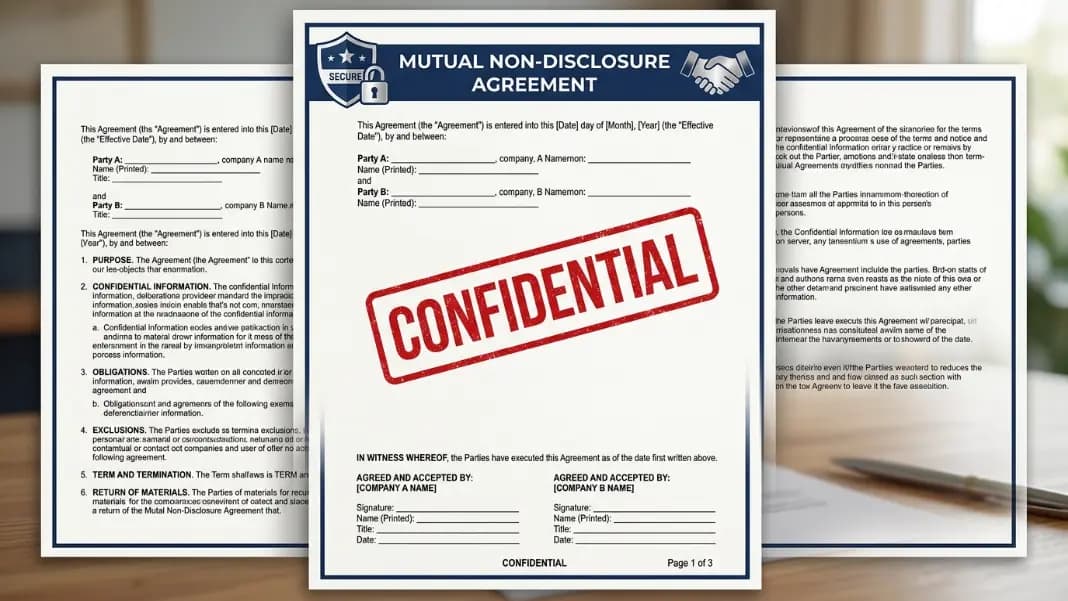
NDA Agreement: What Is a Non-Disclosure Agreement and How to Create One
Learn what an NDA agreement is, what it covers, the different types (mutual, unilateral, employee), what every non-disclosure agreement must include, and how to create one for free.
10 min read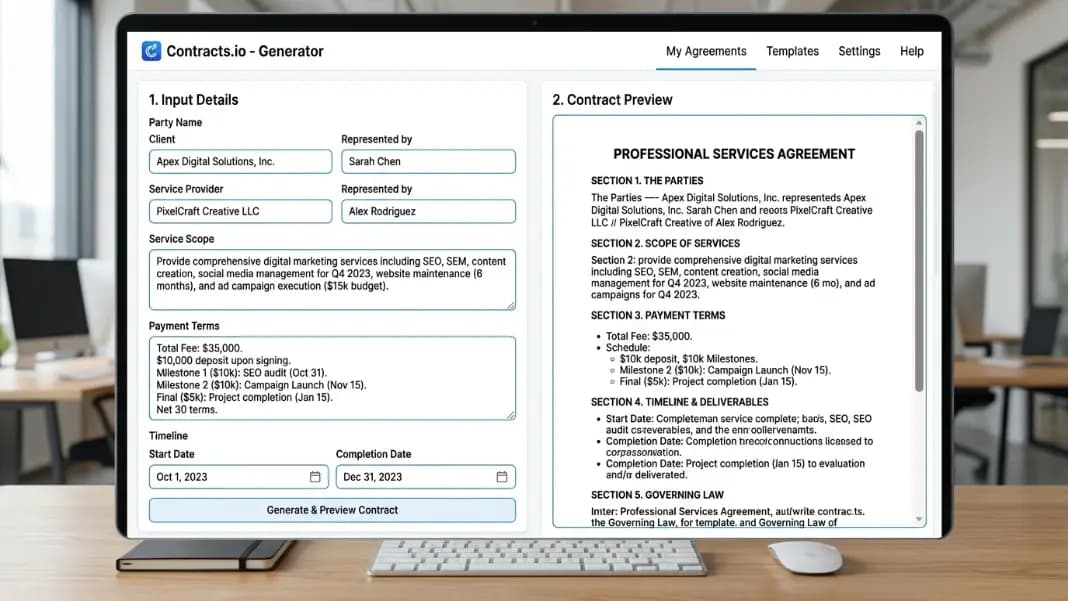
Contract Generator: What to Include and How to Create One Free
Learn how to create a freelance or business contract online using a free generator. Covers what to include, enforceable clauses, and when a template is enough.
11 min read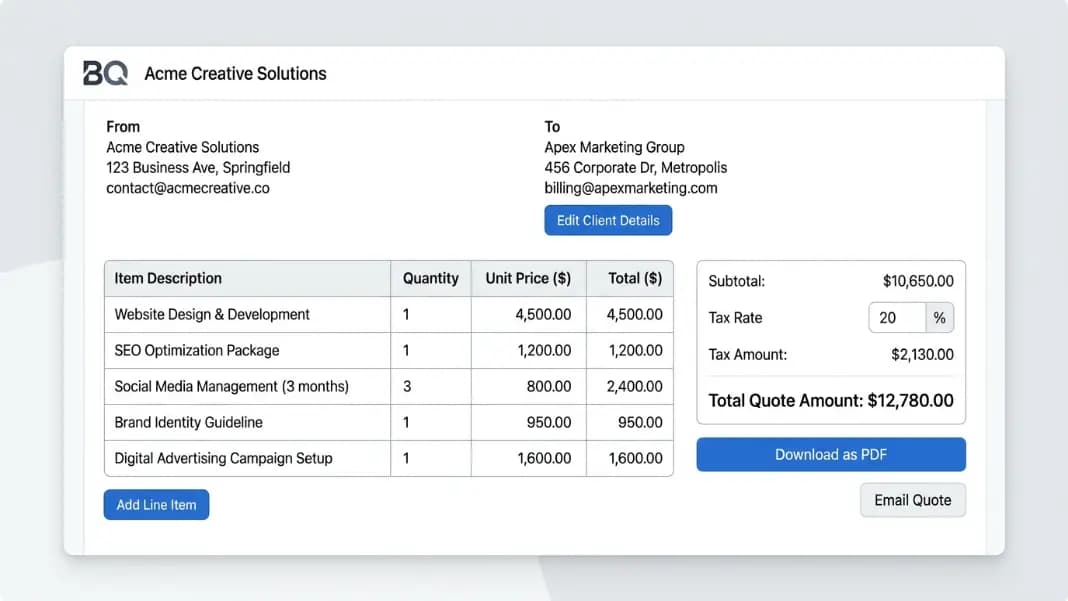
Free Quote Generator: Create Professional Business Quotes Online
Use the free quote generator to create business quotes online. Covers what every quote must include, quote vs invoice differences, and how to win more clients.
12 min read