Free Health and Fitness Calculators
Ten free online health calculators using established clinical formulas. BMI, TDEE, daily calories, macro split, ideal weight, body fat, sleep cycles, water intake, exact age, and pregnancy due date. All in your browser, no account required.
BMI Calculator
Calculate your Body Mass Index with metric or imperial units.
TDEE Calculator
Calculate your Total Daily Energy Expenditure.
Calorie Calculator
Calculate your daily calorie needs for any fitness goal.
Macro Calculator
Calculate your daily protein, carbs, and fat targets.
Ideal Weight Calculator
Find your healthy weight range using four established formulas.
Body Fat Percentage Calculator
Estimate body fat percentage using the US Navy method.
Sleep Cycle Calculator
Find the ideal bedtime or wake-up time by sleep cycle.
Water Intake Calculator
Calculate your daily hydration target based on weight and activity.
Age Calculator
Calculate your exact age in years, months, weeks, and days.
Pregnancy Due Date Calculator
Calculate your estimated due date from your last menstrual period.
10
Health calculators
kg / lb
Metric and imperial
Mifflin-St Jeor
TDEE formula
0
Data stored
WHO BMI classification (adults)
Same thresholds apply regardless of sex or age for adults 20 and over
| Category | BMI Range (kg/m²) | Health Risk |
|---|---|---|
Underweight | < 18.5 | Low weight-related risk; nutritional concerns |
Normal | 18.5-24.9 | Lowest associated health risk |
Overweight | 25.0-29.9 | Moderate risk of type 2 diabetes, hypertension |
Obese I | 30.0-34.9 | High risk across multiple chronic conditions |
Obese II | 35.0-39.9 | Very high risk; medical intervention advised |
Obese III | 40.0+ | Severely high risk; clinical obesity |
Which calculator fits your goal?
Most health goals need more than one calculator. Start with the recommended sequence for accurate results.
Find your TDEE first, then target 300-500 kcal below it for safe, sustainable fat loss
Eat 200-300 kcal above TDEE with protein at 0.7-1g per lb of body weight daily
All three together give a complete picture; BMI alone misses high-muscle individuals
Plan wake-up times at 90-minute cycle boundaries to avoid waking mid-cycle
Supports LMP, conception date, and IVF Day 3 or Day 5 embryo transfer methods
35 ml per kg of body weight baseline, adjusted upward for exercise and hot climates
Body composition calculators: BMI, body fat, and ideal weight
The BMI calculator gives you an instant weight-to-height ratio using the WHO classification system. While BMI is a widely used screening tool, it does not distinguish fat from muscle. The body fat percentage calculator uses the US Navy circumference method, a validated field approach requiring only a measuring tape, to estimate actual fat mass and lean mass. The ideal weight calculator shows your healthy weight range from four clinical formulas (Devine, Robinson, Miller, and Hamwi) simultaneously so you can see the full range rather than a single fixed target.
Using all three together provides the most complete picture of body composition: BMI gives a quick population-level reference, body fat percentage shows the actual fat-to-lean ratio, and ideal weight defines the target range from established medical formulas. For people with high muscle mass, body fat percentage is significantly more meaningful than BMI alone, since muscular individuals often sit in the overweight BMI range while having a healthy or athletic body fat percentage.
Nutrition calculators: TDEE, calories, and macros
The TDEE calculator is the starting point for any nutrition plan. It uses the Mifflin-St Jeor formula to estimate your basal metabolic rate and multiplies it by your activity level to calculate total daily energy expenditure. From your TDEE, the calorie calculator applies your goal (weight loss, maintenance, or muscle gain) to give you a target daily calorie intake. For weight loss, a deficit of 300 to 500 calories per day below TDEE produces approximately 0.3 to 0.5 kg of fat loss per week.
The macro calculator takes your calorie target and breaks it into daily protein, carbohydrate, and fat gram targets based on evidence-based ratios for your goal. For fat loss, a high-protein ratio (30 to 35% of calories) preserves lean mass during a caloric deficit. For muscle gain, moderate-to-high protein with a caloric surplus supports hypertrophy. For ketogenic diets, the macro calculator applies the standard keto split of roughly 70% fat, 25% protein, and 5% carbohydrates.
Sleep and hydration: optimizing recovery and performance
The sleep cycle calculator identifies bedtimes and wake-up times that fall at the end of a complete 90-minute sleep cycle, minimizing sleep inertia (the grogginess caused by waking mid-cycle during deep sleep). Most adults function optimally with 5 to 6 complete cycles (7.5 to 9 hours). The tool supports both directions: find the best bedtime for a required wake-up time, or find the best wake-up times from a planned bedtime.
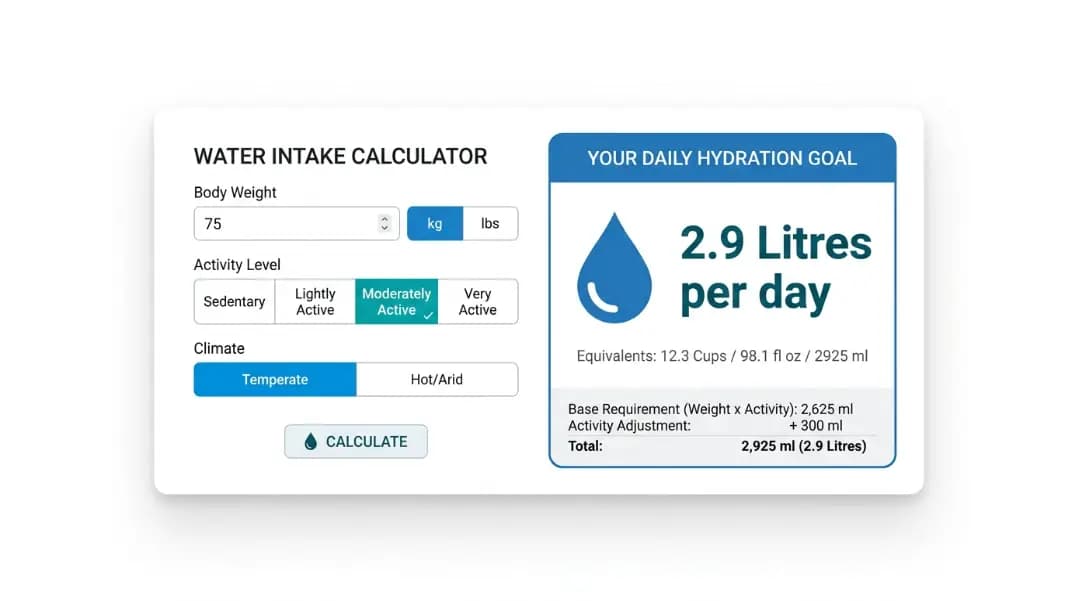
The water intake calculator computes your personalized daily hydration target based on body weight, activity level, and climate using the evidence-based formula of 35 ml per kg of body weight, adjusted upward for exercise and hot environments. Adequate hydration directly supports fat metabolism, cognitive performance, and workout recovery. For weight loss, slightly elevated hydration (40 ml per kg) helps the liver process stored fat more efficiently and reduces meal calorie intake when consumed before eating.
Age and pregnancy calculators
The age calculator computes your exact chronological age in years, months, weeks, and days from your date of birth, with bonus features including birthday countdown, day of week born, zodiac sign, Korean age, and an age gap calculator tab for comparing two people's ages. Chronological age is a required input for TDEE, calorie, and BMR calculations since the Mifflin-St Jeor formula includes age as a direct variable.
The pregnancy due date calculator estimates your estimated delivery date from your last menstrual period (LMP), conception date, or IVF embryo transfer date. It shows your current pregnancy week, trimester, and a full milestone timeline with key appointments including the NT screening window, anatomy scan, and glucose tolerance test. IVF due date calculation supports both Day 3 and Day 5 embryo transfer with the correct formulas for each.
How the health calculators are built
Every calculator on this page runs entirely in your browser using JavaScript. No data you enter (weight, height, birthdate, menstrual period date, or any other value) is sent to any server, stored in a database, or logged in any way. The calculations happen locally and exist only in your browser tab. Closing the tab clears all entered data. There is no account system, no cookie tracking of inputs, and no usage limits.
The formulas used are the same ones referenced in peer-reviewed literature and clinical guidelines: Mifflin-St Jeor for metabolic rate (preferred over Harris-Benedict for accuracy with modern populations), Hodgdon-Beckett for body fat (the formula behind the US Navy and Army body composition assessments), and Naegele's rule for due date estimation (in use since 1812 and validated in large obstetric datasets). All results include reference ranges so you can interpret your number in context, not just as an isolated figure.
Frequently asked questions
Yes. All 10 health and fitness calculators on ToolCenterHub are completely free with no account, no signup, and no usage limits. Results are calculated in your browser and nothing is stored.
The calculators use established clinical formulas: Mifflin-St Jeor for TDEE and daily calories, the US Navy circumference method for body fat percentage, and Devine, Robinson, Miller, and Hamwi formulas for ideal body weight. These are the same formulas used in clinical and research settings. Results are estimates and should not replace advice from a qualified healthcare professional.
Yes. All calculators that accept weight and height measurements (BMI, TDEE, calorie, macro, ideal weight, and body fat) support both metric (kg, cm) and imperial (lb, ft/in) inputs. Switch between units using the toggle at the top of each tool.
BMI (Body Mass Index) is a ratio of weight to height squared and does not distinguish fat from muscle. Body fat percentage measures the actual proportion of fat mass to total body weight. Two people with the same BMI can have very different body fat percentages depending on their muscle mass. BMI is a useful population-level screening tool; body fat percentage is more informative for individual body composition assessment.
Use the TDEE calculator to find your total daily energy expenditure based on your weight, height, age, sex, and activity level. This uses the Mifflin-St Jeor formula to estimate your basal metabolic rate (BMR), then multiplies it by your activity level. For weight loss, subtract 300 to 500 calories from your TDEE. For muscle gain, add 200 to 300 calories. The calorie calculator provides the same result with goal-specific outputs.
The TDEE calculator uses the Mifflin-St Jeor formula, which is the most accurate BMR estimation formula for the general population according to current evidence. For men: BMR = (10 x weight in kg) + (6.25 x height in cm) - (5 x age) + 5. For women: BMR = (10 x weight in kg) + (6.25 x height in cm) - (5 x age) - 161. BMR is then multiplied by an activity factor (1.2 to 1.9) to produce TDEE.
The US Navy circumference method has a margin of error of approximately 3 to 4 percentage points compared to DEXA scanning (the clinical gold standard). It requires only a soft measuring tape and is significantly more accessible than skinfold calipers or body composition scanners. For tracking trends over time, it provides reliable and consistent results if measurement technique stays the same across sessions.
Yes. All calculators provide estimates based on population-level formulas and are intended for general information. Before making significant changes to your diet, exercise routine, or health practices, especially if you have a medical condition, consult a qualified healthcare professional.
From the blog
All articles →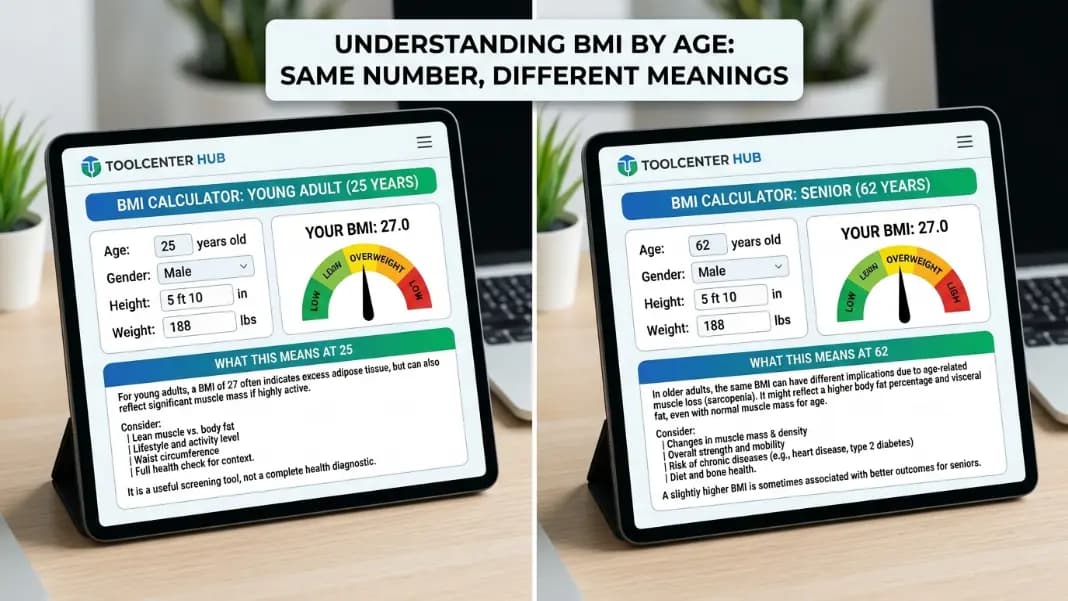
12 min read
BMI by Age: How Your Healthy Range Changes from 20 to 65
Learn how healthy BMI ranges shift from your 20s to 65, why the standard chart becomes less reliable after 50, and which numbers matter more as you age.

11 min read
Body Fat Percentage for Women: Healthy Ranges by Age Explained
Understand healthy body fat percentage ranges for women by age, why women carry more essential fat than men, and how to measure yours with a free calculator.
12 min read
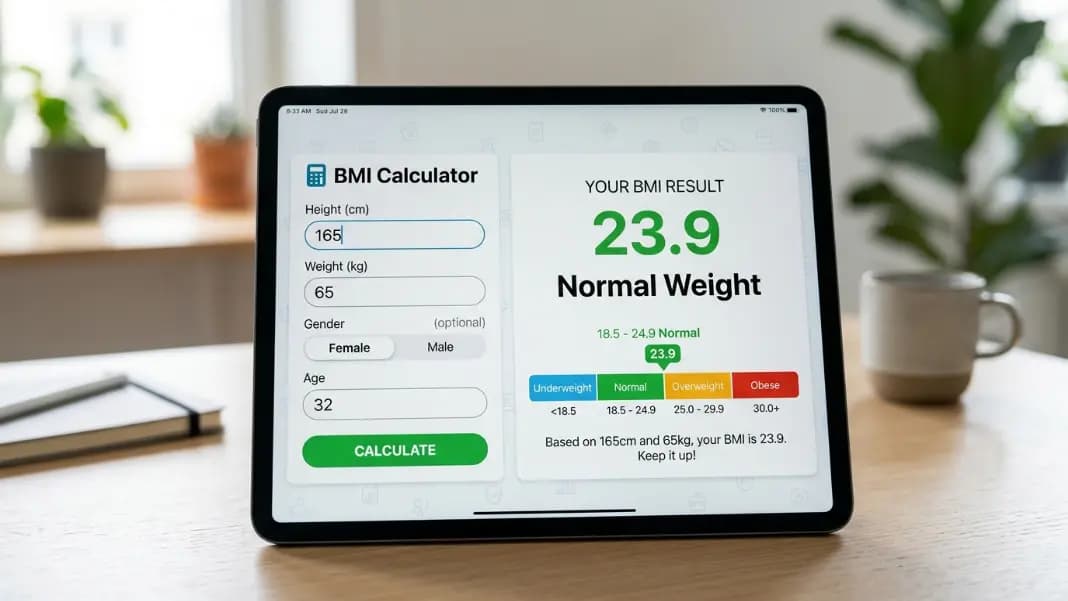
BMI Calculator for Women: Healthy Ranges by Age and What the Numbers Mean
BMI calculator for women: find your healthy range by age, understand your result in kg, and learn what the numbers mean for your body and health goals.
13 min read
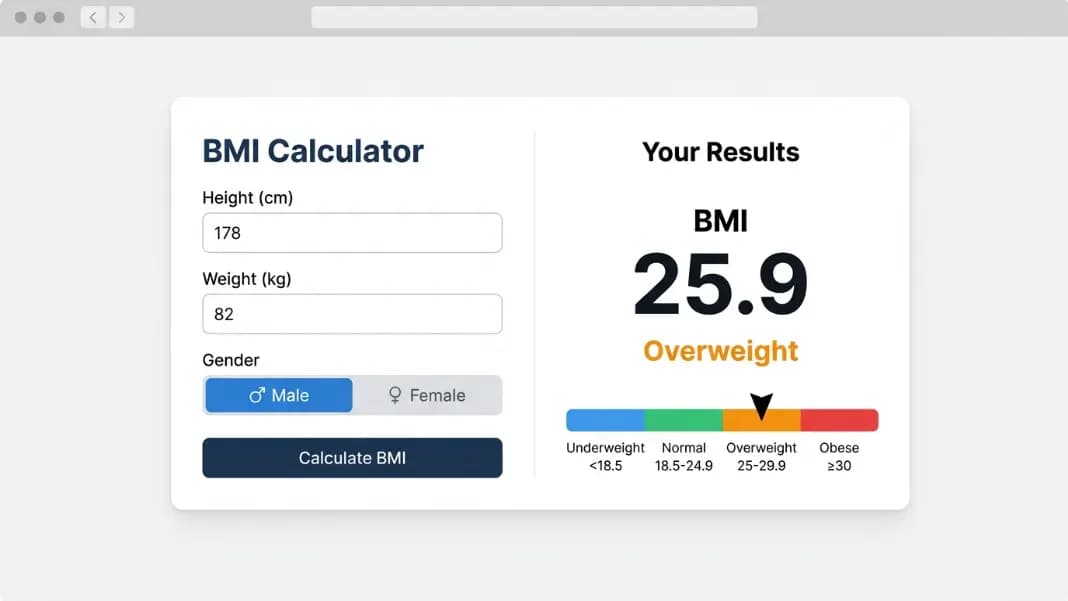
BMI Calculator for Men: Healthy Ranges, Age, and What the Numbers Mean
Use a BMI calculator for men by age and weight in kg. Covers healthy BMI ranges for males, how results shift with age, and when the numbers can mislead.
12 min read
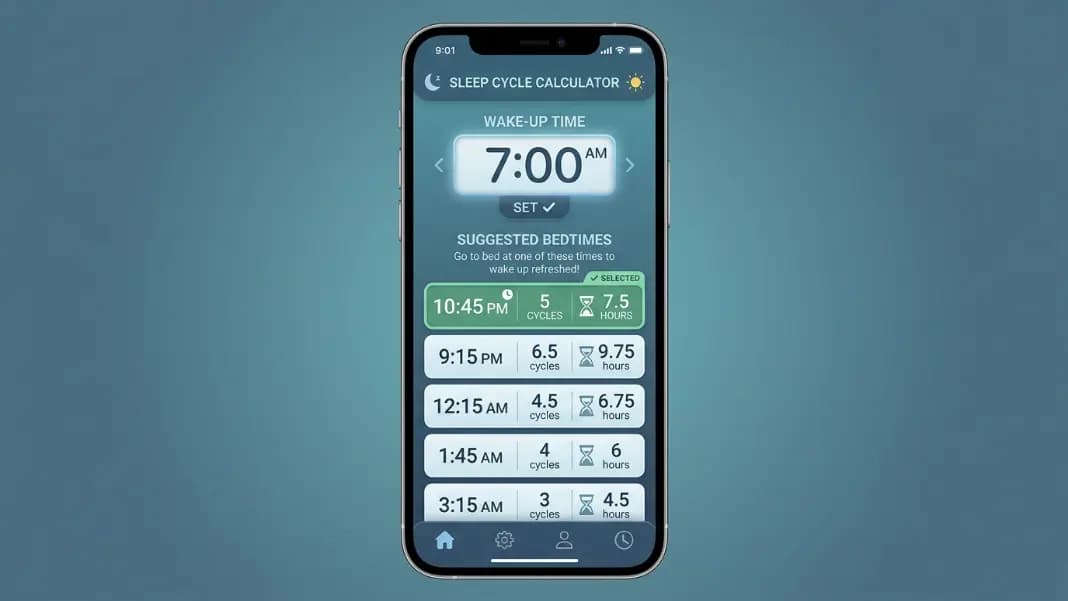
Sleep Cycle Calculator: Wake Up Refreshed Using 90-Minute Cycles
Calculate the best bedtime or wake-up time using 90-minute sleep cycles. Covers REM sleep stages, sleep debt, and why 8 hours still leaves you groggy.
13 min read
Water Intake Calculator: How Much Water Should You Drink Per Day
Calculate how much water you need per day based on body weight and activity. Covers the 35 ml per kg formula, exercise adjustments, and the hydration myth.