Most people who feel exhausted all day are sleeping seven or eight hours. The problem is rarely the amount.
Sleep is not a uniform rest state. It moves through a repeating sequence of four distinct stages, and the moment your alarm fires within that sequence determines whether you wake up sharp or drag yourself through the first two hours of the day. Eight hours of sleep interrupted mid-cycle can feel worse than six and a half hours that ends at a natural boundary.
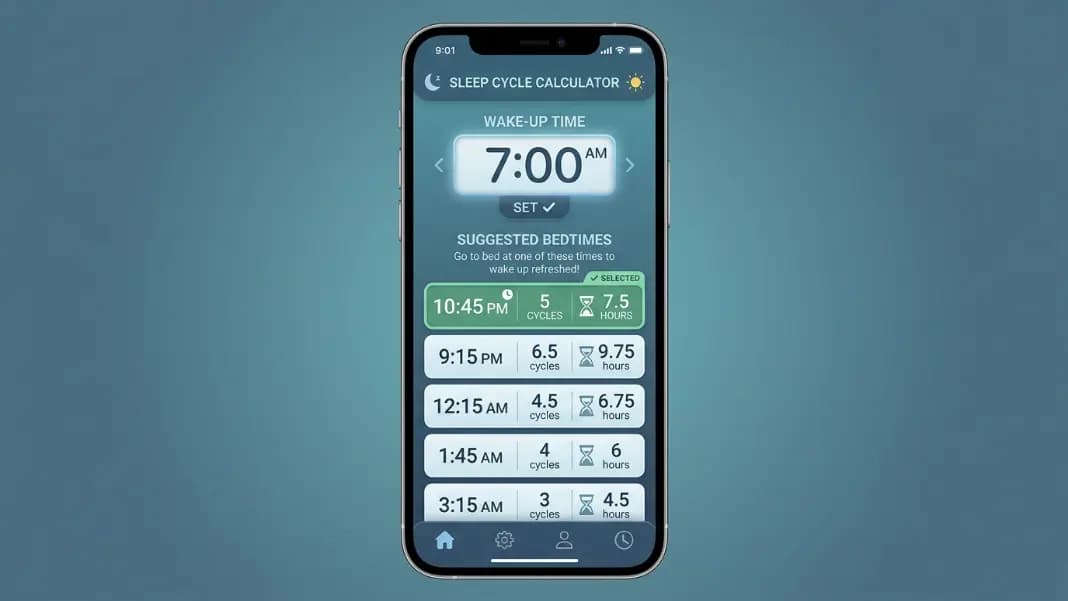
The sleep cycle calculator takes your intended wake-up time and returns the five best bedtimes based on 90-minute cycles. Enter your wake time and it outputs the exact times to aim for, each labeled with the number of cycles and total sleep duration. The calculation is immediate and requires no account.
This guide explains how sleep cycles work biologically, how to calculate the right bedtime from any wake-up time, what happens when REM sleep gets cut short, and why timing your sleep is usually more effective than simply trying to add more hours.
Why You Feel Groggy After a Full Night of Sleep
Grogginess after a complete night of sleep is almost always caused by waking mid-cycle, specifically mid-deep-sleep or mid-REM. The technical term is sleep inertia: a transitional state where the brain has not yet completed the shift from sleep neurochemistry to wakefulness.
Sleep inertia is not just tiredness. For the first 15 to 60 minutes after a mid-cycle wake, reaction time, working memory, and decision-making are measurably impaired. Studies comparing sleep inertia to total sleep deprivation have found that the first 30 minutes after an interrupted deep-sleep wake can produce cognitive impairment equivalent to being awake for 24 hours straight.
This is preventable. If your sleep ends at a cycle boundary, you are far more likely to be in Stage 1 or Stage 2, the two lightest stages. The transition from the final moments of one cycle back into Stage 1 is neurologically close to wakefulness, and waking there requires almost no adjustment period.
An alarm at 7:00 AM and one at 7:30 AM are not equivalent. One might fire mid-deep-sleep; the other might catch you in the light moment between cycles. That 30-minute difference matters more than the sleep it costs.
What a Sleep Cycle Is: The Four Stages Explained
A sleep cycle is one complete pass through four sequential stages. Each cycle lasts roughly 90 minutes on average, with individual variation between 80 and 120 minutes depending on the person, the night, and environmental factors like temperature and prior sleep debt.
Stage 1 (N1) is the entry to sleep. Muscle activity slows, eye movement decreases, and the brain produces theta waves. Stage 1 lasts 5 to 10 minutes. You can be woken easily and may not register you were asleep at all.
Stage 2 (N2) deepens sleep without reaching slow-wave territory. Heart rate slows, body temperature drops, and the brain produces sleep spindles and K-complexes. Stage 2 accounts for roughly 50 percent of total sleep time across a full night. Declarative memory consolidation, transferring information from short-term to long-term storage, is particularly active here.
Stage 3 (N3 or slow-wave sleep) is the most physically restorative stage. Delta brain waves dominate, growth hormone is released, and tissue repair occurs. Waking from Stage 3 produces the worst sleep inertia. This stage is the most disrupted by alcohol, elevated room temperature, and irregular sleep timing.
REM (Rapid Eye Movement) is the dreaming stage. Brain activity during REM closely resembles wakefulness. Emotional memory processing, creative integration, and procedural memory consolidation all occur here. The body enters atonia, a temporary muscle paralysis that prevents physically acting out dreams.
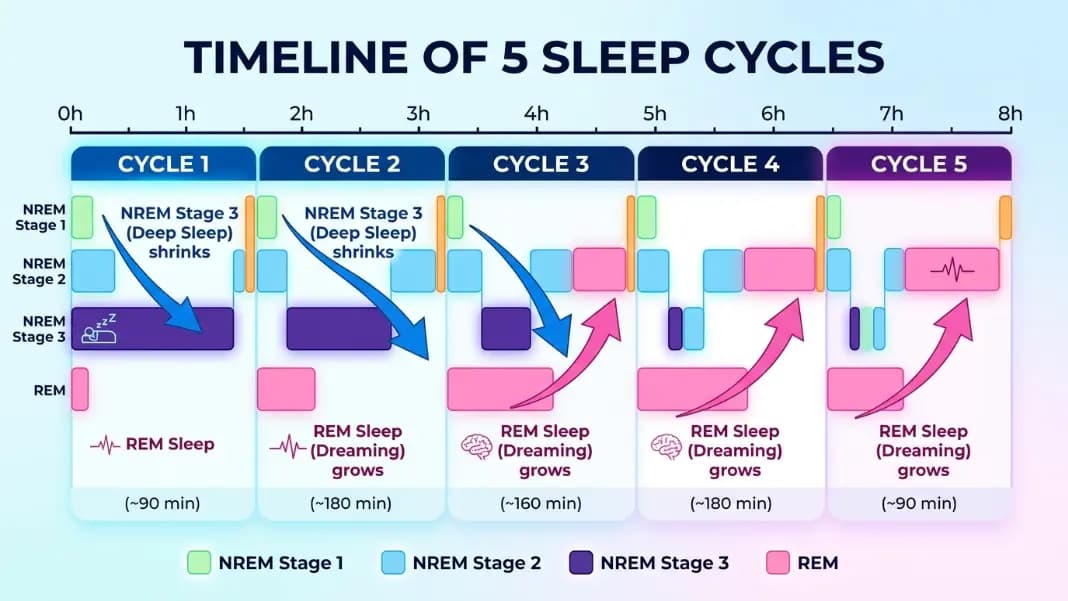
Early in the night, cycles contain more slow-wave sleep and shorter REM. As the night progresses, deep sleep decreases and REM periods grow longer. By cycles 4 and 5, most of the time is Stage 2 or REM. Cutting the last 90 minutes of sleep does not cost a little of everything. It costs disproportionately more of the longest REM periods.
How to Calculate Your Bedtime from Any Wake-Up Time
The calculation is straightforward: work backwards from your wake-up time in 90-minute increments, then subtract 15 minutes for sleep onset.
Most adults take 10 to 20 minutes to fall asleep after lying down. A 15-minute buffer is accurate enough for scheduling purposes.
Formula: bedtime = wake-up time minus (cycles x 90 minutes) minus 15 minutes
Reference bedtimes for a 7:00 AM wake-up:
| Cycles | Sleep duration | Bedtime |
|---|---|---|
| 5 | 7.5 hours | 10:45 PM |
| 4 | 6 hours | 12:15 AM |
| 3 | 4.5 hours | 1:45 AM |
| 2 | 3 hours | 3:15 AM |
| 1 | 1.5 hours | 4:45 AM |
The sleep cycle calculator generates this table automatically for any wake-up time. The 5-cycle option is the default target for any night where your schedule allows it.
One practical issue: the table assumes you actually fall asleep at the target time. If you lie down at 10:45 PM but spend 35 minutes on your phone, your first cycle starts closer to 11:35 PM and every cycle boundary shifts accordingly. Use the bedtime result as the point to put screens away, not the point to check them one last time.
How Many Sleep Cycles You Actually Need Per Night
Five complete cycles, or 7.5 hours including onset, is the evidence-based target for most adults. Four cycles is the minimum before objective cognitive impairment shows up on standardized tests the following day, and it compounds across consecutive nights.
Research from the University of Pennsylvania sleep laboratory found that participants restricted to 6 hours per night for two weeks showed cumulative impairment equivalent to two full nights without sleep. The important detail: participants did not feel progressively worse. Sleep debt impairs the ability to accurately assess your own impairment. Their scores declined steadily while their self-ratings held roughly flat.
Six cycles (9 hours) makes sense for active recovery: after illness, heavy training, or extended debt accumulation. It is not a maintenance target. For healthy adults without active debt, 9 hours produces diminishing returns and can fragment the following night's sleep onset if circadian timing is not adjusted.
Teenagers are the one group with genuinely higher baseline requirements. The American Academy of Sleep Medicine recommends 8 to 10 hours for adolescents aged 13 to 18. This reflects documented hormonal changes that shift the circadian phase later during puberty, not a lifestyle preference. Early school start times before 8:30 AM consistently show up in research as a structural contributor to adolescent sleep deprivation, independent of screen habits.
Sleep requirements also shift with age in the other direction. Adults over 65 typically experience natural sleep shortening to 6 to 6.5 hours, more frequent nighttime awakenings, and earlier natural wake times. If you use the age calculator to track exact age milestones, the sleep architecture changes that occur after 60 are worth understanding: they are normal developmental shifts, not disorders that require intervention.
What Waking Mid-REM Does to Your Energy for the Day
REM is the lightest stage in a cycle, which means waking from it is easier than waking from deep sleep. But the timing of where you are within the REM period still matters.
Early REM periods in cycles 1 and 2 are short, typically 10 to 20 minutes. The tail end of those short REM periods is close to the cycle boundary, near the natural transition back into Stage 1. Waking there feels close to waking naturally. This is why some people feel better on 6 hours than on 7: the 6-hour wake landed at a cycle boundary; the 7-hour attempt ended mid-deep-sleep in the start of cycle 5.
Later REM periods in cycles 4 and 5 run 40 to 60 minutes. The emotional processing that happens in these longer REM periods carries more weight than early-night REM. Research on REM function has linked disruption of late-night REM specifically to elevated cortisol response and reduced emotional regulation the following day. People who chronically cut the last REM period short often describe feeling more reactive or short-tempered without a clear cause. The cause exists; it just happened seven hours earlier.
The practical recommendation is direct: the last 90 minutes of a 7.5-hour night should not be the first thing you cut when a morning gets busy. An earlier bedtime by 30 minutes produces a disproportionately larger benefit than the lost evening time costs.
How Alcohol, Screens, and Temperature Fragment Your Cycles
Three factors reliably disrupt sleep cycles without reducing total sleep time in an obvious way, which is why people often cannot explain why they feel unrested despite sleeping enough hours.
Alcohol suppresses REM in the first half of the night. As blood alcohol drops, REM rebounds in the early morning hours with higher intensity, causing fragmented sleep. One to two drinks within 3 hours of bedtime reduces total REM by 20 to 25 percent, even when total sleep time remains the same. The effect is dose-dependent and linear. There is no consumption level that leaves sleep cycles fully intact.
Screen use before bed suppresses melatonin through blue light exposure. Melatonin signals circadian timing, not sleep itself, but delaying melatonin onset pushes sleep onset later. When wake time is fixed, this compresses the total sleep window. A 45-minute delay in sleep onset removes roughly half a cycle. Stopping screen use 30 to 45 minutes before target sleep time is more reliable than filtering modes alone.
Room temperature affects sleep onset more than most people expect. Core body temperature must drop roughly 1 to 2 degrees Fahrenheit to initiate sleep. Rooms above 68 to 70 degrees Fahrenheit (20 to 21 Celsius) slow this cooling process and increase nighttime wakefulness. Staying well hydrated also supports nighttime thermoregulation; the water intake calculator covers the baseline hydration target for your body weight if that piece is missing from your routine.
Sleep quality connects to energy expenditure in a direct way. Research on total daily energy output shows that fragmented sleep reduces non-exercise activity thermogenesis (NEAT), the unconscious movement that accounts for a significant portion of daily calorie burn, by roughly 5 to 10 percent on the following day. If you use the TDEE calculator to track your energy balance, poor sleep is a variable that shifts the actual output number even though it does not appear in the calculator inputs.
How Age Changes Your Sleep Architecture
Sleep composition changes across the lifespan in predictable, measurable ways. Understanding those changes prevents misinterpreting normal aging as a problem that needs fixing.
Infants spend roughly 50 percent of sleep time in REM. By adolescence that drops to 20 to 25 percent. Adults maintain roughly 20 to 25 percent REM through their working years. After age 65, total REM typically falls below 20 percent, and slow-wave sleep can drop below 5 percent of total sleep time.
The practical effect for older adults is lighter overall sleep, more frequent nighttime awakenings, and a natural shift toward earlier wake times. Total sleep shortens slightly to 6 to 7 hours. This is normal sleep architecture change, not insomnia. Using sleep medication to force longer or deeper sleep in older adults often backfires because many sleep medications suppress the same REM and deep sleep stages that are already declining naturally.
For younger adults in their 30s and 40s, the main drift to watch is gradual sleep onset delay caused by accumulated light exposure and irregular schedules. Social jet lag, the misalignment between biological sleep timing and social obligations, correlates with higher rates of metabolic disruption, mood instability, and chronic mild fatigue that is often attributed to stress or diet rather than sleep timing. The fix is simpler than most interventions: hold a consistent wake time and let the biological anchor do the rest.
The health tools cover the adjacent metrics that interact with sleep: TDEE, BMI, macros, and water intake all have documented relationships with sleep quality even though most people manage them independently. Getting the sleep timing right is the part of the equation that costs nothing and requires no supplement.
Building a Sleep Schedule That Actually Holds
Consistency in wake time matters more than consistency in bedtime. The circadian rhythm anchors primarily to morning light exposure, not to when you go to sleep. If your wake time drifts by 2 to 3 hours between weekdays and weekends, the rhythm never fully stabilizes. Researchers call this social jet lag, and it links to measurable performance and metabolic effects throughout the week regardless of total sleep hours.
The practical sequence:
- Fix your wake time based on real schedule constraints. Do not choose an ideal time that your obligations cannot support.
- Use the sleep cycle calculator to find the bedtime that gives you 5 complete cycles before that fixed wake time.
- Set that bedtime as your lights-out target, not your start-winding-down time.
- Remove the main disruptors: no alcohol within 3 hours, screens off 30 to 45 minutes before target sleep time, bedroom below 68 degrees Fahrenheit.
- Hold the wake time for 10 to 14 days before evaluating. Circadian rhythm stabilization takes that long to produce noticeable improvements in sleep quality. Most people abandon a new schedule on day 3 or 4 because they do not feel dramatically better yet. The consolidation happens on a longer timeline than the initial friction.
The sleep timing piece is genuinely one of the lowest-cost changes with the most consistent return. You are not adding anything, buying anything, or restricting anything. You are just choosing when to wake up and protecting the cycle count that follows from that decision.