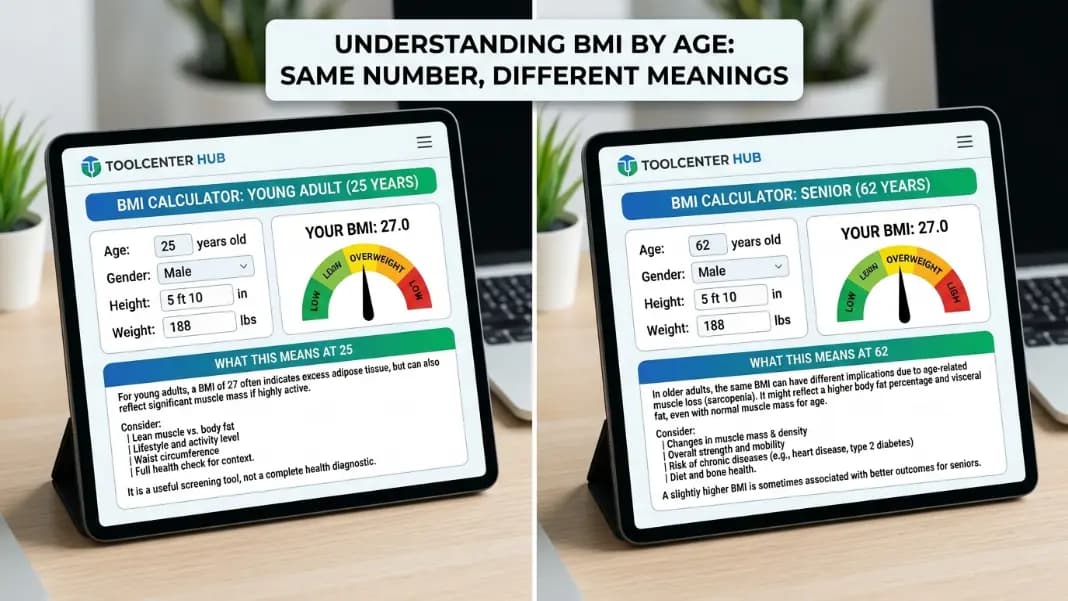
Two people, same height, same weight, same BMI of 27. One is 28 years old with good muscle mass and an active lifestyle. The other is 64 years old and has been losing muscle gradually for a decade while their weight barely moved. The BMI calculator will give both of them the same number. What that number means for their health is a different conversation entirely.
BMI was designed as a population-level screening tool, not an individual diagnostic measure. It was calibrated primarily on data from younger adults, and its relationship to health outcomes shifts as people age. Understanding how that shift works is the difference between using your BMI result intelligently and treating a single number as more definitive than it actually is.
How the Standard BMI Chart Was Built and What Age Has to Do With It
The body mass index formula divides weight in kilograms by height in meters squared. It was developed by Belgian statistician Adolphe Quetelet in the 19th century to describe average body proportions across populations, not to assess individual health. The current threshold categories used by the World Health Organization (underweight below 18.5, normal weight 18.5 to 24.9, overweight 25 to 29.9, obese 30 and above) were established through research conducted primarily on younger and middle-aged adults in Western populations.
The fundamental limitation is that BMI measures mass relative to height but cannot distinguish between fat mass and lean mass. Two people with identical BMI values can have dramatically different body compositions. An athlete with high muscle mass and a sedentary person with high fat mass can share the same number. At younger ages, this limitation matters but is less clinically significant for most people. At older ages, when body composition naturally shifts independent of weight changes, the limitation becomes much more important.
Age interacts with BMI in two main ways. First, body composition changes with age: muscle mass declines and fat mass increases even when overall weight stays roughly stable. Second, the health consequences associated with a given BMI value are different in older adults compared to younger ones. Research consistently shows that the BMI level associated with lowest mortality risk rises slightly after age 65.
BMI in Your 20s: Where the Standard Ranges Apply Most Directly
For adults in their 20s, the standard BMI categories align reasonably well with metabolic health markers. Muscle mass is typically at or near its peak in this decade. Body composition has not yet been significantly affected by the gradual changes that come with aging. The relationship between BMI and body fat percentage is more predictable than it will be at any later stage of life.
At this age, BMI in the normal range of 18.5 to 24.9 generally corresponds to a body fat percentage within healthy ranges for both men and women. A BMI below 18.5 is worth investigating because underweight in young adults is associated with hormonal disruption, bone density loss, and immune function issues. A BMI above 25 warrants attention, particularly if accompanied by a waist circumference above 35 inches for women or 40 inches for men.
That said, even in your 20s, BMI misclassifies some groups. Young men with high muscle mass from sport or resistance training frequently show BMI values in the overweight range while having very low body fat percentages. Young women who are below average in muscle mass may have a normal BMI while carrying a higher fat percentage than the number suggests. For most people in their 20s without significant athletic training, BMI is a reasonable screening number to understand.
BMI in Your 30s and 40s: When Body Composition Starts Shifting
Muscle mass begins declining gradually from around age 30, a process called sarcopenia. The rate is roughly 3 to 5 percent per decade without active intervention through resistance training. What this means in practice is that someone who maintains the same weight from age 30 to age 45 has very likely lost some muscle and gained a roughly equivalent amount of fat. Their BMI has not moved, but their body composition has changed.
This is when BMI starts becoming a less complete picture on its own. A 42-year-old with a BMI of 24 might have an identical number to their 28-year-old self but meaningfully higher body fat and lower muscle mass. The number looks the same; the metabolic reality is different.
For people in their 30s and 40s, the BMI calculator for men and BMI calculator for women guides cover the gender-specific context in detail, but the general principle is that the standard ranges still apply as a rough guide. A BMI in the overweight or obese range in this age group still signals elevated cardiovascular and metabolic risk. The issue is more about what a normal BMI can hide than about the thresholds themselves being wrong.
Waist circumference becomes increasingly useful as a companion measurement in this decade. Visceral fat (the fat stored around abdominal organs) is a stronger predictor of metabolic disease risk than total body fat, and BMI does not measure it at all. A waist circumference above 35 inches for women or above 40 inches for men, regardless of BMI, is a meaningful health signal.
BMI After 50: Why the Standard Cutoffs Become Less Reliable
After 50, the relationship between BMI and health outcomes becomes considerably more complex. Two phenomena are worth understanding.
The first is accelerating sarcopenia. Muscle loss speeds up after 60. People can be at a BMI of 23 while carrying body fat percentages above 35 percent, a condition sometimes called normal-weight obesity or sarcopenic obesity. The metabolic risk profile of this condition is closer to that of someone who is conventionally overweight than to someone with a genuinely healthy body composition. BMI will not flag this.
The second is what epidemiologists call the obesity paradox. Multiple large studies have found that older adults with BMI in the 25 to 29.9 range (conventionally overweight) have lower mortality rates than those with BMI in the 18.5 to 24.9 range (conventionally normal). This finding is consistent enough across different populations that most clinical guidelines now suggest the optimal BMI range for adults over 65 is approximately 23 to 30, not 18.5 to 24.9.
The practical implication: a 67-year-old with a BMI of 27 is not necessarily at elevated health risk from that number alone. A 67-year-old with a BMI of 20 may be more at risk from low muscle mass and potential undernutrition than the number suggests. Context from body composition, waist measurement, and functional fitness matters more after 50 than any single number.
A Practical BMI Reference by Age Decade
This table reflects where the research currently sits on BMI thresholds and their health implications by age group:
| Age range | Standard BMI normal range | Lowest mortality risk in research | Key limitation at this age |
|---|---|---|---|
| 20 to 29 | 18.5 to 24.9 | 20 to 25 | Misclassifies athletes with high muscle mass |
| 30 to 49 | 18.5 to 24.9 | 21 to 26 | Does not capture fat gain with stable weight |
| 50 to 64 | 18.5 to 24.9 | 22 to 27 | Increasingly misses body composition changes |
| 65 and above | 18.5 to 24.9 | 23 to 30 | Standard cutoffs may flag healthy weight as overweight |
These ranges are reference points, not prescriptions. Individual variation, ethnicity, muscle mass, and overall health status all affect what a specific BMI number means for a specific person.
What to Track Alongside BMI as You Get Older
BMI remains a useful starting point because it requires only height and weight, which everyone knows. The issue is treating it as a complete picture rather than an entry point.
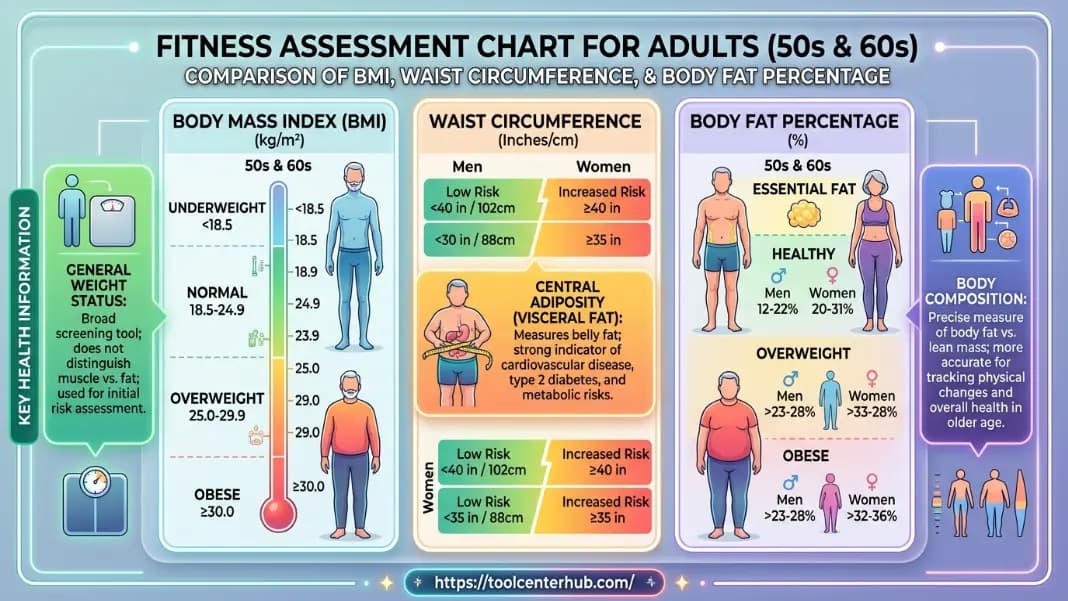
Waist circumference is the most accessible companion measurement. Measure at the level of the navel, without pulling the tape tight. Values above 35 inches for women and 40 inches for men indicate elevated visceral fat regardless of BMI. This measurement takes thirty seconds and adds meaningful context to any BMI result.
Body fat percentage is more precise but requires either a clinical measurement or an estimation tool like the Navy method body fat calculator. Healthy body fat ranges shift with age and gender. For men over 50, a body fat percentage above 28 to 30 percent is associated with metabolic risk even with a normal BMI. For women over 50, the threshold is roughly 38 to 40 percent.
Grip strength and functional fitness tests are increasingly used in clinical settings for older adults because they measure what matters most in practical terms: the ability to perform daily activities safely and independently. A BMI of 26 with good grip strength in a 70-year-old represents a very different health picture than a BMI of 22 with poor functional strength.
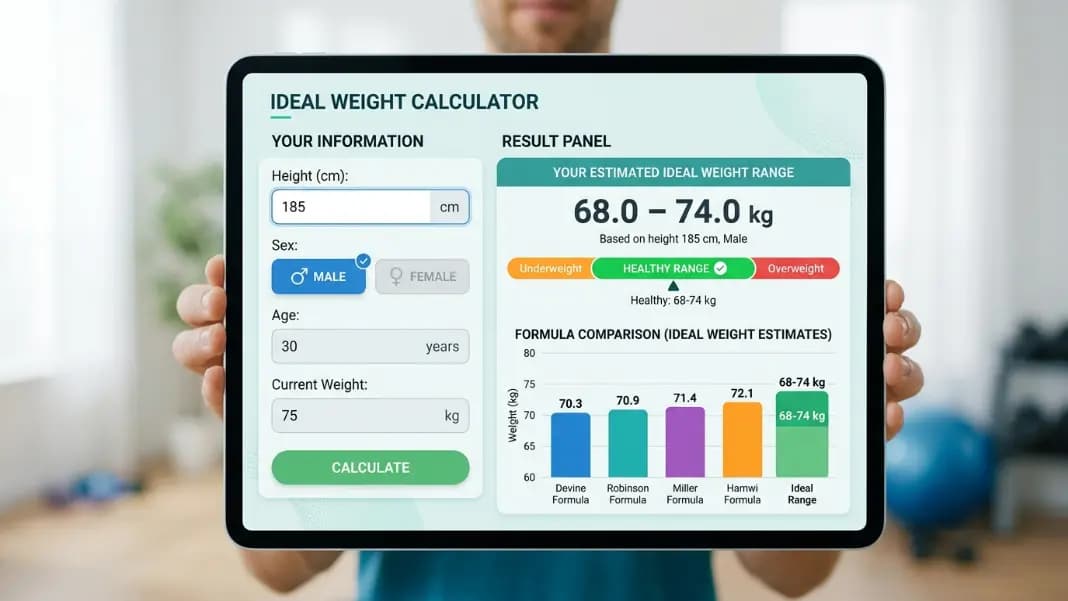
The ideal weight calculator adds another reference point by using frame size and other factors that BMI ignores. Using two or three measures together gives a much clearer picture than any single number alone.
Using the BMI Calculator With Your Age in Mind
The BMI calculator gives you a number. The number is a starting point, not a verdict. Use it the way it was intended: as a quick screening value that tells you whether more detailed investigation is worth pursuing, not as a definitive statement about your health.
If you are under 40 and your BMI falls in the normal range with no particular risk factors, you can treat it as broadly reassuring while keeping an eye on waist circumference. If you are in the overweight range, waist circumference and any available body fat data help distinguish between muscle-related BMI elevation and fat-related BMI elevation.
If you are over 50, apply the adjusted context above. A BMI of 26 or 27 is not cause for immediate concern. A BMI below 20 after 60 warrants a closer look at muscle mass and nutritional status. A waist circumference above the threshold at any BMI number is worth discussing with a clinician.
The health tools section includes body fat calculators, ideal weight tools, and other measures that give you a fuller set of data points. No single number tells the whole story, and the BMI result becomes most useful when you treat it as one piece of a broader picture rather than the answer to a question it was never designed to answer definitively.