Random Number Generator: Pick a Number 1-100 or Any Range
Pick a number from 1-100 in one click, or set any custom range you need. Enter a minimum, enter a maximum, choose how many numbers to generate, and click Generate. Use this number randomizer for classroom draws, picking lottery numbers, raffle winner selection, probability exercises, and any situation where picking a number at random removes the decision from you. Unique mode prevents repeated results across multiple picks. No signup, instant results, runs entirely in your browser.
How to use the random number generator
- Set the minimum value in the Min field (default is 1).
- Set the maximum value in the Max field (default is 100).
- Set the Count to generate more than one number at once.
- Enable unique numbers if each result must be different from the others.
- Click Generate. Results appear instantly and can be copied to your clipboard.
Common range presets
Most use cases map to one of these standard ranges. Use the table as a quick reference for Min, Max, Count, and unique settings:
| Range | Common use | Count | Unique |
|---|---|---|---|
| 1 to 6 | Standard six-sided die roll | 1+ | No |
| 1 to 10 | Rating scales, single-digit picks | 1 | No |
| 1 to 20 | D20 tabletop RPG rolls, quiz scoring | 1 | No |
| 1 to 100 | Probability exercises, classroom picks | 1 | No |
| 1 to 49 | Canada Lotto 6/49 | 6 | Yes |
| 1 to 59 | UK National Lottery (Lotto) | 6 | Yes |
| 1 to 69 | Powerball main numbers (US) | 5 | Yes |
| 1 to 70 | Mega Millions main numbers (US) | 5 | Yes |
| 1000 to 9999 | 4-digit PIN simulation | 1 | No |
| 1 to 1000 | Large raffle draws by ticket number | 1 per prize | Yes |
Random number generator 1-100: the most common range
The default range is 1 to 100, which covers the majority of everyday number picks. Use the random number generator 1-100 for classroom guessing games, raffle draws, probability exercises, deciding who goes first, game scoring, and any situation where a fair number pick within a familiar scale is needed. Every integer from 1 to 100 has exactly the same 1% probability on each generation. The result is not influenced by previous outputs, so the randomizer is equally fair on the first pick or the hundredth.
For a random number 1-20, simply change the maximum to 20. This range is common in tabletop RPG contexts where a D20 result is needed, in quiz scoring where questions are numbered 1 through 20, or in any activity that needs a smaller bounded range. For a dedicated die-rolling experience with polyhedral dice visuals, the dice roller is the purpose-built option.
Random number generator 1-6 and 1-10 ranges
Setting the range to 1-6 produces results equivalent to a six-sided die roll. This is the most common range in board games, probability teaching, and any game that uses a standard D6. The random number between 1 and 6 result has equal probability for each value, exactly like a fair physical die. Set count to 2 and you get results equivalent to rolling two dice simultaneously.
The random number generator 1-10 range is useful for rating scales, single-digit random picks, and games or exercises that need a number from one to ten. Both ranges are set by simply adjusting the min and max fields before generating. There is no limit to how many times you can generate, and each result is fully independent of the previous one.
Lottery number generator: settings for popular formats
This tool works as a lottery number generator for any format worldwide. Enable unique numbers, match the range and count to your lottery, and click Generate. Here are the correct settings for the six most popular lotteries:
| Lottery | Country | Range | Count | Unique |
|---|---|---|---|---|
| UK National Lottery (Lotto) | United Kingdom | 1 to 59 | 6 | Yes |
| Powerball (main numbers) | United States | 1 to 69 | 5 | Yes |
| Mega Millions (main) | United States | 1 to 70 | 5 | Yes |
| EuroMillions (main) | Europe | 1 to 50 | 5 | Yes |
| Canada Lotto 6/49 | Canada | 1 to 49 | 6 | Yes |
| Australia Powerball (main) | Australia | 1 to 35 | 7 | Yes |
Note that jackpot lotteries like Powerball and Mega Millions have a separate bonus ball drawn from a different, smaller pool. This table covers the main number draw only. Generate the main numbers first with unique on, then generate the bonus ball separately with the bonus pool range.
Number randomizer for raffle and classroom draws
For a raffle, set the range from 1 to the total number of tickets sold and generate one number per prize draw. Enable unique numbers if you are drawing multiple winners in one session. The unique numbers mode guarantees no ticket number repeats across results, making every draw fair and verifiable.
For classroom use, the number randomizer works for student selection, random question assignment from a numbered list, and seat assignment. Set the range to match the class size or question count and generate one number at a time. For options that have names rather than numbers, the wheel spinner lets you enter names directly and spin for a result. For a complete breakdown of range settings and use cases, read our random number generator range guide.
Picking a number from 1 to 100 for games and quick decisions
Picking a number from 1 to 100 is a fast way to settle turn order, choose a starting player, assign raffle positions, or resolve any tie without an argument. Set the maximum to 100, click Generate, and the number is picked for you with no human judgment involved. For smaller groups, set the maximum to match the number of players or options and generate one result per round.
For the classic think-of-a-number game, have each player enter their guess before generating, then reveal the result. The closest guess wins. The randomizer also works for any game where a referee needs to pick a number on demand without anyone being able to predict the result ahead of time. For splitting people into balanced groups rather than picking a single number, the team generator handles the full group assignment in one step.
True random, pseudo-random, and cryptographically secure: what is the difference?
Not all random number generators are equally random. Here is how the three main types compare:
| Type | How it works | Predictable? | Example | This tool |
|---|---|---|---|---|
| PRNG (pseudo-random) | Deterministic algorithm seeded with a starting value. Same seed always produces the same sequence. | Yes, if seed is known | Math.random() in JavaScript, most language stdlib functions | No |
| CSPRNG (cryptographically secure) | Draws from the OS entropy pool. No predictable seed, no repeatable pattern. | No | crypto.getRandomValues() (used by this tool) | Yes |
| TRNG (true random) | Derives randomness from physical phenomena: atmospheric noise, radioactive decay, thermal noise. | No | RANDOM.ORG, hardware security modules (HSMs) | No |
For lottery draws, raffles, games, and everyday decisions, a CSPRNG is indistinguishable from a TRNG. The practical difference only matters in cryptographic applications where even a tiny statistical bias could be exploited. This tool uses crypto.getRandomValues() exclusively. Each generation is independent of all previous results, with uniform distribution across whatever range you set.
Frequently asked questions
Set the minimum field to 1 and the maximum field to 100, then click Generate. The result is a uniformly random integer from 1 to 100 inclusive. This is the most common range for classroom activities, probability demonstrations, and quick random picks. The random number 1-100 range is set by default when you open the tool.
Set the minimum to 1 and the maximum to 6 and click Generate. This produces a result equivalent to a single D6 dice roll. The random number between 1 and 6 use case is common for board games, probability exercises, and any situation where a standard six-sided die result is needed digitally. For a full dice experience with multiple die types and quantity controls, the dice roller tool is the dedicated option.
Set minimum to 1, maximum to 10, and click Generate. The random number generator 1-10 range is useful for rating scales, small sample selections, guessing games, and any activity that needs a single digit random result. The range is inclusive on both ends, so 1 and 10 are both possible outcomes.
Enter your minimum value in the Min field and your maximum value in the Max field, then click Generate. The random number picker works for any integer range including negative numbers and very large ranges. To generate multiple picks at once, increase the Count field. Enable unique numbers to ensure no value appears more than once in the result set.
Yes. Set the minimum to 1000 and the maximum to 9999 and click Generate. This produces a random 4 digit number between 1000 and 9999. If you need a PIN-style number that can start with 0, set minimum to 0 and maximum to 9999 and note that results below 1000 represent 3-digit values with a leading zero.
A number randomizer is a tool that produces a random integer within a range you define. It is functionally identical to a random number generator but the term is commonly used in contexts like lottery draws, raffle selections, and game mechanics. This number randomizer supports any integer range, any quantity per generation, and a unique mode that prevents repeated values across a single result set.
When unique numbers is enabled, the generator ensures each number in the result set appears only once. This is essential for lottery draws, raffle selections, and any use case where repeated values are not permitted. For example, a 6-number lottery draw from 1 to 49 requires 6 unique numbers. Enable unique mode, set the range to 1-49 and the count to 6, and click Generate.
This tool uses the browser's crypto.getRandomValues() API to generate each number. This draws from system-level entropy sources and produces cryptographically secure random values with no predictable pattern. It is significantly stronger than Math.random(), which produces deterministic sequences from a seed and can be predicted if the seed is known. Each generation is fully independent of all previous results.
This tool uses crypto.getRandomValues(), which is a cryptographically secure pseudo-random number generator (CSPRNG). It draws from system-level entropy sources and is not predictable, making it suitable for security-sensitive applications. A true random number generator (TRNG) derives randomness from physical phenomena like atmospheric noise or radioactive decay, as used by RANDOM.ORG. For everyday use cases including lotteries, raffles, games, and classroom activities, a CSPRNG is equally fair and unpredictable in practice.
Yes. Set the min and max to match your lottery format, set the count to the number of balls drawn, and enable unique numbers. For the UK National Lottery, use range 1-59 with count 6 and unique on. For Powerball main numbers, use range 1-69 with count 5 and unique on. For Mega Millions main numbers, use range 1-70 with count 5 and unique on. For EuroMillions main numbers, use range 1-50 with count 5 and unique on. Each number in the range has equal probability of being selected.
Math.random() is a pseudo-random number generator that uses a deterministic algorithm seeded internally by the JavaScript engine. Its output is not cryptographically secure and can potentially be predicted. crypto.getRandomValues() draws from the operating system entropy pool, which collects unpredictable data from hardware events. This makes its output cryptographically secure and suitable for security-critical applications like key generation and token creation. This random number generator uses crypto.getRandomValues() exclusively.
Yes. Set the minimum to 1 and the maximum to 1000 and click Generate. The tool supports any integer range with no upper limit on the range size. For a large raffle where each ticket is numbered 1 through 1000, set count to 1 and draw once per prize. Enable unique numbers if you are drawing multiple winners to ensure no ticket number repeats.
Related articles
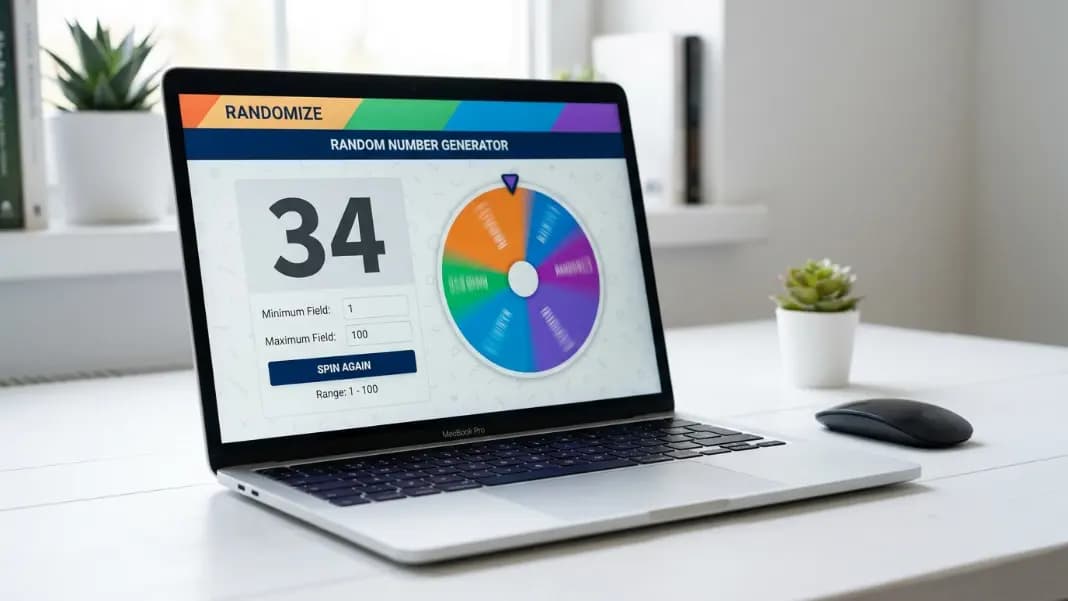
Random Number Generator Wheel: Spin Numbers for Any Range
A random number generator wheel lets you spin for any number in your range. Covers how it works, when to use it, and how to set min, max, and no-repeat mode.
14 min read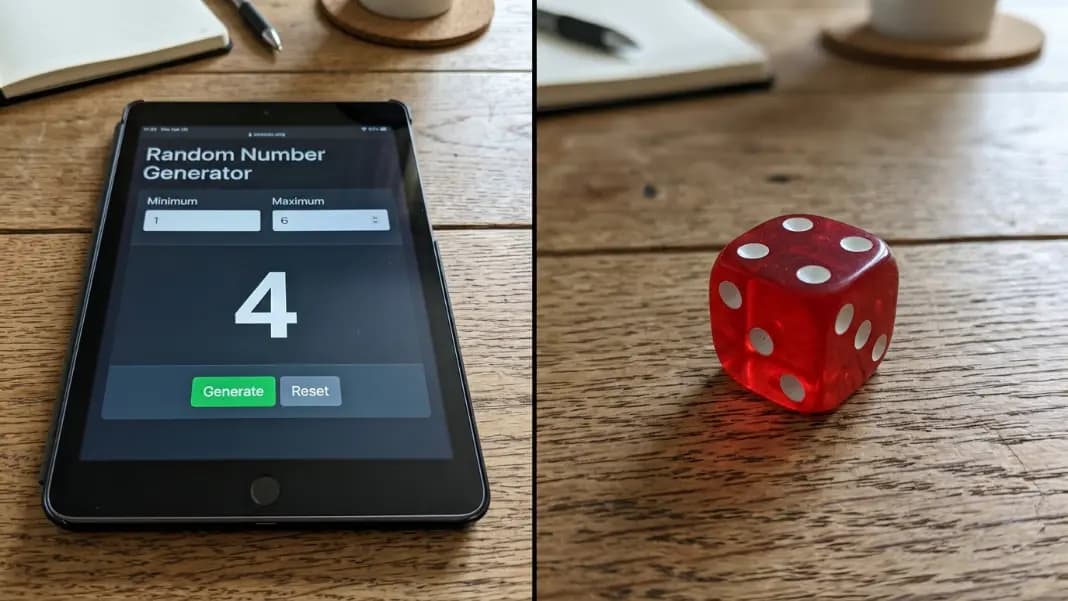
Random Number Generator 1 to 6: Dice Rolls and Small Range Picks
Generate a random number 1 to 6 online without dice. Covers dice replacement, 1-3, 1-4, and 1-5 small ranges for games, classrooms, and quick decisions.
14 min read
Lottery Number Generator: Powerball, Mega Millions, and Global Formats
Generate lottery numbers for Powerball, Mega Millions, UK Lotto, and EuroMillions. Covers correct range settings, no-repeat mode, and Quick Pick alternatives.
14 min read