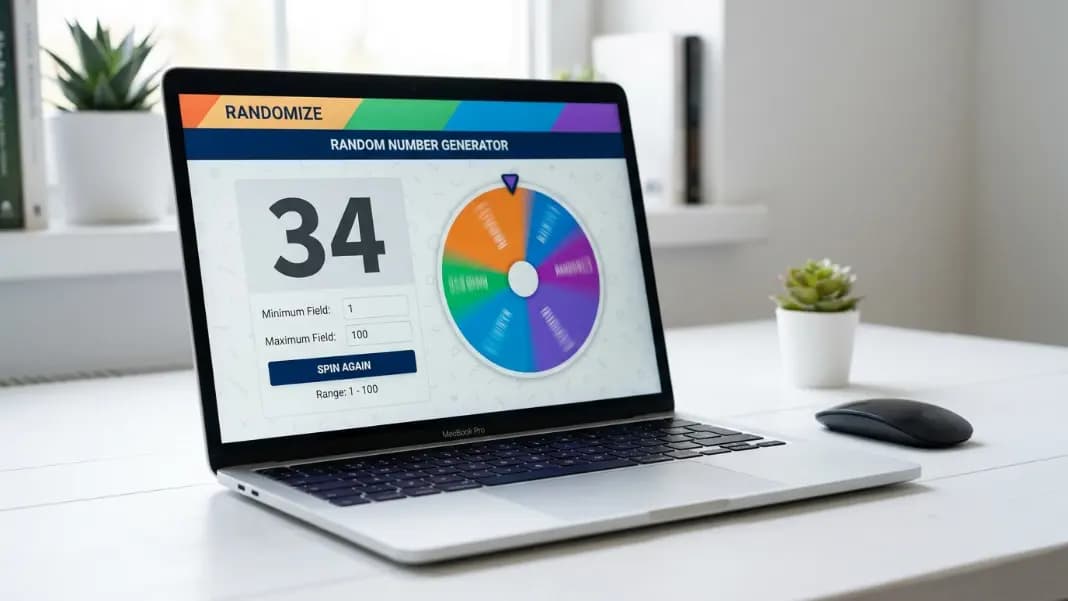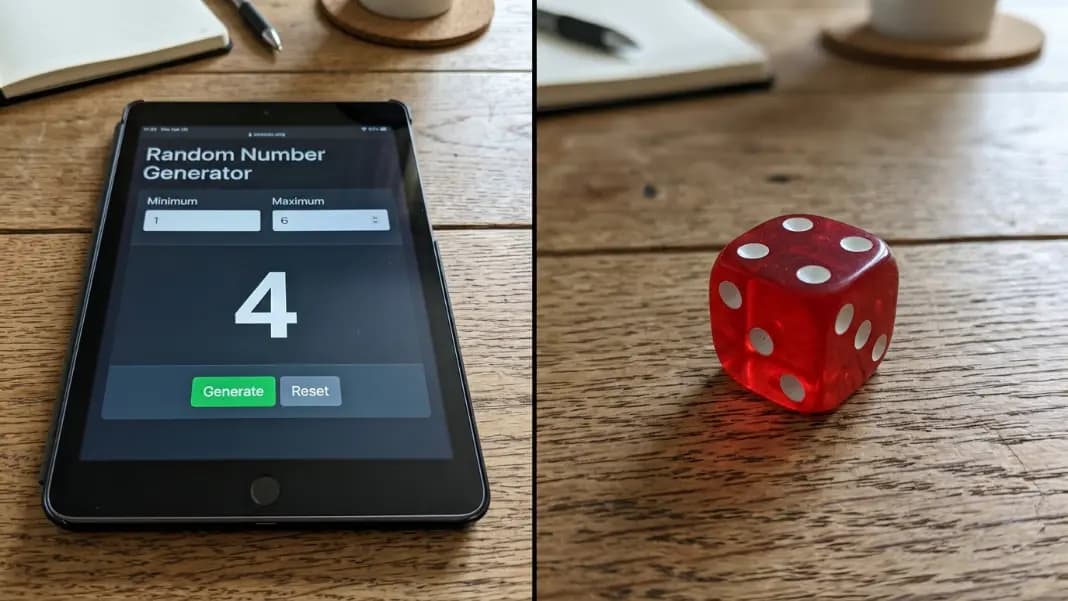
You are mid-game and the dice rolled under the couch for the third time. Or you are in a classroom and need to assign one of six groups to a task. Or you need to settle something between three people quickly and do not want to flip a coin twice while everyone waits. A random number generator set to 1-6 handles all of these in under five seconds, on any device, without finding anything first.
The random number generator accepts any minimum and maximum you set. The 1-6 range is the most common small range because it matches a standard die, which is one of the most frequently needed random results in everyday life. But the same tool works for 1-3, 1-4, 1-5, or any other small range your situation calls for, and switching between them takes two seconds.
This guide covers when to use 1-6 and its close variations, how each small range maps to a real use case, and where a digital generator is more reliable than a physical die in ways most people do not consider until they actually need the difference.
Why 1-6 Is the Most Used Small Range in Random Generation
The 1-6 range maps directly to a standard die. Dice have been used for decisions and games for thousands of years, and when people need a quick small random number without a physical die nearby, 1-6 is the first range they reach for.
But the use cases for a 1-6 generator extend well beyond replacing a missing die. Six options is a natural fit for many everyday structures. Six teams in a round-robin, each needing a randomly assigned match slot. Six tasks distributed among team members. Six students presenting in random order. Six recipe options for the week. The number shows up across ordinary decisions more often than people notice.
The digital version of a 1-6 pick has several practical advantages over a physical die. The most obvious is availability. You cannot lose a browser tool under the couch or forget to pack it. A phone, a laptop, or a shared projector screen is enough.
Less obvious is the question of fairness over time. Physical dice can develop bias. Cheap dice are often molded with slight asymmetries. Heavily used dice wear their corners unevenly. A well-documented issue with casino-grade dice is that even precision manufacturing cannot guarantee perfectly equal face probabilities across thousands of rolls without regular retirement and replacement. A digital generator using crypto.getRandomValues() draws from hardware entropy sources that do not wear. The probability distribution stays exactly 1-in-6 for each face, for every roll, regardless of how many times the tool has been used or when.
How to Generate a Random Number Between 1 and 6 in Under Five Seconds
Open the random number generator. Set the minimum to 1 and the maximum to 6. Press Enter or click generate.
That is the complete process. The result appears immediately. If you want the animated spinning wheel format, it is available by default. If you want a faster result with no animation, pressing Enter skips the delay and delivers the number directly.
For situations where you roll the same range repeatedly, the tool retains the last settings you used. Start a session, set 1 and 6, and every subsequent spin uses the same range until you change it. No re-entering values between rolls.
The dice roller is an alternative for this use case with a dedicated game-oriented interface. It has a D6 button, supports multiple dice simultaneously, and shows individual results alongside a running total. If you are playing a board game that requires rolling two or three dice at once and seeing each result individually, the dice roller is the better tool. If you need a quick 1-6 result for any other purpose, the number generator is slightly faster to configure and handles any custom range beyond standard die sizes.
One note on range interpretation: the generator is inclusive on both ends. Setting 1-6 means the result can be exactly 1 and exactly 6, not just the numbers between them. This is the expected behavior for dice equivalents and most other small range uses.
The Difference Between a 1-6 Generator and a Physical Die
Statistically, a properly implemented digital generator and a fair physical die are equivalent for a 1-6 range. Each of the six outcomes has a 1-in-6 probability per roll in both cases. The differences that matter are practical and situational.
Availability. A physical die requires finding the die. A browser tool is a URL on a phone. In a context where dice are not present, the digital generator is the only option. In a context where dice are present, either works.
Dispute resolution. Physical dice rolls generate disputes. "It hit the book." "It tilted on the mat." "It was spinning when it stopped, does that count?" A digital result is unambiguous. The number is the number. There is no surface, no edge, no trajectory to argue about.
Consistent probability. As covered above, physical dice can develop bias from manufacturing variation and wear. A digital generator's probability is fixed by its algorithm, not by its physical condition. For casual games the difference is rarely meaningful. For high-stakes decisions where fairness genuinely matters, the digital generator is the more reliable choice.
Tactile experience. Physical dice win here. Picking up a die, shaking it, and throwing it is a physical ritual that is part of many games. The sound, the texture, the roll across the table. A digital generator replaces the function but not the feeling. For players who value that experience, the physical die is worth keeping even if a digital alternative is technically more accurate.
Custom ranges. A physical die cannot produce a result from 1-7 or 1-9 or 1-15. The number generator can produce any range from 1-2 up to ranges in the millions. This is where the digital tool has no physical equivalent at all.
When 1-3 Works Better Than 1-6
The 1-3 range is one of the most searched small ranges online, sitting above 1-5 and 1-4 in volume. That reflects how often three-way decisions come up in practice.
A coin flip resolves two-option decisions quickly, but three-way choices create a problem with coins. You either flip twice (with the risk of landing on the already-eliminated option) or make up a more complex rule on the spot. A 1-3 generator is cleaner. Assign one number to each option before spinning. Spin once. Done.
Common 1-3 situations: choosing which of three tasks gets prioritized when all are due. Picking which of three restaurants to order from when the group cannot agree. Determining which of three player positions gets a randomly assigned bonus. Assigning a three-person group their presentation order.
The generator handles this range in exactly the same interface as 1-6. Type 3 in the maximum field instead of 6 and the rest is identical. Each of the three numbers has exactly a 1-in-3 probability per spin.
One subtlety worth noting: a 1-3 range can also resolve decisions that would typically be framed as yes/no/maybe, where "maybe" deserves equal weight alongside the binary options. If a coin flip feels too decisive for a question that has a genuine third state, 1-3 maps those three states cleanly.
When 1-4 and 1-5 Fit Better
1-4 range. Four options appear in specific structures. Four groups in a classroom. Four quarters in a bracket. Four card suits. Four players at a table needing a random turn order. Four tasks to assign to four team members.
For bracket and tournament use, the 1-4 range assigns bracket positions randomly when seeding should not be predetermined. Spin once for each team or participant, assign them the bracket slot matching their result, and the seeding is done without manual judgment. The random number generator no repeats guide covers how to run this draw with no-repeat mode so each slot is assigned only once.
1-5 range. Five-point scales are extremely common in feedback, evaluation, and rating systems. Generating a random point on a 1-5 scale has a specific teaching use: start with a randomly generated score and ask students or participants what it would mean in context. What does a 3 represent? What behavior or condition would push it to a 4? This kind of backwards reasoning activity generates discussion more effectively than starting from a defined target.
Five-option selections come up in game mechanics, lesson formats, and group rotations. Whenever exactly five possibilities exist and one needs to be picked randomly, 1-5 is the right range. The generator handles it identically to any other range.
Small Range Picks for Classrooms and Group Settings
Small ranges are one of the most underused features in classroom number generators. Teachers who use the tool tend to default to large ranges (1-30 for student selection) and miss how much small ranges add to structured activities.
For group assignment, a 1-4 or 1-6 range distributes students across groups rather than selecting a single student. Spin once per student and assign them to the group matching their result. The groups will not be perfectly equal in size because randomness does not guarantee balance, but they will be close, and the assignment process is demonstrably fair.
For rotating roles or tasks, a 1-5 or 1-6 range assigns positions across a rotation. If five roles exist in a group activity, spin once to determine which role each student gets and record the results. No negotiation, no students claiming the "good" roles. The generator assigned them.
For probability demonstrations, small ranges make the distribution visible in a way that large ranges do not. Spin a 1-6 range 30 times and tally the results on a board. Students can see the distribution forming. They can predict where the next result will land. They understand directly that "each outcome has equal probability" means something that shows up over many spins rather than something that guarantees an even spread across any 6 spins. The random number generator for classroom guide covers structured lesson formats for this kind of activity across age groups.
For office or team decisions, the same logic applies. If five people each need to take one of five tasks, number the tasks 1-5 and the people 1-5, spin once per person (without repeats), and assignments are done in two minutes with no negotiation required.
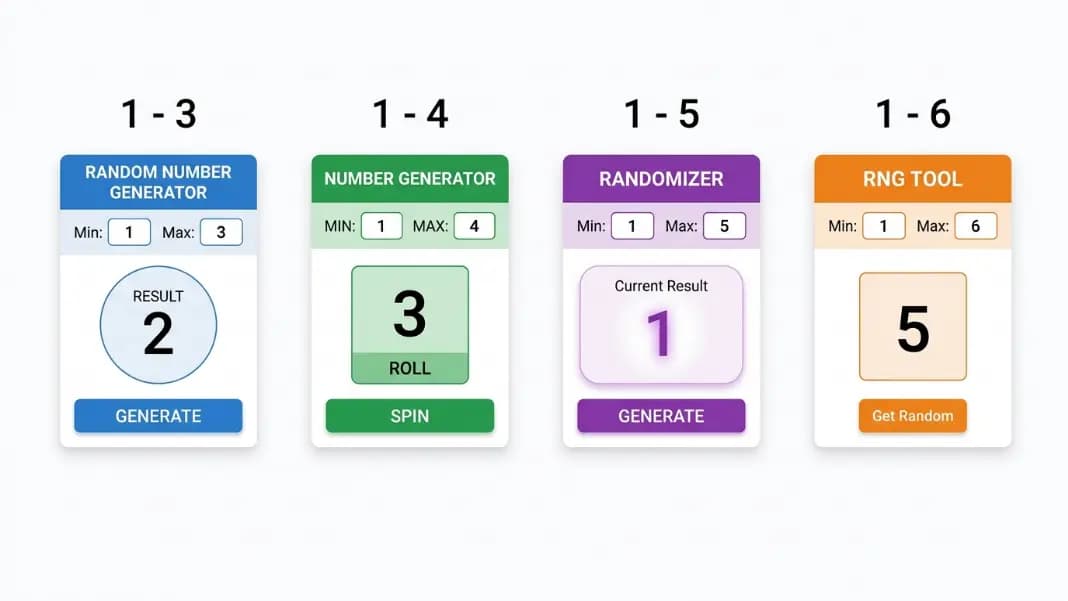
Small Range Reference by Number
Some ranges map to specific use cases so consistently that listing them directly is more useful than explaining the general pattern.
1-2: Binary pick. Two options, no preference. Equivalent to a coin flip but in number form. Also used in games where two possible results carry different meanings and a yes/no wheel is not available.
1-3: Three-way choice. Choosing between three food options. Three candidate proposals. Three player roles. Three possible directions. Faster than any multi-coin or multi-flip method, and cleaner than asking people to agree.
1-4: Four-group assignment. Bracket quarter selection. Four-player turn order. Any structure that happens to have exactly four parts. The 1-4 range is also the smallest range where running draws without repeats makes practical sense.
1-5: Rating scale picks. Five-option game mechanics. Five-team rotation assignments. Five tasks to distribute. The 1-5 range shows up often in feedback-driven activities and evaluation systems.
1-6: Die replacement. Six-team or six-player draws. Six-option selections. Any structure built around the standard die format. This range covers the widest variety of game, classroom, and decision scenarios of any small range.
For ranges beyond 1-6, the random number 1 to 10 guide covers the 1-10 range in detail, and the random number generator range guide explains how to set any min and max correctly, including how the inclusive boundaries work across ranges of different sizes.
Switching Ranges Mid-Session
The generator does not require you to start over when your range changes. Edit the maximum field, and the new range takes effect on the next spin. History from previous spins is saved in the session log below the result, so earlier results stay visible for reference even after the range changes.
For situations where multiple ranges are needed at the same time, open the generator in two browser tabs with different configurations. Each tab maintains its own settings and its own spin history independently. A game that needs both a 1-6 roll for movement and a 1-4 roll for a special action can have both ready without one tab's settings overwriting the other.
For group sessions where the range changes between rounds, calling out the new range before spinning and showing the updated fields on a shared screen keeps everyone informed. The settings are visible above the result, so participants can confirm the range before the spin happens.
The random tools section has everything beyond numeric ranges: the wheel spinner for named lists, the dice roller for standard multi-die game formats, and the yes/no wheel for binary decisions with adjustable probability. For any pick that maps to a number in a range, the number generator is the starting point. Changing the range to fit the moment is the only configuration step required.