Standard random number generators can produce the same number twice. For most purposes that is fine. For a raffle draw, a classroom activity, or a tournament seed, it is a problem. If two participants get the same number, someone wins twice and someone else wins nothing.
The random number generator at ToolCenterHub supports no-repeat mode, which guarantees every number in the output is unique. Set your range, set how many numbers you need, enable no repeats, and each result is drawn from the pool exactly once.
This guide explains what no-repeat generation actually means, how the algorithm works, and the specific situations where unique numbers matter versus where duplicates are fine.
What no-repeat means
A standard random number generator picks each number independently. If you ask for ten numbers between 1 and 10, the generator might return 3, 7, 3, 1, 7, 9, 2, 3, 6, 7. The number 3 appears three times. This is mathematically correct for independent random sampling.
A no-repeat generator works differently. It treats the range as a pool of items, draws one item out, sets it aside, and draws the next from the remaining pool. Using the same example, asking for ten numbers between 1 and 10 with no repeats gives you all ten numbers in a random order, each appearing exactly once: 4, 9, 1, 7, 3, 10, 6, 2, 8, 5.
The key distinction: no-repeat is the right choice when each item in the pool should have exactly one opportunity to be selected. Standard random with possible duplicates is the right choice when each draw is truly independent of what came before, such as simulating dice rolls or coin flips.
With replacement versus without replacement
These two terms come from probability theory and describe exactly this distinction.
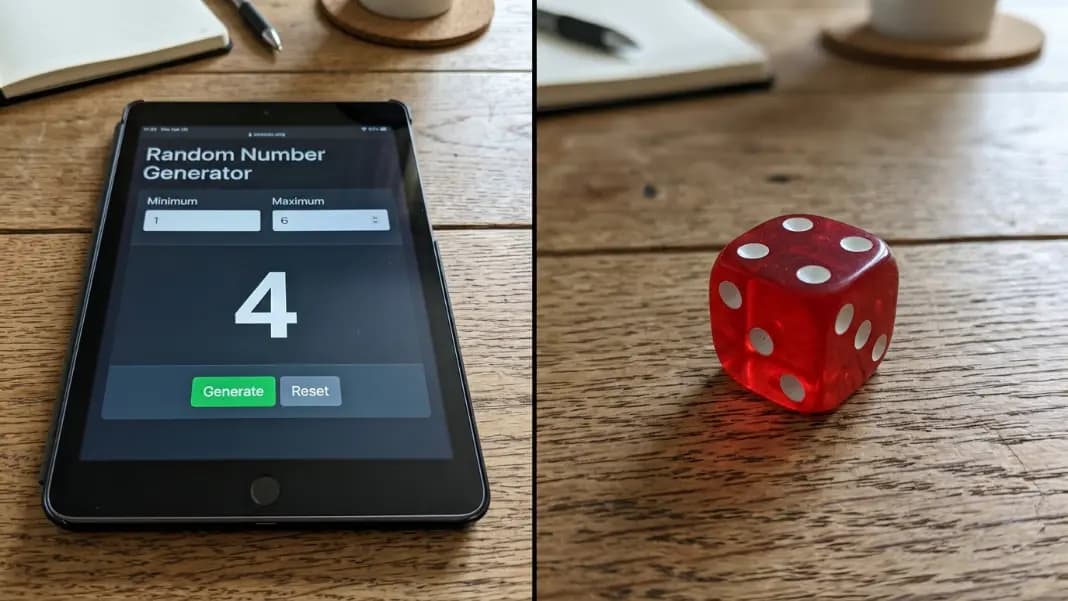
With replacement means after an item is drawn, it goes back into the pool before the next draw. A die roll is with replacement. Rolling a 4 does not remove 4 from the possibilities on the next roll. Online random number generators that allow repeats are simulating with-replacement sampling.
Without replacement means a drawn item stays out of the pool. Drawing lottery balls is without replacement. Once ball number 23 is drawn, it cannot appear again in the same draw. A no-repeat random number generator is simulating without-replacement sampling.
The difference matters for fairness. In any situation where you are assigning unique outcomes to unique participants, without replacement is the correct model.
How the algorithm works
The standard algorithm for generating unique random numbers in a shuffled order is called the Fisher-Yates shuffle, developed by Ronald Fisher and Frank Yates in 1938 and later adapted for computers by Donald Knuth.
The process: create an ordered list of all numbers in the range. Starting from the last position in the list, swap it with a randomly chosen position from the remaining unswapped positions. Repeat from the new last unswapped position until all positions have been processed. The result is a perfectly shuffled list where every possible ordering is equally likely.
Drawing the first N numbers from this shuffled list gives you N unique random numbers in random order. The method is both efficient and provably uniform, meaning no number has a higher or lower probability of appearing than any other.
Raffle and lottery draws
A raffle is the most common use case for no-repeat random number generation. Each ticket corresponds to one number in the range. Each prize draw must produce a different winner.
The correct setup: if tickets are numbered 1 to 500 and you are drawing 3 prize winners, set the range to 1-500, set the count to 3, and enable no repeats. The three numbers returned are the winning ticket numbers, and no ticket can win twice.
Without no-repeat mode, there is a small but real chance the same ticket appears twice. In a small raffle with 50 tickets drawing 5 winners, the probability of at least one duplicate is around 35 percent. That is not a small edge case. For any draw where fairness matters, no-repeat mode is not optional.
The guide to picking a random winner online covers the full setup for fair digital draws, including how to document the result for transparency.

Classroom and education uses
Teachers use random number generators to call on students without repeating the same name twice in a session. Assigning each student a number and drawing from the pool without replacement guarantees every student gets called exactly once before anyone is called again.
The same approach works for:
- Assigning seats randomly: Generate unique numbers equal to the number of seats. Each student draws a number and takes the corresponding seat.
- Group formation: Generate numbers 1 to class size, then divide into groups by sequence. Students 1-5 form group A, students 6-10 form group B, and so on.
- Presentation order: Generate a unique random order for all students presenting on the same day so no one has to go first twice in a row across multiple sessions.
- Question distribution: Number your question bank and draw unique numbers to assign questions to students without giving the same question to two people.
The random number generator for classroom covers more specific education use cases for random selection tools.
Tournament seeding and bracket generation
Tournament brackets require unique seedings. Seed 1 and Seed 3 are different positions in the bracket, and each team should occupy exactly one position. Generating seeds without repeats ensures no two teams share the same bracket position.
For a 16-team tournament, generating 16 unique numbers from 1 to 16 and assigning each team a number gives you a completely random seeding with no conflicts. The bracket generator handles the full bracket structure once the seedings are set.
This also applies to round-robin scheduling. Generating a randomized unique order of all participants for each round ensures the schedule is both random and conflict-free.
When duplicates are actually correct
No-repeat mode is not always the right choice. Some situations genuinely require independent draws where repeats are possible.
Dice simulation: Rolling two dice and getting the same number on both is a valid outcome. The dice do not know what each other rolled.
Random sampling with repetition: In statistics, some simulations require drawing from a distribution with replacement to model real-world processes where the same event can happen multiple times.
Password and code generation: A random password generator that prevents any character from appearing twice would be significantly weaker than one using the full character set independently for each position.
Probability demonstrations: Showing students that a fair coin can land heads three times in a row requires allowing repeats. Removing repeats would change the probability distribution and misrepresent the concept.
Use no-repeat when you are assigning unique identities or positions. Use standard random when each event is genuinely independent of previous results.
Generating numbers for specific ranges
The no-repeat mode works across any range your situation requires. Common setups:
- Raffle with 200 tickets, 5 prizes: Range 1-200, count 5, no repeats
- Class of 30 students, random call order: Range 1-30, count 30, no repeats
- 16-team tournament seeding: Range 1-16, count 16, no repeats
- Lottery pick 6 from 49: Range 1-49, count 6, no repeats
- Random number 1-100 no repeats, pick 10: Range 1-100, count 10, no repeats
The only constraint is that count cannot exceed the size of the range. If you try to pick 15 unique numbers from a range of 1 to 10, the generator cannot produce a valid result because only 10 distinct values exist.
Related random tools
The random team generator builds on the same logic, distributing participants into teams randomly without placing the same participant in two teams.
The are online random generators really random guide explains the difference between pseudorandom and truly random generation, how browser-based tools work, and when the distinction actually matters for practical use.
All random tools are available at the random tools hub and run directly in the browser with no signup or installation required.