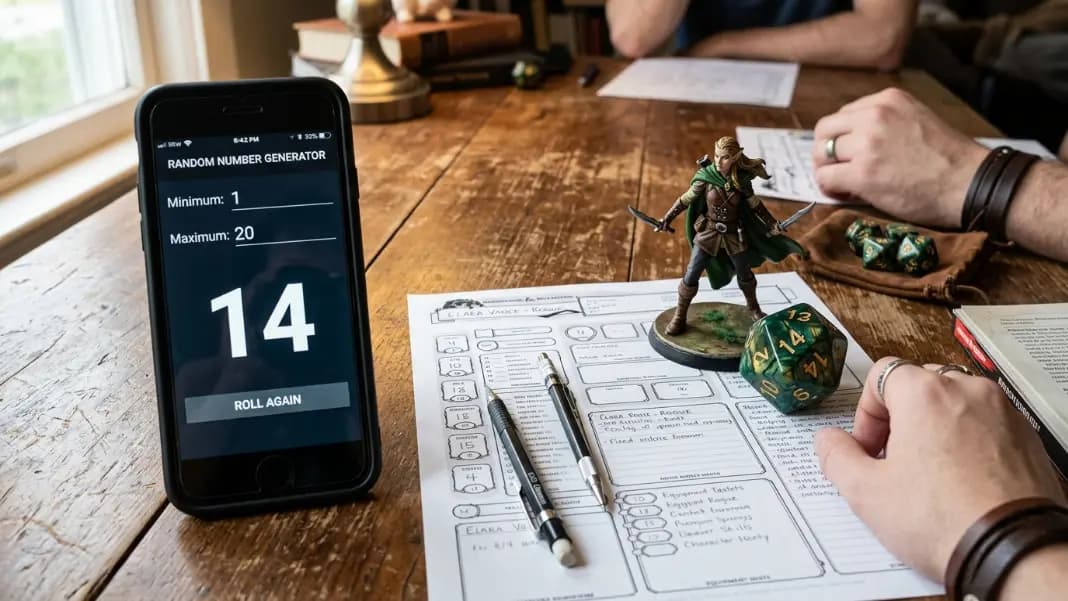
The dice rolled off the table. The dog ate the D12. Nobody packed the D10 and now the entire encounter system is stalled. Physical dice are great when they are available and cooperating. When they are not, a number generator set to the right range produces the same result in under five seconds on any phone or laptop, with no hunting under furniture required.
The random number generator handles every standard die type and any custom range a game needs. The configuration is the same regardless of the game: set the minimum to 1, set the maximum to the face count of the die you need, and generate. For game systems with non-standard mechanics that require a die size that does not exist physically, the generator covers those without compromise.
This guide covers how to configure the generator for every common die type, how to use it for D&D and tabletop RPG sessions specifically, how it fits into board game and party game use, and where the dedicated dice roller is a better choice for certain game formats.
Die Types and Their Number Ranges
Every standard die has a name that tells you its face count. Setting the generator to match is the complete setup.
| Die | Range | Common uses |
|---|---|---|
| D4 | 1 to 4 | Dagger damage, some spell effects, character trait selection |
| D6 | 1 to 6 | Movement in most board games, ability score generation, fireball dice |
| D8 | 1 to 8 | Longsword damage, hit dice for some character classes |
| D10 | 1 to 10 | Crossbow damage, percentile rolls as the tens digit |
| D12 | 1 to 12 | Greataxe damage, barbarian hit dice, some table rolls |
| D20 | 1 to 20 | Attack rolls, saving throws, skill checks in most RPG systems |
| D100 | 1 to 100 | Percentile rolls, encounter tables, wild magic surges |
Beyond the standard set, game designers sometimes require ranges that no physical die covers: D7, D3, D9, D16, D30. The generator handles these by adjusting the maximum. D3 uses maximum 3. D30 uses maximum 30. Any range you need is available without specialized dice.
The random number generator 1-to-6 guide covers small die ranges in detail, including when a D4 or D6 equivalent fits non-game uses. For the full standard die set and multi-die game sessions, this guide covers the complete picture.
How to Run D&D Dice Rolls With a Number Generator
Open the random number generator. Set the minimum to 1. Set the maximum to the face count of the die you need. Generate. That produces one die result.
For an attack roll in D&D 5th edition: set maximum to 20, generate once. Add your attack bonus to the result mentally or on paper. Compare to the target's armor class. Done.
For a saving throw: same setup, same process. The modifier comes from your character sheet. The random number comes from the generator.
For damage: change the maximum to match the weapon's die. A longsword uses D8, so maximum 8. A greatsword uses 2D6, so generate twice from 1-6 and sum the results. A fireball deals 8D6, so set count to 8, range to 1-6, generate once, sum all eight results.
For initiative at the start of combat: every player and monster rolls D20 and adds their initiative bonus. Generating from 1-20 for each participant and recording the results in a list sorts out turn order in about 30 seconds for a typical encounter.
One speed tip: press Enter to generate without the spinning animation. For rapid-fire rolls in a fast-paced encounter, the keyboard shortcut skips the visual and delivers the result immediately.
Character Creation: Ability Score and Hit Point Rolls
Character creation in D&D and similar systems involves multiple rolls that the number generator handles cleanly.
Ability scores using the standard array method: Some players prefer to roll rather than use a preset array. The standard rolling method (4d6, drop the lowest) requires four D6 rolls per ability score, six ability scores, which is 24 dice rolls total in traditional play. With the generator, set range to 1-6, count to 4, generate once per ability score. Drop the lowest of the four results manually and sum the remaining three.
Ability scores using 3d6 straight: Set count to 3, range 1-6, generate six times. Each total is one ability score in the order generated.
Hit points at first level: Most classes have a fixed hit die. Roll the die maximum at first level in many editions, or roll it and add constitution modifier at each subsequent level. For a Fighter using D10, generate from 1-10 each time a level is gained.
Starting gold: D&D 5e gives starting equipment by class or an option to roll for gold. Most classes use 5D4 multiplied by 10. Set count to 5, range to 1-4, generate, sum, multiply by 10.
Random NPC stats and monster stats: When a GM needs to quickly improvise a stat block without preset values, rolling ability scores using the 4d6 drop-lowest method takes about two minutes with the generator and produces believable values.
The random number generator 1-to-20 guide covers the D20 mechanics in more depth, including how to configure for different RPG systems that use the same die but with different modifier structures.
Encounter Tables and Percentile Rolls
Encounter tables are one of the clearest use cases for a number generator in tabletop RPG sessions. These tables assign different random events, creatures, or outcomes to specific numbered rows, and a die roll selects which row applies.
A D20 encounter table has 20 rows. Generate from 1-20, find the row, apply the result. No rerolling needed because every result in 1-20 corresponds to a valid row.
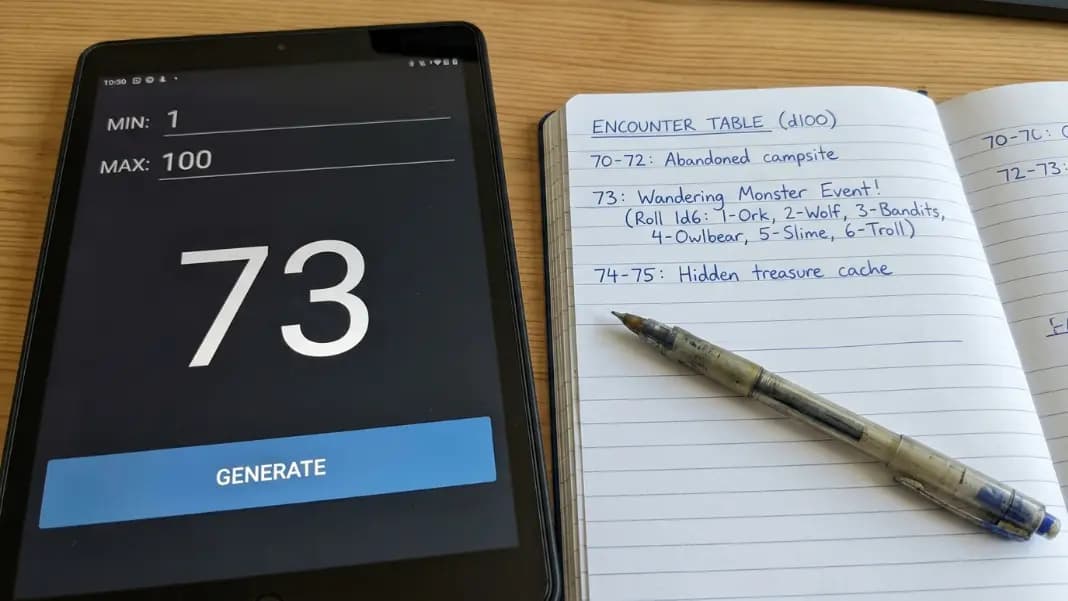
A percentile table (D100) covers 100 outcomes. Common examples include wild magic surge tables in D&D, random loot tables, and critical hit charts with expanded effects. Generate from 1-100, locate the row, apply the result.
Some systems use a D20 table with a subtable on specific results. Roll the primary D20. If the result is 14, consult the subtable for that row, which might use a D6 or D8 for a more specific outcome. Run the generator twice with different ranges: once for the D20 primary roll, then again with the subtable's die size for the secondary roll.
For GMs who run sessions with many random encounters, keeping the generator open in a browser tab throughout the session provides a fast dice roll for any table type without switching tools.
Board Games and Custom Mechanics
Most board games use standard dice, and the dice roller with its preset die buttons is often faster for those formats. Where the number generator earns its place in board game settings is when the game requires a range the standard dice set cannot cover.
Non-standard die sizes in modern board games: Some contemporary board games and wargames use D3, D8, or custom face configurations for specific mechanics. A D3 result uses maximum set to 3. Any non-standard size follows the same pattern.
Custom board game mechanics that use numbers from a range: Some games draw a number from a pool or a spinner rather than a die. When that physical component is missing or worn out, a number generator set to the same range covers the mechanic. If the spinner has 12 positions numbered 1 to 12, set maximum to 12 and generate.
Drawing without replacement: Some board game mechanics require results that cannot repeat within a session, like numbered tiles that are drawn and removed from a pool. The generator with unique mode enabled and count set to the total pool size produces a complete random ordering in one operation. The first result in the sequence is the first tile drawn, the second is the second tile, and so on through the pool. This is the same as physically shuffling and drawing without replacement.
For standard board game formats using D6 rolls for movement, a 1-6 generator covers the mechanic but the dice roller's physical-die-style interface is more game-appropriate if atmosphere matters to the group.
Party Games and Group Decisions
Party games use random numbers in two main ways: picking who goes next or gets a question, and determining a result within a game mechanic.
For pick-who-goes-next, number the players starting at 1. Set the generator maximum to the player count and spin. The result determines who is next. Because everyone sees the same interface and the same spin, no one can accuse the process of bias. The wheel spinner is an alternative for named lists where participants prefer to see their name rather than a number, but the number generator is faster when players are already numbered.
For game mechanics with random outcomes, set the range to match whatever the game needs. A party game where 6 different challenges exist and one is selected each round uses maximum 6. A game with 20 question categories uses maximum 20. A game where a player must earn a score between 1 and 10 uses maximum 10.
For truth or dare variants, the generator picks a number that corresponds to a card from a physical deck or a row on a printed list. Generate from 1 to the total number of cards or items, read the corresponding prompt, run the activity. This removes the need for anyone in the group to act as the selector, which reduces the social pressure that comes from a person making the choice.
For competitive party formats where players are assigned teams or roles by number, generating a unique shuffled list from 1 to the player count distributes everyone in random order without repeats. The first N names in the resulting sequence form team 1, the next N form team 2, and so on.
When the Dice Roller Is the Better Choice
The dice roller and the number generator cover overlapping ground for game use, but each has situations where it is clearly the better tool.
Use the dice roller when:
- You are rolling multiple standard dice types in a single session and want to switch between them with one button tap
- You need a running total displayed alongside each individual result, which the dice roller shows automatically
- The physical-die visual format matters to the group and contributes to the game atmosphere
- You are playing a game with standard D&D die types and need D8 and D12 frequently, which the dice roller presets cover in one tap
Use the number generator when:
- The die size you need does not exist physically (D7, D9, D13, D16, any custom range)
- You need a single roll from an encounter table and are already using the generator for something else
- You need multiple unique results from one range without repeats, which unique mode handles in one draw
- The game mechanic is not dice-based but still requires a random number from a range
For most casual game sessions, both tools are accessible in different tabs and the choice becomes habit: dice roller for standard multi-die encounters, number generator for tables, custom ranges, and anything that falls outside the standard die set.
Getting the Right Range for Any Game Mechanic
The random tools section has everything for game-related randomness beyond the number generator. The dice roller for standard die formats, the wheel spinner for named selections, and the bracket generator for single-elimination tournament setups. Start with the number generator for any mechanic that maps to a number in a range, set the minimum and maximum to match the die or table you need, and the right result is one spin away.
For game sessions that run multiple hours with many different rolls, keeping the generator open in a tab alongside the dice roller gives you coverage for every die type that exists and every range that does not.