Free BMI Calculator Online
Free online BMI calculator for men, women, and children. Enter your height and weight in metric (kg, cm) or imperial (lbs, ft, in) and get your body mass index instantly with your WHO category, healthy weight range, and practical next steps. No signup required.
How to calculate BMI
BMI is calculated by dividing your weight in kilograms by the square of your height in metres. The formula is:
BMI = weight (kg) / height (m)²
For example, a person weighing 70 kg at 1.75 m tall has a BMI of 70 / (1.75 × 1.75) = 22.9. In imperial units, the equivalent formula is BMI = (weight in lbs × 703) / height in inches². The calculation is identical for men and women. This tool handles the arithmetic instantly so you do not need to calculate your BMI manually.
How to use the BMI calculator online
- Select your unit system: metric (kg, cm) or imperial (lbs, ft, in).
- Enter your height and weight in the input fields provided.
- Your BMI calculates instantly and the gauge updates to show your category.
- Read your BMI classification and healthy weight range in the results panel.
- Use the WHO reference table to compare your result against all BMI categories.
BMI categories and what they mean
The World Health Organization defines four standard BMI categories for adults. A BMI below 18.5 is classified as underweight and may indicate inadequate calorie intake or an underlying condition. A BMI between 18.5 and 24.9 is the normal weight range, associated with the lowest risk of weight-related chronic disease in large population studies. A BMI between 25.0 and 29.9 falls in the overweight range, associated with moderately elevated risk of type 2 diabetes, cardiovascular disease, and hypertension. A BMI of 30 or above is classified as obese, with substantially increased risk across multiple conditions.
These thresholds are the same for all adults regardless of sex. To understand your ideal target weight, pair this result with the ideal weight calculator, which provides healthy weight ranges from four clinical formulas specific to your height and sex.
BMI calculator for men vs women
The BMI formula and WHO category thresholds are identical for men and women, but the result has a different meaning by sex. Women naturally carry a higher proportion of body fat than men at the same BMI because of physiological differences in muscle-to-fat ratio. A BMI of 23 in a female typically corresponds to a higher body fat percentage than a BMI of 23 in a male, even though both fall in the normal weight category. This is why BMI alone is not a complete picture of body composition for either sex.
For a sex-specific body composition estimate, use the body fat percentage calculator, which applies the US Navy circumference method and accounts for biological sex in its formula. This gives a more accurate picture of fat mass versus lean mass than the BMI index calculator alone.
BMI by age: adults, children, and teenagers
For adults aged 20 and over, BMI categories are fixed at the WHO thresholds (18.5, 25, 30) regardless of age. Some research suggests that adults over 65 may have better health outcomes at a slightly higher BMI (22 to 27) than younger adults, but clinical guidelines have not formally revised the thresholds for older adults.
For children and teenagers (ages 2 to 20), BMI is calculated with the same formula but interpreted using age- and sex-specific growth percentiles rather than fixed cut-off points. A child BMI calculator compares the score against a reference population of the same age and sex. A result at or above the 95th percentile is classified as obese; 85th to 94th percentile is overweight; 5th to 84th percentile is healthy weight; and below the 5th percentile is underweight. This percentile approach is used because children's body fatness changes naturally as they grow.
Asian BMI thresholds and NHS guidelines
Standard BMI thresholds were developed largely from data on European populations. Research has since shown that people of Asian descent accumulate visceral fat and develop metabolic risk at lower BMI values. The WHO and NHS both recognise alternative action points for Asian adults: overweight is typically defined from a BMI of 23.0 rather than 25.0, and obese from 27.5 rather than 30.0. If you are of South Asian, East Asian, or Southeast Asian descent, your healthcare provider may use these adjusted thresholds when interpreting your BMI index result.
NHS BMI guidelines for the general UK population follow the standard WHO thresholds for adults, with a healthy range of 18.5 to 24.9. The NHS also advises that for adults from Black, Asian, and minority ethnic backgrounds a healthy BMI is 18.5 to 22.9, with overweight defined from 23.0. This makes accurate body mass index BMI calculation particularly important for people in these groups who may face elevated risk at BMI levels that fall within the standard normal range.
BMI limitations and when to use other tools
BMI is a useful population-level screening tool, but it has well-documented limitations when applied to individuals. It cannot distinguish fat mass from lean mass. A highly muscular person with very low body fat may score in the overweight range. Conversely, someone with a BMI in the normal range can still carry dangerous levels of visceral fat, sometimes called normal-weight obesity or skinny fat, which carries similar metabolic risks to a higher BMI.
For a complete picture of your health, combine your BMI result with the body fat percentage calculator and the TDEE calculator to understand both your body composition and daily energy needs. If your BMI suggests action is needed, the calorie calculator can help you set a realistic daily calorie target to reach a healthier weight. All four tools work together to give you an accurate and actionable health snapshot.
Frequently asked questions about BMI
BMI is calculated by dividing your weight in kilograms by the square of your height in metres: BMI = weight (kg) / height (m)². For example, a person who is 70 kg and 1.75 m tall has a BMI of 70 / (1.75 × 1.75) = 22.9 kg/m². In imperial units, the formula is: BMI = (weight in lbs × 703) / height in inches². The calculation is the same for men and women.
The World Health Organization defines a healthy BMI range for adults as 18.5 to 24.9 kg/m². Below 18.5 is underweight. Between 25.0 and 29.9 is overweight. A BMI of 30 or above is classified as obese. These thresholds apply to all adults regardless of age or sex, though some research suggests slightly different values may be more appropriate for older adults and certain ethnic groups.
The BMI formula and WHO category thresholds are the same for men and women. However, women naturally carry a higher proportion of body fat than men at the same BMI, because muscle and fat are distributed differently between the sexes. A BMI of 22 in a woman typically corresponds to a higher body fat percentage than the same BMI in a man. For a sex-specific measurement, use the body fat percentage calculator alongside your BMI result.
BMI for children and teenagers (ages 2 to 20) is calculated using the same formula as adults, but the result is interpreted differently. Instead of fixed category thresholds, a child's BMI is compared to age- and sex-specific growth charts, expressed as a percentile. A BMI at or above the 95th percentile for age and sex is classified as obese; 85th to 94th percentile is overweight; 5th to 84th percentile is healthy weight; and below the 5th percentile is underweight.
No. BMI is a poor measure of health for highly muscular individuals because it cannot distinguish fat mass from lean mass. A bodybuilder or professional athlete may have a BMI in the overweight or obese range while carrying very low body fat. For muscular individuals, the body fat percentage calculator using the US Navy circumference method gives a more meaningful measurement of body composition than BMI alone.
Yes. Research and health authorities including the WHO suggest that Asian adults face increased health risks at lower BMI values than the standard thresholds. The recommended action points for Asian populations are: underweight below 18.5, normal weight 18.5 to 22.9, overweight 23.0 to 27.4, and obese 27.5 and above. If you are of Asian descent, discuss these alternative thresholds with your healthcare provider when interpreting your BMI result.
A BMI in the overweight range (25 to 29.9) is worth addressing but does not require drastic action. Start by calculating your TDEE to understand your maintenance calorie level, then create a modest daily calorie deficit using the calorie calculator. Even a 5 to 10 percent reduction in body weight produces meaningful improvements in blood pressure, blood sugar, and cholesterol. Consult a healthcare provider or registered dietitian before making significant changes to your diet or exercise routine.
The standard BMI formula uses only weight (kg) and height (m) as inputs. Age is not part of the calculation for adults. However, age is relevant when interpreting the result: some researchers suggest that slightly higher BMI values may be acceptable for adults over 65. For children and teenagers, age is essential because the result is compared against age-specific growth percentiles rather than fixed thresholds.
Related articles
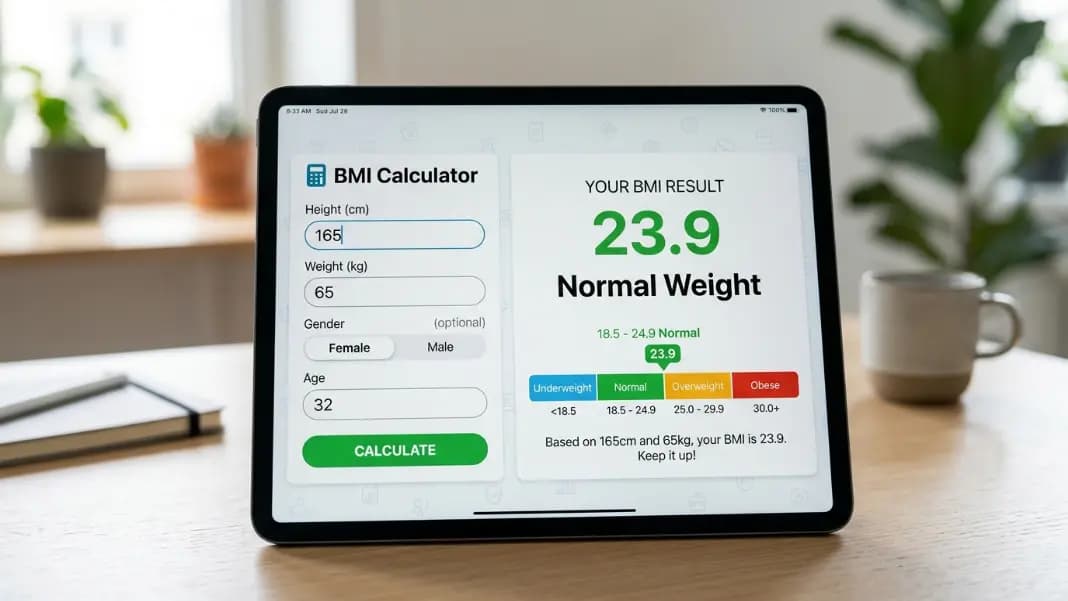
BMI Calculator for Women: Healthy Ranges by Age and What the Numbers Mean
BMI calculator for women: find your healthy range by age, understand your result in kg, and learn what the numbers mean for your body and health goals.
12 min read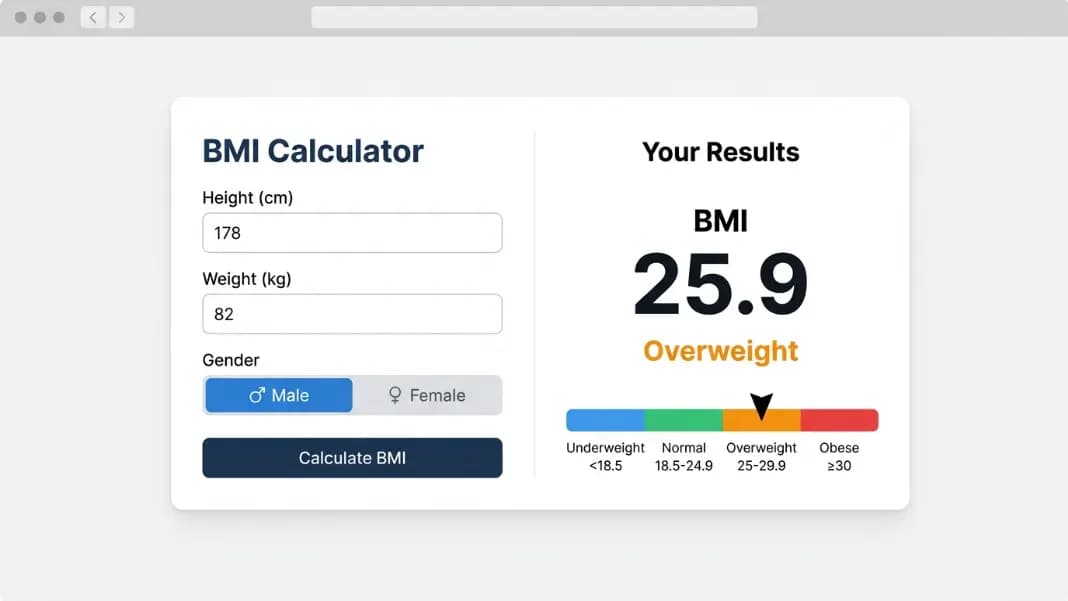
BMI Calculator for Men: Healthy Ranges, Age, and What the Numbers Mean
Use a BMI calculator for men by age and weight in kg. Covers healthy BMI ranges for males, how results shift with age, and when the numbers can mislead.
13 min read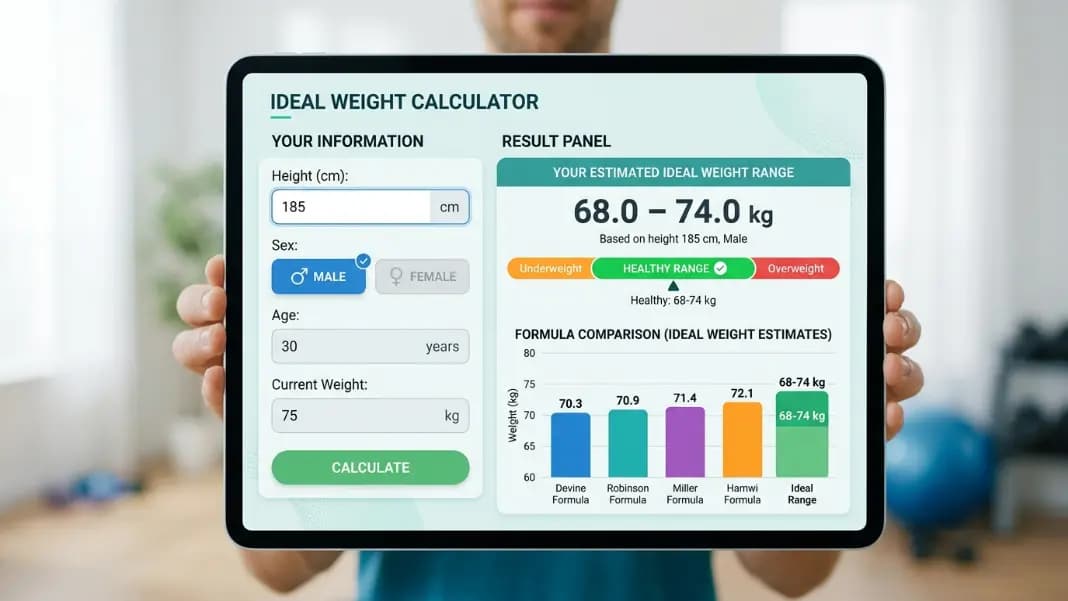
Ideal Weight Calculator: Find Your Healthy Weight Range
Learn how ideal weight calculators work, what formulas they use, how frame size affects your range, and how it differs from BMI and body fat percentage.
8 min read