Free Pregnancy Due Date Calculator Online
The pregnancy due date calculator estimates your expected delivery date from your last menstrual period (LMP), conception date, or IVF embryo transfer date. Returns your estimated due date, current pregnancy week, trimester, days remaining, and a full milestone timeline. Free online pregnancy calculator with no account needed. Always confirm with your healthcare provider.
How to use the pregnancy due date calculator
- Select your input method: Last Period (LMP), Conception Date, or IVF Transfer.
- For LMP: enter the first day of your last menstrual period and your average cycle length.
- For Conception Date: enter the date you believe conception occurred.
- For IVF Transfer: enter the transfer date and select Day 3 (cleavage) or Day 5 (blastocyst).
- Your estimated due date, current week, trimester progress, and milestone timeline appear instantly.
How to calculate pregnancy due date: Naegele's rule explained
The standard formula to calculate pregnancy due date is Naegele's rule, developed in 1812 and still used in obstetric practice worldwide. The formula: EDD = LMP + 280 days (40 weeks). An equivalent shortcut: take the LMP date, add one year, subtract three months, and add seven days.
The 280-day figure assumes a 28-day menstrual cycle with ovulation on day 14. Human pregnancy lasts approximately 266 days from conception (38 weeks), and the extra 14 days account for the period between the LMP and ovulation. This calculator adjusts the EDD if your cycle length differs from 28 days: for every day your cycle is longer than 28 days, one day is added to the EDD; for every day shorter, one day is subtracted.
Only about 4 percent of babies are born on their exact calculated due date. The full-term delivery window spans weeks 37 to 42 (259 to 294 days from LMP), and approximately 80 percent of births occur within two weeks of the EDD. The due date is therefore best understood as the midpoint of a two to three week delivery window, not a fixed deadline.
Pregnancy due date calculator from conception date
If you know your conception date (for example, from ovulation tracking, a positive ovulation test, or fertility monitoring), you can calculate your due date directly: EDD = conception date + 266 days. This bypasses the 14-day LMP-to-ovulation assumption in Naegele's rule and can be more accurate when cycle length is irregular.
The conception date method is particularly useful for women who track ovulation precisely using basal body temperature charts, LH surge tests, or fertility monitors. The calculator's Conception Date tab accepts your conception date directly and computes the EDD as conception + 266 days, with gestational age calculated accordingly. Note that even with a known conception date, the EDD remains an estimate because implantation timing, fetal growth rates, and other factors affect actual delivery timing.
IVF pregnancy due date calculator
The IVF pregnancy due date calculator is more precise than the LMP method because the fertilization date is known exactly. The calculation depends on the age of the embryo at the time of transfer:
- Day 5 blastocyst transfer: EDD = transfer date + 261 days. Equivalent LMP = transfer date minus 19 days.
- Day 3 cleavage embryo transfer: EDD = transfer date + 263 days. Equivalent LMP = transfer date minus 17 days.
The difference is because a Day 5 embryo has already developed for 5 days outside the womb before transfer, so it is developmentally further along than a Day 3 embryo at the moment of transfer. IVF due dates calculated this way are considered highly accurate since the fertilization date is precisely known rather than estimated from cycle dates.
Gestational age in IVF pregnancies is still counted from the equivalent LMP date, not from the transfer date, because obstetric conventions use LMP-based gestational age for all clinical measurements. Your clinic will confirm the EDD at your first ultrasound appointment using fetal measurements.
Pregnancy due date calculator NHS: how UK dating works
The NHS (UK National Health Service) uses Naegele's rule as the initial due date estimate, identical to this calculator. The NHS protocol then requires a dating ultrasound between 10 and 14 weeks (the "booking scan") to confirm or revise the EDD based on fetal crown-rump length measurements.
If the ultrasound date differs from the LMP-based date by more than 5 to 7 days, the NHS revises the EDD to match the ultrasound measurement. This is because early fetal growth is highly consistent across pregnancies and provides a more accurate gestational age estimate than LMP recall, which can be subject to cycle irregularity or uncertainty about the exact LMP date. The result from this online pregnancy calculator will match the NHS LMP-based estimate; the ultrasound confirmation is something only your NHS midwife or sonographer can provide.
Pregnancy week by week: what to expect by trimester
The pregnancy week calculator by due date in this tool shows your current week and trimester alongside the milestone timeline. Key stages by trimester:
- First trimester (weeks 1 to 13): All major organ systems form. Highest miscarriage risk period. Key appointments: first prenatal visit (weeks 8 to 10), nuchal translucency screening (weeks 11 to 14). Morning sickness is most common in weeks 6 to 12.
- Second trimester (weeks 14 to 27): Fetal movement typically first felt (weeks 16 to 20, sometimes called "quickening"). Anatomy scan at weeks 18 to 21. Glucose tolerance test at weeks 24 to 28. Energy typically improves as morning sickness subsides.
- Third trimester (weeks 28 to 40): Rapid fetal weight gain. Lung maturation. Baby descends into pelvis. Prenatal visits increase to weekly from week 36. Full term is reached at week 37; optimal delivery window is weeks 39 to 40.
During pregnancy, daily water intake needs increase by approximately 300 ml above baseline to support increased blood volume, amniotic fluid maintenance, and fetal development. Staying well hydrated also reduces the risk of preterm contractions in the third trimester.
After your due date: planning for your baby's arrival
Once your baby is born, you can use the age calculator to track your baby's exact age in weeks and months, which is particularly useful for pediatric growth chart reference points and developmental milestone tracking in the first two years. Pediatric milestones are typically expressed in corrected age (actual age minus weeks of prematurity) for babies born before 37 weeks, and the age calculator's custom date feature supports this. Sleep cycle tracking becomes relevant postpartum as newborn sleep patterns (45 to 60 minute cycles vs. the adult 90 minutes) directly affect parental sleep quality and recovery.
For a detailed explanation of how Naegele's rule works, how LMP and ultrasound dating compare, and what the 40 weeks mean trimester by trimester, read the pregnancy due date guide.
Frequently asked questions
The standard method is Naegele's rule: add 280 days (40 weeks) to the first day of your last menstrual period (LMP). Alternatively: take your LMP date, add one year, subtract three months, and add seven days. Example: LMP is August 1, 2025. Add one year = August 1, 2026. Subtract 3 months = May 1, 2026. Add 7 days = May 8, 2026 (estimated due date). This assumes a standard 28-day cycle. If your cycle is longer or shorter, the calculator adjusts the EDD accordingly.
To calculate your due date from conception, add 266 days (38 weeks) to the conception date. Conception typically occurs 14 days after the first day of the last menstrual period in a 28-day cycle. Example: if conception occurred on September 15, 2025, the EDD = September 15 + 266 days = June 8, 2026. Use the "Conception Date" tab in the pregnancy calculator to enter your conception date directly without needing to know your LMP.
For IVF pregnancies, the due date is calculated from the embryo transfer date based on the embryo's age at transfer. For a Day 5 blastocyst transfer: EDD = transfer date + 261 days (the equivalent LMP date is transfer date minus 19 days). For a Day 3 cleavage embryo transfer: EDD = transfer date + 263 days (equivalent LMP = transfer date minus 17 days). The IVF due date calculation is more precise than LMP-based calculations because the fertilization date is known exactly.
Using Naegele's rule: add 280 days (40 weeks) to the first day of your last menstrual period. This assumes a 28-day cycle with ovulation on day 14. If your cycle is regularly longer or shorter than 28 days, the due date is adjusted accordingly (one day per day of cycle length difference). Naegele's rule gives an estimated due date. About 80 percent of births occur within two weeks of the calculated EDD.
An LMP-based due date is an estimate. Only about 4 percent of babies are born on their exact calculated due date. Around 80 percent of births occur within two weeks of the EDD. The LMP method is least accurate for women with irregular cycles or cycles significantly different from 28 days. An early ultrasound (performed between 8 and 13 weeks) provides a more accurate due date by measuring fetal crown-rump length and is the preferred method in clinical settings when there is any uncertainty.
The NHS (National Health Service, UK) calculates the estimated due date using the same Naegele's rule formula as most international guidelines: LMP + 280 days. The key difference is that the NHS recommends an early dating ultrasound between 10 and 14 weeks as the primary method for confirming the due date. If the ultrasound date differs from the LMP-calculated date by more than 5 to 7 days, the NHS uses the ultrasound date. The pregnancy due date calculator NHS result from this tool will match the Naegele's rule estimate; always confirm with your NHS midwife or sonographer.
The first trimester spans weeks 1 to 13. The second trimester covers weeks 14 to 27. The third trimester runs from week 28 through delivery at approximately week 40. The first trimester involves the most critical organ formation and carries the highest miscarriage risk. The second trimester is typically when fetal movement is first felt (around weeks 16 to 20). The third trimester involves rapid fetal weight gain, lung maturation, and descent into the pelvis in preparation for birth.
Book your first prenatal appointment as early in the first trimester as possible, ideally before week 10. Your healthcare provider will confirm your estimated due date through clinical history and, most accurately, through an early dating ultrasound (typically between 8 and 13 weeks). The ultrasound measures fetal crown-rump length to estimate gestational age with greater precision than the LMP method alone. Do not rely solely on a calculator-generated date for medical planning.
Related articles
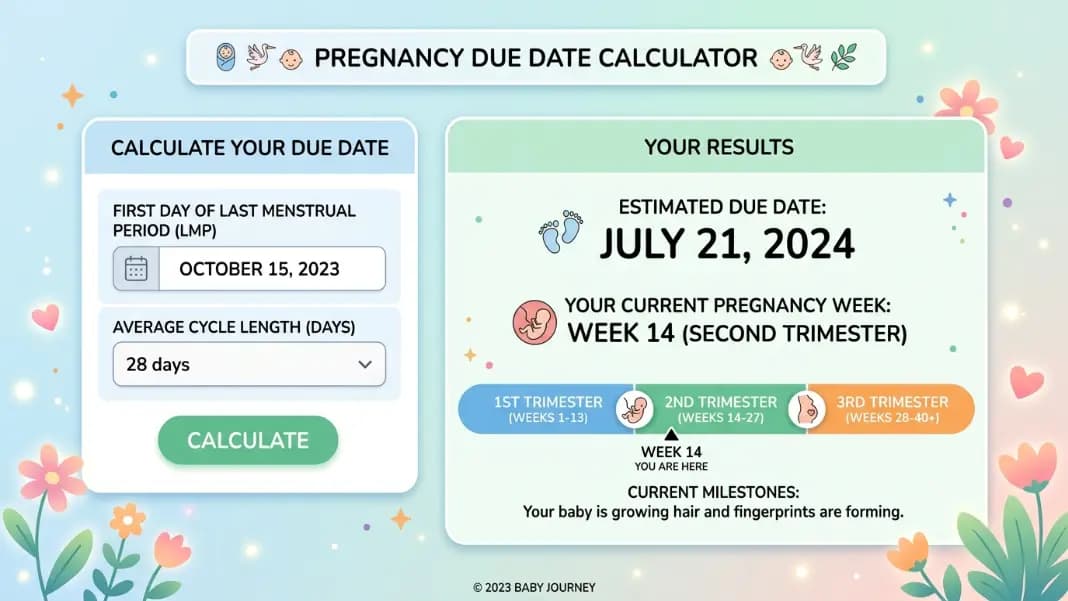
Pregnancy Due Date Calculator: How to Find Your EDD
Learn how pregnancy due date calculators work, what Naegele's rule is, how LMP and ultrasound methods differ, and what the 40 weeks mean trimester by trimester.
8 min read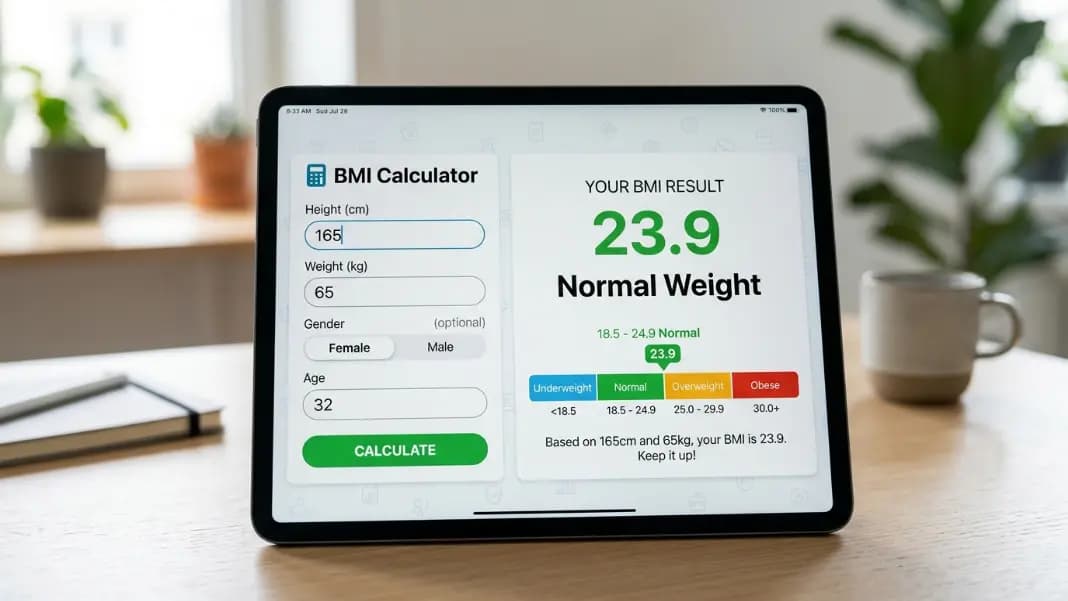
BMI Calculator for Women: Healthy Ranges by Age and What the Numbers Mean
BMI calculator for women: find your healthy range by age, understand your result in kg, and learn what the numbers mean for your body and health goals.
12 min read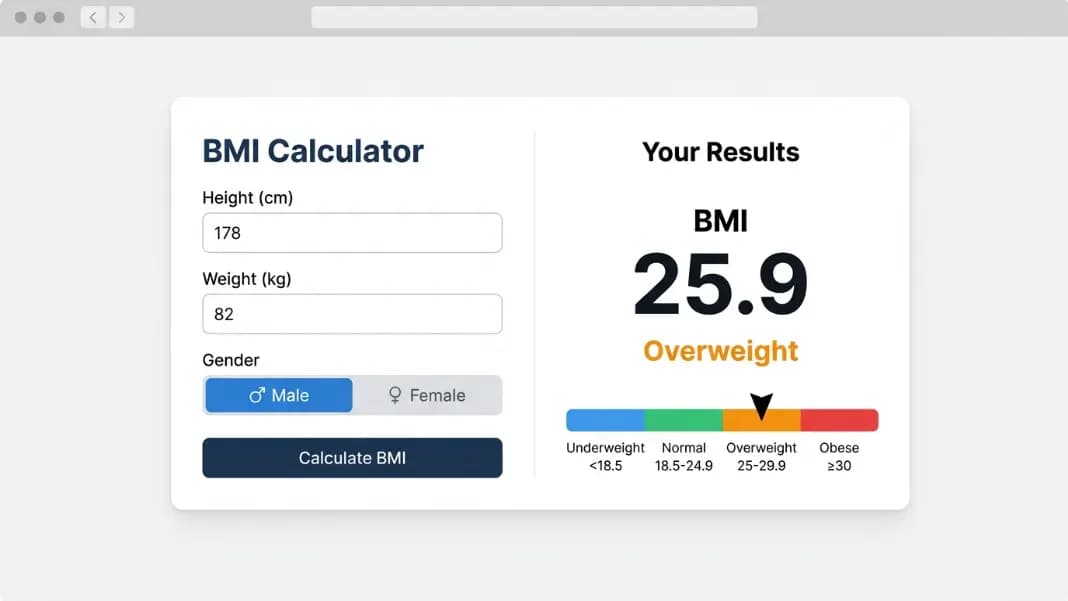
BMI Calculator for Men: Healthy Ranges, Age, and What the Numbers Mean
Use a BMI calculator for men by age and weight in kg. Covers healthy BMI ranges for males, how results shift with age, and when the numbers can mislead.
13 min read