Most pregnancies are dated from the first day of your last period, not from when conception actually happened. This makes the timeline feel counterintuitive at first. By the time a pregnancy test shows positive, you are already considered four to five weeks along, even though fertilization occurred just two weeks earlier.
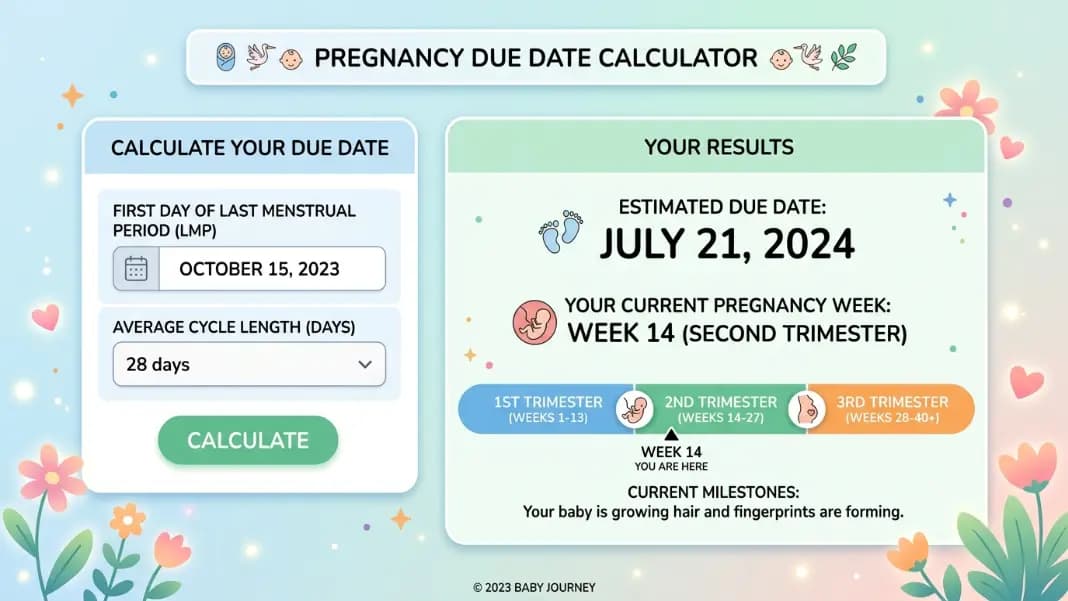
The pregnancy due date calculator at ToolCenterHub gives you your estimated due date, your current week, and your trimester based on your LMP date. Enter the first day of your last period, adjust for cycle length if your cycle is not 28 days, and the result is immediate.
This guide explains the math behind due date calculation, how ultrasound dating compares to the LMP method, what the 40 weeks are organized into, and what full term actually means.
Why pregnancy is dated from the last period
Conception happens at fertilization, roughly two weeks after the start of a typical menstrual period. Logically, you might expect pregnancy to be counted from conception. In practice, it is counted from the LMP for a straightforward reason: most women know when their period started, but very few know exactly when ovulation and fertilization occurred.
The LMP date provides a consistent, reproducible starting point that does not require knowing the exact day of conception. The 40-week timeline is built around this convention. When a provider says you are six weeks pregnant, they mean six weeks have passed since the start of your last period, not six weeks since conception.
This convention is also why pregnancy tests can be positive at four weeks of gestational age even though the embryo is only about two weeks old at that point.
How Naegele's rule works
The standard due date formula is called Naegele's rule. The calculation adds 280 days (40 weeks) to the first day of the last menstrual period.
In practice it works like this: take your LMP date, add one year, subtract three months, add seven days. If your LMP was September 15, adding one year gives September 15 next year, subtracting three months gives June 15, adding seven days gives June 22. That is your estimated due date.
The formula assumes a regular 28-day cycle with ovulation at day 14. If your cycles are consistently longer, say 35 days, you ovulate later than day 14, and your actual due date is likely a week later than Naegele's rule suggests. The pregnancy due date calculator allows you to enter your average cycle length to adjust for this.
Naegele's rule was developed in the early 1800s and remains the foundation of clinical due date calculation today. It is a statistical estimate, not a precise prediction. Only about 5 percent of babies are born on their calculated due date. The majority arrive within two weeks on either side.
LMP method versus ultrasound dating
The LMP method is fast and requires only knowing one date. Ultrasound dating is more accurate, particularly early in pregnancy.
A first-trimester ultrasound measures the crown-rump length of the embryo, the distance from the top of the head to the base of the spine. This measurement correlates closely with gestational age between 8 and 13 weeks. The margin of error is plus or minus five to seven days in the first trimester.
When the ultrasound measurement and the LMP calculation agree within a week, providers typically leave the LMP-based due date unchanged. When they differ by more than seven days, the due date is usually adjusted to match the ultrasound findings.
Second and third trimester ultrasounds measure different parameters, including head circumference and femur length, but are less reliable for dating because babies grow at increasingly variable rates as pregnancy progresses. Fetal size in the third trimester reflects individual genetics and nutrition more than gestational age, so later scans are not used to change the established due date.
The 40 weeks: how pregnancy is divided
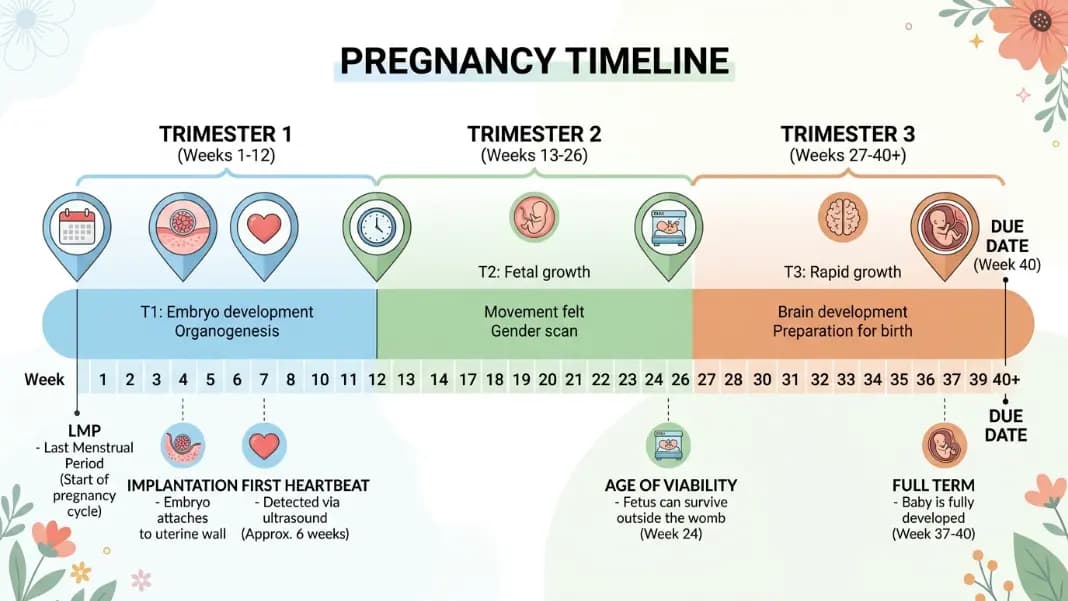
Pregnancy is divided into three trimesters. The gestational ages given here all count from the LMP date.
First trimester: weeks 1 to 13. This is the period of most rapid early development. The embryo forms all major organ systems during this phase. The first trimester ends around the time of the first major prenatal screening tests, including nuchal translucency ultrasound and first-trimester blood screening. Miscarriage risk is highest in the first trimester and drops significantly after 12 to 13 weeks.
Second trimester: weeks 14 to 27. Often described as the most comfortable period of pregnancy. Morning sickness typically eases. The fetus grows substantially in size. Fetal movement is usually felt for the first time between 18 and 22 weeks. Anatomy ultrasound is typically scheduled around 18 to 20 weeks to assess fetal development and check for structural abnormalities.
Third trimester: weeks 28 to 40. The fetus gains most of its birth weight during this period, growing from around 1 kg to the full term weight. Lung maturity is one of the last systems to develop fully. Babies born after 34 weeks have generally good survival outcomes with medical support. After 37 weeks, the lungs are considered mature enough for delivery.
What full term actually means
Full term is defined as 39 weeks 0 days through 40 weeks 6 days. This is a relatively recent clinical definition, introduced after research showed that outcomes differ meaningfully across this range.
Babies born between 37 weeks 0 days and 38 weeks 6 days are classified as early term. While survival rates are high in this window, early term babies have higher rates of respiratory issues, feeding difficulties, and neonatal intensive care admissions compared to babies born at 39 weeks or later.
Babies born before 37 weeks are preterm, with subcategories based on how early delivery occurs. Late preterm (34 to 36 weeks), very preterm (28 to 33 weeks), and extremely preterm (before 28 weeks) carry progressively higher risks requiring more intensive support.
The due date on the calculator is the end of the full-term window, at 40 weeks. It is an estimate, not an expiration date. Going past the due date is common. Most providers allow pregnancies to continue to 41 weeks with close monitoring. Post-term, defined as 42 weeks or beyond, is when the risk of complications begins to rise and many providers recommend induction.
When the due date might change
Due dates are adjusted in a few specific situations.
If early ultrasound measurements are significantly different from the LMP estimate, the due date shifts to match the ultrasound. This is the most common reason for a change in the first trimester.
If you do not know your LMP date, have irregular cycles, were recently on hormonal contraception, or were breastfeeding before conception, LMP-based dating is less reliable. In these situations, ultrasound dating is the primary method used to establish gestational age.
Assisted reproduction changes the calculation. For pregnancies achieved through IVF, the embryo transfer date is known precisely, and gestational age is calculated directly from the transfer date rather than from the LMP.
Cycle length and your due date
The standard due date formula assumes a 28-day cycle. If your cycles run longer or shorter than 28 days consistently, your ovulation date shifts accordingly, and so does your actual conception date.
For every day your average cycle is longer than 28 days, your due date shifts about one day later. For a 35-day cycle, your due date would be approximately one week later than a standard LMP calculation would suggest. For a 21-day cycle, your due date would be about one week earlier.
The pregnancy due date calculator accounts for cycle length. Enter your average cycle length in the calculator to get a more accurate estimate if your cycles are not close to 28 days.
Tracking the weeks ahead
After you have your due date, knowing which week you are in at any given point helps you understand which prenatal appointments and tests are expected.
Key milestones during a typical pregnancy timeline: first prenatal appointment usually between 8 and 10 weeks, first-trimester screening between 11 and 13 weeks, anatomy ultrasound between 18 and 20 weeks, glucose screening between 24 and 28 weeks, group B strep testing between 35 and 37 weeks, and weekly appointments from 36 weeks onward.
The age calculator can help you track how many days and weeks have passed from any date, which is useful for confirming gestational age between appointments.
All health calculators at ToolCenterHub are available at the health tools hub and run directly in the browser without any login or app installation required.