The scale gives you a number. What it does not tell you is whether that number is right for your height, your build, or your sex. Ideal weight calculators translate height into a target range, giving you a more useful reference point than the scale alone.
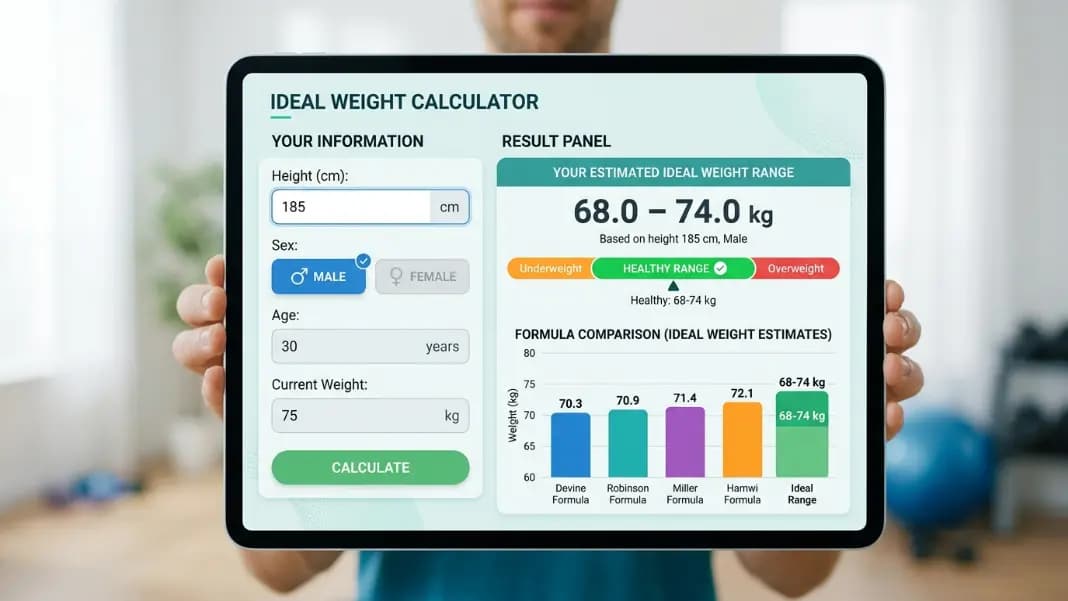
The ideal weight calculator at ToolCenterHub uses four established formulas to produce a weight range specific to your height and sex. Enter your measurements and you get the range immediately, along with how each formula compares.
This guide explains how the formulas work, why men and women have different targets at the same height, how frame size affects the result, and how ideal weight relates to BMI and body fat percentage.
What ideal body weight actually means
Ideal body weight is not a single precise number. It is a range, typically spanning 5 to 10 kg, that represents the weights associated with the best average health outcomes for a given height and sex in large population studies.
The concept originated in medical and pharmaceutical contexts. Clinical dosing for certain medications depends on body weight, and dosing based on total body weight in obese patients can lead to overdosing because fat tissue does not absorb many drugs the same way lean tissue does. Ideal body weight formulas gave clinicians a lean-tissue-based weight reference for dosing calculations.
The formulas have since migrated into general health and fitness use, where they serve as a rough benchmark for healthy weight targets. They are useful as a starting point for goal-setting but should not be interpreted as a precise prescription for any individual.
The formulas behind the calculator
Four formulas are widely used for ideal weight calculation, each developed in a different decade with slightly different base values.
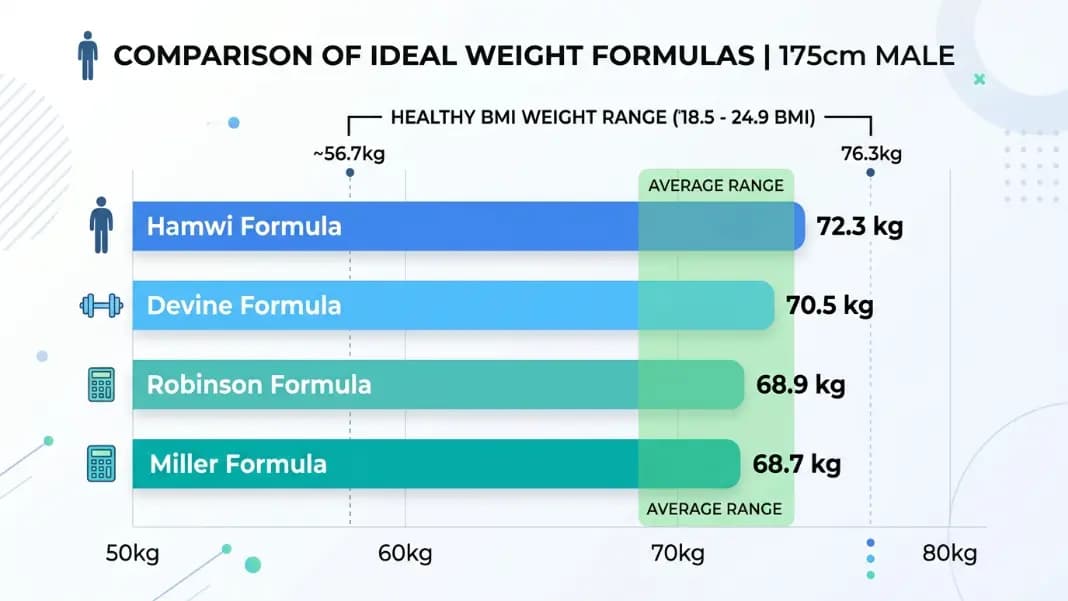
Devine formula (1974): The most commonly referenced formula. For men, ideal weight = 50 kg + 2.3 kg for each inch over 5 feet. For women, ideal weight = 45.5 kg + 2.3 kg for each inch over 5 feet. A 175 cm man (5 ft 9 in) gets a Devine ideal weight of approximately 70 kg.
Robinson formula (1983): A revision of Devine that adjusts the per-inch increment slightly. For men: 52 kg + 1.9 kg per inch over 5 feet. For women: 49 kg + 1.7 kg per inch over 5 feet. Produces slightly lower results than Devine for taller individuals.
Miller formula (1983): Another revision. For men: 56.2 kg + 1.41 kg per inch over 5 feet. For women: 53.1 kg + 1.36 kg per inch over 5 feet. Tends to give higher base weights than Devine but a lower per-inch increment.
Hamwi formula (1964): The oldest of the four. For men: 48 kg base at 5 feet, plus 2.7 kg per inch. For women: 45.4 kg base, plus 2.2 kg per inch. The Hamwi formula produces the widest spread across different heights.
The ideal weight calculator runs all four formulas and returns both the individual results and an average range, which accounts for the natural variation between formulas.
Why men and women have different targets at the same height
Men and women of the same height have different ideal weight ranges because of genuine physiological differences in body composition.
Men have denser bones on average. Bone mineral density differences between sexes are well documented and contribute several kilograms to total body weight in men compared to women of equal height. Men also carry higher proportions of muscle mass as a baseline, driven by differences in testosterone and lean tissue distribution.
This means a man and woman who are both 170 cm tall and both in excellent health will naturally weigh different amounts, with the man's healthy weight being 5 to 8 kg higher than the woman's. A single unisex formula would either overestimate for women or underestimate for men, which is why all four major ideal weight formulas have separate male and female calculations.
Frame size and its effect on ideal weight
The standard formulas produce one number for each height and sex. In practice, people of the same height and sex can have meaningfully different skeleton sizes, and a larger frame carries more bone mass and supporting structure.
Frame size is typically estimated using wrist circumference. For a man with a height above 5 ft 5 in, a wrist under 16.5 cm indicates a small frame, 16.5 to 19 cm is medium, and above 19 cm is large. For women with height above 5 ft 2 in, under 15.2 cm is small, 15.2 to 16.5 cm is medium, and above 16.5 cm is large.
A common adjustment for frame size is to take the formula output and apply a 10 percent bracket in each direction. A person with a small frame would aim for the lower end of the range. A large-framed person can reasonably target the upper end. This adjustment is not built into most online calculators but is a straightforward mental adjustment once you know your wrist measurement.
Ideal weight versus BMI versus body fat percentage
These three metrics describe related but different things. Understanding which one to use for what purpose saves a lot of confusion.
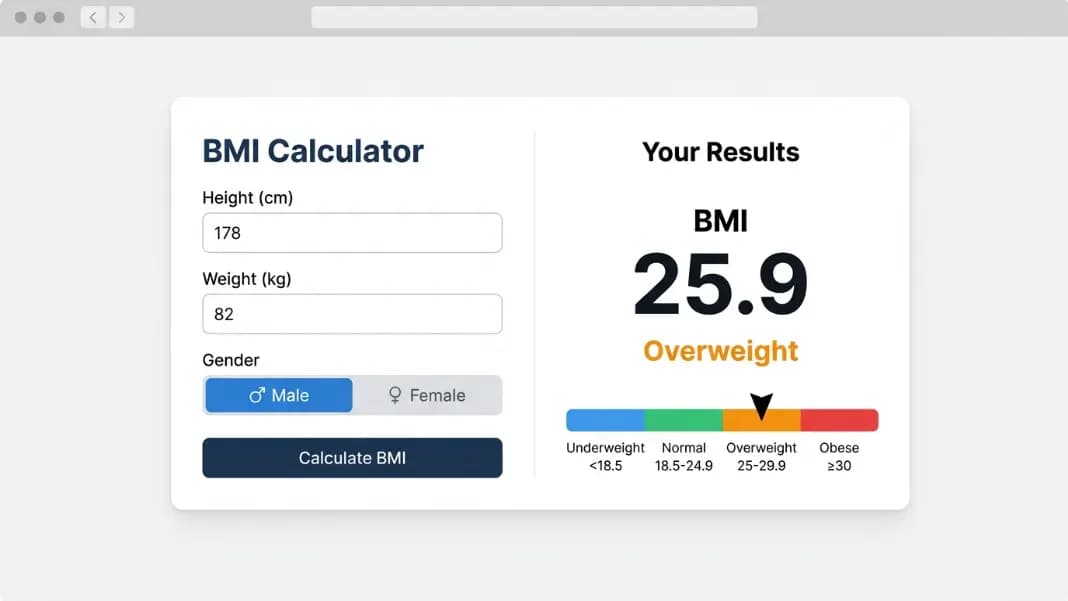
BMI is the quickest calculation: weight divided by height squared. It produces a number that falls into underweight, normal, overweight, or obese categories. The healthy range is 18.5 to 24.9. BMI covers a wide weight span, which makes it a broad screening tool rather than a precise target.
Ideal weight gives a narrower window near the middle of the healthy BMI range. The Devine ideal weight for a 175 cm man is around 70 kg, which corresponds to a BMI of approximately 22.9. This sits comfortably within the healthy BMI range but is more specific than the full 18.5 to 24.9 range, which would cover roughly 55 to 77 kg for the same height.
Body fat percentage is the most informative of the three for health purposes. It tells you what proportion of your weight is actually fat versus lean tissue. Two people can weigh the same, have the same BMI, and have the same ideal weight formula output while carrying dramatically different amounts of fat and muscle. The body fat calculator measures this directly, and the BMI calculator gives the weight-to-height ratio.
For most people, checking all three gives the fullest picture: BMI for a quick category check, ideal weight for a goal reference point, and body fat percentage for the actual composition behind the weight.
Using your ideal weight result practically
The most useful way to use an ideal weight calculation is as a directional guide rather than an exact target.
If you are significantly above the ideal range and also above the healthy BMI range, reducing weight toward the ideal range is a reasonable goal with documented health benefits. The TDEE calculator establishes your daily energy expenditure as the starting point for setting a caloric deficit, and the rate of weight loss can be calibrated from there.
If you are within the healthy BMI range but at the high end of the ideal weight formula's output, the distinction matters less than your body fat percentage and metabolic health markers. A person who exercises regularly, has normal blood pressure, and carries a normal body fat percentage is not meaningfully at risk because they weigh 3 kg more than a formula suggests.
If you are below the ideal weight range, the same logic applies. Being underweight carries its own health risks, particularly for bone density and immune function. A result that puts you below the ideal range should be interpreted in context with how you feel, your energy levels, and medical markers rather than as a number to chase downward.
When weight is not the right goal
Ideal weight formulas focus entirely on the scale and say nothing about body composition. An individual who loses weight through a very low calorie diet with no exercise may reach the ideal weight range while losing significant muscle mass in the process, leaving them at a higher body fat percentage even at a lower scale number.
This is why fitness and body composition goals are often more meaningful than scale weight targets. A goal of reducing body fat percentage from 28 percent to 22 percent, or of adding 5 kg of lean muscle, produces measurable health improvements that a scale weight target does not capture.
For people who have been sedentary and want to improve their health, resistance training combined with a moderate caloric deficit consistently produces better body composition outcomes than aiming for a number on the scale. The weight may not drop as fast, but the proportion of fat to muscle shifts in the right direction, which is the health outcome that matters.
Related health calculators
The TDEE calculator calculates how many calories you burn each day based on your height, weight, age, and activity level. This is the number you need to know before setting any calorie target for weight change.
The body fat calculator gives you the body composition context that ideal weight and BMI cannot provide. Knowing your fat percentage alongside your weight tells you whether your weight is driven by muscle or fat.
The BMI calculator provides the broader weight category reference and is useful for comparing your position within the medically defined healthy, overweight, and obese ranges.
All health tools are free and available at the health tools hub without any account or app required.