Free TDEE Calculator Online
Free online TDEE calculator. Enter your sex, age, height, weight, and activity level to calculate your Total Daily Energy Expenditure instantly. Powered by the Mifflin-St Jeor formula, this accurate TDEE calculator returns your BMR, maintenance calories, and ready-to-use targets for weight loss and muscle gain. Works in metric and imperial units, no account required.
TDEE = BMR × 1.55 (Moderately Active)
What is TDEE and how is it calculated
TDEE stands for Total Daily Energy Expenditure and represents every calorie your body burns in a 24-hour period, including rest, digestion, and all physical activity. It is the single most important number for any nutrition plan because it defines your true maintenance calorie level. To calculate TDEE, the calculator first determines your Basal Metabolic Rate (BMR) using the Mifflin-St Jeor equation, then applies an activity multiplier based on your weekly exercise and movement.
The Mifflin-St Jeor formula for TDEE calculation differs by sex. For men: BMR = (10 × weight in kg) + (6.25 × height in cm) - (5 × age) + 5. For women: BMR = (10 × weight in kg) + (6.25 × height in cm) - (5 × age) - 161. TDEE is then: BMR × activity multiplier, ranging from 1.2 for a sedentary lifestyle to 1.9 for a physically demanding job combined with daily training. This BMR and TDEE calculator applies these formulas automatically so you get an accurate result in seconds.
How to use the TDEE calculator online
- Select your sex (male or female) and enter your age in years.
- Enter your height and weight in metric (cm, kg) or imperial (ft, in, lbs).
- Choose the activity level that best matches your typical weekly routine.
- Read your BMR and TDEE in the results panel.
- Use the calorie targets shown for weight loss (deficit), maintenance, or muscle gain (surplus).
TDEE calculator for weight loss: setting your calorie deficit
The most reliable way to lose weight is to eat fewer calories than your TDEE each day. Knowing your TDEE for weight loss removes the guesswork and gives you a precise number to target. A moderate deficit of 15 to 20 percent below TDEE (typically 400 to 600 calories per day) produces steady fat loss of 0.4 to 0.6 kg per week without triggering significant metabolic adaptation or muscle loss. This is the range most dietitians and evidence-based coaches recommend for sustainable results.
For faster weight loss, a calorie deficit of 500 to 750 calories below TDEE can produce 0.5 to 0.7 kg per week. Deficits above 1,000 calories per day are generally only appropriate under medical supervision. Once you have your TDEE calorie deficit target, use the macro calculator to split your daily calorie allowance into the right protein, carb, and fat ratios for your goal. High protein intake (at least 1.6 g per kg of bodyweight) is especially important during a deficit to preserve lean muscle mass.
TDEE calculator for women vs men
Men and women have different TDEE values at identical height, weight, age, and activity levels. This is primarily because men carry more skeletal muscle mass on average, which is metabolically more expensive than fat tissue. The Mifflin-St Jeor equation accounts for this difference with sex-specific constants: the male formula adds 5 to the BMR while the female formula subtracts 161. In practice, this means a man and woman of the same size and activity level will have a TDEE difference of roughly 150 to 200 calories per day, with the man burning more.
For women, hormonal fluctuations across the menstrual cycle can cause small daily variations in actual energy expenditure of around 100 to 300 calories, which a single TDEE estimate cannot capture. Recalculating your TDEE every four to six weeks as your body composition changes keeps your calorie target accurate. Women considering pregnancy or who are breastfeeding should consult a healthcare provider for calorie needs, as TDEE increases significantly in those states.
TDEE macro calculator: going from calories to macros
TDEE gives you your daily calorie target; the next step is splitting that total into macronutrients. Protein, carbohydrates, and fat each play specific roles in body composition and performance. A common starting split for fat loss is 40 percent protein, 35 percent carbohydrate, and 25 percent fat. For muscle building, a typical ratio is 30 percent protein, 50 percent carbohydrate, and 20 percent fat. Maintenance often uses a balanced 30/40/30 split.
The TDEE macro calculator on this site takes your calorie target and goal, then returns exact daily gram targets for protein, carbs, and fat. Using both tools together gives you a complete, data-driven nutrition plan without needing a personal trainer or nutritionist.
How accurate is the TDEE calculator
The Mifflin-St Jeor equation is the most clinically validated formula for estimating resting metabolic rate in non-obese adults, preferred over the older Harris-Benedict equation in most research settings. Studies show it predicts measured metabolic rate within 10 percent for most individuals. The best TDEE calculator still produces an estimate, not a measurement. The main source of inaccuracy is the activity multiplier, which relies on your self-reported exercise level. Research consistently shows that people overestimate exercise intensity and underestimate sedentary time, leading to an inflated TDEE.
For a more accurate personal TDEE, use the formula result as a starting point, then track your calorie intake and body weight daily for two to four weeks. If your weight is not changing, you are eating at your true maintenance. From there, apply a deficit to lose weight or a surplus to build muscle. For lean and muscular individuals, combining TDEE calculation with a body fat percentage measurement and using the Katch-McArdle formula gives a more accurate BMR by using lean body mass rather than total weight.
Using your TDEE result with other health tools
TDEE is the foundation of a complete health and fitness plan but works best alongside other measurements. Start with the BMI calculator to establish where your current weight sits relative to healthy ranges for your height. Then calculate your TDEE here to set a daily calorie target. Use the calorie calculator to model how different deficit or surplus levels translate to fat loss or muscle gain over time. Finally, feed your calorie target into the macro calculator to build a complete daily nutrition plan.
As your body composition changes through dieting or training, recalculate your TDEE every four to six weeks. Weight loss reduces your TDEE because there is less tissue to maintain, and the activity multiplier may change as your fitness improves and you can train harder or longer. Keeping your calorie targets aligned with your actual TDEE is the most reliable way to keep progress moving in the right direction.
Frequently asked questions about TDEE
To calculate your TDEE, first calculate your BMR using the Mifflin-St Jeor formula: for men, BMR = (10 × weight in kg) + (6.25 × height in cm) - (5 × age) + 5. For women, BMR = (10 × weight in kg) + (6.25 × height in cm) - (5 × age) - 161. Then multiply your BMR by your activity factor: sedentary ×1.2, lightly active ×1.375, moderately active ×1.55, very active ×1.725, or extra active ×1.9. The result is your TDEE, the total calories your body burns per day.
BMR (Basal Metabolic Rate) is the calories your body burns at complete rest, the minimum energy needed to sustain life processes like breathing and circulation. TDEE (Total Daily Energy Expenditure) is your BMR multiplied by an activity factor that reflects your actual daily movement. TDEE is always higher than BMR. For weight management, TDEE is the relevant number because it represents all the calories you burn in a day, not just at rest.
A deficit of 500 calories per day below TDEE produces approximately 0.45 kg (1 lb) of fat loss per week, a sustainable and evidence-based rate. For faster loss, a deficit of 750 to 1,000 calories per day can produce 0.7 to 0.9 kg (1.5 to 2 lbs) per week. Deficits larger than 1,000 calories per day increase the risk of muscle loss, nutrient deficiency, and metabolic adaptation. A minimum intake of 1,200 calories per day for women and 1,500 for men is a widely cited safety threshold for healthy adults.
Yes. The Mifflin-St Jeor formula uses different constants for men and women. Men have a +5 adjustment to their BMR while women have a -161 adjustment, reflecting the fact that men typically have more lean muscle mass and a higher resting metabolic rate at any given height, weight, and age. As a result, a man and a woman with identical stats will have different BMR and TDEE values, with the man's TDEE being higher on average.
Select the level that matches your typical week: Sedentary (×1.2) for desk jobs with little exercise; Lightly active (×1.375) for light exercise 1 to 3 days per week; Moderately active (×1.55) for moderate exercise 3 to 5 days per week; Very active (×1.725) for hard training 6 to 7 days per week; Extra active (×1.9) for physical labour jobs plus daily training. Most office workers who exercise 3 to 4 times per week fall in the lightly to moderately active range. When unsure, choose a lower multiplier since overestimates are more common than underestimates.
The Mifflin-St Jeor equation is the most validated formula for estimating BMR in non-obese adults. Studies show it predicts measured resting metabolic rate within 10 percent for most people. The main source of inaccuracy is the activity multiplier, which relies on self-reported exercise levels. Most people underestimate sedentary time and overestimate exercise intensity, which leads to an overestimated TDEE. Tracking your actual food intake and weight changes over two to four weeks gives you a more accurate personal TDEE than any formula.
Yes, the Katch-McArdle formula calculates BMR from lean body mass rather than total body weight, which makes it more accurate for lean or muscular individuals. To use it, you need your body fat percentage. Calculate your lean mass: lean mass = weight × (1 - body fat fraction). Then: BMR = 370 + (21.6 × lean mass in kg). If you know your body fat percentage from the body fat percentage calculator, entering it gives a more precise TDEE estimate, especially for athletes.
TDEE is not fixed. As you lose weight your body burns fewer calories because there is less mass to maintain. Prolonged calorie restriction can also trigger metabolic adaptation, where the body lowers its metabolic rate beyond what weight loss alone explains. This is sometimes called adaptive thermogenesis and is why fat loss often stalls after several weeks on the same deficit. When this happens, recalculate your TDEE using your new weight, take a diet break at maintenance calories, or adjust your activity level.
Related articles

Calorie Calculator: How Many Calories a Day Do You Actually Need?
Your daily calorie needs depend on your age, sex, height, weight, and activity level. Learn how calorie calculators work, what formula they use, and how to apply the result to your diet goals.
10 min read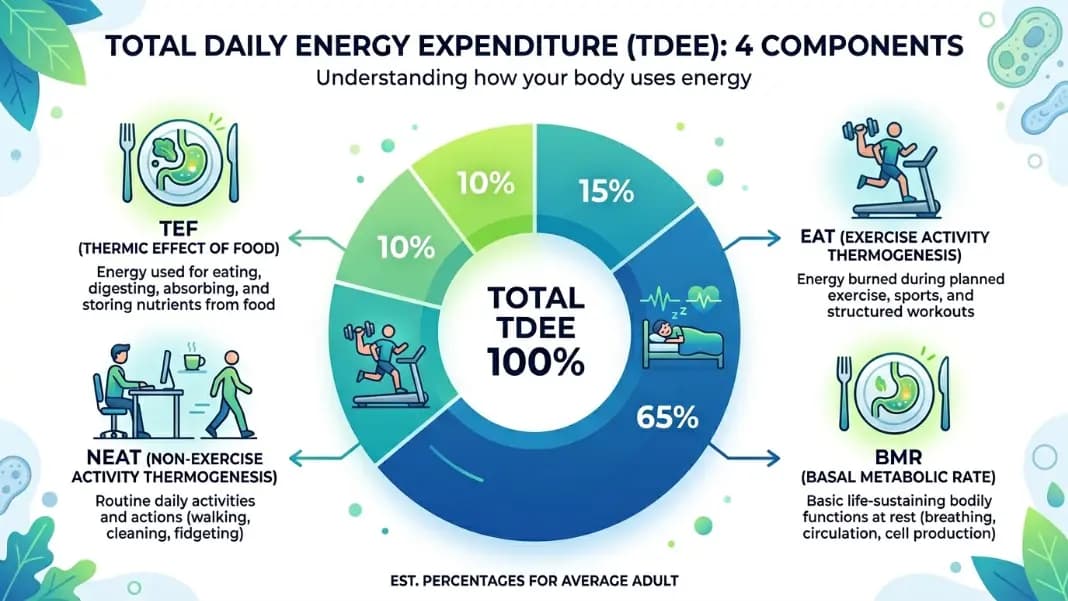
TDEE Calculator: What TDEE Is and How to Use It for Weight Loss
Learn what TDEE means, how to calculate your total daily energy expenditure using the Mifflin-St Jeor formula, and how to use it to lose weight, maintain, or build muscle. Free TDEE calculator included.
10 min read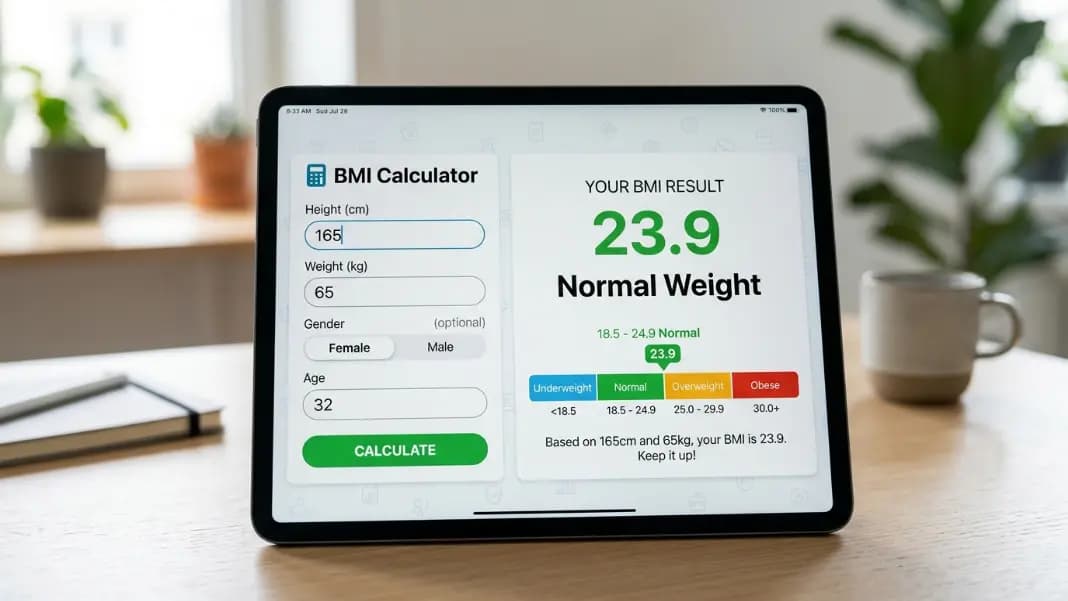
BMI Calculator for Women: Healthy Ranges by Age and What the Numbers Mean
BMI calculator for women: find your healthy range by age, understand your result in kg, and learn what the numbers mean for your body and health goals.
12 min read