If you have ever tried to lose weight by eating less without knowing how much you should be eating in the first place, TDEE is the number you were missing. Total daily energy expenditure is the total number of calories your body burns each day, accounting for everything from basic organ function to your workouts and daily movement.
Getting that number right is the difference between a calorie deficit that produces steady, sustainable fat loss and one that is so aggressive it causes muscle loss and exhaustion, or so small it produces no results at all. This guide covers what TDEE is, how to calculate it with the formula, how it compares to BMR, and how to use the TDEE calculator practically for weight loss, maintenance, or muscle gain.
What is TDEE
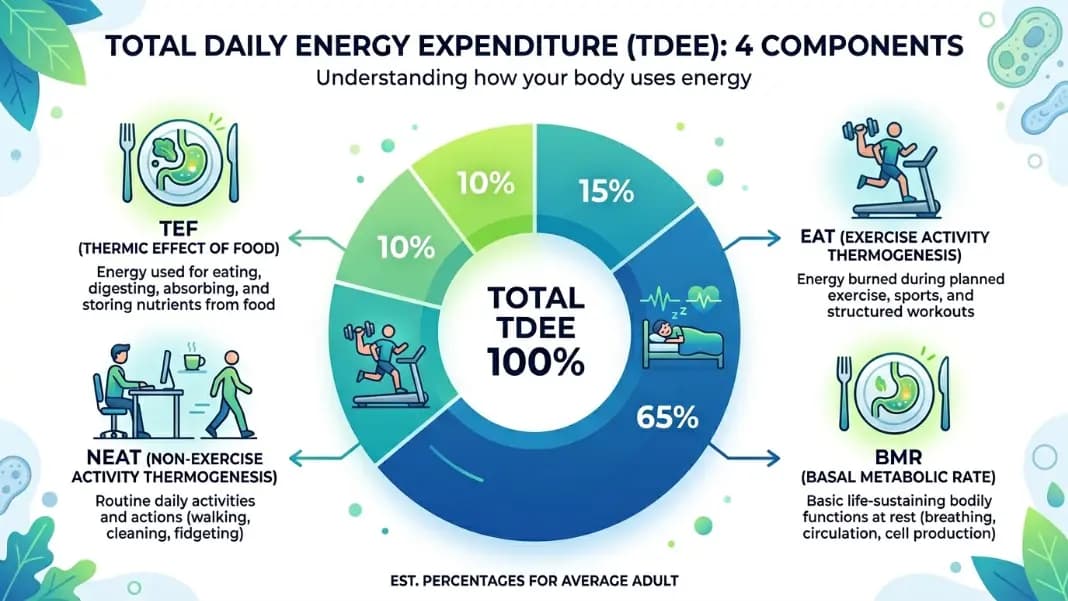
TDEE stands for Total Daily Energy Expenditure. It represents the total calories your body uses across a full 24-hour period.
TDEE has four components:
Basal Metabolic Rate (BMR): The calories your body burns at complete rest to maintain basic functions like breathing, circulation, body temperature, and organ operation. BMR accounts for roughly 60 to 70 percent of most people's TDEE. It is determined primarily by body size, lean muscle mass, age, and sex.
Thermic Effect of Food (TEF): The energy required to digest, absorb, and process the food you eat. Protein has the highest thermic effect at 20 to 30 percent of its calories. Carbohydrates come in at 5 to 10 percent and fat at 0 to 3 percent. TEF accounts for roughly 10 percent of total daily calorie burn.
Exercise Activity Thermogenesis (EAT): Calories burned during intentional, planned exercise such as running, lifting weights, cycling, or swimming.
Non-Exercise Activity Thermogenesis (NEAT): Calories burned through all movement that is not intentional exercise: walking between rooms, fidgeting, household tasks, taking stairs, standing rather than sitting. NEAT varies enormously between individuals and has a larger effect on daily calorie burn than most people realize. Two people with identical BMRs and exercise habits can have TDEEs that differ by 500 or more calories per day due to NEAT differences alone.
Your TDEE is not fixed. It changes with your weight, age, body composition, and how active each day is. As you lose weight, your TDEE decreases. As you add muscle, your BMR rises slightly.
How to calculate TDEE
TDEE calculation has two steps: calculate your BMR, then multiply by an activity factor.
Step 1: Calculate BMR using the Mifflin-St Jeor equation
The Mifflin-St Jeor equation is the most accurate formula for estimating BMR in the general population. It is the basis for most online TDEE calculators.
For men: BMR = (10 × weight in kg) + (6.25 × height in cm) − (5 × age in years) + 5
For women: BMR = (10 × weight in kg) + (6.25 × height in cm) − (5 × age in years) − 161
Example: A 28-year-old woman weighing 68 kg at 168 cm: BMR = (10 × 68) + (6.25 × 168) − (5 × 28) − 161 BMR = 680 + 1050 − 140 − 161 = 1429 calories
Step 2: Multiply by your activity level
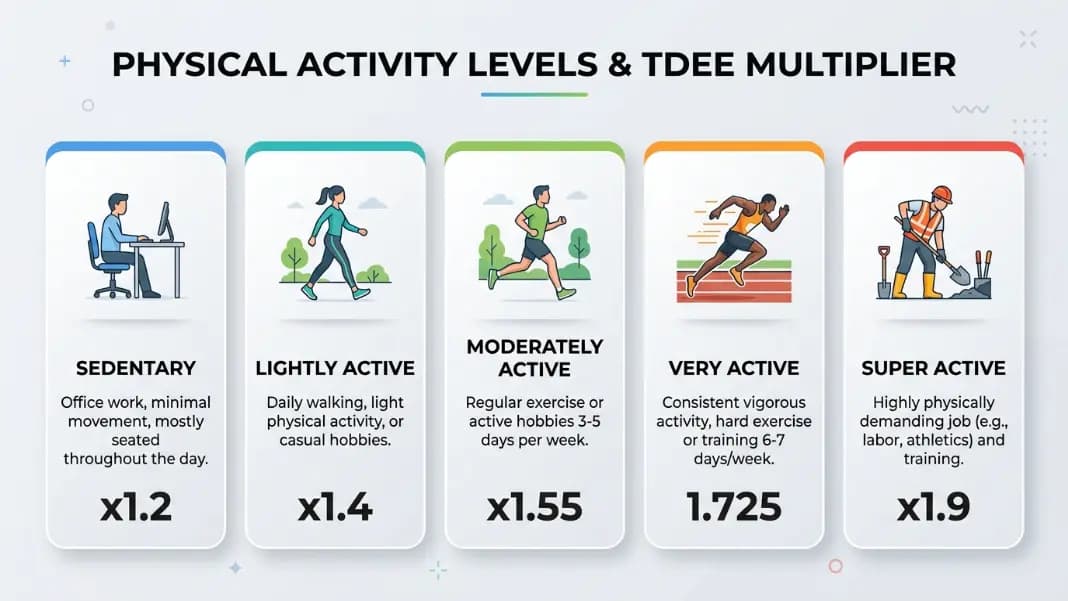
| Activity Level | What it looks like | Multiplier |
|---|---|---|
| Sedentary | Desk job, little movement outside exercise | × 1.2 |
| Lightly active | Light exercise 1 to 3 days per week | × 1.375 |
| Moderately active | Moderate exercise 3 to 5 days per week | × 1.55 |
| Very active | Hard exercise 6 to 7 days per week | × 1.725 |
| Extra active | Physical job plus hard daily training | × 1.9 |
Using the example above, if this woman exercises moderately 3 to 5 days per week: TDEE = 1429 × 1.55 = 2215 calories
She burns approximately 2215 calories per day. Eating at that level maintains her current weight. Eating below it produces fat loss. Eating above it produces weight gain.
The free TDEE calculator handles both metric and imperial units and runs this calculation instantly. Select your activity level, enter your stats, and get your TDEE alongside targets for weight loss and maintenance.
TDEE vs BMR: the difference that matters
BMR and TDEE are often confused, and using the wrong number as a calorie target is one of the most common mistakes in weight management.
BMR is how many calories your body needs to stay alive at complete rest. No movement, no digestion, no daily activity. It is the floor of your calorie needs, not a practical eating target.
TDEE is how many calories you actually burn on a normal day, accounting for everything you do. For most people, TDEE is significantly higher than BMR.
A sedentary person's TDEE is about 1.2 times their BMR. A highly active person's TDEE might be 1.9 times their BMR. Eating at your BMR level when your TDEE is 40 to 90 percent higher creates an unnecessarily large and unsustainable deficit that leads to fatigue, loss of muscle mass, and hormonal disruption.
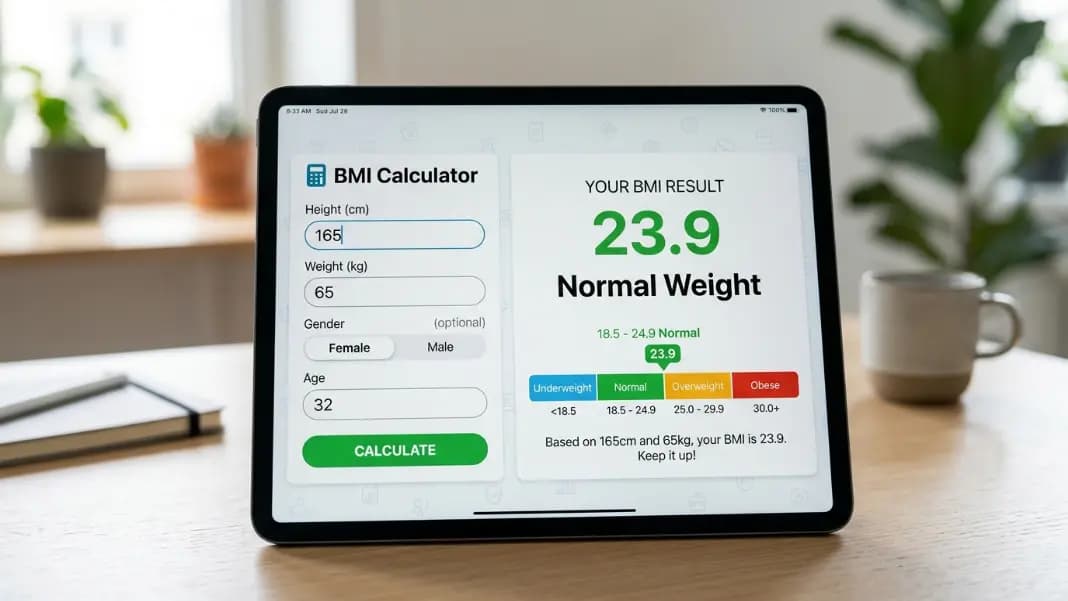
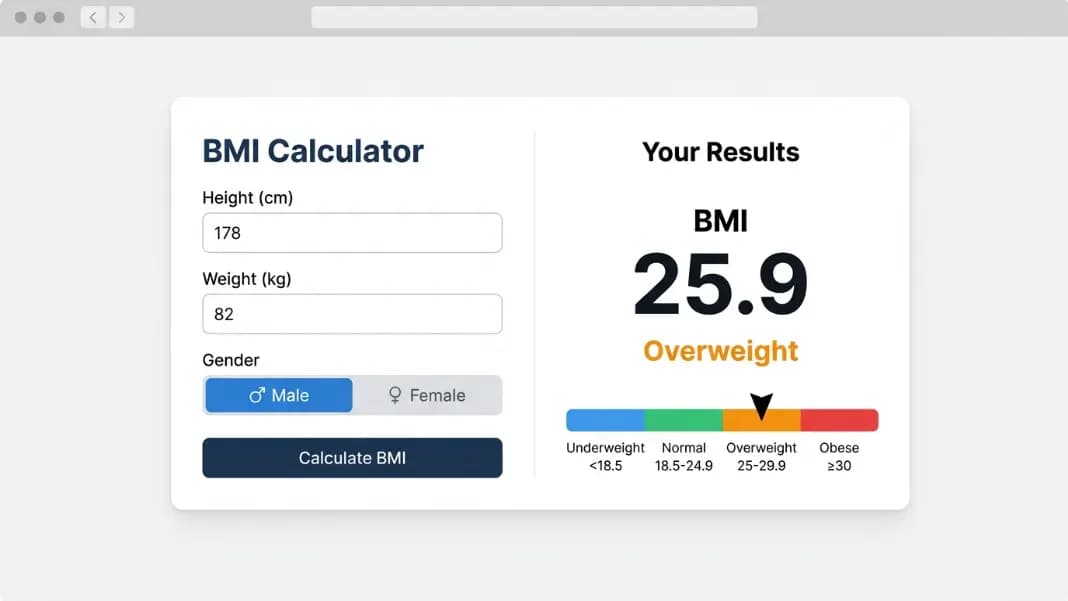
Always set your calorie targets based on TDEE. Use BMR only as a reference point for understanding what your body needs at minimum. If you want to see both numbers side by side along with your weight category, the BMI calculator paired with the TDEE calculator gives a fuller picture of where your body is starting from. You can also check your BMI calculator guide.
Using TDEE for weight loss
Knowing your TDEE makes weight loss a math problem with a concrete answer. You eat fewer calories than you burn, and the deficit forces your body to draw on stored fat for energy.
Choosing a deficit size:
A deficit of 500 calories per day below your TDEE produces approximately 0.45 kg or 1 pound of fat loss per week. Over a month, that is roughly 2 kg. This is a moderate, sustainable pace that preserves muscle mass for most people.
A deficit of 250 calories per day produces slower loss (around 0.25 kg per week) but is easier to maintain, causes less hunger, and has a smaller risk of muscle loss or energy problems.
A deficit larger than 750 to 1000 calories per day is generally too aggressive for anyone who is not under medical supervision. At this level, the body begins using muscle tissue for energy, metabolic rate drops faster, hunger becomes difficult to manage, and adherence rates collapse over time.
A practical example:
TDEE of 2200 calories. You eat 1700 calories per day, creating a 500-calorie daily deficit.
- Weekly deficit: 3500 calories
- Monthly fat loss estimate: approximately 1.8 kg
Why results may differ from the estimate:
TDEE calculators give an average estimate. Your actual daily burn varies based on sleep quality, stress, body composition changes, and daily activity fluctuations. If your weight is not moving after two to three weeks of consistent tracking, your true TDEE is likely lower than the estimate. Reducing intake by 100 to 200 calories is the right adjustment, not abandoning the approach.
For weight loss goals with a specific target and timeline, the calorie calculator translates your TDEE into a daily eating target based on how much you want to lose and by when. The daily calorie calculator guide for a detailed breakdown.
TDEE calculator for women
Women typically have a lower TDEE than men of the same height, weight, and age. The main reason is lean muscle mass: women carry less muscle on average, and muscle tissue has a higher metabolic rate than fat tissue. The Mifflin-St Jeor formula accounts for this with a constant that adjusts BMR downward for women.
A few situations affect how women should apply their TDEE:
Menstrual cycle fluctuations: Calorie expenditure and hunger shift across the monthly cycle. During the luteal phase (roughly two weeks before a period), many women have a slightly elevated BMR and increased appetite. This is normal. The TDEE estimate is a monthly average and does not need adjustment for cycle phases, though understanding this pattern helps explain hunger variations.
Hormonal conditions: Hypothyroidism, PCOS, and other hormonal conditions can significantly reduce metabolic rate. If your results consistently fall well short of what your TDEE calculation predicts despite accurate tracking, a medical evaluation of thyroid and hormonal function is worth considering.
Perimenopause and menopause: Body composition and metabolic rate shift during this period, often independent of changes in weight or activity. Recalculating TDEE more frequently helps keep targets accurate as these changes occur.
For most adult women without these specific factors, the standard TDEE calculator produces an estimate that is reliable enough to use as a direct basis for calorie planning.
TDEE and macros
Your TDEE gives you a total daily calorie target. Breaking that target into macronutrients (protein, carbohydrates, and fat) gives you a complete daily nutrition structure rather than just a calorie ceiling.
For weight loss, the priority order for macros is:
Protein first: Set protein at 1.6 to 2.2 grams per kilogram of body weight. Protein protects muscle mass during a calorie deficit, keeps hunger lower than carbs or fat at the same calorie level, and has the highest thermic effect, meaning your body burns more calories processing it. At 4 calories per gram, protein takes up a meaningful share of a deficit-level calorie budget.
Fat second: Set fat at a minimum of 0.5 to 1 gram per kilogram of body weight. Fat supports hormone production, vitamin absorption, and cell function. Going below the minimum consistently causes hormonal issues that affect both health and body composition.
Carbohydrates fill the rest: Once protein and fat are set, the remaining calories come from carbohydrates. Carbs fuel exercise performance and brain function and are flexible in quantity for most people.
A starting split that works for many people in a weight loss deficit is approximately 35 percent protein, 30 percent fat, and 35 percent carbohydrates. This is a starting point rather than a rigid rule.
The macros calculator breaks your daily calorie target into grams of each macronutrient based on your goal, giving you specific daily targets to work from rather than percentages to calculate yourself.
How accurate are TDEE calculators
TDEE calculators are estimates based on population-level formulas. They are useful and generally reliable, but they are not exact measurements.
Sources of inaccuracy:
Activity level selection is subjective and most people overestimate it. Someone who trains four times per week but sits for ten hours a day between sessions is not "very active." Picking one level lower than your instinct often produces a more accurate result.
The formula uses population averages for body composition. Two people with the same height, weight, age, and sex can have meaningfully different BMRs if their muscle-to-fat ratios differ significantly. A person with above-average muscle mass has a higher BMR than the formula estimates; a person with below-average muscle mass has a lower one.
Metabolic adaptation reduces TDEE over time during a calorie deficit. As you eat less, your body responds by reducing output through lower NEAT and some reduction in metabolic rate. This is normal and expected, but it means your calculator estimate becomes less accurate as you progress through a weight loss phase.
Despite these limitations, most people find that starting with their calculated TDEE and adjusting based on two to three weeks of real results gets them to an accurate working number quickly. The estimate is almost always within 15 percent of actual expenditure, which is close enough to build a functional plan around.
Use a free TDEE calculator
Running the Mifflin-St Jeor formula manually and multiplying by an activity factor is doable, but most people want the result quickly without working through the arithmetic. A free TDEE calculator online handles everything in one step.
The free TDEE calculator accepts age, sex, height, weight, and activity level in both metric and imperial units. It returns your TDEE alongside suggested calorie targets for weight loss, maintenance, and muscle gain, giving you a practical range to work from without needing to calculate deficits separately.
The health tools section also includes a macros calculator to split your calorie target into protein, carbs, and fat, a calorie calculator for goal-specific daily targets, a BMI calculator to check your weight category, a body fat percentage estimator, and an ideal weight calculator for target weight ranges. All tools run in the browser with no account or data submission required.
TDEE is the foundation number for any evidence-based approach to nutrition. Know yours, set your target around it, and you have an objective framework for every food and exercise decision going forward. For specific medical conditions, pregnancy, or any situation where diet has clinical implications, work with a registered dietitian or healthcare provider rather than relying on a calculator alone.