Free Sleep Cycle Calculator Online
The sleep cycle calculator finds the best times to wake up or go to sleep based on 90-minute sleep cycles. Waking at the end of a complete cycle rather than mid-cycle reduces sleep inertia (the grogginess that follows a disrupted deep sleep stage). Enter your wake-up time or bedtime and get an optimized sleep schedule instantly. Free, no account needed.
How to use the sleep cycle calculator
- Select your mode: calculate a wake-up time from a bedtime, or find the ideal bedtime for a required wake-up time.
- Enter your target time using the time input.
- The sleep calculator shows options for 4, 5, 6, and 7 complete 90-minute cycles with total sleep hours for each.
- Choose the option that gives the most complete cycles while fitting your schedule.
- Set your alarm and track how refreshed you feel to confirm the cycle count matches your needs.
How to calculate sleep cycles: the 90-minute method
To calculate your sleep cycle manually, use this formula: Wake-up time = Bedtime + 14 minutes (sleep onset) + (90 minutes x number of cycles). For example, if you go to bed at 11:00 PM and want 5 complete cycles: 11:00 PM + 14 min = 11:14 PM fall asleep, then 11:14 PM + 450 minutes (5 x 90) = 6:44 AM wake-up time.
Pre-calculated wake times from common bedtimes based on 90-minute cycles:
- Sleep at 10:00 PM: 4 cycles = 3:44 AM | 5 cycles = 5:14 AM | 6 cycles = 6:44 AM
- Sleep at 11:00 PM: 4 cycles = 4:44 AM | 5 cycles = 6:14 AM | 6 cycles = 7:44 AM
- Sleep at 12:00 AM: 4 cycles = 5:44 AM | 5 cycles = 7:14 AM | 6 cycles = 8:44 AM
- Sleep at 1:00 AM: 4 cycles = 6:44 AM | 5 cycles = 8:14 AM | 6 cycles = 9:44 AM
The online sleep cycle calculator handles this math automatically and displays all options simultaneously so you can choose what fits your schedule. The 14-minute sleep onset buffer is the population average; if you tend to fall asleep faster or slower, the tool lets you adjust this.
REM sleep cycle calculator: the four stages of a sleep cycle
Each 90-minute sleep cycle moves through four distinct stages. Understanding these stages explains why cycle-aligned wake times work:
- Stage 1 NREM (1 to 5 min): The transition from wakefulness. Easily disrupted. Muscle twitches are common. Brain produces theta waves.
- Stage 2 NREM (10 to 25 min): Heart rate slows, body temperature drops, sleep spindles appear. This is the stage targeted by 20-minute power naps, and where cycle-end wake times typically land.
- Stage 3 NREM / Deep Sleep (20 to 40 min in early cycles): Slow delta waves, hardest stage to wake from. Critical for physical repair, immune function, and memory consolidation. Dominates the first half of the night. Waking here causes the worst sleep inertia.
- REM Sleep (10 to 60 min, lengthening in later cycles): Brain activity resembles wakefulness. Vivid dreams, emotional memory processing, creative consolidation. REM periods grow longer in cycles 4, 5, and 6, which is why skipping late-night sleep disproportionately cuts REM.
The REM sleep cycle calculator logic is built into all cycle timing: by targeting the end of a full 90-minute cycle, you wake at the transition out of REM into light stage 2 sleep, the biologically easiest point to rouse.
Nap sleep cycle calculator: best nap durations
The same 90-minute cycle logic applies to daytime naps. The three most effective nap lengths are:
- 20-minute power nap: Stays in NREM stage 2, avoids deep sleep entirely. No sleep inertia on waking. Best for a quick alertness boost during the day without disrupting nighttime sleep.
- 90-minute full cycle nap: One complete sleep cycle including REM. Provides memory consolidation and creative processing benefits. Best when you have flexibility in your schedule. Set an alarm for 90 minutes from when you lie down.
- 180-minute two-cycle nap: Two full cycles. Suitable only when significantly sleep-deprived and nighttime sleep cannot be extended.
Avoid naps of 30 to 60 minutes. This duration drops you into deep sleep but does not complete a full cycle, causing significant sleep inertia on waking. The nap sleep cycle calculator sweet spots are 20 minutes (no deep sleep) or multiples of 90 minutes (complete cycles).
Sleep duration by age: how many cycles do you need?
Sleep needs vary significantly by age. The National Sleep Foundation recommendations by age group:
- Newborns (0 to 3 months): 14 to 17 hours (cycles are shorter, about 50 to 60 minutes)
- School-age children (6 to 13 years): 9 to 11 hours (6 to 7 cycles of adult-length duration)
- Teenagers (14 to 17 years): 8 to 10 hours (5 to 6 cycles)
- Adults (18 to 64 years): 7 to 9 hours (5 to 6 cycles)
- Older adults (65+): 7 to 8 hours (4 to 5 cycles, with less deep sleep per cycle)
For adults, 5 complete cycles (7.5 hours) is a strong target for most people. 6 cycles (9 hours) is appropriate if you are recovering from sleep debt, in a high-training athletic phase, or consistently feel unrested at 7.5 hours. Regularly getting fewer than 4 cycles produces measurable performance and health deficits within days.
Sleep and metabolism: how poor sleep affects your health
Insufficient sleep does more than cause tiredness. Chronic sleep deprivation (under 6 hours per night) produces measurable metabolic disruption: cortisol rises, ghrelin (hunger hormone) increases, and leptin (satiety hormone) drops. This typically increases daily calorie intake by 200 to 500 calories without a corresponding increase in activity, contributing to weight gain over time.
Reduced sleep also lowers insulin sensitivity and suppresses resting metabolic rate, meaning your body burns fewer calories at rest. If your TDEE calculation seems inconsistent with your actual weight changes, sleep quality is worth reviewing as a contributing variable. Well-rested individuals also have better workout recovery, which directly affects the activity multiplier in TDEE estimates.
Sleep deprivation is also associated with increased BMI across large population studies, largely through the appetite and metabolic pathways above. Optimizing sleep is therefore part of any effective weight management strategy, not just a performance consideration.
Sleep cycle calculator app vs online calculator
Sleep cycle calculator apps (such as Sleep Cycle, Pillow, and Rise) use phone accelerometer or microphone data to detect movement and sound during sleep, attempting to identify which sleep stage you are in and trigger an alarm during light sleep within a window you define. The advantage is adaptive timing based on real-time data. The limitation is that accelerometer-based sleep staging is significantly less accurate than polysomnography (clinical sleep lab) or even consumer wearables with heart rate sensors.
This online sleep cycle calculator uses the fixed 90-minute model, which is a validated population average. It cannot adapt to your specific cycle length in real time, but it requires no device, no subscription, and no permissions. For most people without sleep disorders, the 90-minute fixed model and a consistent sleep schedule produce results comparable to smart alarm apps. The most impactful variable is not alarm precision but sleep consistency: going to bed and waking at the same time daily stabilizes your circadian rhythm more than any alarm optimization.
Frequently asked questions
To calculate your sleep cycle wake-up time, start from when you plan to fall asleep (not when you get into bed). Add 14 minutes for average sleep onset latency, then add multiples of 90 minutes: 90 minutes x number of cycles desired. For example, to get 5 complete cycles starting at 10:30 PM: add 14 minutes (fall asleep at 10:44 PM) + 5 x 90 minutes (450 minutes = 7.5 hours) = wake up at 6:14 AM. The sleep cycle calculator automates this math and shows all cycle options at once.
One complete sleep cycle lasts approximately 90 minutes for most adults, though the range is 80 to 110 minutes. A cycle contains four stages: NREM stage 1 (light sleep, 1 to 5 minutes), NREM stage 2 (light sleep, 10 to 25 minutes), NREM stage 3 (deep slow-wave sleep, 20 to 40 minutes in early cycles), and REM sleep (10 to 60 minutes, lengthening in later cycles). The first two cycles of the night have the most deep sleep; later cycles have progressively longer REM periods. The calculator uses 90 minutes as the standard cycle length.
Each 90-minute sleep cycle has four stages: Stage 1 NREM (light sleep onset, 1 to 5 min): the transition from wakefulness, easily disrupted. Stage 2 NREM (light sleep, 10 to 25 min): heart rate slows, body temperature drops, sleep spindles appear. Stage 3 NREM (deep or slow-wave sleep, 20 to 40 min): hardest stage to wake from, critical for physical recovery, immune function, and memory consolidation. REM sleep (10 to 60 min): brain activity resembles waking, vivid dreams occur, essential for emotional regulation and cognitive processing. Deep sleep dominates the first half of the night; REM dominates the second half.
Waking during deep sleep (NREM stage 3) causes sleep inertia: a temporary state of impaired alertness, grogginess, and disorientation that can last 30 to 60 minutes or more. Deep sleep suppresses arousal, which is why an alarm interrupting this stage creates such strong resistance to waking. Waking at the natural end of a REM cycle is biologically easier because light sleep and REM involve brain activity closer to wakefulness and lower arousal thresholds.
Most adults function best with 5 to 6 complete sleep cycles per night, equivalent to 7.5 to 9 hours of sleep. Fewer than 5 cycles (under 7.5 hours) builds sleep debt that impairs cognitive performance, mood, immune function, and physical recovery. The minimum for most healthy adults is 4 complete cycles (6 hours), but this should not be a regular target. The number that leaves you feeling refreshed varies by individual: some people do well on 5 cycles, others consistently need 6.
Yes. The calculator adds an average sleep onset latency of 14 minutes to all bedtime calculations. Sleep onset latency is the time between lying down and actually falling asleep. The average for healthy adults is 10 to 20 minutes. If you consistently fall asleep faster or slower than 14 minutes, adjust the suggested bedtime accordingly. Regularly taking longer than 20 minutes to fall asleep may indicate stress, caffeine sensitivity, screen exposure, or sleep environment issues worth addressing.
A nap sleep cycle calculator applies the same 90-minute logic to daytime sleep. The three most effective nap lengths are: 20 minutes (power nap): stays in NREM stage 2, avoids deep sleep entirely, no sleep inertia on waking. 90 minutes (one full cycle): completes one full sleep cycle including REM, provides memory consolidation and creative processing benefits. 180 minutes (two cycles): suitable when significantly sleep-deprived. Avoid 30 to 60 minute naps as they drop into deep sleep but do not complete a full cycle, causing significant sleep inertia on waking.
Sleep deprivation raises cortisol and ghrelin (hunger hormone) while suppressing leptin (satiety hormone), which typically increases daily calorie intake by 200 to 500 calories. Chronic sleep loss also reduces insulin sensitivity and lowers resting metabolic rate over time, meaning your body burns fewer calories at rest. Sleeping fewer than 6 hours per night for multiple consecutive nights produces measurable reductions in metabolic function comparable to several weeks of caloric restriction.
Related articles
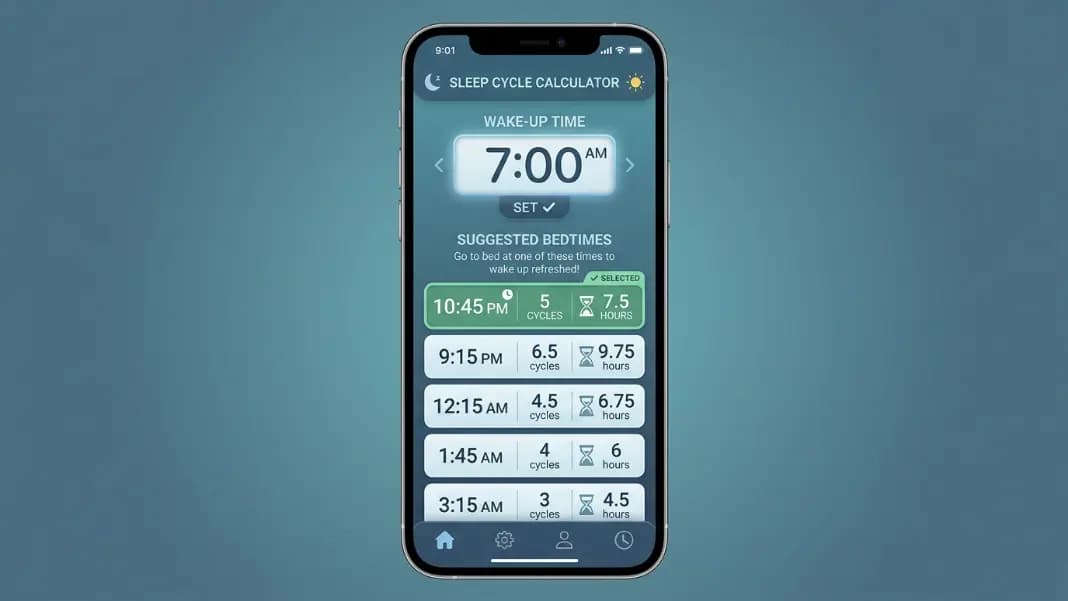
Sleep Cycle Calculator: Wake Up Refreshed Using 90-Minute Cycles
Calculate the best bedtime or wake-up time using 90-minute sleep cycles. Covers REM sleep stages, sleep debt, and why 8 hours still leaves you groggy.
12 min read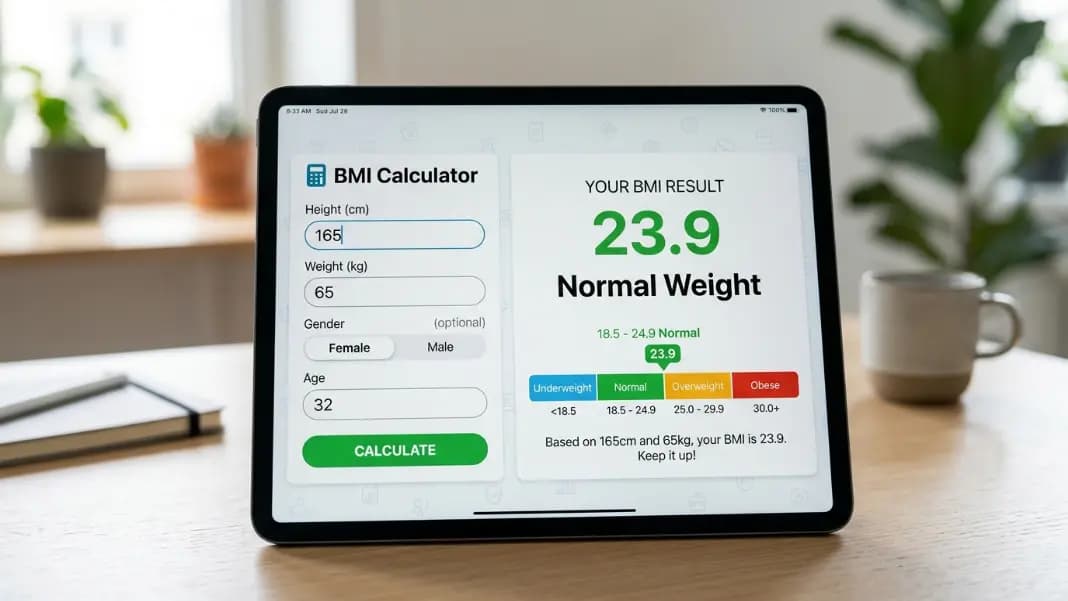
BMI Calculator for Women: Healthy Ranges by Age and What the Numbers Mean
BMI calculator for women: find your healthy range by age, understand your result in kg, and learn what the numbers mean for your body and health goals.
12 min read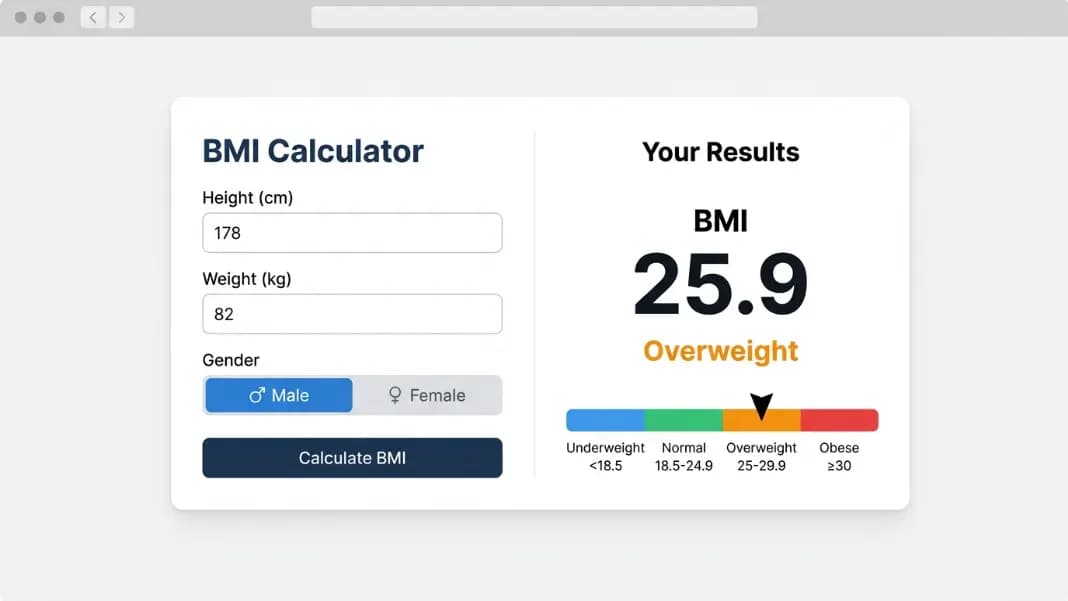
BMI Calculator for Men: Healthy Ranges, Age, and What the Numbers Mean
Use a BMI calculator for men by age and weight in kg. Covers healthy BMI ranges for males, how results shift with age, and when the numbers can mislead.
13 min read