You get a BMI number and immediately wonder whether it actually applies to you. For the average man, it does. For a man who lifts weights regularly, plays a contact sport, or has simply been at the same weight for thirty years while his body composition has quietly shifted, the number is a starting point that needs context.
BMI for men uses the same calculation as BMI for anyone else: weight in kilograms divided by height in meters squared. The World Health Organization created no male-specific version of the formula. What varies is how the result should be interpreted depending on your age, build, and training history. The BMI calculator gives you the number in seconds. The harder work is reading it correctly for your situation.
This guide covers what healthy BMI ranges look like for men, how age changes what those numbers mean, why muscular men often see results that do not reflect their actual health, and what to do after you have the calculation in front of you.
What a healthy BMI range is for men
A healthy BMI for men falls between 18.5 and 24.9. This is the World Health Organization's standard classification, used by clinicians globally as a screening threshold for weight-related health risk.
The full BMI scale:
| BMI Range | Category |
|---|---|
| Below 18.5 | Underweight |
| 18.5 to 24.9 | Normal weight |
| 25.0 to 29.9 | Overweight |
| 30.0 to 34.9 | Obese, Class 1 |
| 35.0 to 39.9 | Obese, Class 2 |
| 40.0 and above | Obese, Class 3 (severe) |
These thresholds are identical for men and women. The formula does not adjust by sex.
One thing that gets glossed over: the line between 24.9 and 25.0 is a screening threshold, not a biological tipping point. A man at 25.2 who is active, has a normal waist circumference, and no metabolic risk factors is not in danger. A sedentary man at 24.7 who has never exercised and carries most of his weight around his midsection may have considerably more to address. Use the classification as directional information, not a verdict.
How to calculate BMI with kg and cm inputs
The BMI formula is weight in kilograms divided by height in meters squared. If your height is in centimeters, divide by 100 to convert to meters, then square it.
A worked example for a man who weighs 85 kg and stands 180 cm:
- Convert height: 180 divided by 100 = 1.80 meters
- Square the height: 1.80 x 1.80 = 3.24
- Divide weight by height squared: 85 divided by 3.24 = 26.2
A BMI of 26.2 falls in the overweight range.
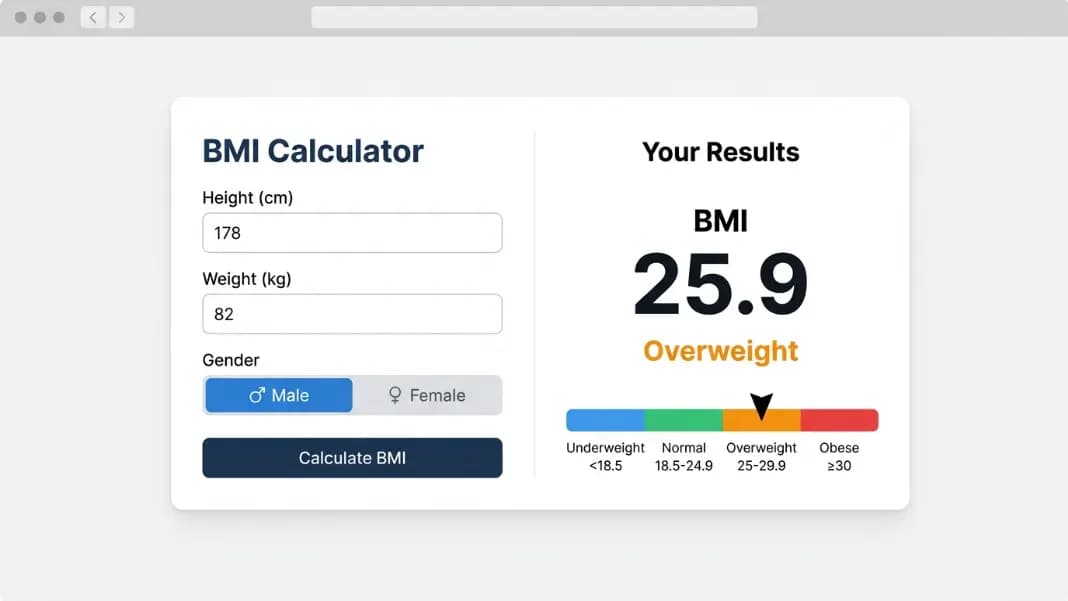
The BMI calculator runs this arithmetic automatically. Enter weight in kilograms and height in centimeters and the result appears immediately with a classification and color scale. You can also switch to pounds and feet if that is what you have, though kg and cm inputs are standard for most clinical reference charts.
Practical notes on input accuracy: weigh yourself in the morning before eating, without shoes, on a hard floor rather than carpet. Body weight normally fluctuates 1 to 2 kilograms across a single day based on hydration and food, so consistent morning measurements give the most stable baseline when tracking changes over time.
How BMI changes in meaning as men age
The BMI formula has no age adjustment built into it. A 60-year-old man and a 25-year-old man with identical height and weight will get identical BMI results. The clinical interpretation of that result, however, should differ.
Starting around age 30, men experience a gradual decline in testosterone, which leads to progressive muscle loss, a process called sarcopenia. The typical rate of muscle loss is approximately 3 to 5 percent per decade after age 30, accelerating meaningfully after age 60. Meanwhile, body fat tends to increase even when total body weight stays the same. The result: the same BMI number represents more fat and less muscle at 55 than it did at 30.
This matters because muscle and fat have different metabolic effects. Muscle tissue is metabolically active, contributing to insulin sensitivity and resting calorie burn. Fat tissue, particularly visceral fat stored around the organs in the abdominal cavity, is associated with insulin resistance, cardiovascular disease, and inflammatory markers. Two men at the same BMI but different ages may have meaningfully different health profiles, even though their BMI calculation returns the same number.
Several large studies have also found that for men over 65, a BMI in the range of 25 to 27 is associated with lower mortality risk than a BMI in the lower half of the normal range. This appears to reflect the protective effect of muscle mass and fat reserves during illness and recovery. It does not mean gaining weight after 65 is beneficial. It means an older man should not fixate on hitting a BMI of 22 if his current weight reflects genuine fitness and strength. For a full breakdown of how healthy BMI ranges shift decade by decade from your 20s to 65, the BMI by age guide covers the research behind age-adjusted interpretation in detail.
For men over 45, the most useful addition to a BMI check is waist circumference. The World Health Organization identifies a waist measurement above 94 cm in men as increased metabolic risk and above 102 cm as high risk. Waist circumference captures abdominal fat distribution in a way BMI cannot.
Why high muscle mass makes BMI unreliable for some men
This is the limitation most athletic men encounter and the one that causes the most confusion.
BMI treats weight as a proxy for fat. The assumption is that the heavier you are relative to your height, the more fat you carry. For the general non-athletic population, this holds well enough. The correlation between BMI and body fat percentage across large populations is reasonably strong.
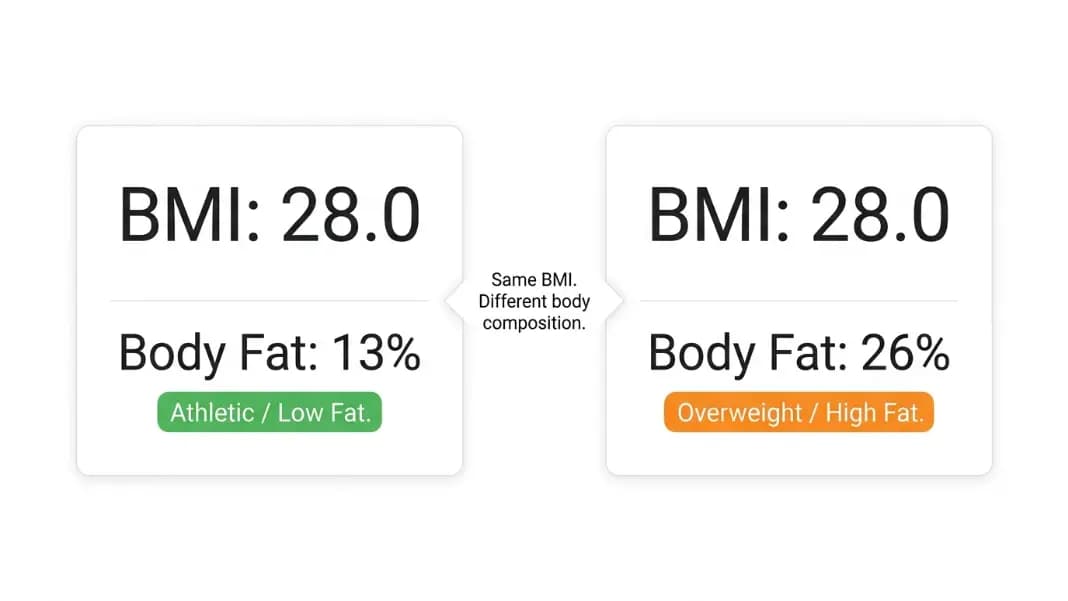
The logic breaks down for men with significant muscle development. Skeletal muscle is approximately 18 percent denser than fat tissue. A man who has built substantial muscle through consistent resistance training weighs more than a sedentary man of the same height and fat level because muscle takes up less space per kilogram. That extra weight pushes BMI upward without carrying any corresponding health risk.
A practical example: an experienced weightlifter standing 180 cm and weighing 95 kg has a BMI of 29.3, which the WHO classification calls overweight. If his body fat percentage is 12 percent, he is lean by any clinical measure. His BMI looks overweight because BMI cannot distinguish the source of the weight.
The fix is not to discard BMI. It is to supplement it. The body fat calculator uses the US Navy method, requiring only waist, neck, and height measurements. No equipment beyond a tape measure, takes about two minutes, and gives a direct estimate of body fat percentage. If your body fat is under 20 percent and your BMI is in the overweight range, the BMI reading almost certainly reflects muscle, not a health problem.
BMI for men over 40 and 50: what changes in interpretation
Two shifts happen after 40 that affect how to read a BMI result in practice.
First, the muscle-mass effect discussed above becomes more relevant for men who were once active and are now less so. A man who trained consistently in his 30s and has since reduced his activity may now carry less muscle and more fat at the same body weight. His BMI has not moved, but his body composition has. The number that once reflected good fitness now reflects a different physical reality.
Second, abdominal fat distribution becomes more clinically significant than overall fat. Visceral fat, the fat stored around internal organs rather than under the skin, carries the strongest association with metabolic syndrome, cardiovascular disease, and type 2 diabetes in men. BMI cannot tell you where your fat is stored. Two men at a BMI of 27 can have very different risk profiles depending on whether their fat is subcutaneous or visceral.
For men in their 40s and 50s, the most useful combination is BMI plus waist circumference plus a standard blood panel covering fasting glucose, HDL and LDL cholesterol, and triglycerides. BMI gives the rough scale. Waist circumference adds fat distribution information. Blood markers add metabolic context. Any two of these pointing in the wrong direction is a clearer signal than one number alone.
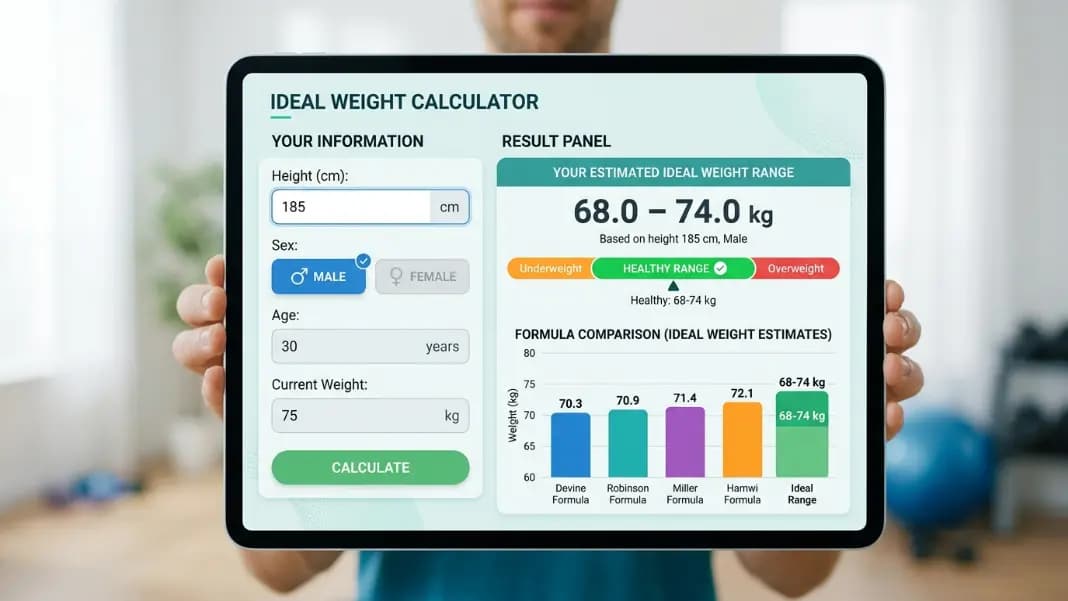
The ideal weight calculator provides reference points using four established formulas: Devine, Robinson, Miller, and Hamwi. Each formula produces a slightly different target weight for the same height, and comparing across them gives a weight range rather than a single fixed target. For men whose BMI is in the overweight range but who are visibly fit, this cross-reference can confirm whether their current weight genuinely exceeds a healthy range by multiple measures.
What a high or low BMI actually means for a man
If your BMI is 25 to 29.9 (overweight):
This result is worth reviewing, not panicking about. First, check whether muscle mass could explain the reading. Second, measure waist circumference. Third, look at the trend: is this higher than it was two years ago, or has it been stable? A stable BMI in this range with a normal waist circumference and no metabolic markers is a different situation from a BMI that has climbed five points over three years.
If the number is trending upward, a moderate caloric deficit combined with resistance training is the most evidence-based approach. The general guideline from the National Institutes of Health is that reducing intake by 500 calories per day produces approximately 0.5 kilograms of fat loss per week without the muscle loss that comes with more aggressive restriction.
If your BMI is 30 or above (obese):
Take it seriously regardless of muscle considerations. At BMI 30 and above, the population-level association with metabolic disease, cardiovascular risk, and certain cancers is well-documented. Body fat testing is still worth doing to understand composition, but at this range fat mass is almost always a significant contributor.
If your BMI is below 18.5 (underweight):
Less discussed than overweight, but real. Underweight BMI in men is associated with reduced bone density, suppressed immune function, and hormonal disruption. If this reflects recent unexplained weight loss rather than a longstanding stable pattern, it warrants medical attention.
Using BMI alongside TDEE and calorie tracking
BMI tells you where you stand. It says nothing about how to change. The practical path runs through energy balance.
The TDEE calculator estimates your total daily energy expenditure based on weight, height, age, and activity level. This is the calorie level at which your weight stays stable. A daily deficit below TDEE produces gradual weight loss. A surplus produces gradual weight gain.
For men targeting a lower BMI, the most sustainable approach is a 300 to 500 calorie daily deficit paired with resistance training. The resistance training component matters because a calorie deficit without any training signal tends to reduce both fat and muscle. Preserving muscle while losing fat requires that your body has a reason to keep the muscle. Lifting provides that reason.
Work out the weight that corresponds to the top of the healthy BMI range for your height and use TDEE as your caloric baseline. Changing weight at a rate of 0.5 to 1 kilogram per week is sustainable for most men and minimizes muscle loss. Going faster typically means going further into deficit than the body tolerates without hormonal and muscular cost.
The BMI calculation guide covers the formula in full detail alongside the historical context of how it became a clinical standard. The full health tools section runs BMI, TDEE, macros, body fat, and ideal weight in one place, so you can get a complete picture without jumping between sites.