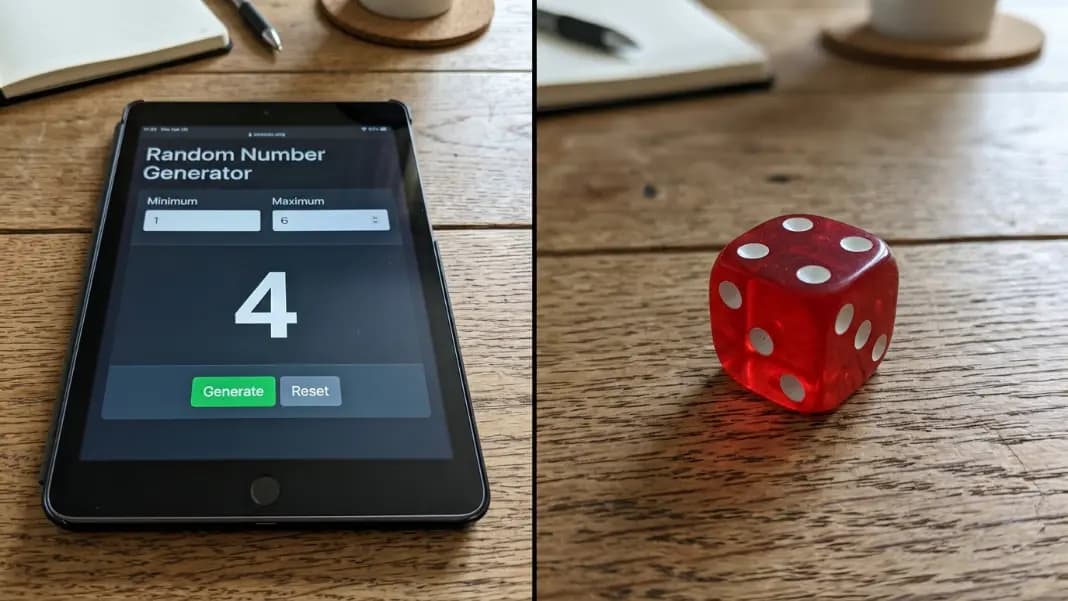
When you click generate on a random number generator, you might wonder whether the number you get is genuinely random or just the output of some hidden formula that looks random. It is a fair question, and the answer is more nuanced than a simple yes or no.
The short version: most online random generators are not random in the purest physical sense, but the best ones are so unpredictable that the distinction does not matter for anything you are likely to do. Understanding the difference helps you use the right tool with confidence and spot the ones that fall short.
This guide breaks down what randomness actually means in computing, how different generator types work, and what all of this means when you are picking raffle winners, rolling dice, or making any other everyday decision.
What "Random" Actually Means in Computing
In everyday language, random means something feels unpredictable. In mathematics and computer science, the definition is stricter. A truly random sequence must meet several criteria: each outcome must have an equal probability, each result must be statistically independent from every other, and no observer should be able to identify any pattern or predict future values.
Computers are deterministic machines. Given the same inputs, a program always produces the same outputs. This creates a fundamental tension: a machine that follows rules cannot, by its own processes alone, produce a result that is genuinely rule-free.
The solution is not to make the machine behave randomly. The solution is to find a starting value that is unpredictable, then use the machine to expand that unpredictability into a longer sequence. This is the core idea behind every random generator you use online.
The "starting value" is called a seed. Where that seed comes from is the key difference between the types of random generators, and it is the thing that determines whether the output is secure, fair, or predictable.
Pseudo-Random Number Generators: Predictable by Design
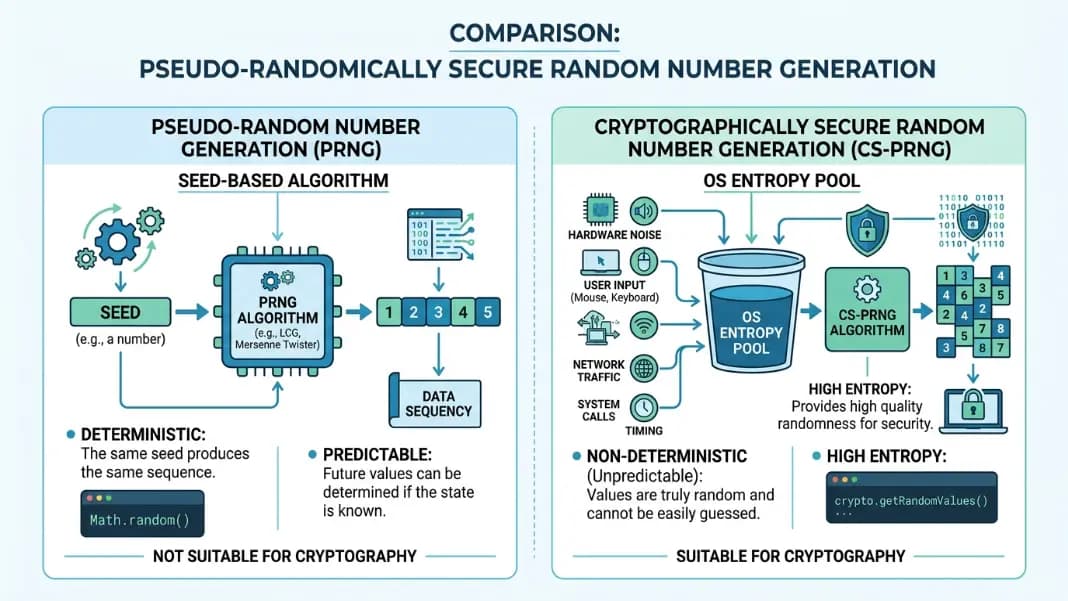
A pseudo-random number generator, or PRNG, uses a mathematical algorithm that starts from a seed and produces a long sequence of numbers that look random. The sequence passes most statistical tests for randomness: uniform distribution, no obvious patterns, no clustering.
The classic browser function Math.random() is a PRNG. Most JavaScript environments implement it using an algorithm like xorshift128+ or Mulberry32. These are fast and produce statistically decent output.
The problem is the seed. If Math.random() is seeded from the current time in milliseconds, and someone knows approximately when you ran the generator, they can reconstruct the seed. From there, they can reproduce the exact sequence of numbers you generated. The outputs might look random to you, but they are entirely determined by information that could be knowable to someone motivated to find it.
This matters in specific contexts. If you ran a raffle using Math.random() and a determined participant knew your system and the approximate time, they could replay the sequence. This is not a theoretical risk in casual games, but it is a real concern for anything with meaningful stakes.
For everyday use in games, simulations, and casual decisions, basic PRNGs are usually fine. For anything where fairness needs to be verifiable and stakes are real, you need something stronger.
Cryptographically Secure Random: The Standard for Online Tools
Cryptographically secure pseudo-random number generators, or CSPRNGs, solve the seed problem. Instead of using a predictable value like the system time, they gather entropy from multiple hardware-level sources that are genuinely difficult to observe or reproduce.
Your browser's crypto.getRandomValues() function is a CSPRNG. It collects entropy from sources including the precise timing of hardware interrupts, mouse movement patterns, keyboard event timing, thermal noise from electronic components, and OS-level randomness pools. These sources are combined and mixed to produce a seed that no external party can realistically reconstruct.
The random number generator uses crypto.getRandomValues() for all generation. So does the coin flip tool and the dice roller. Every result is seeded from hardware entropy rather than from anything predictable.
The practical consequence: even if someone knew the exact algorithm, they could not predict your output. The seed is unknown and the mixing process destroys any traceable connection between the entropy sources and the final number.
For online tools, CSPRNG is the right standard. It is what you should look for, and it is what good tools use.
True Random: Physical Entropy Sources
True random number generators, or TRNGs, go a step further. They do not use algorithms at all. They measure physical phenomena that are fundamentally unpredictable at the quantum level.
RANDOM.ORG is the most well-known example. It uses atmospheric radio noise measured by radio receivers. The noise is a natural byproduct of lightning, solar activity, and other electromagnetic phenomena. It has no pattern that any algorithm could reproduce.
Other TRNG sources include radioactive decay (the timing of particle emissions is governed by quantum mechanics and cannot be predicted), thermal noise in resistors, and photon behavior in optical systems.
TRNGs are slower than algorithmic generators and can introduce slight statistical bias that needs correction. They are used in regulated gambling systems, high-security cryptography, and scientific research where verifiable non-determinism is a requirement.
For picking a raffle winner or deciding who goes first in a game, a TRNG gives you no meaningful advantage over a CSPRNG. The additional overhead and complexity are justified only when the application specifically requires non-algorithmic randomness, such as in regulated lottery systems or cryptographic key generation for financial systems.

Can Someone Predict or Reverse the Output?
The practical answer depends on which type of generator you are using.
With a basic PRNG like Math.random(): technically yes, under the right conditions. If an attacker knows the algorithm (which is often public), knows the seed (which may be derivable from the timestamp), and has observed several consecutive outputs (which narrows down the state), they can predict subsequent values. This is not a hypothetical. Security researchers have demonstrated this against real systems.
With a CSPRNG like crypto.getRandomValues(): no, not with current computing. The entropy pool is too large, the mixing function is designed to resist reversal, and the sources of entropy are not observable. Predicting the output would require breaking the underlying cryptographic primitives, which is computationally infeasible.
With a TRNG: no, by definition. There is no algorithm to reverse and no seed to reconstruct.
For the tools on the random tools section, the generation is CSPRNG-based, which puts it firmly in the second category. You cannot predict or reverse the output.
Does Randomness Quality Matter for Everyday Use?
For most things you will actually do with a random generator, the quality difference between a CSPRNG and a TRNG is zero in practice.
Picking a number between 1 and 100 for a classroom activity, rolling a virtual die in a board game, choosing which movie to watch tonight: all of these work correctly with any decent random method. No one is motivated to reverse-engineer the output, and the stakes do not justify any concern.
Where quality starts to matter is in contexts with meaningful stakes and motivated parties. Giveaways with prizes, competitions with rankings, raffles with real-money rewards: for these, using a CSPRNG and documenting the process is reasonable and worth doing. Using Math.random() alone is not appropriate.
For cryptographic applications like generating passwords, encryption keys, or session tokens, CSPRNG is the minimum standard. TRNGs are used in government and financial cryptography, but CSPRNG meets the bar for general security applications.
The good news is that if you are using a quality online tool that discloses it uses crypto.getRandomValues() or an equivalent, you are already in the CSPRNG category. You do not need a TRNG for anything in everyday life.
How Streaks and Patterns Are Not What They Seem
One of the most common misconceptions about random generators is that streaks and patterns indicate something is wrong. You flip heads five times in a row and start to wonder whether the coin flip tool is broken or biased.
It is not. Streaks are a normal feature of genuine randomness. Each flip is independent. The probability of heads is 50% regardless of what came before. Five heads in a row does not make the sixth flip more likely to be tails. That belief has a name: the gambler's fallacy.
True independence means past results carry no information about future results. A sequence of ten heads is as likely as any other specific sequence of ten results. It just stands out because humans are pattern-recognition machines who notice runs and clusters.
If you generate numbers from a range of 1 to 10 and see 7 appear three times in a row, that is expected behavior, not evidence of bias. Statistical tests for randomness specifically check whether results cluster at the expected rate, not whether they avoid clustering entirely.
When you see a streak, the correct interpretation is that randomness is working as intended. The alternative, a generator that avoids repeating recent results, would actually be less random, not more.
How to Check if an Online Tool Uses Secure Randomness
You do not need to read source code to get a reasonable sense of whether a random tool uses a secure method. Here are practical things to look for.
Check the documentation or about page. Reputable tools mention which generation method they use. Phrases like "crypto.getRandomValues()", "CSPRNG", or "cryptographically secure" indicate the right standard. Silence on the topic is a yellow flag.
Look for browser-side generation. If the tool sends your request to a server and returns a result, the generation happens somewhere you cannot verify. Browser-side generation using the Web Crypto API is more transparent because it happens on your device using a documented standard.
Check whether the tool is open source. Open-source tools let you verify the generation method directly. Closed tools require you to trust the provider's claims.
Avoid tools that use visible timestamps or request counters in their results. These patterns suggest the seed is time-based and potentially predictable.
The random number generator guide goes deeper into what distinguishes quality tools from basic implementations if you want a more technical comparison.
For practical everyday use, the tools at ToolCenterHub use the Web Crypto API, run entirely in your browser, and do not transmit your inputs or results to any server. You can generate freely without any concern about logging or reproducibility.