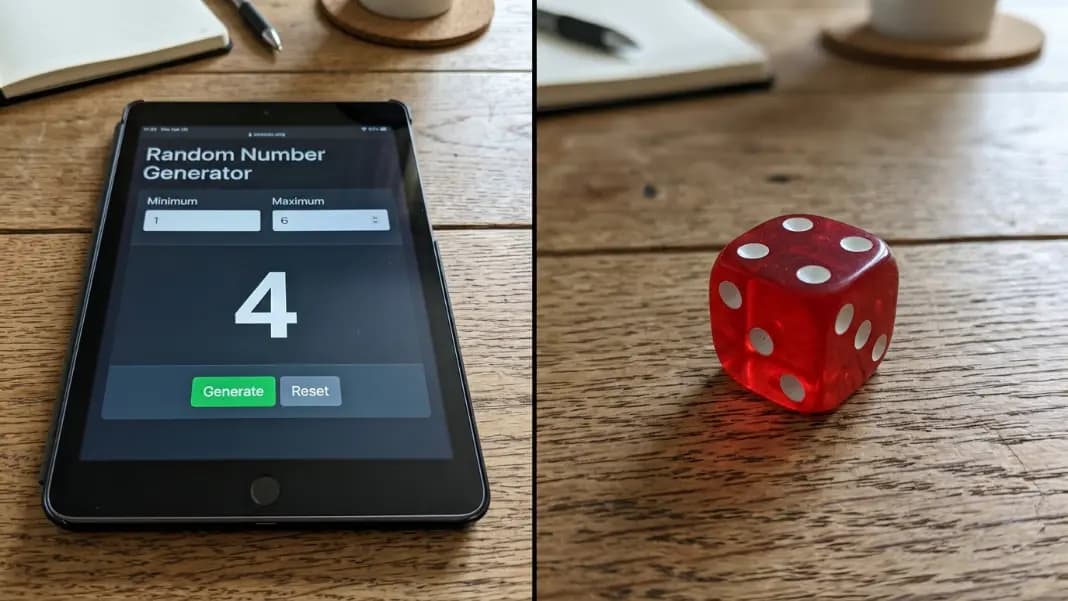
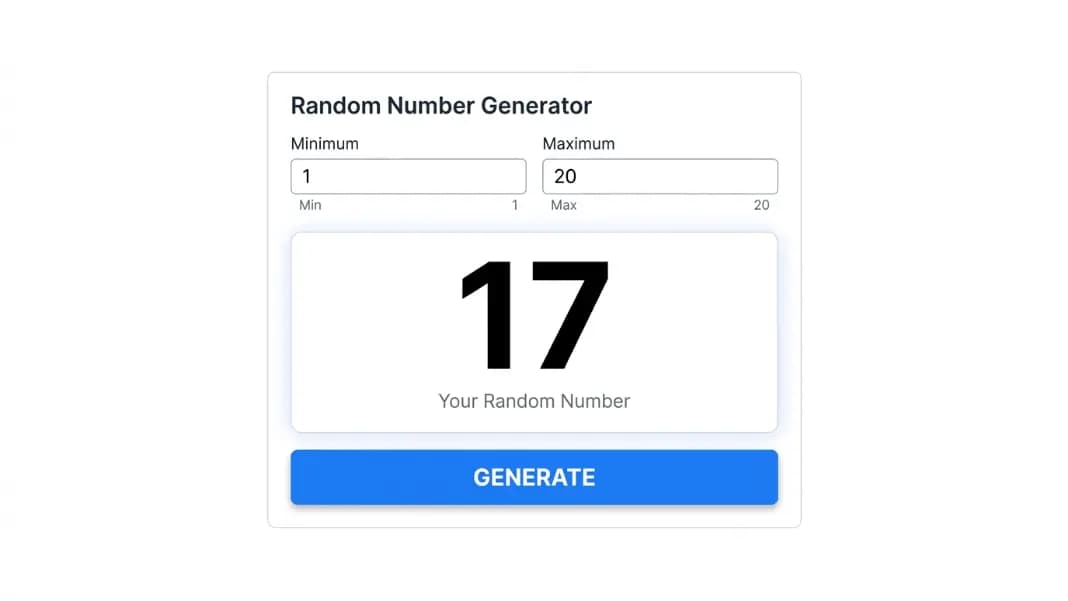
Every major lottery offers a Quick Pick option at the counter. Push a button and the terminal generates your numbers on the spot. Most players who buy Quick Picks never think about how it works, only whether it wins. But if you want to generate your own numbers before you get to the store, set up combinations for multiple formats, or understand exactly what your picks are before you commit them, a dedicated random number generator gives you the same result with more control.
The random number generator handles every lottery format in use today. The difference between Powerball and Mega Millions, between UK Lotto and EuroMillions, comes down to two settings: the range maximum and the count. Get those right for your lottery, and the numbers the tool produces are equivalent to any Quick Pick for that draw.
This guide covers the exact settings for every major lottery format, how the two-pool structure of Powerball and similar lotteries works in practice, and the one thing about random number selection that most lottery guides get wrong.
Lottery Formats and What Each One Actually Requires
Every lottery has a published structure: how many numbers to pick, the range to pick from, and whether a bonus number comes from a separate pool. Getting this right before generating is the only step that matters.
Powerball (United States): Pick 5 numbers from 1 to 69. Then pick 1 Powerball number separately from 1 to 26. These are two independent draws from two different ranges. The 5 main numbers must be unique among themselves, but the Powerball can match any of the main numbers because it comes from a completely separate pool.
Mega Millions (United States): Pick 5 numbers from 1 to 70. Then pick 1 Mega Ball from 1 to 25. Same two-pool structure as Powerball, different maximums. The most common configuration error when switching between the two is using the wrong maximum: 69 instead of 70 for the main draw, or 26 instead of 25 for the ball.
UK Lotto: Pick 6 numbers from 1 to 59. Single pool, no bonus draw required for the ticket itself. A bonus ball is drawn separately at the event but is not part of your ticket selection. This is the simpler structure: one draw, count set to 6, maximum set to 59, unique mode on.
EuroMillions: Pick 5 numbers from 1 to 50. Then pick 2 Lucky Stars from a separate pool of 1 to 12. Two separate draws with different counts and different ranges. Generate the 5 main numbers first, then run a second draw for the Lucky Stars with count set to 2 and unique mode on.
Irish National Lottery: Pick 6 numbers from 1 to 47. Single pool structure, similar to UK Lotto but with a smaller range.
Australian Powerball: Pick 7 numbers from 1 to 35, then 1 Powerball from 1 to 20. The larger count relative to a smaller range makes duplicates more likely in the main draw, which is exactly why unique mode is necessary.
For any lottery not listed here, find the official rules page and note two things: how many numbers to pick, and what the maximum value is. Those two numbers are all you need to configure the generator correctly.
Setting Up the Generator for Powerball
The two-pool structure of Powerball is where most people run into trouble. Because the main numbers and the Powerball come from different ranges, they cannot be generated in a single draw. You need two runs.
Open the random number generator. For the main numbers:
- Set minimum to 1
- Set maximum to 69
- Set count to 5
- Enable unique numbers mode
Generate. Write down or save the 5 numbers. Those are your white ball picks.
Without changing the minimum, update the settings for the Powerball:
- Set maximum to 26
- Set count to 1
- Unique mode does not matter for a single number draw, but leave it on
Generate. That result is your Powerball number.
You now have a complete Powerball entry: 5 numbers from 1-69 and 1 from 1-26. The entire process takes under 90 seconds including the settings changes. Each number was drawn with equal probability from the correct range. The output is equivalent to a Quick Pick from a lottery terminal.
For Mega Millions, the process is identical. Change the main draw maximum from 69 to 70, and the Powerball draw maximum from 26 to 25. Every other step is the same.
UK Lotto and Single-Pool Formats
Single-pool lotteries are the simpler case. One draw, one range, one count. UK Lotto is the standard example and the most searched international format outside the United States.
For UK Lotto:
- Minimum: 1
- Maximum: 59
- Count: 6
- Unique mode: on
Generate. You have your six numbers. There is no second draw.
Irish Lotto follows the same pattern with a maximum of 47 instead of 59. Most state lotteries in Australia use a similar single-pool format with their own specific ranges.
The advantage of single-pool lotteries for number generation is that there is no configuration step to get wrong. Set three values, enable unique mode, generate. The result is a valid ticket entry.
One thing worth knowing: UK Lotto draws a bonus ball as part of the official draw, but it is not part of your ticket selection. You pick 6, and the draw produces 6 main balls plus 1 bonus ball used to determine the second prize tier. You do not need to generate a bonus ball for your ticket.
For large single-pool draws where you want multiple picks documented in one place, the random number list generator can generate and display a full set of results with the range settings recorded. For lottery pools where multiple people want their picks in a shared document, that format is more convenient than screenshotting multiple individual spins.
EuroMillions and Formats With Multiple Secondary Numbers
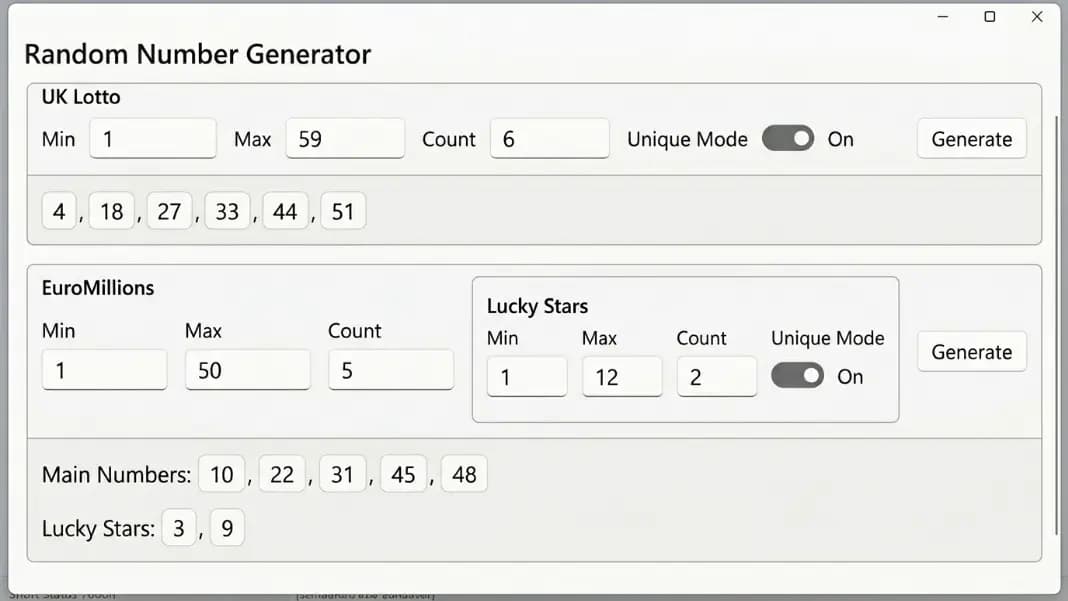
EuroMillions adds a complication beyond Powerball: the second draw requires 2 numbers, not 1. The Lucky Stars pool runs from 1 to 12, and you need 2 unique numbers from it.
For EuroMillions main numbers:
- Minimum: 1
- Maximum: 50
- Count: 5
- Unique mode: on
For Lucky Stars:
- Minimum: 1
- Maximum: 12
- Count: 2
- Unique mode: on
Two separate generation runs. The second run must have unique mode enabled because selecting the same Lucky Star twice is not a valid ticket entry.
The same approach applies to any lottery that uses a secondary pool: identify the count and maximum for the secondary draw, run it separately from the main draw, and treat the results as a distinct section of your ticket.
For Australian Powerball (7 from 1-35, plus 1 from 1-20), the main draw uses a higher count relative to the range. Without unique mode, the probability of at least one repeat across 7 picks from 35 values is meaningful enough to matter. Always enable unique mode for the main draw regardless of format.
Why Random Picks Are as Likely to Win as Chosen Numbers
This is the thing lottery guides get wrong most consistently, so it is worth stating directly.
Every valid combination of lottery numbers has exactly equal probability of winning on any given draw. A Powerball ticket with numbers 1, 2, 3, 4, 5 plus Powerball 1 has precisely the same winning probability as 7, 23, 41, 55, 62 plus Powerball 14. No combination is luckier. No pattern is due to appear. No number is overdue. Each draw is statistically independent of every previous draw.
The reason people believe certain number choices are better is cognitive bias, not probability. Birthdays cluster picks between 1 and 31 because months and days do not exceed those values. This means a large share of ticket buyers never pick numbers above 31, leaving the upper range underrepresented. If you hold a ticket with numbers above 31 and it wins, you are less likely to share the jackpot with another winner because fewer people chose those numbers. But your ticket's probability of winning was identical regardless.
A random number generator removes selection bias automatically. Because the generator draws from the full range with equal probability, it naturally avoids the human tendency to cluster in the lower third of the range. This does not improve your odds of winning, but it does mean that if you win, you are statistically less likely to split the prize with someone who manually chose the same combination.
The online random generators guide covers how cryptographically secure generators compare to physical lottery machines and why both produce results that are genuinely random rather than patterned.
Using No-Repeat Mode Correctly for Every Lottery Format
No-repeat mode is not optional for lottery number generation. Every lottery format requires distinct numbers within the main draw pool. Generating 5 numbers from 1-69 with duplicates allowed could produce 23, 23, 41, 55, 62, which is not a valid Powerball entry.
The random number generator no repeats guide covers how the Fisher-Yates shuffle algorithm works under unique mode, but the practical point is this: enable unique mode for every lottery draw involving more than one main ball. No exceptions.
The only situation where unique mode is technically irrelevant is a single-number draw (the Powerball or Mega Ball result), because a single number cannot duplicate itself. Even so, leaving unique mode on for consistency is harmless.
A related constraint: your count cannot exceed the size of the range in unique mode. Drawing 6 unique numbers from a maximum of 59 is valid. Requesting 60 unique numbers from 1-59 is impossible because only 59 distinct values exist. For all standard lottery formats, the count is well within the range size, so this constraint never triggers in practice.
Generating Multiple Ticket Lines
If you want picks for more than one ticket, run the generator once per ticket line. Each run is an independent draw with full probability across the range. The second ticket's numbers are not influenced by the first ticket's results in any way.
For five Powerball tickets:
- Run the main draw (1-69, count 5, unique on). Record results as Ticket 1 white balls.
- Run the Powerball draw (1-26, count 1). Record as Ticket 1 Powerball.
- Repeat for each subsequent ticket.
Keep your settings consistent across all runs. A mistake on the maximum between tickets means some entries come from the wrong range and are not valid for that draw.
For office lottery pools where multiple people contribute to a shared set of tickets, the download function in the number generator saves the results as a text file with the range and count settings recorded. That gives the group a documented record of how the numbers were generated, not just what they are. The random number generator for raffles guide covers this kind of documented draw setup in detail.
Quick Pick vs a Dedicated Generator
A Quick Pick terminal at a lottery retailer uses a certified random number generator built into the system. The output is printed directly onto your ticket. The terminal's generator is audited by the lottery authority and produces results with the correct range and probability for the format.
A dedicated online number generator gives you the same kind of output with more visibility. You see the numbers before committing to a ticket. You can run multiple sets and choose which combination you want to use. That choice does not change the probability of any individual set, but it satisfies personal preference and gives you numbers to review before going to the counter.
The generator does not produce a ticket. You still need to enter the numbers at a retailer or the official lottery website. But for players who want to generate their own picks at home before they get to the store, the process is the same as a Quick Pick. The numbers come from a cryptographically secure source. The probability is identical.
The practical difference is documentation. A Quick Pick leaves no record of how your numbers were selected. A generator result can be saved, screenshot, or downloaded as a text file. For group plays or situations where participants want to see that the draw was genuinely random rather than chosen by one person, that record matters.
Configuring the Generator for Any Format
The random number generator does not have lottery-specific presets, which keeps it flexible across every format in use globally. Any lottery is configurable with three values: minimum, maximum, and count. Set them correctly for your format, run separate draws for separate pools, and enable unique mode for every multi-ball draw.
The random tools section has everything else for number-based draws, including the coin flip for binary decisions, the team generator for group splits, and the wheel spinner for named selections. For lottery specifically, the number generator is the right starting point and the only tool you need.