Pick a Card Online (Free)
Pick a card any card from a full shuffled 52-card deck. This free random card picker draws any card instantly with no physical deck needed. Use it for card games, magic trick demonstrations, probability exercises, daily card readings, and any activity that requires a genuine random card draw. No signup, no download, runs entirely in your browser.
Click “Draw card” to pick from the deck
How to pick a card online
- Click Draw to pick any card at random from the full 52-card deck.
- The card, its value and suit, is displayed immediately.
- Enable without-replacement mode to simulate picking from a real shuffled deck.
- Set a quantity greater than 1 to draw multiple cards at once.
- Click Reset to restore all 52 cards to the deck and start fresh.
Pick a card any card: shuffle and draw
The classic "pick a card, any card" invitation is the opening to countless magic tricks and card games. This card picker random tool replicates that moment digitally. Every card in the standard 52-card deck has exactly equal probability of being selected on any draw. There is no weighting, no forced card, and no hidden pattern. The result is as random as a proper riffle shuffle followed by a blind cut.
The deck covers all four suits: Spades, Hearts, Diamonds, and Clubs, each with 13 cards from Ace through King. Face cards (Jack, Queen, King) and the Ace are included. Jokers are not included, matching the standard configuration for poker, blackjack, bridge, and most Western card games. For a random number pick without the card framework, the random number generator handles any custom range.
Card draw probabilities: what are the odds?
Each card draw from a full 52-card deck follows well-defined probabilities. The table below shows the odds for the most common draw goals.
| Draw goal | Fraction | Chance | Cards that qualify |
|---|---|---|---|
| One specific card (e.g., Ace of Spades) | 1/52 | 1.9% | 1 card |
| Any Ace | 4/52 | 7.7% | 4 cards |
| Any face card (J, Q, or K) | 12/52 | 23.1% | 12 cards |
| Any card of one suit (e.g., hearts) | 13/52 | 25% | 13 cards |
| Red card (hearts or diamonds) | 26/52 | 50% | 26 cards |
| Black card (spades or clubs) | 26/52 | 50% | 26 cards |
| Any card ranked 2 through 10 | 36/52 | 69.2% | 36 cards |
Pick a tarot card: playing cards and daily readings
While this tool uses a standard 52-card playing deck rather than a 78-card tarot deck, the cartomancy tradition assigns intuitive meanings to all 52 playing cards. Hearts traditionally represent emotions, relationships, and matters of the heart. Diamonds correspond to material concerns, finances, and practical decisions. Clubs relate to work, ambition, and creative energy. Spades are associated with challenges, change, and mental effort.
For a daily card reading in this tradition, click Draw once and reflect on the suit and number of the card you receive. A low-numbered heart suggests early emotional beginnings. A King of spades suggests authority in difficult circumstances. A pick a tarot card for the day practice using playing cards predates formal tarot and is still used in cartomancy traditions across many cultures. The tool provides the random draw. The interpretation belongs to the reader.
Pick a card trick: magic and mentalism uses
The pick a card trick is one of the most recognizable formats in close-up magic. In an online version, a volunteer clicks Draw to select a card from the shuffled deck, remembers the result, and the magician reveals it through a pre-prepared prediction. Because the card draw is genuinely random and not forced, the reveal is a real surprise when the prediction is set up in advance without knowing the outcome.
For party games and social activities, the pick a card game format works well as a group decision method: whoever draws the highest card goes first, or the person who draws a specific card completes a challenge. For the 52 card pick up prank format (throwing all 52 cards and asking someone to pick them up), this digital version is considerably tidier: no cards on the floor, and the picking is instantaneous.
Yes or no pick a card: binary decisions
For a yes or no pick a card decision method, assign red cards (hearts and diamonds, 26 total) as yes and black cards (spades and clubs, 26 total) as no. Draw a single card for a perfect 50/50 binary result. This method has a long tradition in cartomancy as a quick yes or no reading. The color split is exact at 50% each, making it statistically equivalent to a coin flip with the added layer of suit and value for anyone who wants more detail from the draw.
For a dedicated binary decision tool with a visible spin animation and the option to adjust the probability away from 50/50, the yes or no wheel is the more focused option. Use the card picker when the card identity itself adds value to the result beyond just yes or no.
Card picker for probability and math exercises
The card randomizer tool is well suited to probability education because the theoretical probabilities are known and calculable. The probability of drawing any specific card is 1/52. The probability of drawing a heart on a single pick is 13/52 or exactly 25%. The probability of drawing a face card (Jack, Queen, or King) is 12/52. Drawing in without-replacement mode lets students work through conditional probability: after one heart has been drawn, the probability of drawing another heart on the next pick changes to 12/51.
For tabletop games that combine dice and cards, use the dice roller alongside this card picker to handle both random elements in a single browser session. The two tools together cover the full range of randomness needed for most tabletop RPG and board game scenarios without any physical components.
How the card randomizer works
The card picker generates each draw using the browser's crypto.getRandomValues() API, which produces cryptographically secure random values from system entropy. In with-replacement mode, a random integer from 0 to 51 is generated and mapped to a card in the full deck. In without-replacement mode, a Fisher-Yates shuffle using the same secure random source pre-shuffles the entire deck, and each draw takes the next card from the shuffled order.
This means the draw is genuinely unpredictable and cannot be reverse-engineered or predicted. The result is statistically equivalent to a proper physical shuffle and blind cut. No card is weighted, no card is excluded, and the tool has no memory across sessions. Each new session starts with a fresh deck at equal probability.
Frequently asked questions
Click the Draw button to pick any card at random from the full 52-card deck. The card is displayed immediately with its suit and value. In the default mode, the deck resets on every draw so any card can appear on any pick. To draw without replacement and simulate picking from a real shuffled deck, enable the without-replacement mode before drawing.
This tool uses a standard 52-card playing deck rather than a 78-card tarot deck. However, the cartomancy tradition assigns meanings to all 52 playing cards: hearts represent emotions and relationships, diamonds represent material matters and finances, clubs represent work and ambition, and spades represent challenges and transformation. Drawing a single card each day using this picker for personal reflection follows the same daily card practice as tarot without requiring a separate tarot deck.
52 card pick up is a classic joke-prank card game where one person asks another if they want to play, then throws all 52 cards into the air and says "pick them up." It is not a real card game but the phrase "52 card pickup" is widely known. This online card picker is the opposite: it randomly selects cards for you from the shuffled deck so you never have to pick up anything yourself.
A classic pick a card magic trick works like this: ask a volunteer to click Draw to pick a card from the deck, have them remember the card without telling you, then use a memorized force or prediction to reveal it. For an online version, you can set up the prediction in a sealed note before anyone draws, then reveal it after the card is picked. The random card picker produces an unbiased draw that makes the reveal genuinely impressive.
Yes. Assign red cards (hearts and diamonds) as yes and black cards (spades and clubs) as no, then draw a single card to get a random binary decision. Each color has exactly 26 cards in the 52-card deck, giving a perfect 50/50 split. For a dedicated yes or no tool with a visual spin animation and adjustable probability, the yes or no wheel is purpose-built for that use case.
You can choose. The default mode draws with replacement, each draw is from a full 52-card deck and any card can appear again regardless of previous draws. Enable without-replacement mode to simulate dealing from a real shuffled deck where each drawn card is removed from the pool. The remaining card count updates after each draw. Reset the deck at any time to restore all 52 cards.
A card randomizer is a tool that selects a random card from a deck using a computer-generated random number. Unlike a physical shuffle, a card randomizer uses the browser's cryptographic random source to ensure the result is unpredictable and unbiased. This makes it more reliable than a hand shuffle for probability exercises and fair for any game or decision that requires a genuinely random card selection.
Yes. Set the quantity to the number of cards you want and click Draw. All cards are drawn simultaneously from the same pool. In without-replacement mode, drawing 5 cards at once is equivalent to dealing a 5-card hand from a shuffled deck, with each card distinct from the others in the hand.
In cartomancy, the playing card tradition that predates tarot, the four suits carry distinct themes. Hearts correspond to emotions, relationships, and matters of love. Diamonds represent material concerns, finances, and practical decisions. Clubs relate to work, ambition, creativity, and building things. Spades are associated with challenges, change, difficulty, and mental effort. Card value also matters: Aces represent beginnings or singular importance, Kings and Queens represent authority figures or significant people, and number cards represent degrees of the suit energy from emerging (low) to developed (high).
The probability of drawing any Ace from a full 52-card deck is 4 in 52, or approximately 7.7%. There are four Aces, one per suit. The probability of drawing the Ace of Spades specifically is 1 in 52, about 1.9%. In without-replacement mode, if one Ace has already been drawn, the probability of drawing another on the next pick changes to 3 in 51, approximately 5.9%.
Yes, with some limitations. Enable without-replacement mode to simulate drawing from a real shuffled deck, which matches how blackjack and poker work. For blackjack practice, draw 2 cards for a starting hand, then draw 1 more at a time to simulate hitting. For 5-card poker, draw 5 cards at once in without-replacement mode to get a proper hand. The tool does not enforce game rules or score hands automatically, but it provides a genuinely random card draw that matches a physical deck.
Related tools
Related articles
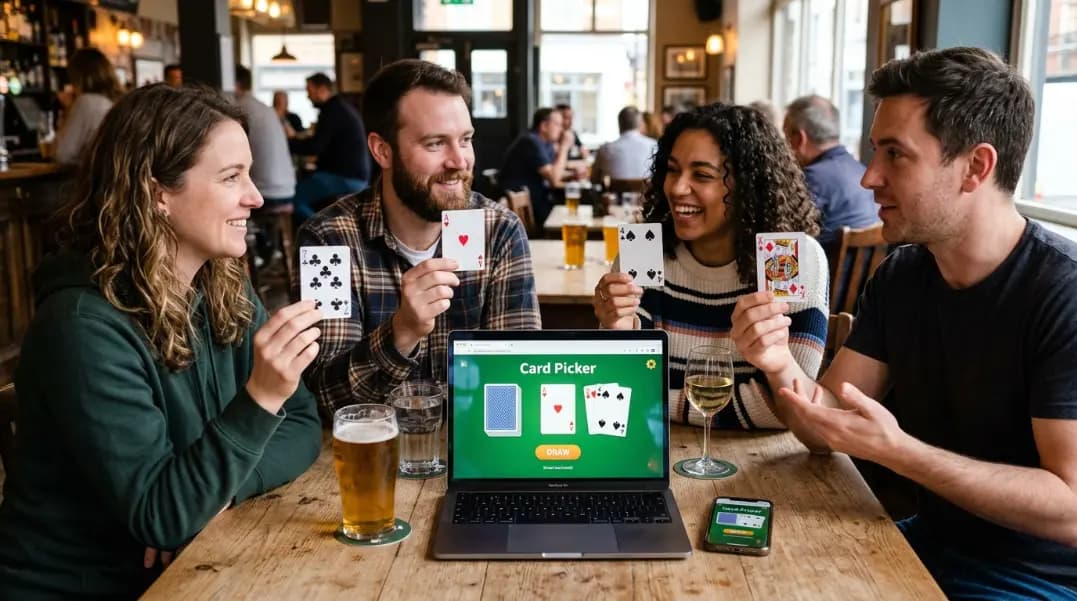
Random Card Picker: 9 Ways to Settle Any Group Decision
A random card picker resolves group decisions without argument. Nine ready-to-use methods for turn order, task assignment, party games, and meeting rotation.
10 min read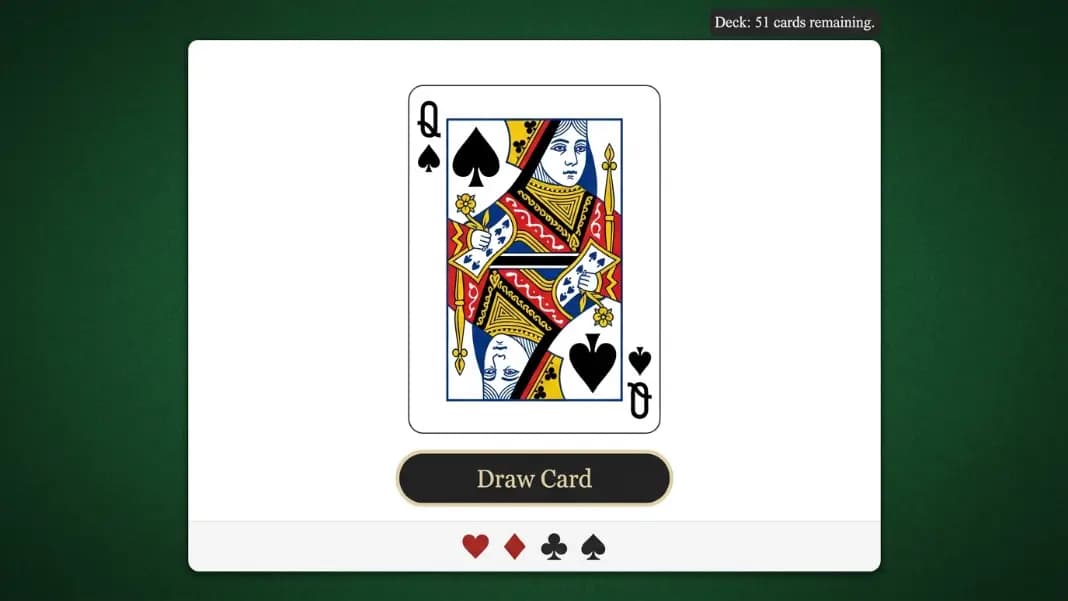
Random Card Generator: Picking Cards for Games, Magic, and Probability
Pick a random card from a 52-card deck online. Covers how the random card generator works, uses for games and magic, and drawing multiple cards without repeats.
12 min read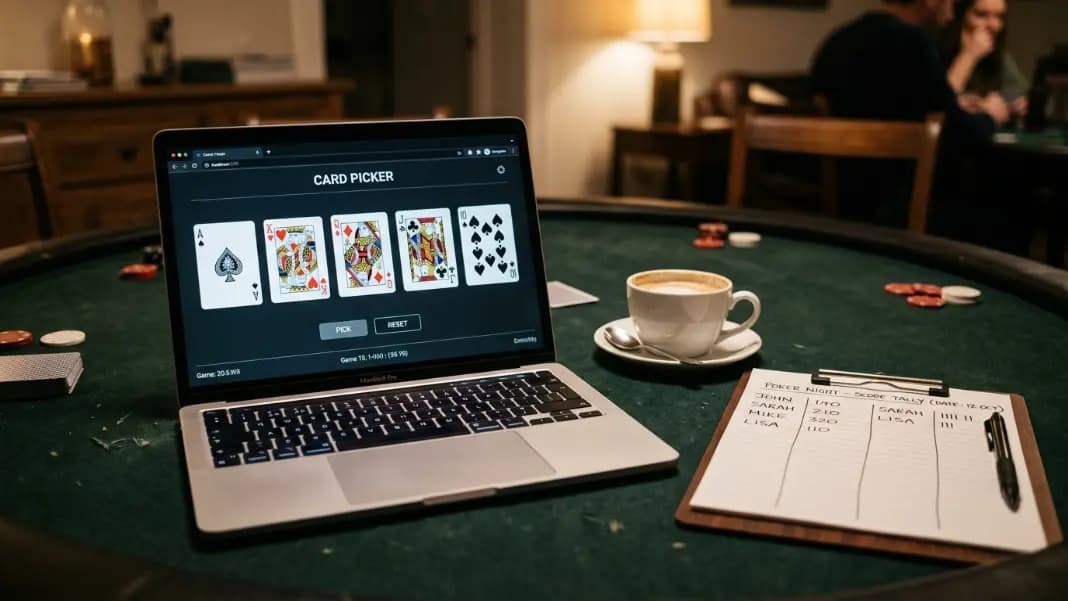
Card Games With a Deck of Cards: 7 Formats That Work Online
Seven card games you can play using a digital deck of cards online. Covers Blackjack, Higher or Lower, War, Beat the Dealer, and poker hand practice with full setup instructions for each format.
11 min read