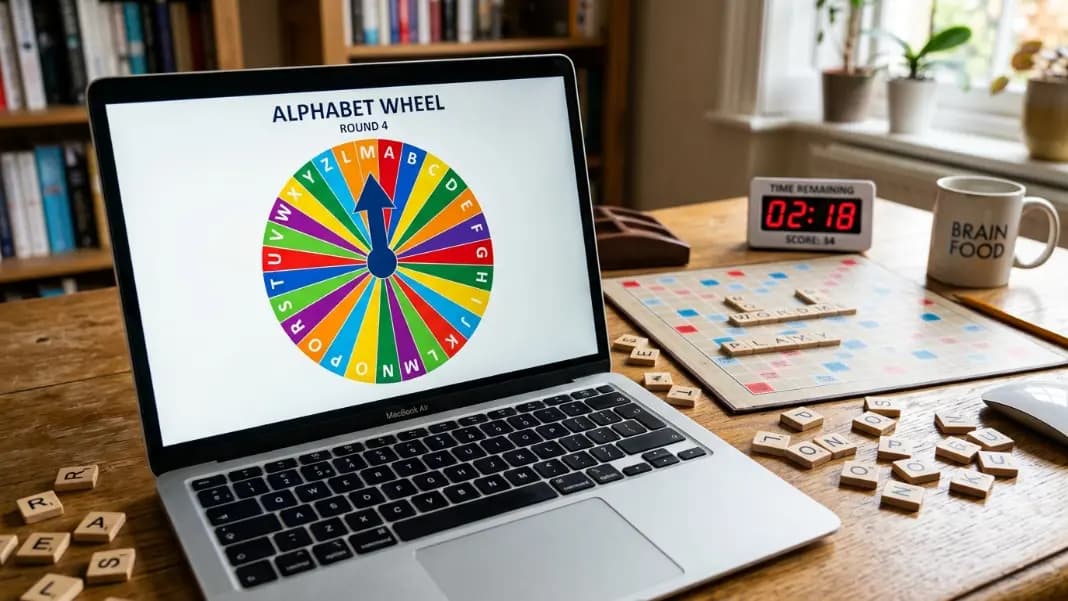
Word games that use a random letter as a starting constraint have one recurring design problem: a 26-segment equal-probability wheel treats E and Z as equals. E starts roughly 12.7 percent of English text. Z starts 0.07 percent. Spinning for Z produces a naming round most groups cannot complete. Spinning for E produces a round almost any group breezes through. A well-designed letter wheel accounts for this imbalance before the first spin.
The wheel spinner accepts any list as segments, including repeated letters. Load the wheel with frequency-adjusted entries rather than a flat A-to-Z list, and every spin produces a round the group can engage with. This guide covers how English letter frequency works, how to build a wheel that reflects it, and the specific word game and classroom formats where the distinction matters.
How English Letter Frequency Affects Word Game Design
The standard 26-letter equal wheel is the default starting point. Each letter gets a 1-in-26 (3.85 percent) chance. The problem is that this treats the alphabet as though all letters contribute equally to English vocabulary, which they do not.
The ten most frequent letters in English text, in order: E, T, A, O, I, N, S, H, R, L. These ten letters make up approximately 70 percent of all written English. The ten least frequent: J, K, Q, V, W, X, Y, Z, B, G.
For STARTING letters specifically, the distribution shifts. The most common word-starting letters in English are S, C, B, T, P, A, F, M, D, and R. S starts more English words than any other letter, accounting for a disproportionate share of common nouns, verbs, and adjectives. Q, X, and Z start almost no common English words in everyday conversation.
What this means for a naming game: If the game asks players to name animals starting with the spun letter and the wheel lands on Z, most groups will struggle. Zebra, Zonkey, Zorse, Zebu. The round stalls. If the wheel lands on S, the round practically runs itself. Snake, Spider, Shark, Swan, Salamander, Seal.
An equal-probability wheel occasionally produces a round nobody can complete, which stalls momentum. A frequency-weighted wheel prevents this by reducing the probability of rare letters or removing them entirely, depending on the activity's purpose.
Building a Frequency-Weighted Letter Wheel
A frequency-weighted letter wheel loads some letters more than once, making them proportionally more likely to come up than rare letters.
Common letter wheel (highest-frequency word starters): S, S, C, C, B, B, T, T, P, P, A, A, F, M, D, R, H, G, L, W
This 20-segment wheel loads the most productive starting letters twice, giving them double the probability of single-entry letters. Every spin produces a letter with a substantial English vocabulary pool. No impossible rounds.
Challenge wheel (includes hard letters): S, C, B, T, P, A, F, M, D, R, H, G, L, W, E, N, I, O, J, K, Q, X, Z
This 23-segment wheel includes rare letters at single probability while keeping common letters at higher probability. Q, X, and Z can appear but are less likely than S or C. Used for competitive rounds or groups with strong vocabularies.
Hard-letter wheel: Q, X, Z, J, V, K
Six segments, every result is a difficult starting letter. Reserved for championship rounds in longer games or for groups who want maximum challenge.
Open the wheel spinner, clear defaults, and type each entry one per segment, including repeats for letters you want to appear more frequently.
Vowel/Consonant Balance in Word Games
The 5-versus-21 vowel-to-consonant split in the alphabet looks straightforward. It is not, in practice.
Vowels appear in 39 percent of all letter occurrences in English text. But only about 14 to 15 percent of English words start with a vowel. This creates an asymmetry: vowels are everywhere inside words but proportionally rare as starting letters.
A vowel-only wheel (A, E, I, O, U) produces naming rounds of unequal difficulty:
- A and E: large starting vocabulary. Animals: Alligator, Ant, Elephant, Eagle. Easy rounds.
- I: moderate. Iguana, Ibis, Impala. Manageable but smaller.
- O: smaller pool. Octopus, Owl, Orca. Harder in some categories.
- U: the hardest vowel. Urial, Uakari. Most groups struggle.
For classroom phonics activities that target vowel sounds, knowing that U produces consistently harder naming rounds lets teachers prepare extra scaffolding for U rounds while letting A and E run freely.
A consonant-only wheel removes the vowels and forces every round to start with one of the 21 consonants. The difficulty range is still wide (S is easy, X is nearly impossible) but the floor is higher than a full 26-letter wheel because every vowel-start easy round is removed.
Word Association Game Format
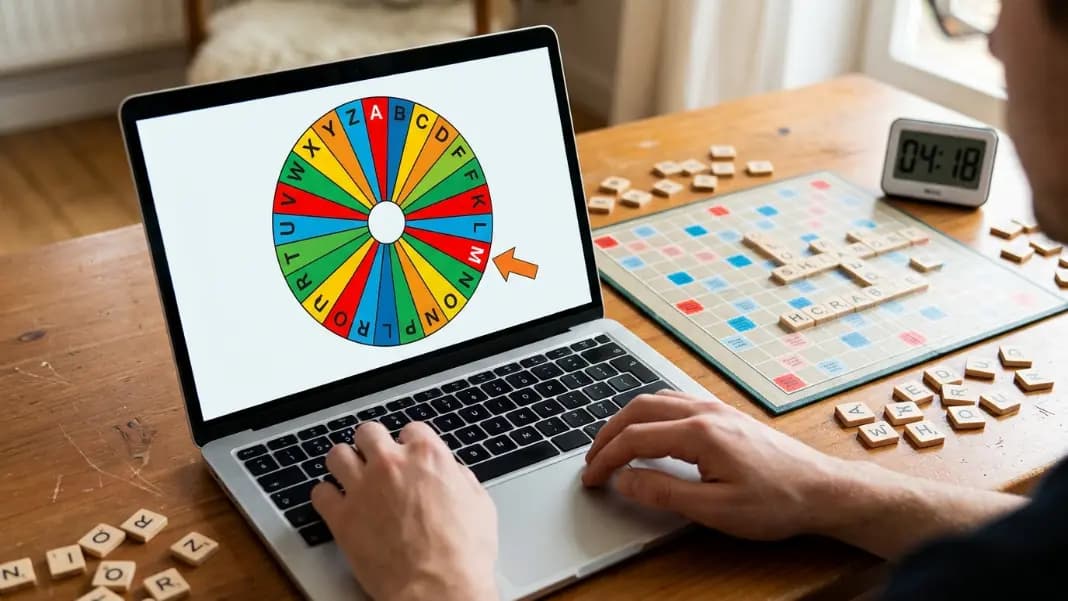
Word association with a letter constraint is a format most word game guides do not cover, and it produces a different kind of challenge than standard naming games.
Setup: Spin the wheel to pick a starting letter. Every word in the association chain must start with that letter.
How to play:
- The first player says any word starting with the spun letter.
- The next player says a word that is meaningfully associated with the previous word, also starting with the same letter.
- Continue around the group.
- A player who cannot respond within the time limit, or whose word has no clear connection to the previous one, is eliminated.
- Last player remaining wins.
For example, if the wheel lands on B: Ball, Bounce, Big, Bear, Brown, Branch, Bird, Beak, Bill, Bank, Bag, Buttons. Each word connects to the previous one and starts with B.
The letter constraint makes this harder than standard free association because the player must find a connection AND satisfy the starting letter simultaneously. Common letters like S and T produce long chains. Hard letters like Q force creative connections. Quilt, Quiet, Question, Quick, Quadrant.
This format works well for groups who find simple naming games too easy, and for language teachers who want students to demonstrate both vocabulary depth and word relationships at the same time.
Alphabet Trivia Format
An alphabet trivia wheel assigns categories by letter rather than picking from a pre-written question bank.
How to play:
- Spin the wheel to pick a letter.
- The host names a category (countries, capitals, inventors, athletes, films, foods).
- Players race to name one item from that category starting with the spun letter.
- First correct answer scores the point. The round lasts thirty seconds maximum.
Variant: Letter Lockout. After a letter comes up, that letter is removed from the wheel. As the session continues, the remaining letters skew toward harder starting consonants. The final rounds of the session are naturally the most difficult.
Category difficulty by letter: Some categories produce consistently hard rounds for specific letters. Countries starting with Q: Qatar. Countries starting with X: none recognized internationally (the trap round). Capital cities starting with Z: Zagreb, Zurich, Zamboanga. These known difficulty spikes let a host manage round pacing by removing them before spinning if the group is less experienced.
Word Game Formats
Scattergories format: Spin for the round's letter. Players individually write one item per category starting with that letter within a set time. Points score only for answers no other player wrote. The wheel replaces the physical Scattergories letter die with equal probability.
Naming challenge: Spin for a letter, name a category, players list as many items starting with that letter as possible in ninety seconds. More items than any other player wins the round. Remove the letter from the wheel after each round to prevent repeats.
Word chain: Spin once for the starting letter. First player names a word starting with that letter. Each subsequent player names a word starting with the last letter of the previous word. The initial spin only sets the first word. The rest follows from player choices.
Speed round: Spin for a letter. Set a ten-second timer. Players alternate naming items starting with that letter as fast as possible. First player to hesitate or repeat is out. No categories, any English word counts.
Classroom Uses
For vocabulary: spin to pick a letter and have students name one word in the subject area starting with that letter. For a language class, one word in the target language. For a science class, one term from the current unit.
For spelling practice: spin for a letter, the teacher calls out a word starting with that letter, students write it. The wheel picks the starting letter. The teacher picks the specific word from their lesson vocabulary.
For topic assignment: spin to give each student a starting letter for their presentation subject. This distributes topics across the alphabet rather than having multiple students choose the same popular options. A student who gets Q has a harder assignment but a more distinctive topic.
For phonics: load only the letters being practiced that session. A four-letter wheel with B, D, F, and G keeps each spin focused on the active lesson sounds without introducing letters not yet covered.
The random letter generator guide covers the dedicated letter generator for bulk generation and individual use where animation is not needed. For any activity that combines letter selection with team assignment, the wheel spinner for teams guide covers how to manage group divisions alongside the letter wheel format. For the full set of random tools that pair with word games, the random tools section has the coin flip for binary choices and the number generator for point scoring.