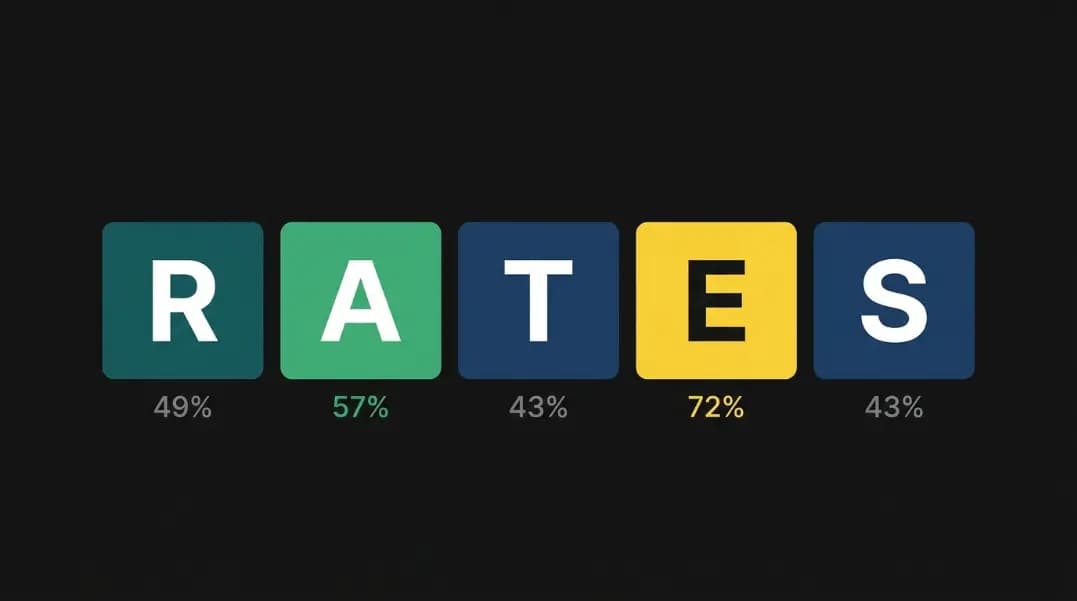
You open Wordle, stare at the blank grid, and cannot decide where to start. You want a word that covers the most useful letters, but you do not know which letters show up most often in the answer pool. The answer is not random: E appears in roughly 72 percent of all valid 5-letter Wordle answers. A appears in 57 percent. R appears in 49 percent. The best opening words are not guesses; they are the ones that cover these high-frequency letters in a single row.
The random letter generator does not generate full words, but it serves a specific purpose in 5-letter word practice that a dictionary word generator cannot: it gives you an unpredictable starting constraint, which forces you to find words from a set of letters rather than choosing the ones you already know. This guide covers how letter frequency works in 5-letter words, how to use random letters for Wordle practice, and the specific game formats where 5 random letters produce competitive rounds.
How Does a Random Letter Generator Produce 5-Letter Words?
The short answer is that it does not, not directly.
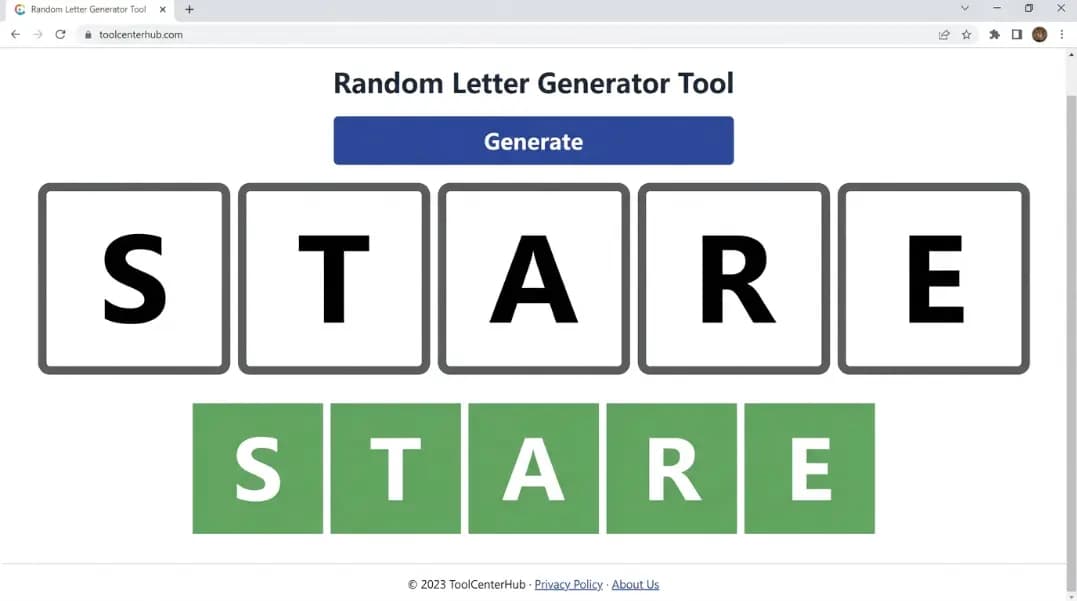
The random letter generator picks individual letters at random from the alphabet pool you specify. Set the count to 5 and it returns 5 independently chosen letters. If you ask for 5 letters, you might get A, R, T, E, S or you might get X, Q, Z, V, J. Both outputs are equally likely from the generator's perspective because each letter has equal probability on each draw.
What you do with those letters determines whether you get a word. A, R, T, E, S can be arranged into STARE, TEARS, RATES, ASTER, and several other valid words. X, Q, Z, V, J cannot be arranged into any common English word because those letters rarely appear together in English vocabulary.
This gap between letter generation and word formation is the key distinction. If you need a specific valid 5-letter word for a game, the letter generator alone will not reliably produce one. If you need an unpredictable set of letters to practice word-finding under constraint, the generator is the right tool.
The random letter generator guide covers the general use cases for the tool, including Scrabble setups, classroom draws, and mixed-case letter generation. This guide focuses specifically on the 5-letter use case and the Wordle connection.
Letter Frequency in 5-Letter Words: The Wordle Data
Not all letters appear equally often in valid 5-letter English words. The NYT Wordle answer pool, which contains 2,309 words chosen for familiarity and fairness, shows a clear frequency distribution that determines which letter combinations are most productive.
| Letter | Approximate Frequency in Wordle Answers | Rank |
|---|---|---|
| E | 72% | 1 |
| A | 57% | 2 |
| R | 49% | 3 |
| O | 44% | 4 |
| T | 43% | 5 |
| S | 43% | 6 |
| I | 42% | 7 |
| N | 37% | 8 |
| L | 35% | 9 |
| C | 31% | 10 |
The bottom of the frequency table is equally informative. Q appears in under 2 percent of answers, X in under 1 percent, and Z in approximately 2 percent. A random 5-letter string that includes Q, X, or Z has very little chance of forming a valid Wordle answer, even with rearrangement.
This table explains why certain words are analytically strong Wordle openers. RAISE covers R, A, I, S, and E: five of the top seven most frequent letters. STARE covers S, T, A, R, and E. CRANE covers C, R, A, N, and E. Each of these words gathers information about the most probable letters in any answer, which is why they appear repeatedly in strategy discussions.
If you use the random letter generator to practice, draws that include E, A, and R give you the best chance of forming multiple valid words from the set. Draws dominated by low-frequency letters (J, Q, V, X, Z) may produce only one valid word or none at all, which is the intended challenge in harder game formats.
Why Random 5-Letter Strings Rarely Form Valid Words
The English alphabet has 26 letters. A 5-letter string drawn at random from all 26 letters with equal probability produces a valid English word in a small fraction of cases.
The reason is vowel distribution. Valid English words require vowels. A typical 5-letter English word contains 1 to 2 vowels, most often in the second and fourth positions (consonant-vowel-consonant-vowel-consonant patterns are common: STARE, CRANE, BLEND, GRIPS). The alphabet has 21 consonants and only 5 vowels. A random draw across all 26 letters is more likely to produce 4 or 5 consonants than a vowel-consonant mix suitable for a word.
Even when a vowel appears in the random set, the specific consonants matter. The letters X, Q, and Z rarely combine with common vowels to produce recognizable words. K, J, and V appear at the ends of very few English words.
The practical result: if you set the letter generator to draw from all 26 letters with equal probability and generate 5 letters, the resulting set will form a valid English word in a minority of draws. Adjusting the pool to include vowels more frequently, or limiting draws to the 15 or 16 most common English letters, increases the rate of word-forming sets substantially.
For a version of this approach tuned to word game use, the letter wheel spinner covers frequency-weighted letter selection, where common letters appear more often than rare ones to produce more completable rounds.
How to Use Random Letters for Wordle Practice
Wordle gives you six guesses to find a specific 5-letter word. The strategy question is which words to guess in what order to eliminate the most letters fastest.
Random letter generation helps with two distinct practice modes.
Mode 1: Constraint practice. Generate 5 random letters. Your goal is to find a valid Wordle guess word that uses as many of those letters as possible. If the generator returns R, A, P, S, E, you might use REAPS (R, E, A, P, S) which uses all five. If it returns B, L, T, V, J, you must find a word using only the letters you can form into something valid. This forces you to scan your vocabulary quickly rather than defaulting to the same openers every game.
Mode 2: Information efficiency practice. Generate 5 letters and then challenge yourself to find the highest-coverage opening word containing as many high-frequency letters as possible. The goal is to assess how good a word opener is by how many of the top-10 frequency letters it covers, not just by whether it uses the generated letters.
Neither mode replaces playing actual Wordle rounds, but both train the vocabulary recall and letter pattern recognition that makes Wordle easier.
5-Letter Word Game Formats for Groups
Random letter sets work well for group games where the letters are the same for all players and the winner is whoever finds the most words or the best word.
Anagram challenge (4 to 8 players): Generate 5 random letters. All players see the same letters. Set a 90-second timer. Each player writes every valid English word they can form using only those five letters, with each letter used at most once per word. Scoring: one point per unique valid word, two points for any word that uses all five letters. The player with the most points wins the round. A new 5-letter set starts each round.
A set like S, T, A, R, E produces many words: ARE, EAR, EAT, ERA, ATE, STAR, TARE, RATE, TEAR, EARS, STARE, RATES, TARES, RESAT. A set like B, L, X, J, Q produces almost none, which is why you may want to filter out rare letters or use a vowel-weighted setup.
Word length race (any group size): Generate 5 random letters. The first player to call out a valid word using those letters scores a point. All players compete at the same time. Longer words score more points: 3 letters = 1 point, 4 letters = 2 points, 5 letters = 3 points. Once a word is called, it cannot be repeated that round.
Vowel rounds and consonant rounds: Alternate between drawing from vowels only (A, E, I, O, U five times) and consonants only. Vowel-only rounds are harder because you need consonants to anchor words. Consonant-only rounds with common letters (S, T, R, N, L) produce shorter, more structured rounds. The letter generator's filter settings handle this directly.
What Makes a Strong 5-Letter Opening Word?
An opening word in Wordle is strong when it covers as many of the top-frequency letters as possible without repeating any. Repeated letters waste a guess position because they only test one letter possibility instead of two.
The three most analyzed high-coverage openers:
RAISE: Covers R (rank 3), A (rank 2), I (rank 7), S (rank 6), E (rank 1). Five of the top seven most frequent letters with no repeats. The word is common enough to be in the answer pool, which matters in games where guesses must be valid words.
STARE: Covers S (rank 6), T (rank 5), A (rank 2), R (rank 3), E (rank 1). Similar coverage to RAISE with T replacing I. If the previous day's answer ended in S, RAISE tests that position again. STARE does not.
CRANE: Covers C (rank 10), R (rank 3), A (rank 2), N (rank 8), E (rank 1). Slightly lower frequency coverage than RAISE or STARE but introduces C and N, which are absent from the other two words. Used as a second-round opener after RAISE eliminates some common letters.
The diminishing returns of opener optimization: the gap between the best opener (RAISE) and a decent opener (ADIEU, AUDIO) is smaller than most players expect. RAISE correctly places roughly 2 to 3 letters on average. ADIEU correctly places roughly 1.5 to 2.5. The improvement is real but not decisive. Vocabulary recall on guesses 3 through 5 determines outcomes more than opener choice for most players.
Random 5-Letter Words Across Different Word Games
The 5-letter constraint shows up across several different word game formats, each with different rules about what counts as a valid word and what the letter set must include.
Scrabble: In Scrabble, 5-letter words score well because they cover more board space without being impossible to build. The letter distribution in a standard Scrabble set is frequency-weighted: 12 E tiles, 9 A tiles, 6 each of I, O, N, R, T. Drawing 5 random letters from a Scrabble bag is more likely to produce word-forming sets than drawing from an equal-probability 26-letter pool, because the bag mirrors English frequency distribution.
Bananagrams: All tiles must be used, and the 5-letter word constraint is one way players organize their grids when they have a cluster of common letters. Generating random 5-letter sets for solo Bananagrams practice mimics the pressure of managing an unfamiliar tile draw.
Word chain: Each new word must start with the last letter of the previous word and be exactly 5 letters. Generate a random starting word, then alternate. The 5-letter constraint narrows each player's options significantly compared to free word chains, which increases the difficulty and produces longer game sessions.
For the full range of letter-based random tools, the random tools section has the letter generator, wheel spinner, and number generator for game formats that combine letter and number constraints.
The core use of the random letter generator for 5-letter word work is as a constraint engine: it removes the player's choice from the starting position and forces vocabulary recall under unpredictable conditions. Whether the goal is Wordle preparation, competitive anagram play, or a casual group round, the letters set the terms and the player's word knowledge determines the outcome.