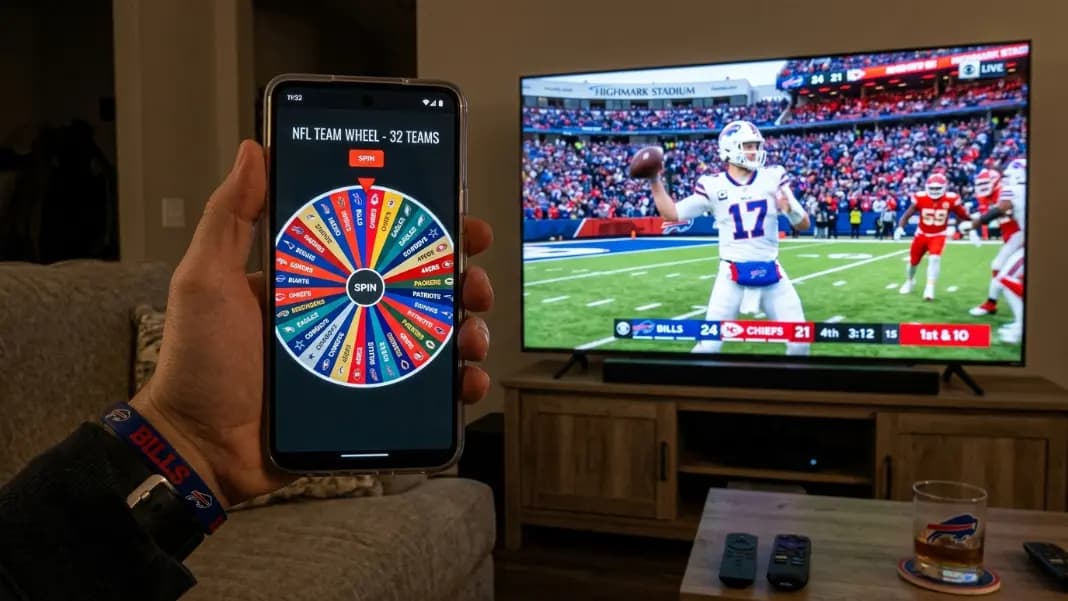
Nobody wants to go first. Everyone waits for someone else to come up with a statement worth using. The game stalls before it starts, or the same three players carry all the prompts while everyone else waits their turn. A never have I ever wheel spinner removes both problems. Load your statements before the game starts, spin once per round, and the group focuses on responding rather than generating.
The wheel spinner accepts any text as segments. Type one statement per line, spin, and the result picks the round's prompt. No deck to shuffle, no turn order to manage, no pressure on anyone to produce something on the spot. This guide covers the mechanical differences between wheel format and card format, what makes a statement work on a wheel, fifty prompts organized by stakes level, and how the two-player version runs differently from the group format.
How Wheel Format Changes NHIE Dynamics Compared to a Card Deck
A card deck and a wheel spinner both randomize statement selection. The mechanics behind that randomization produce different game sessions.
A card deck is finite and depletes as the session progresses. Players who remember which statements are in the deck know approximately what remains in the second half of an evening. This creates a quiet form of management: a player who has something honest to answer might give a deflected response early, knowing a more specific version of the same territory is still in the deck. The deck also has a natural endpoint: when the cards run out, the session ends.
A wheel spinner keeps every statement at equal probability on every spin, throughout the entire session. The wheel does not remember that a statement already came up. If "never have I ever sent a message to the wrong person" lands in round three, it has the same probability of landing in round fifteen as it did before the first spin. This eliminates strategic withholding because there is no information about what comes next.
The more significant difference is what happens when a statement lands twice. In a card format, this cannot happen within a single session. On a wheel it can, and the second landing often gets a different response than the first. Group comfort changes over the course of an evening. A statement that produced a deflected answer in the first twenty minutes can produce a genuine answer an hour later, once the group has settled and the early social pressure has dropped. This is a property of the wheel format that card format cannot produce by design.
The third difference is modifiability. A card deck cannot be edited mid-session without disrupting the shuffle structure. A wheel can be updated between any two spins: add a statement a player suggests mid-game, remove one that fell flat in two consecutive rounds, adjust the list as the session evolves. Longer sessions with mixed groups benefit from this: you can calibrate the wheel toward what is actually working rather than staying locked into the initial list.
What Makes a Good NHIE Statement for a Wheel?
Not all statements work equally well in wheel format. The visual constraint of a segment means the statement has to be readable in under two seconds.
Length: Fifteen words or fewer. "Never have I ever sent a message to the wrong person" is fourteen words and reads clearly at a glance. A 25-word setup with specific context does not. Players need to read the result while the wheel is still displaying it.
Universality: The statement should produce a clear yes or no from most players. Statements so specific they only apply to one player type, or so rare that almost nobody has done the thing, produce flat rounds with no reaction. Statements about common social situations, food decisions, and everyday choices get more genuine responses because most players can answer honestly from their own experience.
Specificity: The statement still needs to be specific enough that different people give different answers. "Never have I ever made a mistake" is too vague: everyone says yes. "Never have I ever submitted something in the last possible minute" is specific enough to produce genuine splits across the group.
Stakes calibration: Statements work on a spectrum from low-stakes to high-stakes. Low-stakes statements (nodding along to a conversation you stopped following) warm the group up. High-stakes statements (maintaining a lie until backing out became complicated) land better once the group's comfort level is established. Load the wheel with a mix across the full spectrum, or build separate low-stakes and high-stakes wheels and switch between them as the evening progresses.
50 Statements Organized by Stakes Level
These are ordered from lower to higher stakes. For new groups or mixed gatherings, build the wheel from the first two categories. Add entries from the lower end of higher-stakes categories as the session loosens up.
Everyday life:
- Never have I ever set an alarm and ignored it more than three times in a row.
- Never have I ever eaten leftovers that were questionably old and said nothing.
- Never have I ever googled something I was embarrassed not to know.
- Never have I ever nodded along to a story I completely stopped following.
- Never have I ever made up an excuse to leave a situation I did not want to be in.
- Never have I ever fallen asleep during a movie I said I wanted to see.
- Never have I ever sent a message to the wrong person.
- Never have I ever typed something, reconsidered it entirely, and deleted it.
- Never have I ever bought something and immediately regretted the price.
- Never have I ever pretended to like a gift I did not like at all.
Travel and experience: 11. Never have I ever been on a flight that got diverted or significantly delayed. 12. Never have I ever arrived somewhere with no plan and no booking. 13. Never have I ever gotten genuinely lost in a place I thought I knew. 14. Never have I ever slept in an airport overnight. 15. Never have I ever missed transportation I had already paid for. 16. Never have I ever traveled somewhere alone and enjoyed it more than I expected. 17. Never have I ever visited another country and spoken fewer than ten words of the local language. 18. Never have I ever packed for a trip in under thirty minutes.
Food and drink: 19. Never have I ever eaten a full meal standing over the kitchen sink. 20. Never have I ever eaten an entire bag of something in one sitting. 21. Never have I ever ordered delivery and forgotten about it until it was cold. 22. Never have I ever tried to cook something ambitious and served something completely different. 23. Never have I ever gone to the same restaurant so many times I ordered without looking at the menu. 24. Never have I ever made a food decision I regretted within five minutes.
Social situations: 25. Never have I ever laughed at the completely wrong moment. 26. Never have I ever waved back at someone who was not waving at me. 27. Never have I ever pretended to recognize someone I had no memory of meeting. 28. Never have I ever been in a conversation and realized I had been using the wrong name the whole time. 29. Never have I ever stood at a door waiting for it to open automatically before realizing it was manual. 30. Never have I ever called a teacher or boss by the wrong name in front of others. 31. Never have I ever gotten someone's order completely wrong and just taken it anyway. 32. Never have I ever applauded in a situation where nobody else was clapping.
Work and school: 33. Never have I ever sent an email to the wrong person at work. 34. Never have I ever sat through a meeting that could have been a message. 35. Never have I ever submitted something in the last possible minute. 36. Never have I ever taken more credit for something than I strictly deserved. 37. Never have I ever turned a camera off in a video call for a reason that was not technical. 38. Never have I ever stayed in a role longer than I should have.
Higher stakes for close groups: 39. Never have I ever pretended to be somewhere I was not. 40. Never have I ever stayed in a relationship longer than I should have. 41. Never have I ever had a strong opinion I changed completely after learning more. 42. Never have I ever done something impressive and actively avoided taking credit. 43. Never have I ever maintained a lie long enough that backing out became complicated. 44. Never have I ever avoided a conversation that genuinely needed to happen. 45. Never have I ever made a decision I still think about years later. 46. Never have I ever spent money on something I knew was a mistake while buying it. 47. Never have I ever stopped being close to someone without any real explanation. 48. Never have I ever regretted something I said immediately after saying it. 49. Never have I ever been completely wrong about someone the first time I met them. 50. Never have I ever watched a situation unfold and wished I had spoken up earlier.

Never Have I Ever for Two Players
The group format works because energy carries across multiple players reacting simultaneously. With two players, the game becomes a structured conversation and the wheel serves a different purpose.
The wheel picks the statement. Both players respond to the same prompt, then spin again. This keeps both players on the same statement simultaneously rather than alternating who generates the next prompt, which makes the exchange more even than the traditional format where one person controls the content.
Statement quality matters more in a two-player session. With a group, other players' reactions carry slow rounds. With two people, each statement needs to generate at least a brief exchange on its own. Favor statements where you are genuinely uncertain whether the other person will say yes or no. Statements with predictable answers in a one-on-one context produce flat rounds where one person already knows what the other will say.
The mid-session modification advantage of the wheel also applies here: if a statement lands and produces no meaningful exchange, remove it before the next spin and add something more likely to generate a real response. Two-player sessions are short enough that the initial statement set matters more than in a large group, where energy carries the game regardless.
Family-Friendly Statements for Mixed Groups
These work for family game nights, school events, and any session where age range is wide and all players need to be able to answer honestly without discomfort:
- Never have I ever cried because a fictional character died.
- Never have I ever tried a food and pretended to like it.
- Never have I ever gotten lost somewhere I thought I knew well.
- Never have I ever stayed up much later than I was supposed to.
- Never have I ever been scared by something that turned out to be completely harmless.
- Never have I ever had a song stuck in my head for an entire day.
- Never have I ever tried to say something in another language and gotten it completely wrong.
- Never have I ever spilled a drink on something important.
- Never have I ever accidentally broken something and hoped nobody noticed.
- Never have I ever read the last page of a book before finishing it.
Both children and adults can answer honestly from real experience. Neither group is put in a position that only makes sense for one age range.
Adding Truth or Dare to the Same Wheel
NHIE and truth or dare run on the same tool. Add TRUTH and DARE as two extra segments alongside your NHIE statements. When the wheel lands on a statement, everyone responds as usual. When it lands on TRUTH or DARE, the most recent player who answered applies.
This runs a longer mixed session from a single wheel. For groups who prefer clean separation between formats, build one wheel for NHIE statements and a second for truth or dare prompts. Switch wheels when the current format runs its course rather than mixing statement types in the same wheel.
A third option: reframe each statement as a dare. If the statement applies and you have done the thing, describe the situation in detail. If you have not done it, complete a dare related to the statement. This is higher-energy and works well once a group has moved past the early rounds and the low-stakes categories.
Two Rules That Keep Sessions Running
Set the response window before the first spin. Agree on a maximum time per round before anyone needs to use it: ten seconds for fast sessions, thirty for conversational ones. After the window closes, spin again regardless. Fast rounds sustain energy. Extended discussion between rounds fragments the game's momentum. Announce the window before the first spin so it is already established rather than being introduced when someone needs slowing down.
Set the pass rule before the first spin. Decide whether players can skip a statement and what the cost is. Groups with no pass rule run cleaner because there is no mid-round negotiation about whether a statement qualifies for a skip. Groups where some statements might touch sensitive territory should establish a clear pass option before anyone has a reason to invoke it. Setting this rule after someone needs it creates more awkwardness than the statement itself.
For structured group formats where a wheel handles rotation and task assignment rather than game prompts, the wheel spinner for teams guide covers standup order, rotating task assignment, and the fairness math behind recurring wheel sessions. For party game formats that involve activity lists and structured dare rotation for birthdays and celebrations, the birthday wheel spinner guide covers age-specific formats in detail.
For binary yes or no decision games that use a different wheel format, the yes or no wheel games guide covers those formats. For any other random tool that pairs with game night, the random tools section has the coin flip for binary choices and additional tools for group selection and scoring.