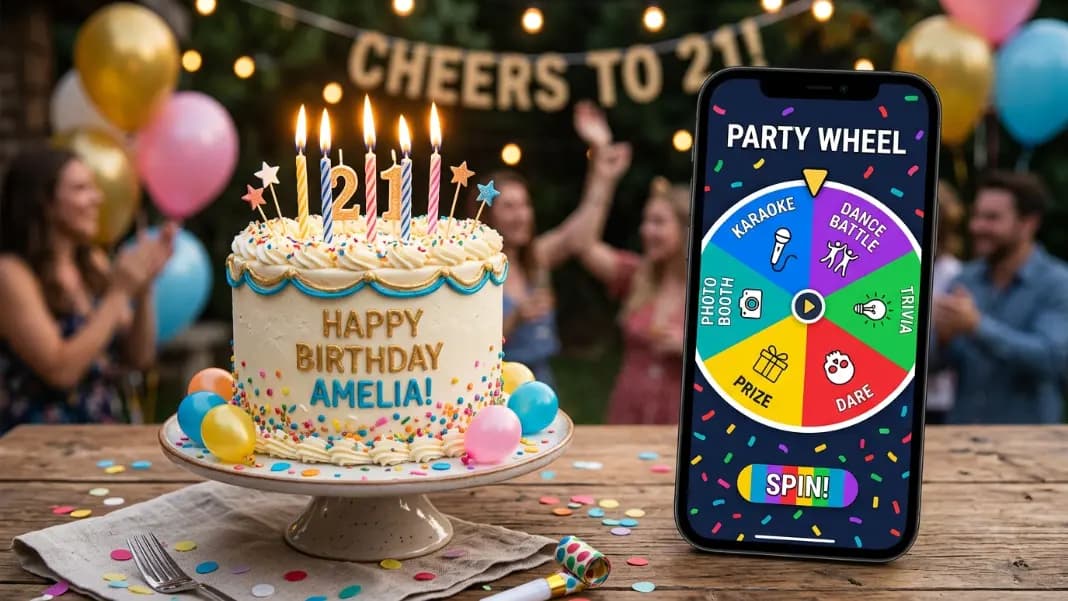
The party is thirty minutes in and three people have asked what comes next. The birthday person wants to start a game but does not want to be the one who picks something the group is not excited about. The host is holding a list of activities that everyone approved in theory but nobody is enthusiastic about right now. A birthday wheel spinner moves things forward before the question becomes a negotiation.
The wheel spinner accepts any list as segments. Load it with activities, guest names, dares, or game prompts, spin in front of the group, and whatever it lands on is what happens next. This guide covers the formats that actually improve party flow: who goes first decisions, gift reveal order, dare assignment, repeat pick management, and age-specific activity lists for every stage from ages four to adult.
Who Goes First: Why the Choice Creates Social Friction and How the Wheel Fixes It
Every group game at a birthday party starts with the same problem: somebody has to go first, and whoever picks who goes first is making a social decision, not just a game decision.
When a host picks manually, they almost always choose one of three people: themselves, the birthday person, or the most socially confident person in the room. Each pick carries an implicit message. Picking yourself looks self-serving. Picking the birthday person looks predictable and avoids any real randomness. Picking the most vocal guest reinforces existing group dynamics and signals to quieter guests that they are lower in the order before the game has started.
The guests who go later in a manually ordered game also read meaning into their position. Going third or fifth in a six-person game does not feel neutral if a person made the call. It feels like they were ranked third or fifth.
A wheel removes both problems. The visible randomness of a spin means the person who goes first is not more valued than the person who goes fifth. Nobody chose the order, which means nobody can attach social meaning to their position. The mechanism is explicitly neutral, and that neutrality changes how the result feels in a way that manual selection, however well-intentioned, cannot replicate.
Setup: Load the wheel with the names of all participants. Spin once to pick who goes first. For games where order matters throughout, spin after each turn to pick who goes next. For games where you want a full sequence set in advance, assign numbered positions and have each person spin once to claim their number. First spin gets position one, second spin gets position two, and so on.
Birthday person rule: Decide before the first spin whether the birthday person is excluded from the who-goes-first wheel. At most parties, the birthday person starting a game is natural and expected. If the group agrees on this, remove the birthday person's name before spinning. If the group prefers total randomness, include their name and spin normally. Decide this before the wheel opens, not after seeing the result.
Gift Reveal Order Wheel
At birthday parties where the guest of honor opens presents in front of the group, the order of opening is a small but real social decision. A host who picks the order manually creates an implicit hierarchy, consciously or not. The gift opened first gets the freshest reactions and the most group attention. The gift opened last carries its own weight, sometimes positive, sometimes the sense that those guests waited the longest.
A gift reveal order wheel makes the sequence explicitly random and removes any social interpretation from the order. Load the wheel with the name of each person who brought a gift. Spin to pick which gift is opened first. Spin again for second. Continue until all gifts have been revealed in spin order.
The person whose gift is opened first is not the closest friend. The person whose gift is opened last was not saved because they matter most. The wheel picked the order. Guests understand this, which means nobody leaves the party wondering what it meant that their gift was opened fourth.
For large gift piles where loading every name is impractical, assign numbers to the gifts as they arrive and load the wheel with numbers. Spin for each number in sequence. The birthday person matches the number to the physical gift. Same effect, simpler setup for larger parties.
Dare Assignment Formats
A dare wheel works better when dares are loaded as complete prompts rather than a single word that requires improvisation. A segment labeled dare produces a pause, a generic suggestion, and occasionally a dare that does not fit the group because it was invented under social pressure while everyone watches.
Pre-written dares loaded as full segments solve all three problems. The wheel spins. The dare appears. The person executing it knows exactly what they are doing without a negotiation step.
Dare prompts for kids' birthday parties (ages 7 to 12): Do ten jumping jacks while singing happy birthday, Name five dinosaurs in ten seconds, Speak in a robot voice for the next two minutes, Do your best impression of a famous cartoon character, Hop on one foot to the other side of the room and back, Make the funniest face you can and hold it for thirty seconds
Dare prompts for teen birthday parties: Recreate the birthday person's most embarrassing photo from this year, Text your most-used contact the words "I have news" and wait for a response with the group watching, Speak only in questions for the next five minutes, Do a sixty-second stand-up bit about the birthday person, Demonstrate how you would explain social media to your grandparents
Dare prompts for adult birthday parties: Tell your most embarrassing story from the last twelve months in thirty seconds or less, Make a toast in the style of an award show acceptance speech, Recreate the birthday person's most iconic photo exactly, Explain a current trending topic to the oldest person in the room, Name the last five books you actually finished reading if you can
Pre-writing dares before the party and loading them as full prompts takes ten minutes of preparation and removes the most common stall point in dare-format party games.

Age-Specific Activity Lists
The difference between a birthday wheel that sustains energy and one that stalls mid-party is usually the activity list. Generic activities fail at parties because they require equipment, preparation, or skill levels that not every age group in the room shares. These lists are built around what each age group can actually execute without additional setup.
Ages 4 to 6 (physical movement, simple rules, short attention spans): Freeze dance, Balloon stomp, Simon says, Pass the parcel, Musical chairs, Duck duck goose, Bubble station, Find the hidden toy, Name that animal sound, Ring around the rosie
Ages 7 to 10 (competitive interest, rules comprehension, team formats): Trivia with age-appropriate questions, Relay race, Drawing challenge with a theme, Scavenger hunt around the party space, Balloon pop with a note inside, Telephone game, Pictionary with simple words, Limbo, Name that tune with a phone, Obstacle course with cushions and chairs
Ages 11 to 14 (social awareness, peer comparison, structured formats): Karaoke one verse each, Photo challenge round with phones, Blind taste test, TikTok trend recreation, Costume dress-up from available items, Group trivia on music or movies, Would you rather with vote reveals, Worst advice for common problems, Speed drawing round
Adults (varied comfort levels, optional physical, low-pressure to join): Group trivia by decade, Charades with celebrity names, Card game round, Best gift story from everyone at the table, Karaoke one song per person, Couple or group photo in a forced pose, Longest video message recorded for the birthday person, One question answered by everyone: what did you think of this person the first time you met them
For mixed-age birthday parties where children and adults are both present, build two separate wheels: one for the children's section of the party and one for the adult section. Running one shared wheel for a six-year-old and a forty-year-old forces every activity to be either too simple for adults or too demanding for children. Two wheels solve this without requiring the group to negotiate over each entry.
Managing Repeat Picks
A birthday wheel with guest names will land on the same person more than once, especially in groups smaller than ten. Repeat picks in a dare or turn-based format create a real problem: the person who has already gone feels called on again unfairly, and other guests who have not yet had a turn are waiting longer.
Exclusion rule: After each person completes their turn, remove their name from the wheel before the next spin. Spin from a progressively smaller list until everyone has gone once. Then reload all names for a second round if the game continues. This guarantees each person takes exactly one turn before anyone takes a second. It is the cleanest approach for prize draws and dare games where fairness of distribution matters.
Veto cap: Each person can invoke the repeat rule once per game session. If their name comes up a second time, they call it and the host re-spins. After using that option once, every subsequent landing on their name is final. This format allows some repeat probability while giving each person one protected bypass. It works for longer games where some repetition is acceptable and the exclusion rule would make the wheel list too short too quickly.
For prize draws or favor wheels where each guest should receive exactly one item, use the exclusion rule every time. Remove each name as soon as the prize is received. The wheel shrinks to zero names at the end, which also makes it easy to see who is still waiting without keeping a separate list.
Setting Up Before Guests Arrive
The most common reason a birthday wheel underdelivers is that it gets set up mid-party while guests are already waiting. Building the wheel while people are standing around recreates the "what should we do next" conversation at the list-building stage rather than solving it.
Two minutes of setup before the first guest arrives is enough for most party formats.
Open the wheel spinner in a browser tab and load the first wheel, usually an activity wheel. Open a second tab for the dare or game wheel. Open a third tab if running a prize draw. Switching between pre-loaded tabs during the party takes two seconds and does not require rebuilding anything in front of the group.
Test each wheel with a practice spin before guests arrive. The test spin catches entries that are too long to read on the segment, activities that actually require equipment you do not have, and dares that sounded reasonable when writing them but feel off-tone on second read.
Keep the entry list in a notes app or on paper so the wheel can be rebuilt quickly if the tab closes or the phone restarts. There is no automatic save between sessions.
Multi-Wheel Formats for Longer Parties
For a birthday party lasting more than three hours, a single activity wheel for the full event produces repeats and loses energy midway through. Multi-wheel formats divide the party into structured phases, each with its own wheel and its own tone.
Opening hour wheel: Activities that work before the full group knows each other well. Icebreaker trivia, casual name games, photo challenges. Low-pressure, observational rather than performative. Nobody has to stand in front of the group during this phase.
Main event wheel: The higher-energy activities the party is centered around. Karaoke, dare rounds, team games, prize draws. This phase works best after everyone is warmed up and the social dynamics of the room have settled.
Closing wheel: Lower-energy options as the party winds down. One memory shared by each person, a group photo in a forced pose, a final dare for each guest, a one-question birthday survey answered by everyone. Closing activities should feel conclusive rather than like the energy just ran out.
The wheel spinner for teams guide covers how to manage segment lists across a long event where the wheel changes configuration between phases, which applies directly to multi-wheel birthday formats.
For a truth or dare format that runs throughout the full party rather than in a single round, the never have I ever wheel spinner guide covers a game structure that stays interesting across multiple hours without requiring the group to think of new prompts mid-game.
The random tools section covers anything beyond the wheel: a coin flip for binary choices, a number generator for numbered draws, and a team generator for dividing guests into groups for team games.