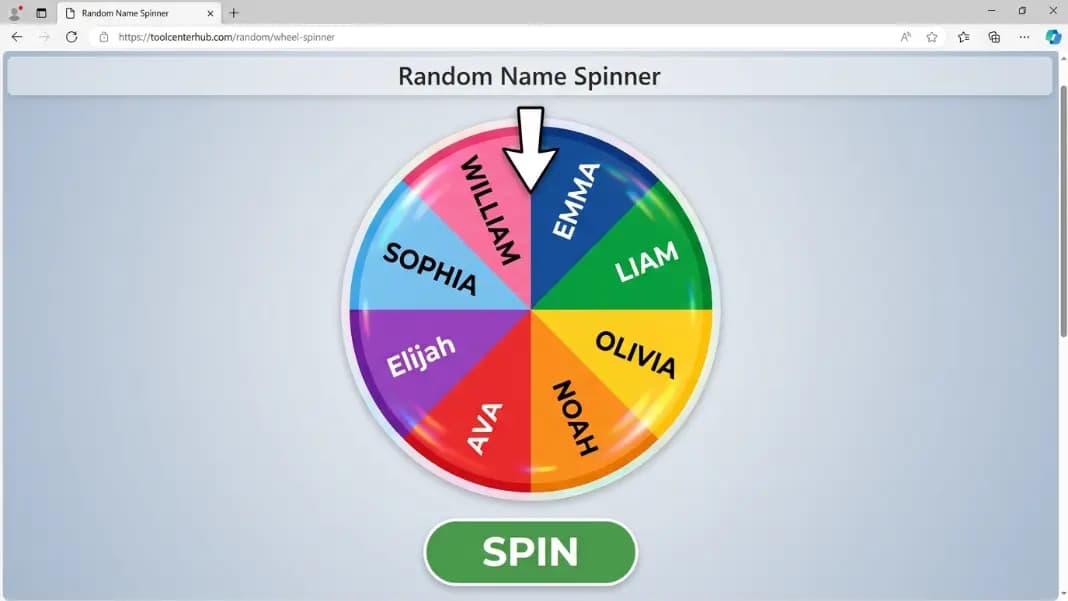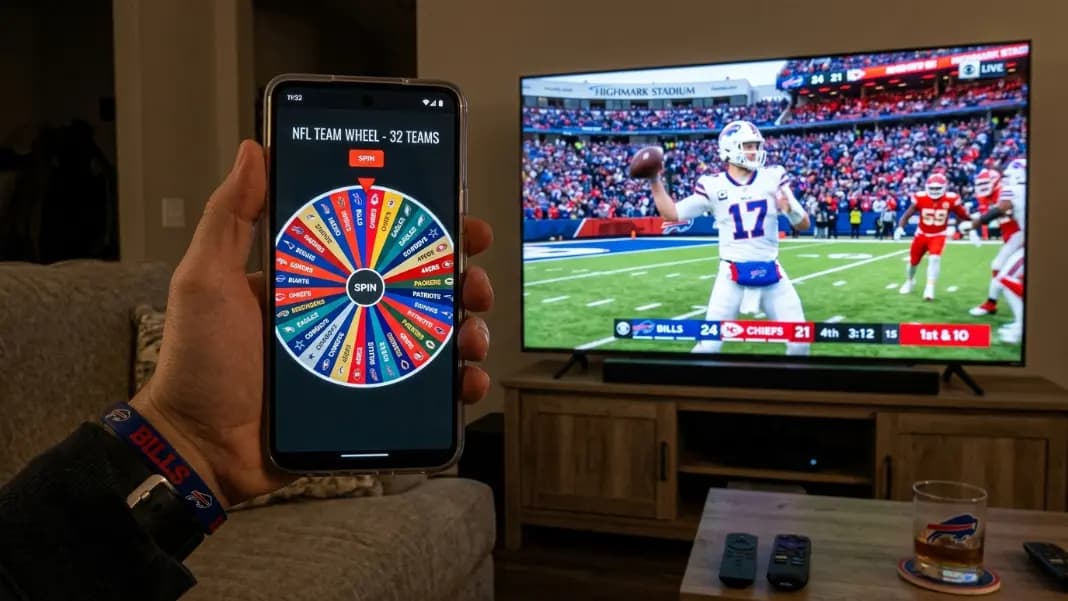
Your fantasy league needs draft order and nobody wants to spend twenty minutes arguing about who picks first. Your pick 'em group is starting a new season and three of the best teams all have winnable matchups in week eight. Your survivor pool has three equally viable options this week and you need to commit before the deadline.
A wheel of NFL teams resolves each situation in under a minute with a result nobody can dispute. The wheel spinner accepts any custom list as segments. Load all 32 NFL teams for a full-league spin, or narrow to a conference, a division, or a specific playoff bracket. This guide covers setup for each format, the math behind why draft order equity matters more than most leagues treat it, and how random picking performs against analysis-based approaches in a weekly pick 'em.
How to Build a Wheel of NFL Teams (All 32)
Open the wheel spinner, clear the default entries, and add one team name per segment. Short nicknames read clearly at 32 segments. Full city-and-team names become hard to read on narrow slices.
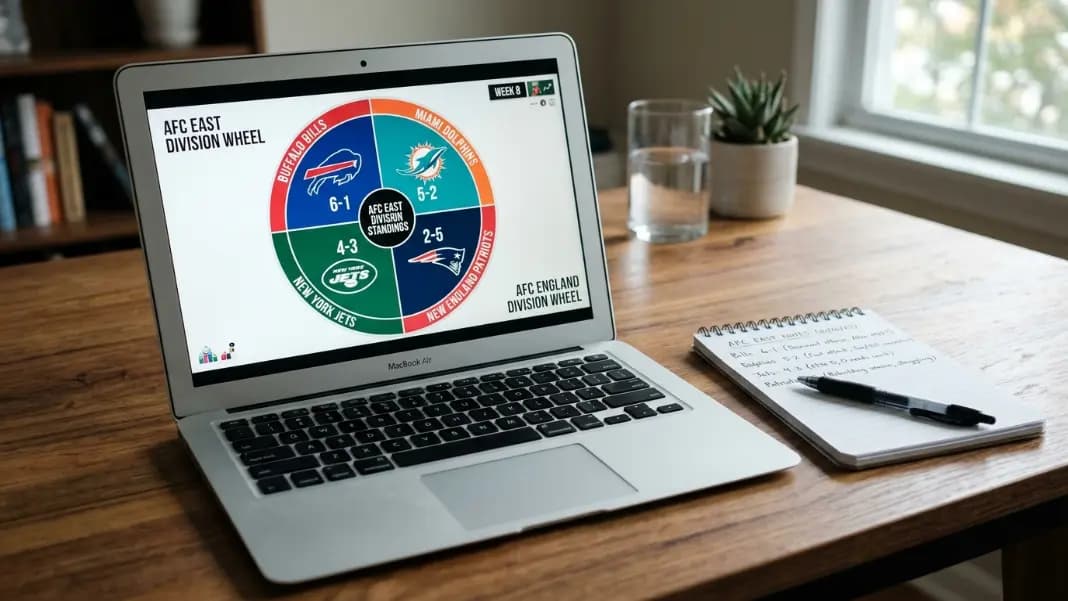
AFC East: Bills, Dolphins, Patriots, Jets
AFC North: Ravens, Bengals, Browns, Steelers
AFC South: Texans, Colts, Jaguars, Titans
AFC West: Broncos, Chiefs, Raiders, Chargers
NFC East: Cowboys, Giants, Eagles, Commanders
NFC North: Bears, Lions, Packers, Vikings
NFC South: Falcons, Panthers, Saints, Buccaneers
NFC West: Cardinals, Rams, 49ers, Seahawks
All 32 entries give each team a 1-in-32 probability on every spin. For narrower uses, load only the relevant subset. A playoff bracket wheel loads only the 12 to 14 teams still in contention. A divisional rivalry wheel loads 4 teams. A Super Bowl prediction wheel loads 2.
If a nickname is ambiguous in your group, add a city abbreviation: KC Chiefs, PHI Eagles, GB Packers. Single-word nicknames read more clearly on phones where segment text is smaller.
Why Draft Position Is the Most Consequential Fairness Decision in Fantasy
Draft order in a snake format is not a neutral assignment. Fantasy analytics research consistently shows the 1st overall pick wins the league at roughly 4 to 5 times the rate of the last pick in a standard 12-team format. That disparity exists because the top available player at pick 1 in PPR scoring typically accumulates 350 or more combined touches across the season: a floor that mid-to-late picks cannot match, regardless of how well those picks are optimized.
In a 15-round snake draft with 12 teams, the 1st position picks first in odd-numbered rounds (1, 3, 5, 7, 9, 11, 13, 15) and last in even-numbered rounds (2, 4, 6, 8, 10, 12, 14). That is 8 first-in-round selections against 7 last-in-round selections, a net advantage of one early pick. The compound effect of that advantage across the first four rounds, where the talent gap between players is steepest, explains the win rate differential.
This makes draft order the highest-stakes assignment in league setup: not just a scheduling formality. A commissioner-chosen order, even with honest intentions, will face disputes in any year when the 1st pick holder wins the championship. A wheel assignment run on a shared screen with the full group watching closes that dispute before the season starts.
How to run the draft order assignment:
- Load every participant's name onto the wheel spinner, one name per segment.
- Spin for the 1st draft slot. Record the result.
- Remove that name from the wheel. Spin for the 2nd slot. Remove and continue.
- Screenshot the final order and post it to the group chat.
Removing names after each spin ensures no participant appears twice. Running it on a shared screen means every result is witnessed rather than announced after the fact.
Weekly Pick 'Em: Does the Wheel Beat Analysis?
The common assumption is that analysis-based pick 'em outperforms random selection. The data does not consistently support this for recreational players.
Over a full NFL regular season of 272 games, random selection produces approximately 136 correct picks, a 50 percent baseline. Professional sharp bettors and predictive models achieve long-term accuracy of approximately 52 to 55 percent, a real but narrow edge over random.
Recreational pick 'em participants frequently underperform the 50 percent random baseline due to three biases that are consistent across groups and difficult to override through willpower alone.
Favorite-team inflation. Participants overrate their own team's win probability week over week, regardless of opponent quality or injury status. A fan who believes their team is a 10-point favorite may systematically pick them in weeks they are actually a 3-point underdog.
Recency bias. A team that won convincingly last week receives elevated probability estimates this week, even when this week's opponent is significantly stronger. Last week's performance is already priced into the line. It does not predict this week's margin.
Home team overvaluation. Home field advantage in the modern NFL is real but smaller than most recreational pickers assume. Statistical home field advantage is approximately 2 to 3 points, not the 7-point swing many pickers implicitly apply when choosing between an at-home underdog and a road favorite.
A wheel picking from each week's two-team matchup avoids all three biases by design. The result is a pick 'em record that matches the 50 percent random baseline, which exceeds what most casual participants achieve through deliberate analysis across a full season.
Matchup-based spin format: Load each game's two teams onto the wheel, one team per segment. Spin for the predicted winner. Remove both teams, load the next game, repeat. A full 16-game week resolves in under two minutes with no deliberation.
Survivor Pool Management With a Wheel
In a survivor pool, you pick one team to win each week without reusing any team across the season. The strategic difficulty is allocation: which teams do you use early against weak opponents, and which do you save for weeks when the matchup is particularly favorable?
The wheel solves the decision between equally viable options. It does not replace strategy at the filtering step.
How to use the wheel in a survivor pool:
- Before each week, identify the teams you consider viable for that week's opponent. This is the filtering step: you decide which teams are eligible based on matchup quality, injury reports, and which teams you have already used.
- Load only those pre-approved remaining teams onto the wheel.
- Spin to pick your selection for that week.
This keeps strategic judgment where it belongs (the filtering step) and removes paralysis from the final selection between three equally strong options. The cognitive difficulty of choosing between Kansas City at home against a bottom-five defense vs. Philadelphia with a favorable passing matchup vs. Baltimore in a dome does not produce a better pick than the wheel does. The wheel resolves it without regret about the option not taken.
For group survivor pools, a screenshot of the spin creates a timestamped record of how the pick was made, which is useful if anyone questions the selection later in the season.
NFL Trivia Wheel
A team wheel for trivia selects which team each question covers. Players answer about the team the wheel picks rather than steering toward teams they know best.
Franchise history format: Spin for a team and ask about Super Bowl appearances, retired jersey numbers, or coaching tenure records. The wheel prevents players from gravitating toward questions about their own team, where they hold an obvious knowledge advantage.
Stadium quiz: Spin for a team and ask players to name the stadium, the city it is in, or both. Harder versions ask for the stadium's official corporate-sponsored name (which changes periodically), the year it opened, or how many Super Bowls it has hosted.
Draft history format: Spin for a team and ask which player that team selected with a specific first-round pick in a given draft year. This format rewards draft-focused fans and catches participants who only track regular season performance.
Roster challenge: Spin for a team and ask players to name three current starters without being told which position to name. Harder version: name the starting quarterback and the first-string receiver who stepped in when the starter left a specific game.
For a version where question difficulty scales with team market size, weight the wheel toward smaller-market teams that casual fans know less about. The segment duplication method for weighting is explained in the percentage wheel spinner guide.
Conference and Division Wheels
A 32-team wheel is the right setup when the scope is the full league. Narrower contexts need narrower wheels.
Conference wheel (16 teams): AFC or NFC only. Use for conference-specific challenges, intraconference trivia, or any game that tracks conference performance separately.
Division wheel (4 teams): The NFC East (Cowboys, Giants, Eagles, Commanders) is the most nationally televised division, with all four franchises drawing fans well beyond their home markets. A division wheel for NFC East pick 'em or trivia formats draws wider participation than a regional division would. Any four-team division wheel resolves at the speed of a coin flip between four options.
Playoff bracket wheel: Rebuild the wheel after each round as teams are eliminated. Start of January: 12 to 14 playoff teams. After wild card weekend: 8 remaining teams. After divisional round: 4. Super Bowl: 2 teams on the wheel, spin for your prediction.
Season-Long NFL Team Challenge
A season-long format assigns each participant one team at the start of the year. Points accumulate based on how that team performs through the regular season and playoffs.
Setup:
- Load all 32 teams onto the wheel.
- Each participant spins once. Record the assignment.
- Remove the team from the wheel before the next participant spins.
- Lock all assignments before week one starts.
Scoring: 1 point per regular season win is the simplest structure. Add bonus points for division championship, conference championship, and Super Bowl victory. The format runs the full season with no weekly decisions required.
For groups larger than 32, allow repeats: do not remove teams after each assignment. Multiple participants can track the same team. For groups of 8 to 16 where not everyone can have a viable team, load only the likely playoff contenders (8 to 12 teams), giving every participant a team with a realistic path to the postseason.
For assignments that involve a prize at the end of the season, the spin the wheel for giveaways guide covers how to run the final prize draw using participant names as segments. For group-splitting and team assignment formats across NBA, MLB, and NHL alongside the NFL, the sports team wheel spinner guide covers multi-sport challenge setups. For any other random selection the league needs between assignments, the random tools section has the number generator and coin flip.