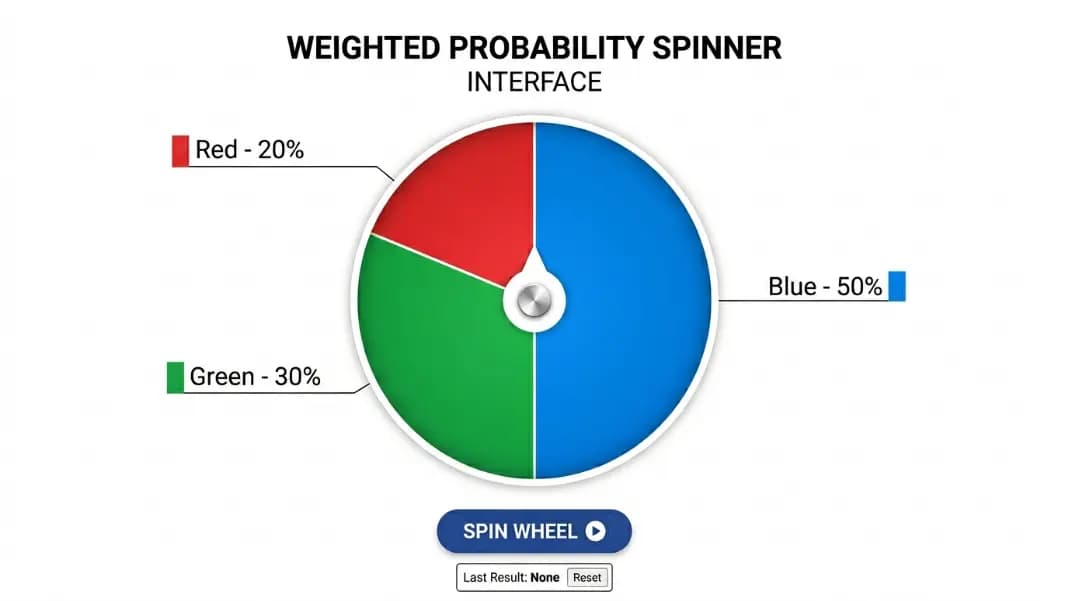
The default wheel treats every segment the same. Add six options and each has a 1-in-6 chance. That equal probability is exactly right for most uses. Some situations call for a different distribution: one option should land more often than another by design, and everyone spinning should know exactly why.
The wheel spinner assigns equal probability to each segment by default. Changing that distribution requires no special settings: add a segment more than once and its probability increases proportionally. The math is direct, the setup takes under two minutes once you understand the formula, and the result is a genuinely weighted wheel where the visible segment sizes confirm the stated probabilities before anyone spins.
This guide covers what percentage wheels are, the formula for calculating minimum segment counts for any target split, what to do when exact representation is not practical, and the specific formats where weighted probability is more useful than equal probability.
How Probability Works on a Percentage Wheel
A standard wheel spinner divides 100 percent probability equally across all segments. A six-segment wheel gives each segment 16.7 percent. A ten-segment wheel gives each 10 percent. Every spin is independent, and every segment has the same probability on every spin regardless of what landed before.
A percentage wheel changes that distribution intentionally. One segment might have a 50 percent chance. Another 25 percent. Two more split the remaining 25 percent. The wheel becomes biased by design, and the bias is determined by whoever builds the wheel.
This is different from a wheel being rigged. A rigged wheel spinner produces results that do not match what is shown. A weighted wheel shows the actual probability through visible segment counts, and results follow that distribution over many spins. The distinction matters for any use involving teaching, transparency, or fairness documentation.
The probability of any segment equals the number of times it appears divided by the total segment count:
- 10-segment wheel, segment appears once: 10 percent chance
- 10-segment wheel, segment appears three times: 30 percent chance
- 10-segment wheel, segment appears seven times: 70 percent chance
How to Calculate the Minimum Segment Count for Any Split
Most guides stop at the examples above. The step most people skip is working out how many total segments a target split actually requires, and whether a smaller wheel can represent it exactly.
The formula uses the greatest common divisor (GCD) of the target percentages:
- Write each option's target probability as a whole-number percentage (all must sum to 100)
- Find the GCD of all those percentages
- Divide each percentage by the GCD to get that option's segment count
- Total segments = 100 divided by the GCD
Worked examples:
70/30 split: GCD(70, 30) = 10. Segments: 70/10 = 7, 30/10 = 3. Total = 10 segments. A 20-segment wheel with 14 and 6 segments would also work, but the 10-segment version is the minimum that represents this split exactly.
80/20 split: GCD(80, 20) = 20. Segments: 80/20 = 4, 20/20 = 1. Total = 5 segments. Not 10. A 5-segment wheel is enough.
75/25 split: GCD(75, 25) = 25. Segments: 75/25 = 3, 25/25 = 1. Total = 4 segments. The simplest weighted two-option wheel after 50/50.
60/40 split: GCD(60, 40) = 20. Segments: 3, 2. Total = 5 segments.
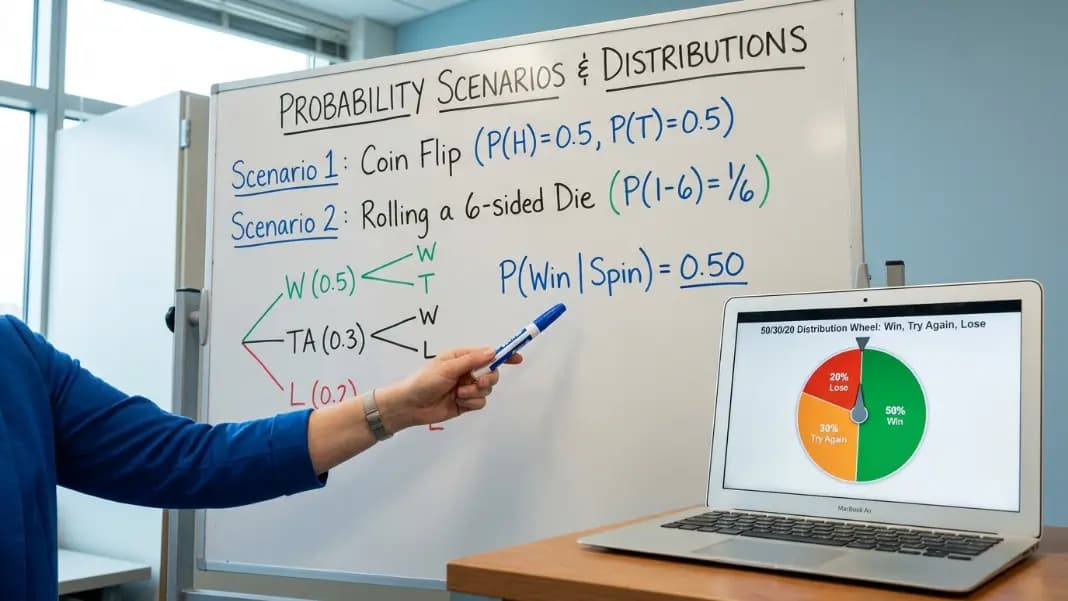
50/30/20 split (three options): GCD(50, 30, 20) = 10. Segments: 5, 3, 2. Total = 10 segments.
60/20/20 split: GCD(60, 20, 20) = 20. Segments: 3, 1, 1. Total = 5 segments.
40/40/20 split: GCD(40, 40, 20) = 20. Segments: 2, 2, 1. Total = 5 segments.
90/10 split: GCD(90, 10) = 10. Segments: 9, 1. Total = 10 segments.
The pattern: any split where all percentages are multiples of 20 fits on a 5-segment wheel. Multiples of 10 fit on a 10-segment wheel. Multiples of 25 fit on a 4-segment wheel. Multiples of 5 fit on a 20-segment wheel.
What to Do When Your Target Percentage Cannot Be Represented Exactly
Some splits cannot be represented exactly on any wheel with a practical number of segments.
33/67 split: GCD(33, 67) = 1. Exact representation requires 100 segments. Not practical on screen. Approximate: use a 3-segment wheel with 1 and 2 segments, which gives 33.3 percent and 66.7 percent. The error is 0.3 percentage points.
37/63 split: GCD(37, 63) = 1. Also requires 100 segments for exact representation. Approximations: round to 40/60 using 5 segments (error = 3 percentage points), or round to 35/65 using 20 segments (error = 2 percentage points). For most practical decisions, a 3-point error is acceptable.
33/33/34 split (three equal-ish options): GCD(33, 33, 34) = 1. Requires 100 segments. Approximate with a 3-segment wheel: each gets one segment, producing 33.3/33.3/33.3. The error in the third option is 0.7 percentage points.
The practical rule for approximation: find the closest set of target percentages where all values are multiples of the same number, then apply the GCD formula to that approximated set. Segment counts above 20 become hard to read on a visible wheel. For classroom teaching where exact numbers matter, explain the approximation to students. The rounding itself is a useful probability lesson.
How to Build a Weighted Wheel Using Duplicate Entries
Open the wheel spinner, clear the default entries, and add your options as individual segments. Each time you add the same text as a new segment, that option's probability increases by one unit.
Common builds:
70/30 between two options: Add Option A seven times, Option B three times. Total = 10 segments.
80/20 between two options: Add Option A four times, Option B once. Total = 5 segments.
50/25/25 between three options: Add Option A twice, Option B once, Option C once. Total = 4 segments.
60/20/20 between three options: Add Option A three times, Option B once, Option C once. Total = 5 segments.
Risk-reward game wheel (80/10/10): Add Safe Result eight times, Bonus once, Penalty once. Total = 10 segments.
The visible segment sizes on the wheel confirm the ratios before the first spin. Participants can count segments to verify the distribution without any external documentation.
Equal vs. Weighted: Which Situation Calls for Which?
Equal probability is correct for most everyday uses: raffles, student selection, team assignment, game night decisions. Introducing weighted probability where equal probability is expected changes the outcome distribution in ways participants have not agreed to.
Weighted probability makes sense in four specific situations:
Modeling an unequal real-world probability. Weather outcomes, genetic ratios, economic scenarios, and historical base rates are not equal across options. A wheel that reflects real-world probabilities produces a more accurate simulation than an equal-probability wheel that ignores those differences.
Teaching probability where unequal distribution is the lesson. A 70/30 wheel demonstrates that probability does not have to be uniform. The weighted wheel is not a shortcut for a biased result. It is a visual tool for showing how probability works when outcomes have different likelihoods.
Designing a game where risk levels are explicit. The jackpot is rare by design. Players see that rarity in the segment count before they spin. The tension before each spin comes from knowing the rare result is possible but unlikely.
Making a decision where your actual preference is not flat. Two strongly preferred options and one acceptable option can be reflected honestly in a 40/40/20 wheel rather than pretending all three are equally desired when they are not.
Weighted Wheels for Game Design
Weighted wheels change game mechanics in ways equal-probability wheels cannot. Three structures come up most in practice.
Risk-reward wheels: Most segments produce neutral or safe outcomes. One or two carry a penalty or jackpot. The rare result feels significant because the probability confirms it genuinely is. An 8-safe, 1-bonus, 1-penalty design on a 10-segment wheel makes the jackpot and penalty each a 10 percent chance. Players can calculate their odds by counting segments before spinning.
Escalating difficulty: Early in a learning game, a wheel weighted toward easier questions keeps new players engaged. As players advance, the ratios shift toward harder results. A 60/30/10 wheel (easy, medium, hard) becomes a 20/40/40 wheel as the group develops skill. Both use the same tool with different segment counts.
Spin-again mechanics: Adding a spin-again segment gives the wheel a built-in reroll with a specified probability. On a 20-segment wheel, two spin-again segments create a 10 percent reroll rate. The reroll can chain if the game design allows it.
For public draws and giveaways where equal probability is the stated terms, a flat equal-probability wheel is the only acceptable choice. The spin the wheel for giveaways guide covers equal-probability prize wheel setups and how to document them for participants.
Teaching Statistics and Probability With a Percentage Wheel
A percentage wheel is one of the clearest visual aids for probability concepts because it makes the distribution observable as physical segments before any result appears.
Law of large numbers: Set up a 70/30 weighted wheel. After 10 spins, the observed distribution will often look nothing like 70/30. Short-run results diverge from probability. After 50 spins, results start clustering toward the expected ratio. After 100 or more, the distribution converges noticeably. Running this live in class demonstrates why probability describes long-run behavior rather than guaranteed short-run outcomes.
Expected value: A wheel where the 50 percent segment earns 2 points and the other 50 percent segment loses 1 point has a positive expected value of 0.5 points per spin on average. Students calculate expected value from the wheel's visible structure before seeing any results, then verify against actual outcomes over many spins.
Independence of events: Each spin of a weighted wheel is independent of every previous spin. A 30 percent segment that has not appeared in 20 consecutive spins is not due. The next spin's probability is still exactly 30 percent. The wheel has no memory. This is the concept most commonly misunderstood about random events, and a live demonstration makes independence more tangible than any explanation.
Geometric probability: The area of each segment equals its probability, expressed as a fraction of the full circle. Students can measure the angle of each segment (probability times 360 degrees) and verify it matches the stated percentage. This connects geometric reasoning to probability concepts using a tool already running in front of them.
Binomial distribution: Run 10 spins of a 50/50 wheel and record the number of times the 50 percent segment appears. Repeat the 10-spin trial multiple times. The distribution of "how many times the segment appeared in 10 spins" across many trials follows a binomial distribution. The wheel generates real data for a distribution lesson without simulation software.
The double wheel spinner guide covers two-variable probability demonstrations where two independent wheels spin simultaneously, a format that complements the single weighted wheel for teaching independence and compound probability in the same lesson.
The Fairness Rule for Weighted Wheels
A weighted wheel is fair when the weights are disclosed before spinning and all participants understand the distribution is intentionally unequal.
It is unfair in two specific situations.
The first: using a weighted wheel for a draw where participants believe the odds are equal. A prize draw where one participant has a 50 percent chance and others each have a 10 percent chance is not a standard draw. Anyone spinning in front of participants who expect equal probability must show a wheel with equal segments.
The second: adjusting weights after participants have joined the draw. Setting the wheel with one distribution, spinning, and then changing segment counts before another round without disclosure is manipulation. The stated odds must match the actual wheel for the full duration of any draw.
For any public or group draw where fairness is required, use a standard equal-probability wheel with one segment per option. Weighted wheels belong in situations where the unequal distribution is the design feature everyone agreed to before the first spin.
For additional context on how digital wheel spinners generate their results, the are online random generators really random guide covers how the browser's cryptographic random source works for both equal and weighted wheel setups. For the full set of random tools, the random tools section covers the number generator, coin flip, and team generator for situations where a spin result is not the right format.