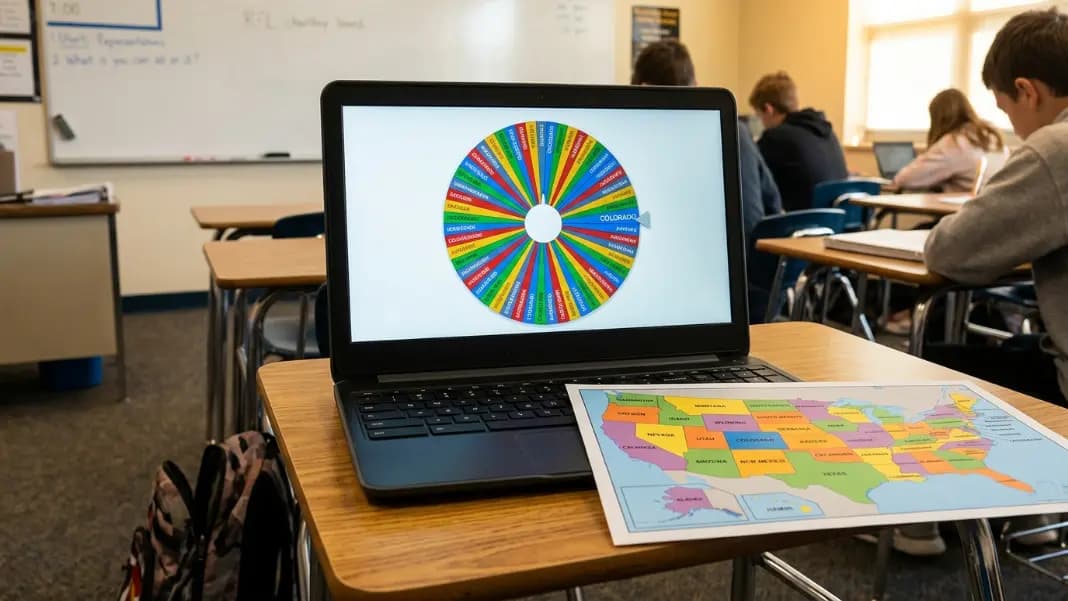
The geography assignment is due Friday and nobody wants to end up with Alaska while everyone else gets a state they can actually drive to. The road trip conversation has been going in circles for an hour. The trivia game needs a neutral way to pick questions without anyone controlling what comes up next. A state wheel spinner resolves all three in one spin.
The wheel spinner accepts any custom list you enter as segments. Load all 50 US states, spin, and the result is impartial. No teacher chose it, no travel app promoted it, no one in the group pushed for it. The wheel picked it, and every state had the same chance.
This guide covers loading the full 50-state list, the geography games and classroom activities that work best with a state spinner, how to build a capitals version, and when a smaller regional wheel works better than the full 50.
How to Load All 50 States Into the Wheel Spinner
Open the wheel spinner, clear the default entries, and add one state name per segment. The full list by region:
Northeast (11 states): Maine, New Hampshire, Vermont, Massachusetts, Rhode Island, Connecticut, New York, New Jersey, Pennsylvania, Delaware, Maryland
South (14 states): Virginia, West Virginia, North Carolina, South Carolina, Georgia, Florida, Kentucky, Tennessee, Alabama, Mississippi, Arkansas, Louisiana, Oklahoma, Texas
Midwest (12 states): Ohio, Michigan, Indiana, Illinois, Wisconsin, Minnesota, Iowa, Missouri, North Dakota, South Dakota, Nebraska, Kansas
West (13 states): Montana, Wyoming, Colorado, New Mexico, Idaho, Utah, Nevada, Arizona, Washington, Oregon, California, Alaska, Hawaii
Adding all 50 takes a few minutes the first time. Once the wheel is set up, keep the browser tab open or save the configuration so you do not need to re-enter the list each session. Each state has exactly a 1-in-50 probability on any spin. For a classroom or game context where participants can see the wheel, that equal probability is visible and self-evident without any explanation.
One practical note: at 50 segments, the text on each slice becomes small. If the display feels crowded, use two-letter postal abbreviations (CA, TX, NY) to keep each segment readable. Abbreviations work well for groups already familiar with them, though full state names produce fewer hesitation moments in trivia and geography games.
Geography Games and Trivia That Work With a State Spinner
A state spinner works as the neutral question-delivery mechanism for almost any geography game. The wheel picks the subject and players provide the answer.
State capitals: Spin for a state and every player simultaneously names the capital. Consistent stumpers in casual play: California's capital is Sacramento, not Los Angeles. New York's is Albany, not New York City. Illinois' is Springfield, not Chicago. Players default to the most famous or most populous city, which is the wrong answer often enough to make all three worth knowing before any capitals game starts.
State abbreviations: Spin for a state and players name the two-letter postal abbreviation. The ones that reliably trip people up: Montana (MT), Mississippi (MS), Minnesota (MN), Michigan (MI), and Missouri (MO) all look similar when recalled under pressure. Maine (ME) and Maryland (MD) are confused often enough to cause arguments.
State facts challenge: Spin for a state and the first player to name one verified fact wins the round. The category can be as broad or narrow as your group decides before starting: landmarks, famous people, sports teams, products, year of statehood. Agree on the category before the first spin so there is no dispute about whether an answer qualifies.
Map challenge: Spin for a state and players mark its location on a blank US map. This works well for younger learners and adds a physical or written component rather than just a verbal response.
Bordering states: Spin for a state and players must name every state that shares a border with it. Harder than it sounds. Colorado has seven bordering states. Tennessee has eight. Missouri has eight and borders both the east and center of the country. These produce the most disagreements because players underestimate how many neighbors a state has.
State Wheel Spinner for Classroom Activities
The most common classroom use is assigning research topics. Each student spins once and presents a project on the state they land on. The wheel removes all negotiation about assignments: nobody can lobby for California or Texas over a less obviously interesting state, and the result is visibly fair because the wheel picked it in front of the class.
For classes with more than 50 students, some states will be assigned twice. Either allow that and let students work independently on the same state, or delete each assigned state from the wheel before the next student spins. The delete-after-assign approach guarantees no duplicates but requires resetting the wheel between sessions.
Activities organized by grade level:
Elementary: Spin for a state and name one food that comes from there. Florida produces oranges. Idaho produces potatoes. Vermont is known for maple syrup. Texas for beef. Georgia for peaches. Maine for lobster. These answers are specific, memorable, and easy to verify.
Middle school: Spin for a state and identify two physical geography features: mountain ranges, major rivers, coastlines, plains, notable lakes. This connects the spinner to a mapping lesson and builds knowledge through multiple short activities rather than one long lecture.
High school: Spin for a state and analyze one aspect of its recent political or economic history: median household income, electoral vote patterns over the last five presidential elections, major industries, or population growth trends. The spinner prevents every student gravitating toward the same handful of states for examples.
The wheel spinner for teams guide covers structured group assignment formats if you need to assign states to small groups rather than individual students, with approaches for handling the no-repeat requirement when group count is smaller than 50.
Using a State Spinner for Road Trip and Travel Planning
A state spinner used for travel planning works differently than a classroom spinner. The goal is a starting point that opens a conversation, not a single definitive result you commit to immediately.
For a decision between a handful of candidate destinations, load only those states rather than all 50. If you have already narrowed the trip to four or five states, spinning from that shortlist introduces chance into a real choice rather than generating a random result from the full national map.
For open-ended planning with no strong preference, the full 50-state wheel generates a destination worth researching. Spin once, look into flights or drive time, and decide whether it is actually a trip worth planning. If it is not, spin again. Treating the wheel as a conversation starter rather than a binding commitment lets you use randomness to break the planning stall without locking yourself into Hawaii in February when your budget is a road trip.
Regional wheels work better for realistic driving trips. A road trip from Chicago makes practical sense through the Midwest, not toward Alaska. Loading only states that are actually reachable for your trip type means every result is actionable rather than a spin you ignore anyway.
State Capitals Spinner: A Harder Variation of the Same Game
Building a capitals version changes the difficulty and the direction of the lookup. Most people find the reverse direction harder: knowing which state a capital belongs to is less intuitive than knowing what a state's capital is.
Capital cities that cause trouble in both directions consistently:
- Montpelier, Vermont (not Burlington, which is Vermont's largest city)
- Augusta, Maine (not Portland, which is far more populous)
- Juneau, Alaska (not Anchorage, which has roughly ten times the population)
- Frankfort, Kentucky (not Louisville or Lexington)
- Jefferson City, Missouri (not St. Louis, Kansas City, or Springfield)
- Olympia, Washington (not Seattle or Tacoma)
- Pierre, South Dakota (pronounced "Peer," not "Pee-air," and not Sioux Falls)
- Annapolis, Maryland (not Baltimore)
- Harrisburg, Pennsylvania (not Philadelphia or Pittsburgh)
- Trenton, New Jersey (not Newark or Jersey City)
For a quiz game that uses both a states wheel and a capitals wheel, alternating directions between rounds keeps difficulty variable. Players who memorize one direction quickly find the reverse much harder, which extends the useful life of the same basic game.

Regional Wheels: When All 50 States Is Too Many
A 50-segment wheel produces narrow slices. For a focused lesson or a quick game, a regional wheel with 10 to 15 states is more practical because the segments are larger, the text is easier to read, and every result is relevant to the activity at hand.
New England (6 states): Maine, New Hampshire, Vermont, Massachusetts, Rhode Island, Connecticut
Mid-Atlantic (5 states): New York, New Jersey, Pennsylvania, Delaware, Maryland
Southeast (8 states): Virginia, North Carolina, South Carolina, Georgia, Florida, Alabama, Mississippi, Tennessee
Great Lakes (5 states): Ohio, Michigan, Indiana, Illinois, Wisconsin
Great Plains (6 states): Minnesota, Iowa, Missouri, North Dakota, South Dakota, Nebraska
Southwest (4 states): Oklahoma, Texas, New Mexico, Arizona
Mountain West (5 states): Montana, Wyoming, Colorado, Utah, Idaho
Pacific Coast (5 states): Washington, Oregon, California, Alaska, Hawaii
Regional wheels fit curriculum units better than the full 50. A unit on the Civil War maps to Southern and Border states. A unit on the Gold Rush maps to Western states. A unit on the industrial revolution connects to Mid-Atlantic and Great Lakes states. The spinner reinforces regional focus rather than pulling a geographically random state from across the whole country.
For travel planning, regional wheels match realistic trip scopes. A Pacific Coast road trip needs only three states. A fall foliage trip through New England needs six. Spinning from a region-specific list means every result is actually a candidate for the trip, not a state you have to explain away.
Creative Uses Beyond Geography and Education
A state spinner has applications outside classrooms and trivia games.
License plate game: Before a road trip, each passenger spins to receive an assigned state. The first person to spot a license plate from their assigned state wins. Spinning to assign states prevents passengers from claiming California or Texas because they know those plates appear more often. Alaska and Hawaii are the jackpot assignments because spotting those plates away from their home states is genuinely rare.
Recipe challenge: Spin for a state and cook a dish associated with it for that week's dinner. Texas chili, Maine lobster rolls, Louisiana gumbo, New Mexico green chile stew, Georgia peach cobbler, Maryland crab cakes. The wheel adds structure to cooking challenges without requiring anyone to make the selection judgment or pick favorites.
Creative writing prompt: Spin for a state and set a short story, scene, or character background there. The random assignment removes the blank-page problem of choosing a setting from scratch and forces writers into locations they would not naturally default to.
For any use case where you need a neutral, impartial selection from a fixed named list, the wheel configuration is identical regardless of what is on the list. Replace states with countries, cities, historical periods, or any other fixed set and the process works the same way.
The random decision maker tools guide covers additional tools for different types of selection when a named wheel result is not the right format for your specific situation.
When to Pair a State Spinner With a Number Generator
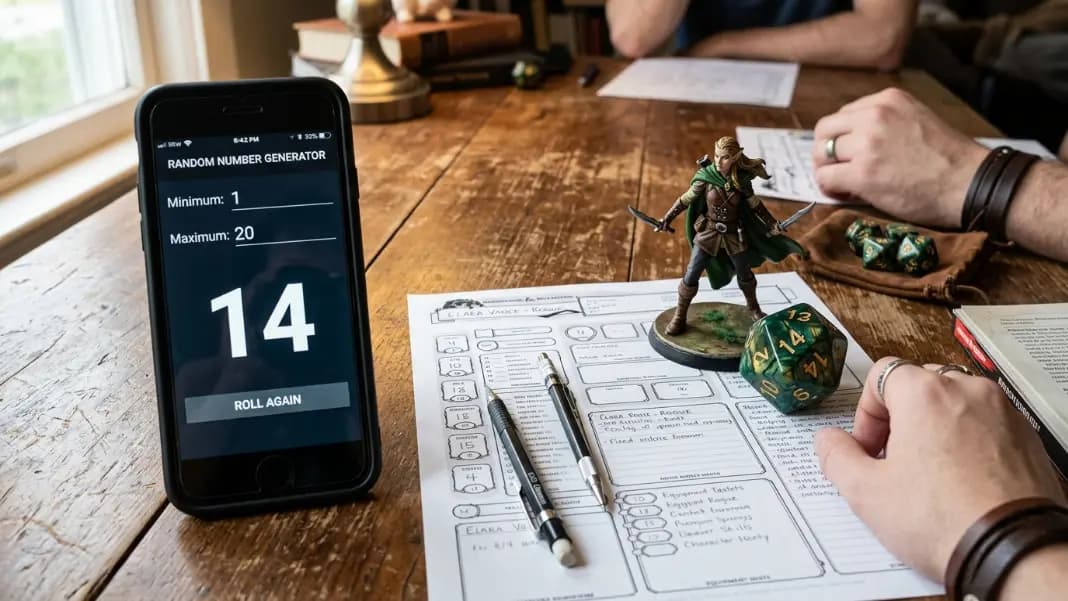
A state spinner produces a named result. Some situations need both: a state and a number, such as a bracket position or a seeded ranking.
For those cases, spin for the state first, then use the random number generator to assign a bracket seed or position number. The combination gives a named result with a quantified position, which covers most tournament assignment or classroom ranking structures without additional tools.
The random tools section has the number generator, coin flip, and team generator for the cases where the result needs to be a number, a binary outcome, or a group split rather than a named selection from a custom list.