You have been drinking eight glasses of water a day for months. You read it everywhere: eight glasses, two litres, simple. But you still get headaches in the afternoon, feel sluggish after lunch, and notice your urine is a deeper yellow than it should be. You are doing the thing everyone recommends and it is not working.
The problem is that eight glasses was never meant to be a universal prescription. It came from a 1945 recommendation that included water from food, not just drinks, and it has been misquoted and simplified for 80 years. For a 90 kg person who exercises daily and lives in a warm climate, eight glasses can leave them 1,000 ml short of what their body actually needs.
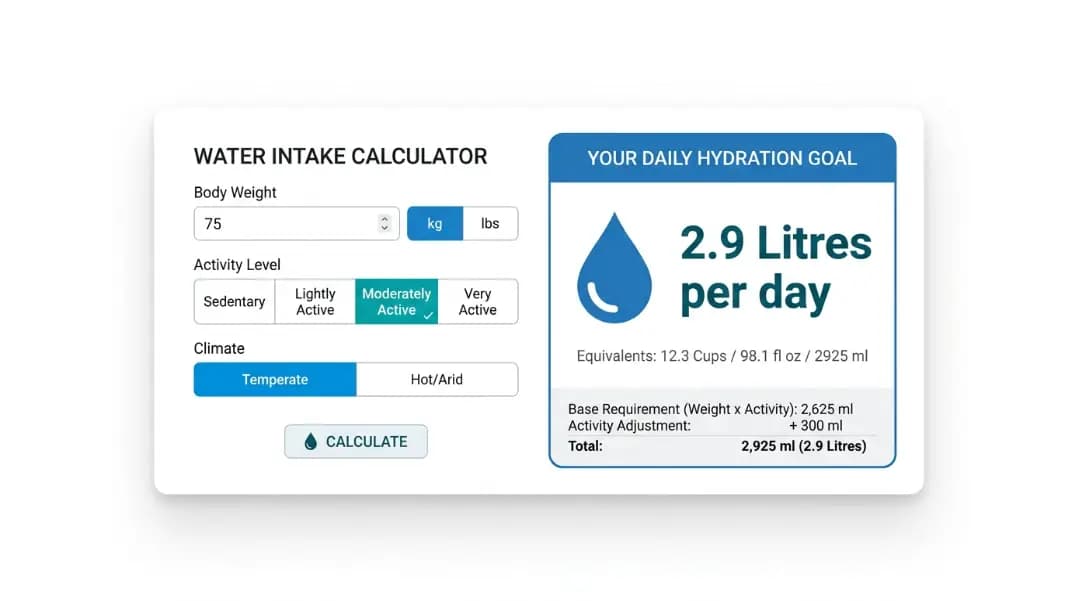
The water intake calculator at ToolCenterHub calculates your personalized daily hydration target based on your body weight, activity level, and climate. The result comes in litres, cups, and ounces. Enter your details and the target is immediate with no signup required.
This guide explains the formula behind the calculation, why your activity level changes the number significantly, what the research says about water and weight loss, and how to consistently reach your daily target without treating it like a chore.
Where the eight glasses rule came from and why it does not apply to most people
The eight glasses guideline has no clear clinical origin. The most likely source is a 1945 US Food and Nutrition Board statement that recommended approximately 2.5 litres of water per day for the average adult, but specified that "most of this quantity is contained in prepared foods." The beverages-only recommendation was considerably lower. Over the following decades, the food qualification was dropped and "eight glasses of water" became the simplified version that circulated everywhere.
No large clinical trial has validated eight glasses as the optimal daily intake for adults of varying sizes, activity levels, and climates. A 2002 review in the American Journal of Physiology found no evidence supporting the eight glasses rule and identified it as a myth that had propagated through popular health writing without scientific basis.
The fundamental problem with a flat number is that water needs scale with body size. A 55 kg woman who sits at a desk in a temperate office needs less water than an 85 kg man who works outdoors in summer. Recommending the same amount to both ignores basic physiology.
Eight glasses is roughly right for a sedentary adult weighing approximately 55 to 60 kg in a temperate environment. For anyone larger, more active, or in a warmer climate, it is too low. The weight-based formula corrects for body size and is adjustable for activity and environment.
How to calculate water intake by weight: the 35 ml per kg formula
The most widely used evidence-based formula for daily water intake is straightforward:
Daily water intake (ml) = body weight (kg) x 35
For imperial units: daily water intake (oz) = body weight (lbs) x 0.5
Reference values at common body weights:
| Weight | Sedentary daily target |
|---|---|
| 55 kg | 1,925 ml (1.9 litres) |
| 65 kg | 2,275 ml (2.3 litres) |
| 75 kg | 2,625 ml (2.6 litres) |
| 85 kg | 2,975 ml (3.0 litres) |
| 95 kg | 3,325 ml (3.3 litres) |
The 35 ml per kg figure comes from adult water balance research and closely matches the Institute of Medicine Adequate Intake values of 3.7 litres total daily water for men and 2.7 litres for women when applied to average adult weights. The key word is total: approximately 20 percent of daily water intake comes from food, so the beverage target is somewhat lower than the total figure.
For weight loss, use 40 ml per kg instead of 35. For a 75 kg person, this difference is 375 ml per day, which is meaningful over time. The water intake calculator calculates your base target and adjusts it automatically for your selected activity level and climate.
How activity level changes your daily water target
Exercise introduces the largest single variable in water needs. Sweat is the primary mechanism your body uses to shed heat during physical work. Sweat rate during exercise ranges from 0.5 to 2.0 litres per hour depending on exercise intensity, ambient temperature, and individual variation.
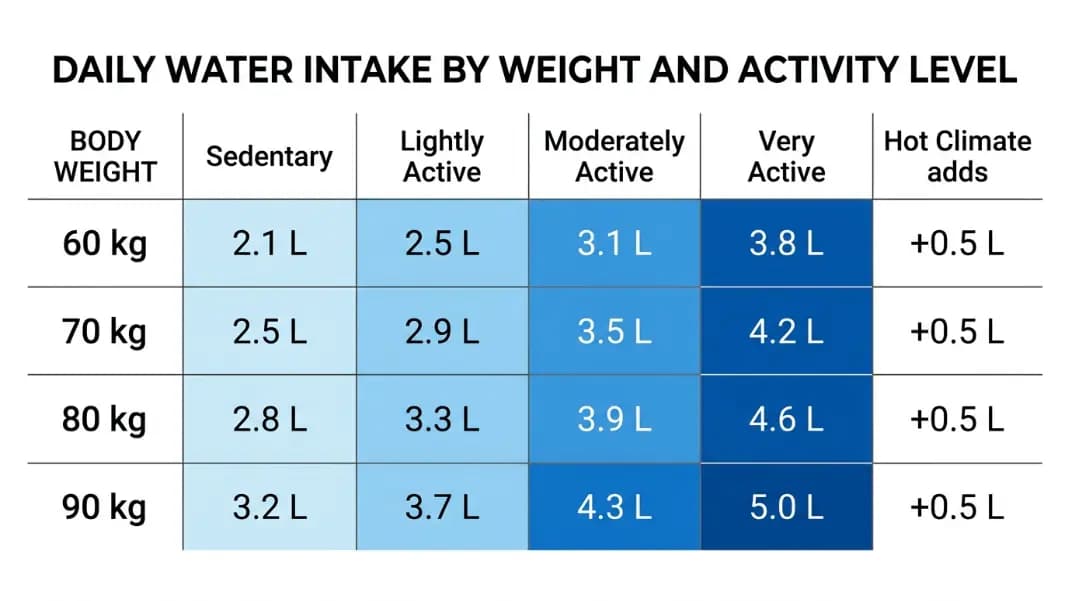
The additions on top of the base weight-based target:
Light exercise (30 to 60 minutes per day): Add 350 ml. This covers casual walking, stretching, or light cycling where sweat loss is modest.
Moderate exercise (60 to 90 minutes per day): Add 500 to 700 ml. This covers brisk walking, jogging, cycling at moderate intensity, or recreational swimming.
Intense exercise or very active work (90+ minutes or heavy physical labor): Add 750 to 1,000 ml. This covers running, high-intensity interval training, strength training with multiple working sets, and outdoor physical jobs in warm conditions.
Hot or humid climate at any activity level: Add 500 ml to whichever activity adjustment applies. Heat increases baseline sweat rate even at rest and at light activity levels.
One practical point: these additions are for the exercise day itself. On rest days, use the sedentary base target unless the weather is very hot. Many people calculate a single daily target and use it every day, which is close enough for consistency but slightly over-hydrates on rest days and slightly under-hydrates on heavy training days.
The most important timing rule is not to wait until thirst arrives. Thirst is a lagging indicator: by the time you feel thirsty during exercise, you have already lost approximately 1 to 2 percent of body weight in fluid. At 2 percent, cognitive performance and physical endurance both measurably decline. Drinking before and during activity prevents dehydration rather than responding to it.
Water intake for weight loss: what the evidence actually shows
The connection between water and weight loss is more specific and more modest than most popular health writing suggests. Water is not a fat-burning compound. It does not directly accelerate metabolism in a meaningful way. What it does is reduce calorie intake through a few well-documented mechanisms.
Pre-meal water reduces food intake. A randomized controlled trial published in Obesity (2010) found that adults who drank 500 ml of water 30 minutes before meals consumed approximately 13 percent fewer calories at that meal. Over a 12-week period, the pre-meal water group lost an average of 2 kg more than the control group. The mechanism is simple: gastric volume is partially filled before food arrives, which triggers earlier satiety signals.
Water displaces higher-calorie beverages. Replacing one sweetened drink per day with water reduces daily calorie intake by 150 to 200 calories on average. This is not a direct water effect; it is a substitution effect. But the outcome is real.
Adequate hydration supports fat metabolism. The liver converts stored fat into usable energy. When the body is mildly dehydrated, the kidneys reduce their function and the liver picks up some of the workload, which reduces the liver's capacity for fat oxidation. This is a plausible mechanism but the practical effect is modest for most people.
The direct recommendation: use 40 ml per kg as your daily water target if weight loss is the goal, drink 500 ml approximately 30 minutes before your largest meals, and replace sweetened beverages with water wherever possible. These three steps combined have the most evidence behind them.
Pairing hydration with a structured calorie calculator target gives a clearer picture of the full energy balance. Water suppresses appetite but does not replace a calorie deficit as the primary driver of fat loss.
Daily water targets for men vs women
Men and women have different water targets at the same body weight for reasons beyond simple size differences.
At the same body weight, the per-kg water requirement is nearly identical for men and women. The 35 ml per kg formula applies to both sexes. The difference in absolute targets comes from average body weight, body composition, and activity patterns.
Muscle tissue holds approximately 75 percent water by weight. Fat tissue holds approximately 10 percent. Men on average carry more lean muscle mass as a proportion of body weight, which means their bodies contain more water by volume and have proportionally higher water turnover. At a given body weight, a person with higher muscle mass has marginally higher water needs than someone with more fat mass.
Practical reference targets at common weight ranges:
Average adult woman (65 kg, moderately active): approximately 2.6 to 2.9 litres per day from beverages
Average adult man (80 kg, moderately active): approximately 3.2 to 3.5 litres per day from beverages
Pregnancy: adds approximately 300 ml per day above the non-pregnant baseline, as blood volume increases and fluid is needed for amniotic fluid production
Breastfeeding: adds 700 to 1,000 ml per day above the non-pregnant baseline to support milk production
Age also plays a role. Kidney function declines gradually after middle age, which means the kidneys become less efficient at concentrating urine and conserving water. Older adults are more prone to dehydration partly because kidney efficiency decreases and partly because thirst sensation becomes less reliable. This is one reason the age calculator connects to hydration considerations: knowing whether you are in your 60s or above changes how proactively you should track water intake rather than relying on thirst.
Hot climates, keto diets, and other factors that raise your needs
Standard hydration formulas assume a temperate environment. Several circumstances push water needs significantly above the formula baseline.
Hot or humid climate: Sweat rate at rest in hot weather is higher than in temperate conditions. Living or working in a climate where the temperature regularly exceeds 28 to 30 degrees Celsius adds approximately 500 ml to the daily baseline. Physical work outdoors in summer can push the addition to 1,000 to 1,500 ml on the heaviest days.
Altitude: At altitudes above 2,500 metres, breathing rate is higher as the body responds to lower oxygen density. Respiratory water loss increases. The combined effect can add 200 to 500 ml per day compared to sea level, depending on altitude and exertion level.
Ketogenic diet: This one catches many people off guard. When carbohydrate intake is very low, glycogen stores are depleted. Each gram of glycogen is stored with approximately 3 to 4 grams of water. When that glycogen is burned and not replaced, the bound water is released and excreted. Keto dieters typically experience increased urination in the first week and significantly higher ongoing water needs. The recommendation for people on a ketogenic diet is to add 500 to 1,000 ml above the standard target and to pay close attention to electrolyte intake (sodium, potassium, magnesium) to replace what is lost with the increased fluid output.
Illness with fever or vomiting: Fever increases water loss through sweat and respiration. Vomiting and diarrhoea cause rapid fluid and electrolyte loss. During illness, standard hydration targets are the minimum and often need to be substantially exceeded. This is a temporary adjustment, not an ongoing calculation.
Diuretic medications: Some blood pressure medications, including thiazide and loop diuretics, increase urine output. If you take any diuretic medication, your water target should be discussed with your prescribing doctor rather than estimated from a general formula.
How to recognize dehydration before thirst tells you
Relying on thirst alone is the most common hydration mistake. Thirst is a useful signal but it activates after you are already mildly dehydrated, not before.
Urine colour is the most reliable real-time indicator available without any equipment. Pale straw yellow or clear indicates good hydration. Light yellow is acceptable. Dark yellow indicates mild dehydration. Amber or darker indicates significant dehydration. If your urine is dark and you feel fine, you are still dehydrated: thirst and performance impairment can lag behind urine concentration.
Performance in the late afternoon is a useful indirect signal. Many people who are chronically slightly dehydrated experience an energy dip between 2 pm and 4 pm that they attribute to the post-lunch glucose crash. Sometimes the dip is real, but dehydration produces a nearly identical sensation: reduced concentration, fatigue, and headache. Drinking 400 to 500 ml of water and waiting 20 minutes is a simple test. If the dip clears, the cause was dehydration, not blood sugar.
Morning hydration matters more than most people realize. You lose water overnight through respiration, particularly if you breathe through your mouth or sleep in a heated room. Drinking 400 to 500 ml of water first thing in the morning, before coffee or food, replaces overnight losses and starts the day's hydration accounting from a neutral position rather than a deficit.
Practical ways to consistently reach your daily water target
Knowing your target and consistently hitting it are different challenges. Most people who fall short do so not because they do not want to drink enough water but because they do not have a system that fits into how they actually spend their day.
Track refills, not glasses. Counting individual glasses throughout a busy day is unreliable. Carrying a fixed-size water bottle and counting refills is easier. If your target is 2.8 litres and your bottle is 700 ml, you need 4 complete refills. That is a concrete, trackable number.
Drink 400 to 500 ml immediately after waking. This is the highest-value single hydration habit. It replaces overnight losses, is easy to implement consistently because it anchors to an existing routine, and immediately contributes a meaningful portion of the daily total before the day has started properly.
Pair water with coffee. Coffee contributes to your fluid intake, but pairing each coffee with a glass of water is a practical habit that offsets any diuretic effect and keeps the running total moving. It also makes the coffee routine feel complete rather than adding a separate step.
Drink before meals, not just with them. The pre-meal 500 ml habit supported by the weight loss research takes 15 minutes of lead time. Setting a timer 30 minutes before each main meal and drinking a glass at that point is the simplest implementation. It also serves as a reminder that the meal is coming, which can reduce impulsive snacking.
Track consistently with TDEE and calorie data. If you are already logging your daily calorie intake, adding a water total is a natural extension. Many people find that on days when they are managing their nutrition consciously, they also hydrate better because they are in a tracking mindset.
Hydration is genuinely one of the lowest-effort health habits with the clearest outcomes: energy, concentration, exercise performance, and appetite regulation all respond measurably to getting the water target right. The water intake calculator gives you the number to aim for. The strategies above give you a way to consistently reach it.