Every freelancer learns this the hard way eventually. A client claims the deliverables were not what they expected. The scope was clear in your head but never written down. The project expands three times over the original brief with no documented approval. Payment comes in late with no agreed consequence because there was no clause to enforce. None of these situations are difficult to prevent with a signed contract. All of them are difficult, and sometimes impossible, to resolve without one.
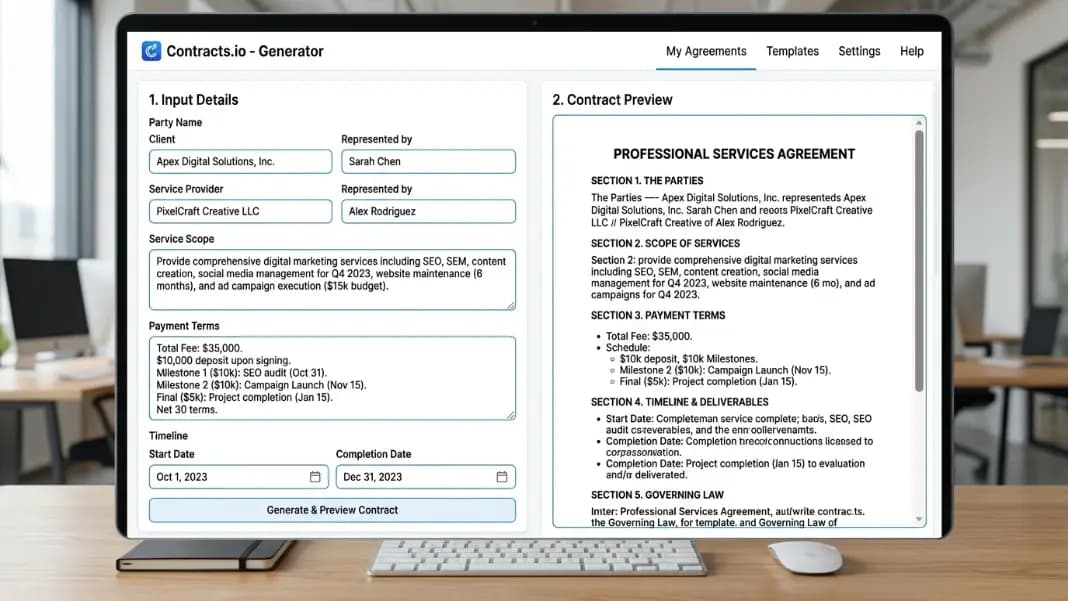
The contract generator creates a complete service agreement from a short form. Enter the parties, the scope of work, payment amount, and timeline, and you get a structured document ready to review and sign. This guide covers what makes a contract legally enforceable, what every service agreement must include, the specific clauses people consistently leave out, and when a template is enough versus when you need a lawyer involved.
This article is for informational purposes only and does not constitute legal advice. For contracts involving significant intellectual property, high contract values, or international parties, consult a qualified attorney.
What makes a contract legally enforceable
A contract does not need to be formal, lengthy, or written in legal language to be enforceable. Courts look for four elements when determining whether an agreement is binding.
Offer: One party makes a specific proposal. "I will design your website for $2,000" is an offer. "I would love to work together sometime" is not. The offer must be specific enough that acceptance of it creates a clear obligation.
Acceptance: The other party agrees to the exact terms of the offer. Acceptance must match the offer without modification. If the client responds with "yes, but for $1,800," that is a counteroffer, not acceptance, and the negotiation continues.
Consideration: Something of value is exchanged by both parties. In service contracts, this is the work on one side and payment on the other. Both parties must give something for a contract to be enforceable. A document where only one party is obligated to do anything has no consideration and is not a contract.
Mutual assent: Both parties understand what they are agreeing to and consent voluntarily. A contract signed under duress or based on misrepresented information can be challenged.
Signed documents from both parties create evidence of all four elements. A countersigned contract is your strongest protection if a dispute arises, because it removes the question of what was agreed.
Freelance contracts vs business service agreements
The terms are used interchangeably in most conversations, but the distinction affects what you need to include.
A freelance contract covers a project-based working relationship between an independent contractor and a client. It defines the deliverables, the timeline, the payment terms, and the rights to the finished work. The contractor is not an employee. They produce a result and are paid for it. Ownership of that result is negotiated in the contract itself.
A business service agreement covers a longer-term or ongoing relationship between two companies. It typically consists of a master agreement that defines the general terms, plus separate statements of work for individual projects. Pricing may be structured as a retainer or ongoing fee rather than a per-project flat rate.
For most freelancers and small businesses, the freelance contract structure is the right starting point. The differences matter mainly when you move into longer-term engagements with larger organizations that have their own vendor management processes and legal teams who will review the agreement.
Both types must address scope, payment, revisions, intellectual property ownership, and termination. The specific language and structure vary, but the underlying questions are the same: who does what, who pays what, who owns the result, and what happens when things do not go according to plan.
What every contract needs to include
Do not skip any of these sections. Each one addresses a specific type of dispute that actually comes up.
Parties: The full legal names of everyone involved. For individuals, their complete legal name. For businesses, the registered legal entity name. "Smith Design Studio" is not a legal entity on its own. "Jane Smith, sole proprietor, operating as Smith Design Studio" is.
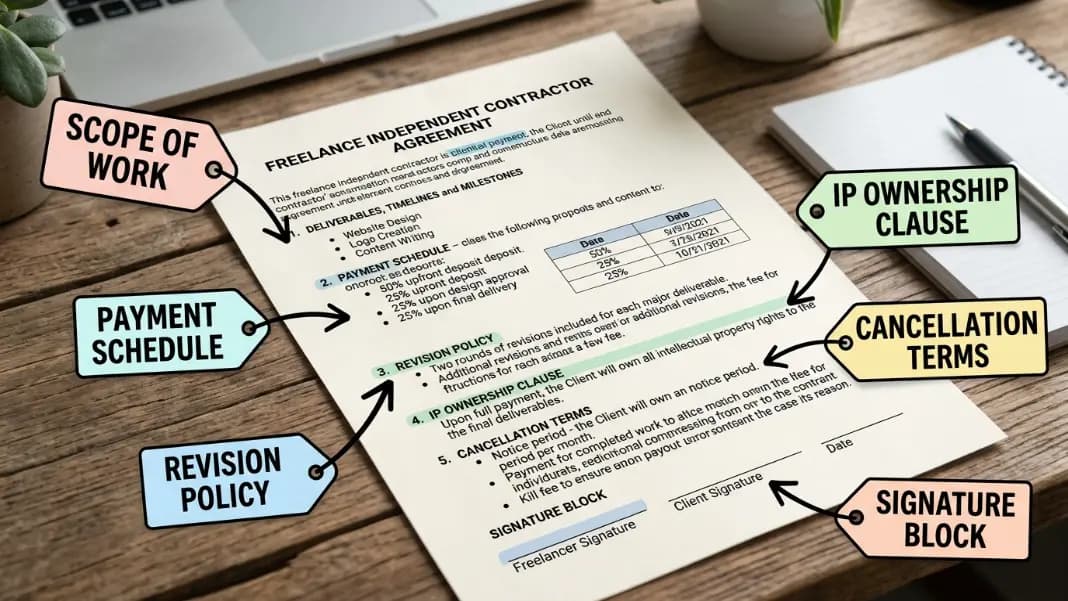
Scope of work: What you will deliver, described specifically. A website with six pages, two rounds of revisions, and copywriting not included is a scope. "A website" is a description that both parties will read differently when a dispute arises. List every deliverable by name, format, and format version where relevant.
Timeline: Start date, key milestones if the project has stages, and the final delivery date. If the timeline depends on client approvals or content delivery, note that explicitly. Delays caused by the client's side should not create an obligation for you to deliver on the original date.
Payment terms: Total amount, payment schedule (deposit, milestone payments, final payment on delivery), accepted payment methods, and the due date for each payment. This is the section most likely to be in dispute. Vague payment terms like "payment due on completion" without a defined date create ambiguity that clients sometimes exploit.
Revision policy: How many rounds of revisions are included, what distinguishes a revision from a new request, and what you charge for additional rounds beyond the included number. "Unlimited revisions" written into a contract is a guarantee of scope creep.
Intellectual property: Who owns the work after payment. In most jurisdictions, the creator retains copyright by default unless ownership is explicitly transferred in writing. If the client expects to own the deliverables outright, that transfer must be stated in the contract. If you grant a usage license rather than transferring ownership, specify what uses are permitted.
Signatures: Dated signatures from both parties. An unsigned contract has no legal force regardless of how well it is written.
The clauses most people leave out
The standard sections above are what most people include. These are the ones that protect you when the relationship deteriorates.
Kill fee or cancellation clause. What happens if the client cancels while you are mid-project? Without a kill fee, you might complete 60 percent of a project and receive nothing. A standard kill fee is 25 to 50 percent of the remaining contract value, payable within a stated period (typically 30 days) after cancellation. Some contracts instead state that the client pays for all completed work at an agreed hourly rate. Either approach works as long as the clause is specific.
Late payment terms. What happens if the invoice is not paid by the due date? State a specific late fee, such as 1.5 percent of the outstanding balance per month after a 30-day grace period, and the process you will follow for non-payment. Without this clause, you have no mechanism other than stopping work or filing in small claims court, both of which damage the relationship.
Revision approval process. When a client confirms a revision in writing (email counts if your contract says so), that version is final. This prevents clients from reopening work you considered complete weeks later. Include a clause stating that written approval of any deliverable constitutes acceptance of that version.
Liability limitation. A liability clause limits your exposure if something goes wrong with the deliverables. A common approach is capping liability at the amount of the contract value. Without this clause, a client could theoretically claim damages beyond what they paid you for the work.
Governing law. Which state or country's laws govern the agreement and where disputes would be filed. For freelancers working with clients in different jurisdictions, this clause determines which legal system applies. Without it, both parties might argue for the law most favorable to their position.
If confidential information is involved in the project, the client may want a separate NDA alongside the service contract. The NDA guide covers when a confidentiality agreement is needed and what it must contain. A contract and an NDA serve different purposes and both are sometimes needed for the same project.
Payment structures for different project types
How you structure payment in the contract affects cash flow and client behavior throughout the project.
Deposit plus final payment is the most common and simplest structure. The client pays 50 percent before work begins and the remaining 50 percent on delivery. This works well for short projects with a clear single output. It protects you against non-payment while giving the client something to withhold (the final payment) until they receive the deliverable.
Milestone payments work for longer projects. Break the project into stages and tie a payment to each stage's completion. The client pays for each stage before the next one begins. This keeps money moving on longer engagements and creates natural checkpoints for reviewing scope against expectations.
Retainer agreements are for ongoing work. The client pays a fixed monthly fee for a defined scope: a number of hours, a set of deliverables, or a combination. Include a clause specifying what happens to unused hours (do they roll over or expire?) and how hours above the retainer limit are billed. Retainers require more detailed contract language but create predictable income if managed properly.
Flat project rate states a single price for the completed scope. This simplifies invoicing but transfers the timeline risk to you. If the project takes longer than expected because the scope was under-specified, your effective hourly rate drops. Flat-rate contracts need especially precise scope definitions and explicit change request procedures.
For most freelancers starting out, deposit plus final payment is the right starting structure. It is simple, clients understand it immediately, and it reduces the risk of delivering work and not getting paid.
How to create a contract online in minutes
The practical process is faster than most people expect once you have the project details in front of you.
Open the contract generator and fill in the form: your name or business name, the client's name, the scope of work, the payment amount and schedule, and the project timeline.
Review the generated document before sending it. Check that the scope description exactly matches what you and the client discussed. Verify the payment amounts and dates are correct. Read the intellectual property section and confirm it reflects what you actually agreed: either the client owns the final work (full assignment) or you retain copyright and grant a usage license (specify what uses are permitted).
Send the contract to the client for review. Give them time to read it and raise questions. Do not begin work before the contract is countersigned.
Store the signed copy somewhere you can find it months later. A PDF with both signatures, filed by client name and project date, is enough. You do not need a complex filing system, just consistency.
The generator handles the legal structure automatically. You focus on filling in the project-specific details. For template-standard projects, this produces a complete agreement without needing to draft anything from scratch or pay for legal review.
When a generator is enough vs when to get a lawyer
A template is the right tool for the majority of freelance and small business contracts. The situations where it falls short are specific.
A lawyer becomes useful when the contract value is high enough that legal review is proportionate. A $600 logo contract does not need a lawyer. A $50,000 software development contract with ongoing licensing rights might.
Also get legal review when the intellectual property involved is complex, such as work that will be commercially licensed or integrated into a product that the client intends to sell. When the client presents their own standard vendor agreement and it contains terms that differ significantly from industry norms, having a lawyer review before you sign protects you. When the parties are in different countries and cross-border jurisdictional questions apply, a lawyer can identify which legal framework governs each part of the agreement.
For template-compatible projects, a generator combined with careful reading of the output covers everything. The generator does not write specific legal opinions or predict how a contract would be enforced in a specific jurisdiction. It creates a correctly structured document with standard clauses. That is what most freelance and service agreements need.
What to do once the contract is signed
A signed contract is the foundation of the working relationship, not the last piece of paperwork you will produce.
Before the contract stage, for any new engagement, you likely sent a quote. A quote states what you plan to charge before the client commits. Once they approve it, the contract formalizes those agreed terms into a binding document. The free quote generator handles the quote step, and the free quote generator guide explains when a formal quote is the right document versus going straight to a contract.
At the end of the project, once the work has been approved, the final step is invoicing for the outstanding balance. The free invoice generator produces professional invoices that match the payment schedule in your contract. The free invoice generator guide explains how to structure invoices for different payment arrangements and how to follow up when payment does not arrive by the due date.
The documents section has all of these tools in one place: NDA, contract, quote, invoice, privacy policy, and terms of service. For freelancers and small business owners managing their own paperwork, having the full set accessible without subscriptions or account requirements covers the complete client documentation workflow from first proposal to final payment.