You type a pale yellow into your stylesheet and write color: lightgoldenrodyellow. Then you stop and think: how is that a real CSS keyword? It is 20 characters. Most of your variable names are shorter.
Longest color name in CSS is a specific, answerable question, and the answer is lightgoldenrodyellow. Understanding why it is so long, and why the runner-up is mediumspringgreen at 17 characters, tells you something useful about how the CSS color naming system actually works. It also turns out that knowing which names are long enough to cause typos is practical information when you are hand-writing CSS rather than copying from documentation.
The color name finder lets you paste any hex code and get the exact CSS color name back without guessing. That is the tool to bookmark when you are working with the longer names covered in this post, because lightgoldenrodyellow is the kind of name that is easy to misspell.
The Longest CSS Color Name: lightgoldenrodyellow
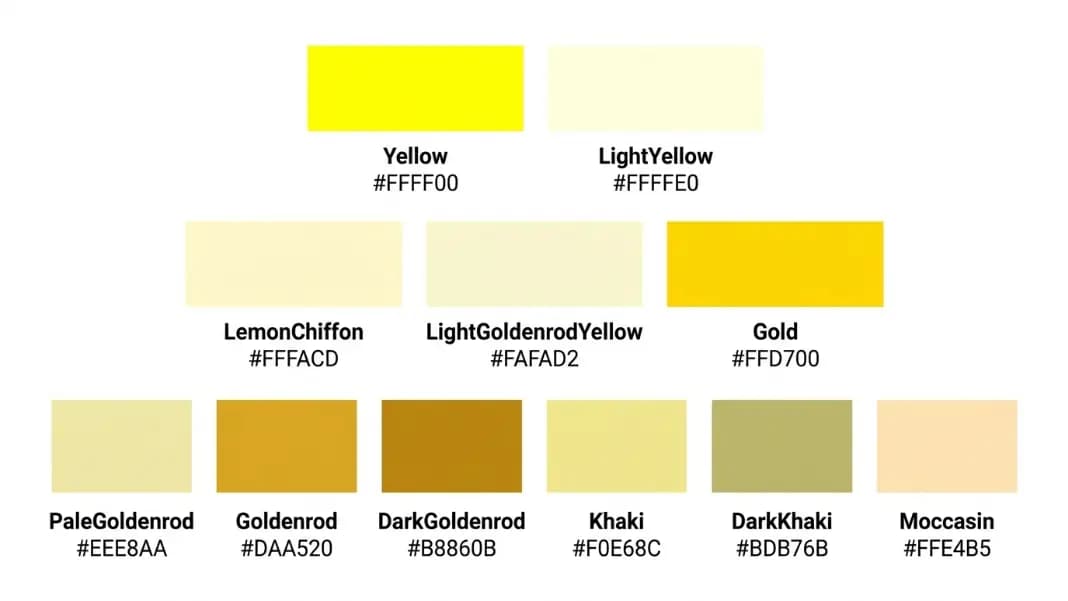
The longest CSS color name is lightgoldenrodyellow at 20 characters. Its hex code is #FAFAD2, a pale warm yellow. The color reads as nearly white with a soft golden tint, and it was named after the goldenrod plant, specifically a light variant of the goldenrod yellow family.
The name has three components stacked together. Goldenrod is itself a compound word, golden and rod referring to the tall wildflower with bright yellow flower clusters. Light is the brightness modifier added in front. Yellow is appended at the end to clarify the hue family. The result is a three-part chain that adds up to 20 characters, which is why no other CSS color name comes close.
For practical work, #FAFAD2 functions as a warm near-white background, similar to ivory (#FFFFF0) but with a more distinct yellow tone. It is not a commonly used design color, which may explain why most CSS developers encounter the name in lists of interesting color facts rather than in production stylesheets.
Typing it correctly matters. The most common typo is dropping the second e, writing lightgoldenrodyellow as lightgoldenrodyellow. Run it through the color name finder if you need to verify the exact CSS name for a pale yellow hex code, since several near-white yellows sit close to this value.
The Full Ranked List of CSS Colors by Character Count
Here is the complete ranking from the top of the length scale downward, covering every CSS named color with 13 or more characters.
20 characters: lightgoldenrodyellow (#FAFAD2)
17 characters: mediumspringgreen (#00FA9A)
16 characters: mediumaquamarine (#66CDAA)
15 characters:
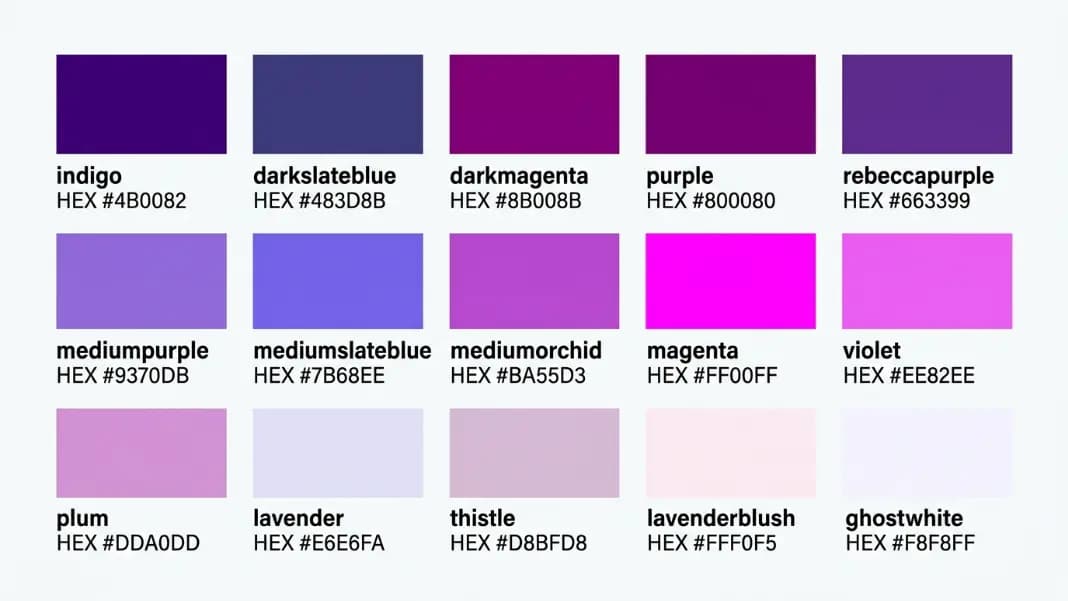
- mediumslateblue (#7B68EE)
- mediumturquoise (#48D1CC)
- mediumvioletred (#C71585)
14 characters:
- blanchedalmond (#FFEBCD)
- cornflowerblue (#6495ED)
- lightsteelblue (#B0C4DE)
13 characters:
- darkgoldenrod (#B8860B)
- darkslateblue (#483D8B)
- darkslategray (#2F4F4F)
- darkturquoise (#00CED1)
- lightseagreen (#20B2AA)
- palegoldenrod (#EEE8AA)
- paleturquoise (#AFEEEE)
- palevioletred (#DB7093)
- rebeccapurple (#663399)
At the other end of the scale, the shortest CSS color names are red and tan at 3 characters each. The gap between 3 and 20 characters shows the full range of how CSS color naming decisions were made, some names purely categorical, others built from layered modifiers.
Rebeccapurple is worth noting in the 13-character group because it is the only CSS named color named after a person. It was added in CSS4 in 2014 in memory of Rebecca Alissa Meyer, the daughter of web developer Eric Meyer. It is the most unusual long color name in terms of its naming origin.
Why the Medium Prefix Produces the Longest Color Names
The medium prefix appears in 9 CSS color names, and it reliably creates long names because the base colors it modifies already carry multiple syllables.
The medium prefix in CSS identifies colors that sit between the light and dark variants of a hue family. CSS uses medium not to describe a specific brightness level, but to single out one representative color from a family when the light and dark variants are also named. This is why mediumspringgreen at 17 characters is the second-longest CSS name: springgreen is already an 11-character base word, and adding medium in front produces a 17-character compound.
The 9 medium-prefix CSS colors are: mediumaquamarine, mediumblue, mediumorchid, mediumpurple, mediumseagreen, mediumslateblue, mediumspringgreen, mediumturquoise, and mediumvioletred.
Of these, mediumblue is the shortest at 10 characters because blue is a single-syllable 4-character base. The longest are mediumspringgreen and mediumaquamarine because their bases are already compound words or multi-syllable names.
In practice, the medium-prefix colors rarely appear in production stylesheets outside of educational or demonstration contexts. Designers working with specific colors use hex values. But the medium names appear in CSS documentation examples and in discussions of the color naming structure, which is part of why they come up in searches.
The Light and Dark Prefixes: How Modifier Chains Create Long Names
CSS has 10 light-prefix colors and more than 12 dark-prefix colors. The light prefix creates long names for the same structural reason the medium prefix does: it attaches a 5-character modifier to an already-long base word.
The 10 light-prefix colors are: lightblue, lightcoral, lightcyan, lightgoldenrodyellow, lightgray, lightgreen, lightpink, lightsalmon, lightseagreen, lightskyblue, lightsteelblue, and lightyellow. Several of these are 13 or 14 characters, and lightgoldenrodyellow is the extreme case.
The dark-prefix colors follow the same pattern. Darkslategray and darkslateblue both hit 13 characters because slate is already a compound qualifier before dark is added. Darkgoldenrod reaches 13 characters because goldenrod is the compound base word.
What you see in both prefix groups is that the longest names occur when the base color word is itself a compound or a multi-syllable proper name. Light or dark added to blue produces lightblue or darkblue, both under 10 characters. Light or dark added to goldenrod or springgreen produces names that stretch past 12.
The goldenrod case is the clearest illustration. Goldenrod is a compound word from golden plus rod. The plant name has two syllables and is already 9 characters. Adding light in front produces lightgoldenrod at 13 characters. Adding yellow at the end of that produces lightgoldenrodyellow at 20. Each step is meaningful: the color is genuinely related to goldenrod yellow, it is genuinely lighter than standard goldenrod (#DAA520), and yellow clarifies the hue. But the result is a three-layer compound that is longer than most identifiers in any language.
How to Find Any Color's Official Name From Its HEX Code

When you have a hex code and need the official CSS name, the method is direct. Paste it into the color name finder and the tool calculates the Delta-E perceptual distance from your hex to every CSS named color, returning the closest match.
This is more reliable than guessing from the name because CSS color names do not always correspond to what you would expect visually. For example, CSS green (#008000) is a mid-range green, not the bright neon green most people visualize when they type green. Lime (#00FF00) is the bright version. The color tools section covers the full set of named colors and the tools for working with them accurately.
For colors that are not in the CSS named set, the tool returns the closest match with a visual comparison so you can judge whether the match is close enough for your purposes. Most hex codes you encounter in production stylesheets do not have exact CSS named color matches, and the tool makes that clear rather than giving a misleading answer.
If you want to see what a specific named color looks like in different shades, the tints and shades generator takes any input color and produces 11 steps from white through the color to black. This is useful for the longer-named colors like mediumaquamarine or palegoldenrod, where you might want to use a tinted version without losing the general hue family.
When you are working on a palette from an image and need to identify which CSS colors are closest to the dominant tones, the color palette generator from image extracts the dominant colors and the color name finder then maps each extracted hex to its closest CSS name.
Converting between formats is straightforward with the color format converter. If you have a CSS named color like cornflowerblue and need its RGB or HSL equivalent for use in JavaScript or CSS custom properties, the converter handles HEX to RGB and all other direction conversions.
When Color Name Length Actually Matters in CSS
For most development work, color name length is background knowledge. You use hex codes or custom properties in production, and named colors appear in quick prototypes, documentation, or educational examples.
But there are specific situations where knowing the long names matters.
Hand-written CSS without autocomplete is where typos in long names cause silent bugs. lightgoldenrodyellow misspelled as lightgoldenyellow will not throw a syntax error in most contexts; the browser simply ignores an unrecognized color value. The element takes its parent's color or becomes transparent, depending on the property. This failure mode is quiet, which makes it hard to catch. Shorter names like red or tan fail obviously because you notice nothing changed visually. A name that is 20 characters can fail in a way that looks like the color is correct until you compare it directly.
Code review contexts are where knowing the names gives you specific vocabulary. If you are reviewing a stylesheet and the author has used cornflowerblue rather than #6495ED, you can confirm they match without looking them up if you know the CSS named color set. This is a minor benefit, but it is a real one in environments where stylesheets use named colors for readability.
Accessibility and documentation work sometimes requires converting named colors to hex for contrast calculations. The color format converter is the fastest path from any CSS name to a hex value for running through a contrast ratio check.
For unusual color names, the 13-character group around palegoldenrod, paleturquoise, and palevioletred appears more often in design discussions than in production code. These are the colors that get mentioned in comparisons or reference documents rather than written directly into stylesheets. Knowing that palegoldenrod (#EEE8AA) is a muted yellow-green and paleturquoise (#AFEEEE) is a light blue-green gives you the category context to understand what the name describes, even if you have never seen the hex rendered on screen.
The full list of long color names is a good study in how the CSS naming committee made decisions. Names that feel awkward (lightgoldenrodyellow, blanchedalmond) were kept because consistency within the naming system mattered more than elegance of individual names. The modifier prefix system was carried forward intact from early browser implementations, which is why you get a color that is 20 characters long sitting in a specification alongside red, which is 3.
Start with the color name finder if you need to verify any of the names in this list against an actual hex code. The full set of 148 CSS named colors, including every long name covered here, is searchable and queryable there. For anything involving the broader color tools collection, format conversion, palette generation, or shade ranges, those are all in the same section.