You are standing in front of a paint display and the colors have names like "Elephant's Breath," "Dead Salmon," and "Setting Plaster." These are real paint colors from Farrow and Ball, and they are some of the most searched paint shades in the world. The names seem deliberately cryptic, but they follow a logic that makes the entire paint color naming system easier to understand once you see it.
A paint color chart with names is more than a list of shades. It is a structured reference system that tells you about hue, depth, undertone, and how a color behaves on a real wall under changing light conditions. Reading one correctly changes how you shop for paint. This guide covers how paint color names are created, what the values on a paint chart actually mean, how to find the hex code for any paint color, and how the color name finder connects paint names to CSS color names for digital design work.
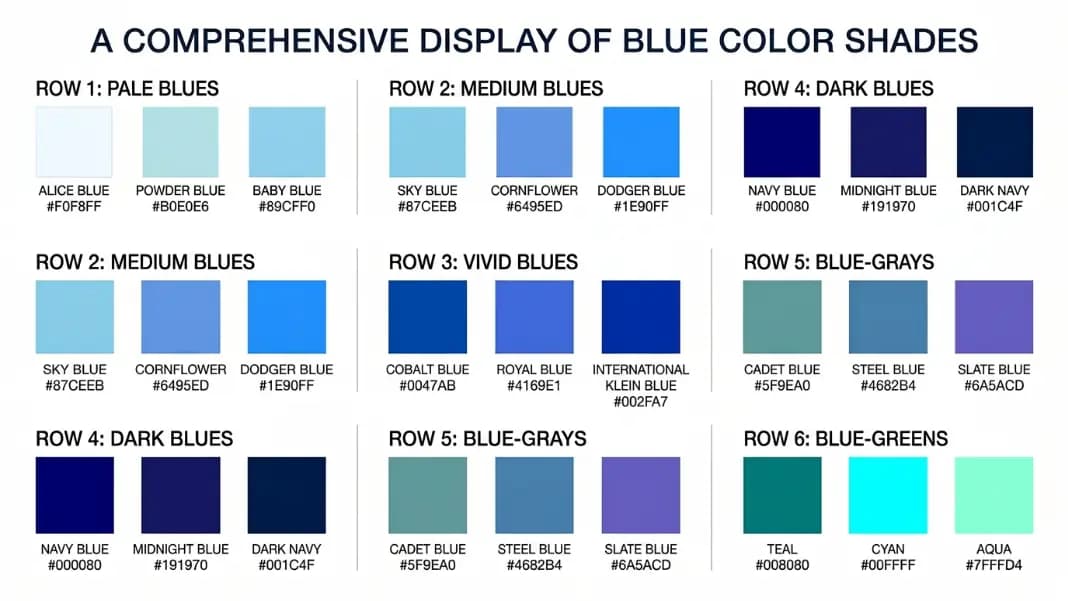
The key thing to understand upfront: paint color names and CSS color names are completely separate systems. Paint names are marketing labels created by individual brands. CSS names are a technical standard with 140 precisely defined colors. A paint called "Navy" from Sherwin-Williams has no direct relationship to the CSS color named navy (#000080). The hex values will likely be different.
How Paint Companies Name Their Colors
Paint color naming is a marketing and psychology exercise. The goal is to make a color memorable and emotionally resonant so it sells. Color names follow a few consistent strategies.
Descriptive names reference the color's most obvious quality: Soft White, Warm Gray, Deep Blue. These are clear but forgettable. Most mass-market brands use them for their core ranges because they reduce buyer confusion.
Evocative nature names connect the color to a natural reference: Sea Glass, Forest Floor, Storm Cloud. These create emotional associations and help buyers visualize how the color will feel in a space even without seeing a large sample.
Place names root the color in geography: Hague Blue, Charleston Green, Parma Gray. Farrow and Ball uses these heavily. They imply a specific cultural character and suggest the color belongs in a certain kind of interior.
Story names are the most unusual and often the most memorable: Elephant's Breath is a warm gray. Dead Salmon is a dusty pink-orange. Mole's Breath is a medium cool gray. These create conversational hooks that make the color easy to remember and talk about.
Paint color names have no technical meaning. They carry no information about hue, saturation, or depth on their own. All of that information is in the paint chip, the color code, and the LRV value.
How to Read a Paint Color Chart
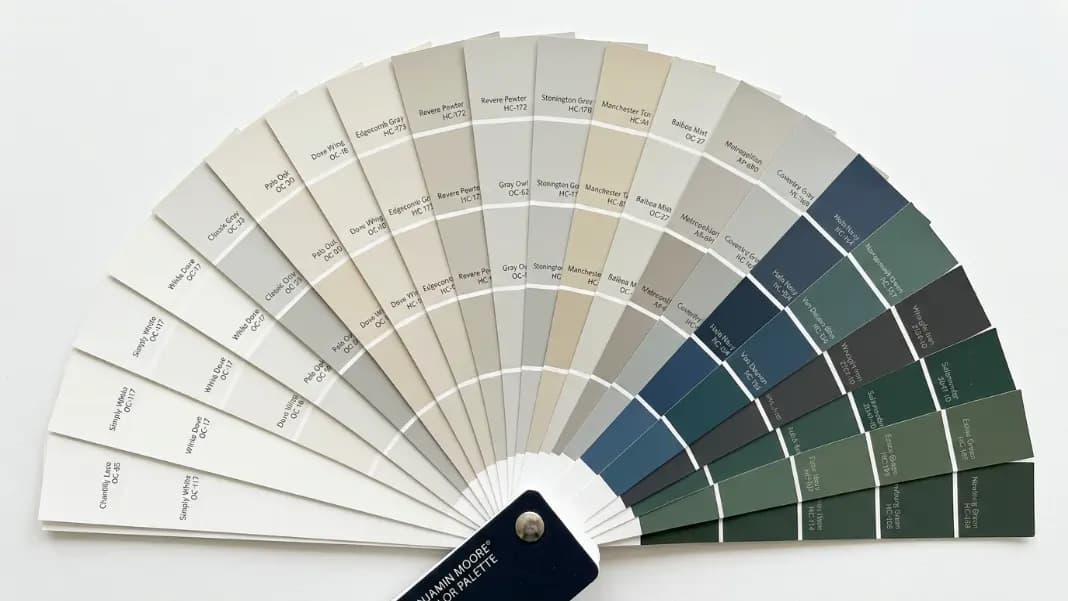
A proper paint color chart organizes colors in two dimensions: by hue family (grouped by color, with neutrals typically at one end) and by depth within each family (lightest tints at the top, darkest shades at the bottom).
Each chip on a chart shows several values:
The name: The marketing label. Useful for ordering and remembering, but carries no technical color information.
The color code: A brand-specific reference number (SW 7015, OC-17, etc.). This is the number you need to order the exact paint. Never order by name alone, since names are not unique across brands or even sometimes within a brand's history.
The LRV: Light Reflectance Value, on a 0 to 100 scale. This is the most useful single number on the chart. An LRV of 0 means the color absorbs all light (theoretical black). An LRV of 100 means the color reflects all light (theoretical white). Most white paints sit between 85 and 95 LRV. Popular neutral grays sit between 50 and 70 LRV.
The LRV number tells you something the chip cannot fully communicate: how the color will behave in a room. A color that reads as light gray on a chip can feel surprisingly dark on four walls, especially in a room with limited natural light. Designers often recommend going one LRV step lighter than what you pick from a chip for exactly this reason.
Undertones: The Hidden Color Inside Every Paint Shade
Undertones are the single most important concept in paint color selection and the most commonly misunderstood.
An undertone is the secondary color that a paint shade reveals under certain lighting conditions. A gray that looks clean and neutral on a paint chip can turn distinctly purple, green, or pink on a large painted wall. This happens because paint pigments mix to create the primary color, and the secondary pigments in that mix become visible when the light changes or when the wall surface reflects adjacent colors.
Every paint shade has an undertone. Whites can read pink, yellow, green, or blue. Beiges can lean green, pink, or orange. Grays are particularly notorious for revealing unexpected undertones: a gray with a slight green pigment in its formula will show that green cast against warm wood floors or in rooms with yellow-toned light.
Identifying undertones from a paint chip:
- Hold the chip against a pure white surface. The undertone becomes easier to see by contrast.
- Look at the chip in the room's actual light, at different times of day. Undertones shift with light color temperature.
- Compare chips from the same hue family. The undertone becomes obvious when similar colors are placed next to each other.
The practical advice is to always test a quart of paint on the actual wall before committing. A chip is 2 inches square. A wall is hundreds of square inches, and the undertone amplifies proportionally.
Wall Paint Color Names and Their Hex Equivalents
These are the most commonly searched wall paint colors with their approximate hex codes for digital reference.
| Paint Name | Brand | Approximate Hex | Character |
|---|---|---|---|
| Agreeable Gray SW 7029 | Sherwin-Williams | #CEC3B2 | Warm greige, LRV 60 |
| Repose Gray SW 7015 | Sherwin-Williams | #C2BFBB | Cool neutral gray, LRV 58 |
| Accessible Beige SW 7036 | Sherwin-Williams | #C8BB9E | Warm beige, LRV 58 |
| Revere Pewter HC-172 | Benjamin Moore | #C2B99A | Warm gray-beige, LRV 55 |
| White Dove OC-17 | Benjamin Moore | #F3EEE4 | Warm white, LRV 85 |
| Chantilly Lace OC-65 | Benjamin Moore | #FBFBF9 | Clean white, LRV 92 |
| Hague Blue No. 30 | Farrow and Ball | #36495C | Deep teal blue, LRV 8 |
| Elephant's Breath No. 229 | Farrow and Ball | #B5ACA5 | Warm mid gray, LRV 44 |
| Dead Salmon No. 28 | Farrow and Ball | #C8967C | Dusty pink-orange, LRV 35 |
These hex values are approximations. Physical paint pigments and screen RGB rendering are different color systems, and the exact hex will vary based on lighting, monitor calibration, and the specific paint formula batch. Use these as reference points, not exact matches.
Color Names Worksheet: How Designers Use Paint Charts for Digital Work
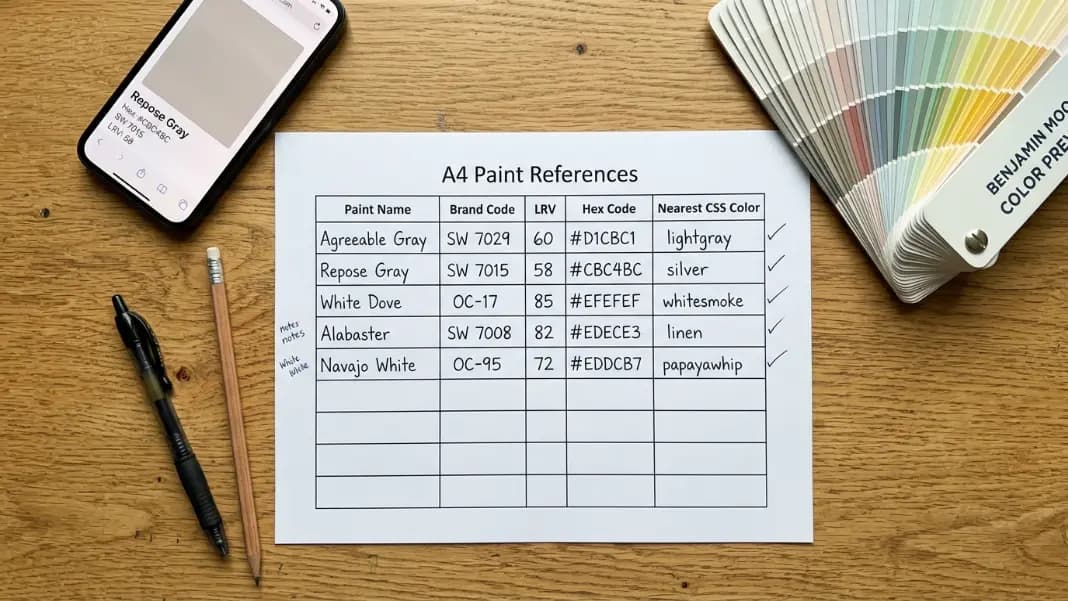
A color names worksheet is a reference document that maps paint chip names to their hex codes, used by interior designers and digital teams that need both physical paint and digital color references from the same project.
The process for creating one:
- Identify the paint colors selected for the physical space.
- Find each color's RGB or hex equivalent from the paint brand's digital tools or website.
- Paste each hex into the color name finder to identify the nearest CSS named color, which gives you a standard color vocabulary for documentation.
- Use the color format converter to generate HSL, RGB, and CSS custom property versions of each hex for use in code.
- Document all values in a reference sheet: paint name, brand code, hex, RGB, HSL, and nearest CSS name.
This workflow creates a single reference that works for both the physical interior design project and any digital work using the same color palette, such as a website for a space that needs to match the physical environment.
How Paint Colors Differ from CSS Named Colors
Paint color naming and CSS color naming are built for completely different purposes and have no formal relationship.
CSS named colors are a technical standard maintained by the W3C. The 140 CSS named colors are precisely defined hex values that render identically in every compliant browser. They were not created for aesthetics: they were created for technical interoperability. Names like cornflowerblue, lavenderblush, and peachpuff are technical labels, not design recommendations.
Paint color names are brand-specific marketing labels with no cross-brand consistency. Sherwin-Williams "Agreeable Gray" is not the same color as Benjamin Moore's gray or any other brand's gray, even if they use similar names. There is no governing body that standardizes paint color names across brands.
The exception is the Pantone Matching System, which does provide a standardized reference used across print, paint, and textile industries. Pantone paint colors from brands licensed to use the system can be precisely matched to Pantone numbers and their hex equivalents. But even Pantone hex values are approximations of physical pigments, not exact screen representations.
Fabric Color Chart with Names: A Different System
Fabric color naming follows yet another logic. Textile color references use industry standards like Pantone Textile (which differs from Pantone print), the AATCC Color Measurement System, or brand-specific shade libraries.
Fabric color names tend to be either highly evocative (Cobalt Dream, Dusty Rose, Blush Nude) or alphanumeric codes (PMS 17-1350 TCX for the Pantone textile reference). The evocative names are for sales and catalog purposes. The codes are for production and manufacturing.
When working between fabric colors and digital design, the same conversion workflow applies: find the fabric color's Pantone reference, get its hex equivalent from Pantone's published data, and use the color name finder or a format converter to translate that into your digital color system.
From Paint Chart to Digital Project: Using the Color Tools
For any project that bridges a physical painted space and a digital design, the workflow is straightforward.
Start with the paint color's approximate hex value, available from the brand's website or digital color tool. Paste it into the color name finder to identify the nearest CSS named color and see a side-by-side comparison of how close the match is. This tells you which standard CSS color is the best available approximation if you need to reference a named color rather than a custom hex.
For building a full digital palette from a paint color, upload a photo of the painted surface or a paint chip to the image color picker. It extracts the dominant colors and returns their hex codes. This accounts for how the paint actually reads under real lighting rather than what the manufacturer's digital representation shows.
For generating tints and shades of a paint color for a digital design system, the tints and shades generator produces 11 steps from white to black through any input hex. This is how you build a usable color scale from a single paint color reference.
The complete set of color tools for this workflow is in the color tools section. For a specific reference on what the most common hex codes in digital design are called in CSS, the hex code color names guide covers the most-searched values from design systems with their nearest CSS named colors and what designers call them in practice.