You pick purple for a brand's primary color and it comes back looking more blue than purple, or more pink than anyone expected. Purple is the most perceptually unstable color family in design because the word covers a range from lavender to indigo that the eye genuinely reads as different colors. Specifying purple color names precisely is the difference between a usable brief and an expensive revision round.
The CSS color specification includes several named purples, and understanding which is which matters the moment you are working in code. Purple (#800080) is a saturated mid-range red-purple. Violet (#EE82EE) is lighter and distinctly more pink. Indigo (#4B0082) is a deep blue-dominant purple. Lavender (#E6E6FA) is pale, cool, and barely purple at all. These are four different visual experiences, all under the same umbrella. The color name finder matches any hex code against all 140 CSS named colors, which helps identify which named purple a specific hex lands closest to.
This guide covers the complete purple naming vocabulary, from the palest lavenders through the richest plums, with hex codes, CSS named color references, and undertone context for each shade.
Why Purple Color Names Are More Specific Than They Appear
Purple spans more visual territory than almost any other single-word color name. The underlying reason is physics: purple has no wavelength of its own in the visible light spectrum. It is a non-spectral color created by stimulating both the red and blue cones in the human eye simultaneously, without stimulating green. That means purple is always a mix of two color families, and where you land on the red-to-blue axis determines which specific name applies.
A purple with more red reads as mauve, plum, magenta, or maroon-purple. A purple with more blue reads as indigo, periwinkle, or blue-violet. A purple that is pale and desaturated reads as lavender or lilac. The naming system carves up this red-blue-depth space into usable categories.
The practical consequence for design is that saying "purple" communicates very little about the actual hex code. Saying "dusty lilac" or "deep plum" narrows the range enough to be actionable. That precision prevents the moment where you approve a color on a brief and get back something that reads completely differently from what you visualized.
Light Purple Color Names: Lavender, Lilac, and Pale Violet
The palest purples have the most descriptive names in fashion and interior design, where soft, desaturated shades are more commercially common than vivid deep purples.
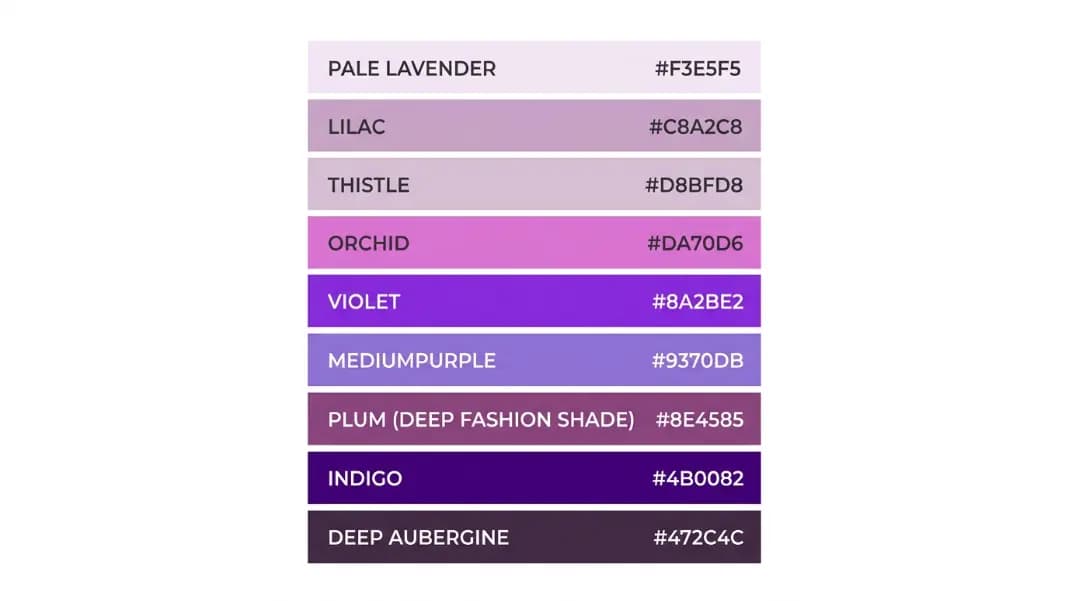
Lavender: The CSS named color lavender (#E6E6FA) is a pale, slightly blue-purple with minimal saturation. Named after the flowering plant, lavender as a color reads cool and silvery. In practice, shades described as lavender in fashion and interior design range between #D8B4E8 and #E6E6FA depending on context and brand.
Lilac: Slightly warmer and more pink than lavender. There is no CSS named color called lilac. Lilac typically falls around #C8A0D8 to #E0B8E8 on the hex scale. The distinction from lavender is the red undertone: lilac leans warmer, lavender leans cooler. They are often used interchangeably in casual speech but they produce noticeably different results next to warm wood tones or cool grays.
Wisteria: A blue-purple similar to lavender but slightly more saturated. No CSS named wisteria exists, but it is a standard Crayola and design vocabulary color. Approximate hex: #C9A0DC.
Thistle: The CSS named color thistle (#D8BFD8) is a pale muted pink-purple, closer to gray-pink than to a clear purple. Often described as a pale lavender-mauve, thistle sits in the desaturated zone where pink, gray, and purple overlap.
Periwinkle: Not a CSS named color, but widely used in design. Periwinkle is a pale blue-purple that reads as more blue than purple. Approximate hex: #CCCCFF. Periwinkle has seen significant use in graphic design and fashion in the early 2020s, where the blue-leaning soft purple became a trend color.
Medium Purple Color Names: Violet, Orchid, and True Purple
Violet: CSS violet is #EE82EE, a medium-light pink-purple. In physics, violet is the spectral color at the blue end of visible light. CSS violet the named color reads pink-purple rather than the deeper blue-purple that physics implies. True spectral violet looks darker and more blue, closer to #7F00FF or #8800FF.
Purple: CSS purple is #800080, a fully saturated mid-range purple with equal red and blue. This is the web standard definition of purple, defined in the early days of HTML color naming. It is the most commonly referenced "pure" purple in technical documentation.
Mediumpurple: CSS mediumpurple (#9370DB) is a lighter, slightly blue-leaning purple. This is closer to what most people visualize when they think of a classic balanced purple without a strong color cast.
Orchid: CSS orchid (#DA70D6) is a medium warm pink-purple, lighter and more pink than purple. Orchid as a name implies the flower's mix of purple and pink, and the hex delivers exactly that.
Amethyst: Not a CSS named color, but a widely recognized purple descriptor in jewelry, design, and marketing. Amethyst refers to a medium purple with a slight blue or violet lean, approximately #9966CC. Named after the gemstone.
Heather: A muted, grayish purple-pink. Heather in color vocabulary implies desaturation and softness rather than vivid purple. Approximate hex: #B47EBE. Common in fashion for its neutral-adjacent quality that pairs easily with grays and creams.
Rebeccapurple: CSS rebeccapurple (#663399) is a medium-deep warm purple added to the CSS standard in 2014. It is the only CSS named color named after a specific person, added by the web design community in memory of Rebecca Meyer, the daughter of CSS developer Eric Meyer, who died at the age of six.
Dark Purple Color Names: Plum, Indigo, and Aubergine
Deep purples have a distinct naming vocabulary used consistently across fashion, interior design, and cosmetics.
Plum: CSS plum (#DDA0DD) is a medium-light pink-purple, much lighter than the fruit it names. In fashion and interior design, plum refers to a deep, dark red-purple, approximately #6B1A3A to #7B2840. This is one of the most significant gaps between a CSS named color value and the common-use meaning of the same word. When a design brief says "plum," confirm whether they mean the CSS value or the fashion shade.
Indigo: CSS indigo (#4B0082) is a deep blue-purple, historically one of the most valuable natural dyes. In the visible light spectrum, indigo sits between blue and violet. The CSS value matches what most people mean by the word, making indigo one of the more consistent purple names across technical and everyday use.
Aubergine: The British English name for eggplant, used in interior design and fashion for a very deep, near-black purple-brown. Approximate hex: #3D0734 to #380030. Aubergine is darker than plum and has a brown-black quality that distinguishes it clearly.
Eggplant: The American English equivalent of aubergine. Used interchangeably in most design contexts. The two terms converge on the same hex range: #380030 to #614051.
Mulberry: A dark red-purple, closer to the color of the fruit. Approximate hex in the fashion range: #6B1040. Mulberry sits between burgundy and plum, with more red than indigo and more purple than burgundy.
Darkviolet and Darkmagenta: CSS darkviolet (#9400D3) is a very deep, highly saturated blue-dominant purple. CSS darkmagenta (#8B008B) is a deep red-dominant purple. These two define the outer edges of the deep CSS purple range.
Purple-Gray and Dusty Purple Color Names
Desaturated or gray-leaning purple shades form their own distinct category. These are popular in interior design because they function as near-neutrals while still reading as purple.
Mauve: A grayish pink-purple named after the mallow flower. Mauve has a softness and desaturation that neither pink nor purple alone carries. Approximate hex: #E0B0C8 for lighter mauve, #C0A0C0 for the dustier versions common in fashion. Mauve works alongside warm whites, grays, and creams in ways that more vivid purples cannot.
Dusty Purple / Dusty Lilac: A muted, desaturated version of a medium purple, approximately #9B7EA8 to #A082B0. Dusty purple reads as vintage or antique in mood. It is often used in botanical and cottagecore aesthetics.
Ube: A purple with a gray-lavender quality, named after the Filipino purple yam. Ube as a color gained significant traction in design and food aesthetics in the 2020s. Approximate hex: #8878C3.
Muted Violet / Vintage Violet: A desaturated medium violet, roughly #8B6A9A. The muted quality makes these shades versatile in color palettes where vivid purple would feel too prominent.
Blue-Purple and Red-Purple: Where Purple Meets Adjacent Colors
Purple exists on a spectrum between blue and red, and understanding where the boundaries sit helps identify which shade names apply.
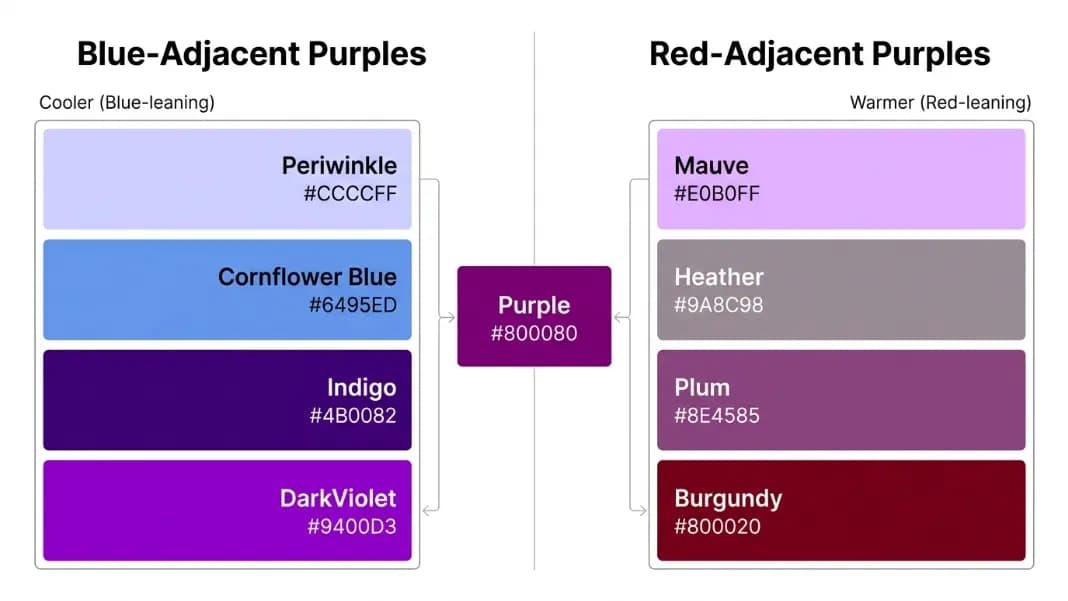
Blue-Adjacent Purples: As purple gains more blue and loses red, it moves toward periwinkle, then cornflower blue, then indigo, then navy. Periwinkle (#CCCCFF) reads as blue-purple. Cornflowerblue (#6495ED) has a purple undertone that pulls it away from pure blue. Indigo (#4B0082) is the deepest named blue-purple in the CSS set.
Red-Adjacent Purples: As purple gains more red, it moves toward magenta, then fuchsia, then bordeaux and burgundy. CSS magenta (#FF00FF) is an equal mix of red and blue, the most red-adjacent purple and a primary color in CMY. CSS fuchsia shares the same hex (#FF00FF).
Violet vs. Purple: In everyday use, violet tends to describe a brighter, more blue-leaning purple, while purple tends to describe a more balanced or red-leaning version. In CSS, the named values are specific and should not be assumed to reflect these everyday definitions.
Burgundy: Primarily a dark red wine color but at its purple end it overlaps with deep plum. The distinction is whether red or purple dominates: burgundy has clear red dominance, plum has purple dominance. Burgundy in design often appears when the brief is for a deep, sophisticated red-purple.
CSS Named Purples and Their Hex Codes
The CSS named color set includes more purple-family colors than most designers realize. Understanding the full set makes the color name finder results more interpretable, particularly for inputs in the purple range.
| CSS Name | Hex | Visual Quality |
|---|---|---|
| lavender | #E6E6FA | Pale blue-purple, cool |
| lavenderblush | #FFF0F5 | Near-white, faint pink-purple tint |
| thistle | #D8BFD8 | Pale muted pink-purple |
| plum | #DDA0DD | Light pink-purple (lighter than the fashion meaning) |
| violet | #EE82EE | Medium pink-purple |
| orchid | #DA70D6 | Medium warm pink-purple |
| mediumpurple | #9370DB | Classic balanced purple with slight blue lean |
| purple | #800080 | Saturated mid-range purple |
| rebeccapurple | #663399 | Medium-deep warm purple |
| darkorchid | #9932CC | Deep vivid blue-purple |
| darkviolet | #9400D3 | Very deep blue-dominant purple |
| blueviolet | #8A2BE2 | Deep blue-purple, high saturation |
| darkmagenta | #8B008B | Deep red-dominant purple |
| indigo | #4B0082 | Deepest blue-purple in the named set |
For building a full purple palette from any of these starting points, the tints and shades generator produces 11 steps from white to black through any input hex. This gives you a complete range of highlights, midtones, and shadows for use in a design system or illustration.
The hex code reference guide at specific hex code color names covers the most commonly searched hex values from design systems with their nearest CSS named color equivalents, which is useful when working with purple values that fall between the named CSS purples.
Purple in Fashion and Beauty: How the Industry Names It
Purple appears across beauty categories with consistent naming that mirrors the broader design vocabulary.
In eyeshadow and eyeliner, violet describes bright vivid purple. Plum describes dark warm purple-brown. Orchid indicates medium pink-purple. Lavender indicates pale cool purple. Mauve indicates grayish desaturated pink-purple. These terms appear directly on product labels and align with the color vocabulary used in interior design, making it relatively easy to translate between beauty and design contexts.
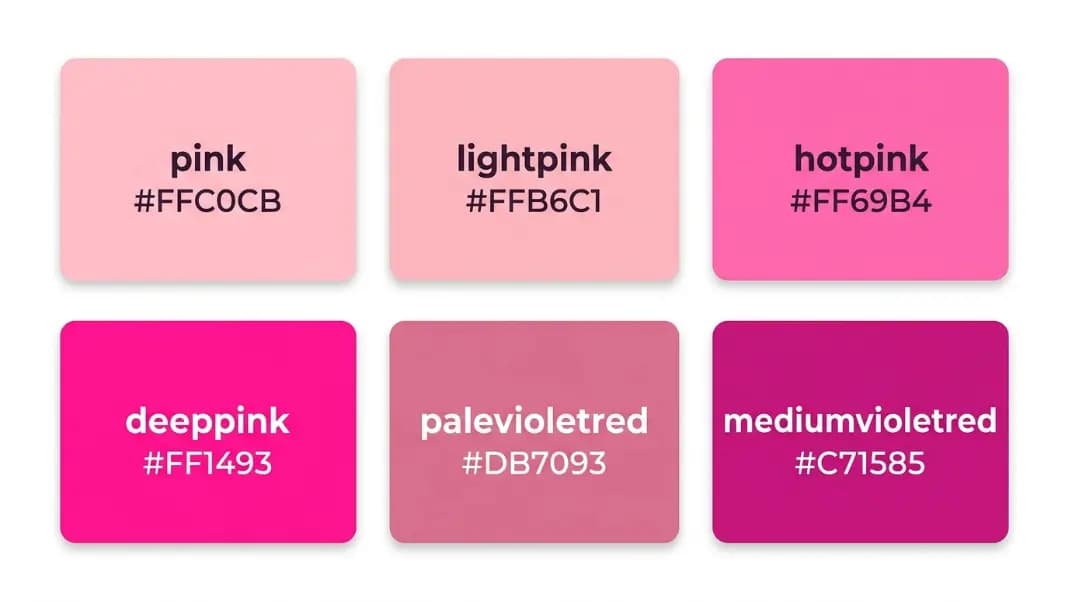
In lipstick, berry describes a dark blue-red-purple. Plum describes a deep warm purple. Lilac describes pale pastel purple. Grape describes a dark warm purple. Wine describes a deep red-dominant dark purple. These names appear consistently enough across brands that "plum lipstick" communicates a specific aesthetic to most people without requiring them to see the product. The parallel system in pink follows the same logic, where pink color names move from blush and ballet pink at the pale end through hot pink and magenta in the middle to raspberry and wine at the deep end.
In nail polish, purple naming runs from lavender and lilac at the lightest end through violet, orchid, plum, eggplant, and blackberry toward the darkest shades.
Choosing the Right Purple for Design Work
The gap between "purple" in a brief and "purple" as a finished hex code is wide enough to cause real project friction. The practical approach is to specify at least two of three dimensions: depth, temperature, and saturation.
Depth: Light (lavender, lilac, wisteria), medium (violet, orchid, mediumpurple), dark (plum, indigo, aubergine).
Temperature: Warm purple (mauve, plum, mulberry, darkmagenta), neutral (rebeccapurple, mediumpurple), cool (indigo, periwinkle, darkviolet, blueviolet).
Saturation: Vivid (violet, darkviolet, blueviolet, magenta), balanced (purple, orchid), muted (mauve, thistle, heather, dusty lilac).
Specify two of these and the range narrows enough to be actionable. "A muted, warm medium purple" points toward mauve or heather. "A deep, cool, vivid purple" points toward indigo or darkviolet. That specificity prevents the revision round.
For any project crossing physical and digital purple references, including paint, print, and screen, the color format converter converts between hex, RGB, HSL, and CMYK. The full set of palette and conversion tools is in the color tools section.