There are at least forty named shades of pink used across fashion, makeup, interior design, and graphic design. Most people can name five of them. That gap matters when you are trying to describe a specific shade in a brief, match a color across platforms, or explain to a client why the pink in the logo is not the same pink as the pink in the mockup.
The pink family covers one of the widest ranges of any color in the spectrum: from barely-there blush that reads almost white in certain lighting, through the soft muted roses of bridal design, all the way to the eye-burning neon pinks of contemporary streetwear. Each zone of that range has its own vocabulary, and the vocabulary is not consistent across industries. Fashion calls it dusty rose. Interior design calls it blush. Makeup calls it rose nude. The hex code is the same.
This guide covers the full range of pink shades from the CSS named colors through the broader naming vocabulary used in fashion, nail polish, and lipstick. For any specific pink you encounter as a hex code, the color name finder identifies the nearest CSS named color using perceptual Delta-E matching so you can place it in the right part of the pink spectrum.
The Pink Shades That CSS Actually Names
CSS has six named colors that sit clearly in the pink range, plus several adjacent colors in the coral, violet, and salmon zones that pink discussions often include.
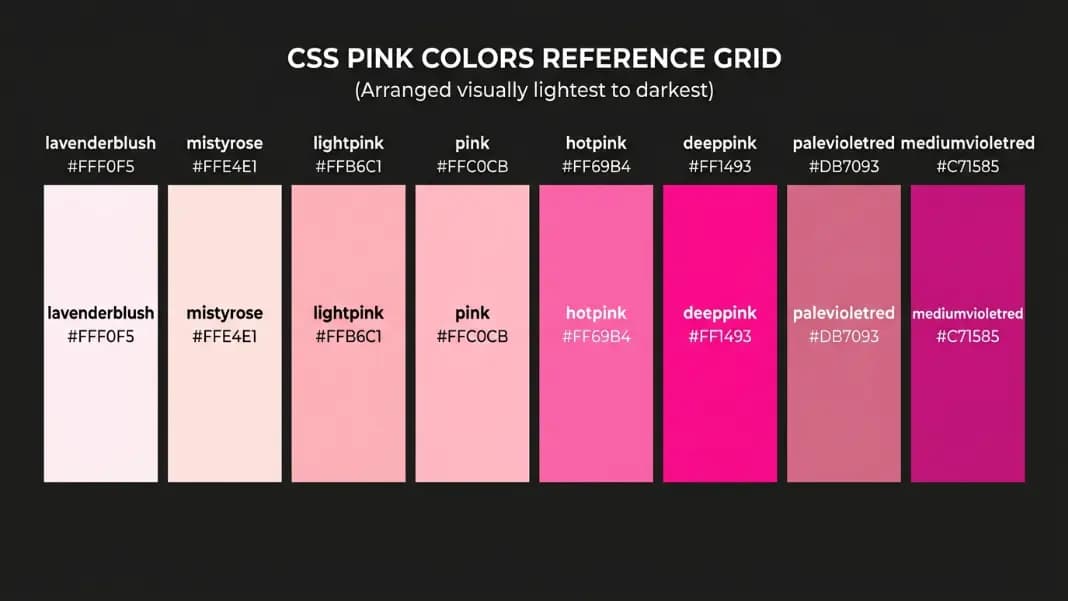
lightpink (#FFB6C1): The lightest CSS pink, a soft warm pink that reads as gentle and feminine. Despite the name, lightpink is slightly more saturated than most shades people call "blush" in makeup vocabulary.
pink (#FFC0CB): The CSS named color "pink" is slightly darker and more warm than lightpink. Both are close, and lightpink is actually lighter than pink, which is a naming choice that confuses people when they look at them side by side. CSS pink is the archetypal soft pink.
hotpink (#FF69B4): A bright medium pink with a warm undertone. Hotpink sits between the soft pinks above and the more saturated deeppink. It is the most commonly recognized "pink" in popular culture and the closest CSS named color to what most people mean when they say "hot pink."
deeppink (#FF1493): A highly saturated pink with significant blue undertone, closer to magenta territory. This is the CSS color people sometimes call "shocking pink" or "electric pink." It is very close to the bold pinks used in contemporary fashion.
palevioletred (#DB7093): A dusty, muted pink with a slight purple undertone. Despite the name, this reads more as a muted rose or antique pink than a violet-adjacent shade. It is the CSS named color closest to dusty rose and mauve-adjacent pinks.
mediumvioletred (#C71585): A deep berry-pink, closer to raspberry or dark magenta than to typical pink ranges. This is in the CSS named color set but sits at the darkest edge of what most people consider pink.
Two additional CSS named colors belong to adjacent territory. lavenderblush (#FFF0F5) is an extremely pale pink, almost white with a pink tint, useful for very light pink backgrounds. mistyrose (#FFE4E1) is another near-white pink, slightly warmer and more peachy than lavenderblush.
Blush, Rose, and Dusty Pink: The Soft Muted Zone
The soft muted pinks are the most commercially successful zone of the pink spectrum. They appear in bridal fashion, interior design, beauty packaging, and lifestyle branding in quantities that make all other pink shades look niche by comparison.
Blush: A soft peachy-pink with warm undertones. Blush does not have a single industry standard hex, but it typically sits around #FFB6A3 to #F0A898 depending on the source. In interior design and fashion, blush is a neutral pink, meaning it works as a background color rather than an accent. CSS lightpink (#FFB6C1) is the nearest named CSS color, though blush in practice is usually warmer and less saturated.
Rose: A medium pink that can lean warm (pinkish-orange) or cool (pinkish-purple) depending on the context. Rose is one of the broadest terms in pink vocabulary. A rose-toned foundation shade is different from a rose gold accent, which is different again from a rose paint color. In general color naming, rose sits around #FF007F (a pure bright rose) down to softer, more muted versions around #B76E79 (rose gold territory).
Dusty rose: A muted brownish-pink that reads as vintage or antique. Dusty rose became ubiquitous in bridal and wedding design in the 2010s. Approximate hex: #DCAE96 to #C4897C. CSS palevioletred (#DB7093) is the closest named CSS color to dusty rose, though palevioletred is more purple and slightly brighter.
Mauve: A gray-pink with cool purple undertones, one step more muted than dusty rose. Approximate hex: #B5858E to #A0707A. Mauve sits at the intersection of pink and purple in a desaturated zone.
Millennial pink: A media-coined term for the muted peachy-pink that dominated design from roughly 2016 to 2020. The approximate hex most commonly cited is #F4C2C2 or the more peachy #FFD1BA. This is not a standardized color, just a cultural reference to a recognizable shade range.
Hot Pink, Fuchsia, and Magenta: The Bold Zone
The bold pinks are the attention-seeking end of the spectrum, and they have the most complicated naming situation because fashion, print, and CSS all use slightly different definitions for the same words.
Hot pink: In general usage, hot pink refers to a bright saturated pink without strong blue undertones. The CSS named color hotpink (#FF69B4) is the standard reference. In fashion, hot pink can refer to a range from the CSS hotpink through to the more electric shades approaching neon.
Fuchsia: In CSS, fuchsia is another name for #FF00FF, the same as CSS magenta. In fashion and popular culture, fuchsia typically refers to a slightly blue-red pink, closer to #FF0090 or #C154C1. The fashion fuchsia is more pink-leaning than the CSS fuchsia, which is an equal mix of red and blue. The CSS deeppink (#FF1493) is closer to what the fashion industry calls fuchsia than CSS fuchsia itself.
Magenta: In CSS, magenta is the same as fuchsia: #FF00FF. In print and CMYK, magenta is a process ink color with its own specific pigment that does not map exactly to #FF00FF on screen. In general usage, magenta is understood as a blue-red pink, similar to fuchsia. For web design, use color: magenta or color: fuchsia and you get the same result.
Neon pink: A highly saturated pink that pushes toward fluorescent territory. There is no CSS named color for neon pink. Common hex references include #FF6EC7 and #FE428E, but neon pinks vary widely. On screen, neon pinks can only approximate the visual pop of actual fluorescent ink or paint.
Barbie pink: A cultural reference to the bright saturated pink associated with the Mattel brand. The official Barbie pink used in the 2023 film campaign was approximately #E0218A. This is brighter and more blue-toned than CSS hotpink.
Coral and Salmon: The Orange Pinks
The orange-pink zone has its own distinct naming system that crosses between pink and orange vocabulary.
Coral: A warm orange-pink. CSS coral is #FF7F50, which leans more orange than pink on most screens. In interior design and fashion, coral typically refers to the range from orange-tinged pink to true coral, roughly #FF6B6B to #FF7F50. Coral had a moment as a Pantone Color of the Year (Living Coral, Pantone 16-1546, in 2019).
Salmon: CSS salmon is #FA8072, a warm orange-pink that reads as muted coral. In color naming, salmon and coral overlap significantly, with salmon usually implying a slightly less saturated, more muted version. CSS lightsalmon (#FFA07A) is one step warmer and lighter.
Flamingo: A peachy coral-pink associated with the color of flamingo feathers. Approximate hex: #FC8EAC to #FF91AF. Flamingo pink sits between the true pinks and the salmon-coral zone.
Peach: A warm pale orange-pink. CSS color peachpuff (#FFDAB9) and bisque (#FFE4C4) are the nearest CSS named colors in this range. In fashion and beauty, peach refers to a broader range of warm, pale, orange-tinged pinks.
Pink Color Names in Nail Polish
Nail polish shade naming uses all three zones of the pink spectrum, and the naming conventions reflect the target market and occasion for each shade.
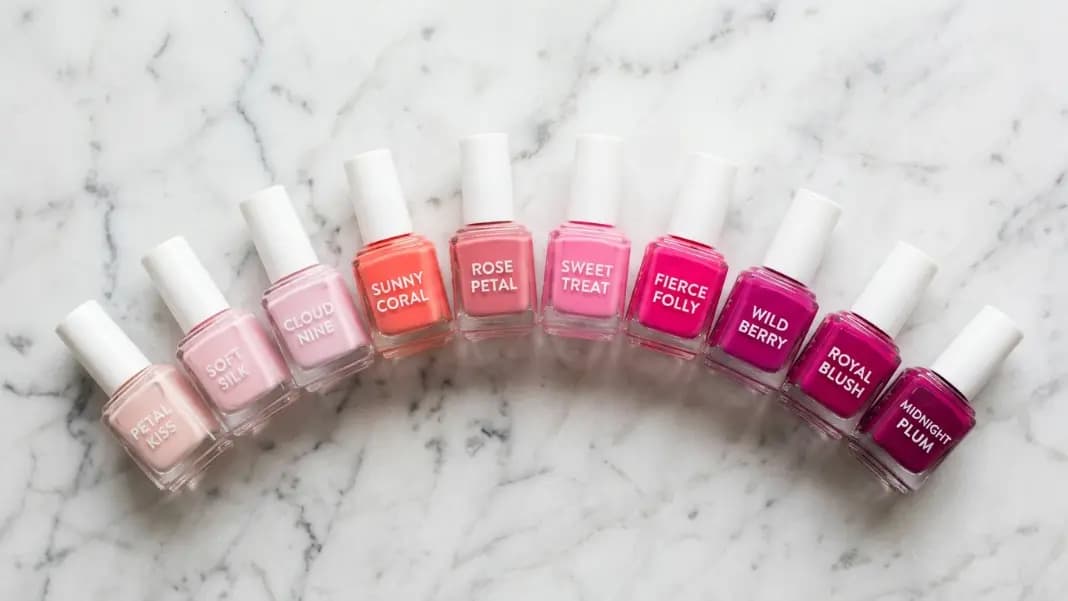
The sheerest, lightest pinks carry names that suggest restraint and elegance: ballet pink, French pink, shell pink, blush nude, barely-there pink, sheer rose, petal pink. These are the shades associated with professional settings and classic French manicures. CSS lightpink (#FFB6C1) and CSS pink (#FFC0CB) are the closest named colors in this category.
Mid-range pinks carry more personality in their names: bubblegum, candy pink, summer rose, cotton candy, flamingo, watermelon. These are the weekend shades, vacation colors, and fun-season picks that lean brighter than the nude-adjacent shades but stop short of the neon end.
The bold end of nail polish pink has names that signal intention: power pink, shocking pink, electric fuchsia, neon jelly, hot mess, magenta flash. These are CSS hotpink (#FF69B4) and CSS deeppink (#FF1493) territory and beyond.
Lipstick Pink Color Names
Lipstick shade naming follows a slightly different arc than nail polish because skin undertone matters more for lips than for nails.
The nude-pink zone covers shades closest to the wearer's natural lip color with slight pink enhancement: barely pink, my lips but better, petal, skin pink, peach nude. These are formulated to read as natural while being slightly more polished. The CSS color palevioletred (#DB7093) sits in the muted-pink zone of this category at the more saturated end.
Classic medium pinks cover the range from rose to bright pink: rose, coral rose, pink rose, poppy, candy, berry rose. These are the workhorse lipstick shades that appear across every brand's lineup because they are flattering on a wide range of skin tones.
Bold lipstick pinks include hot pink, shocking pink, fuchsia, magenta, neon pink, and bright berry. These are the statement shades where CSS deeppink (#FF1493) and the fuchsia-magenta zone sit. They work best as the focal point of a minimal makeup look and tend to be more skin-tone dependent than the mid-range shades.
Building a Pink Color Palette for Design Projects
Pink palettes work best when they establish a clear temperature and maintain it through all shades in the palette. A palette that mixes warm coral-pinks with cool blue-pinks reads as inconsistent, even when the individual shades are each appealing on their own.
For warm pink palettes (blush, coral, peach, rose gold): anchor the palette with a mid-range warm pink like CSS palevioletred (#DB7093) or a custom hex in the dusty rose range, then use the tints and shades generator to build a 11-step scale from white through your anchor to dark. The tints will fall naturally into blush territory and the shades will move toward mauve and rose wine.
For cool pink palettes (magenta, fuchsia, electric pink): anchor with CSS hotpink (#FF69B4) or CSS deeppink (#FF1493) and build a scale the same way. The cool pinks produce different tints and shades than warm pinks: tints lean lavender rather than peach, and shades lean toward deep berry and plum rather than brown-rose.
For checking whether a specific pink has enough contrast for text use against a background, the WCAG contrast checker verifies the ratio against AA and AAA standards. Hot pinks on white often fail for text at normal size because their contrast ratio sits below 4.5:1, which is why bold pinks work better as accents and backgrounds than as text colors.
For building a full palette including pinks alongside other brand colors, the palette generator creates harmony-based color schemes from any input color, which helps if you need the pink to work with blues, greens, or neutrals rather than standing alone.
The complete reference for CSS named colors in the pink family and adjacent zones, with their hex codes and where they sit in the full color spectrum, is in the color name finder. The color tools section has all the related utilities for working with pink palettes across formats, scales, and accessibility standards. For the broader context of how paint companies name their pink shades and how paint color names connect to digital hex values, the paint color chart with names guide covers the physical color naming system in full.