You write a character's eyes as "blue" and the reader pictures powder blue. You meant steel gray-blue. In a portrait, you mix "brown" for the irises and the result is flat and lifeless because you missed the amber ring around the pupil. Eye colors are far more specific than their basic names imply, and both writers and artists run into the vocabulary gap when they need to be precise.
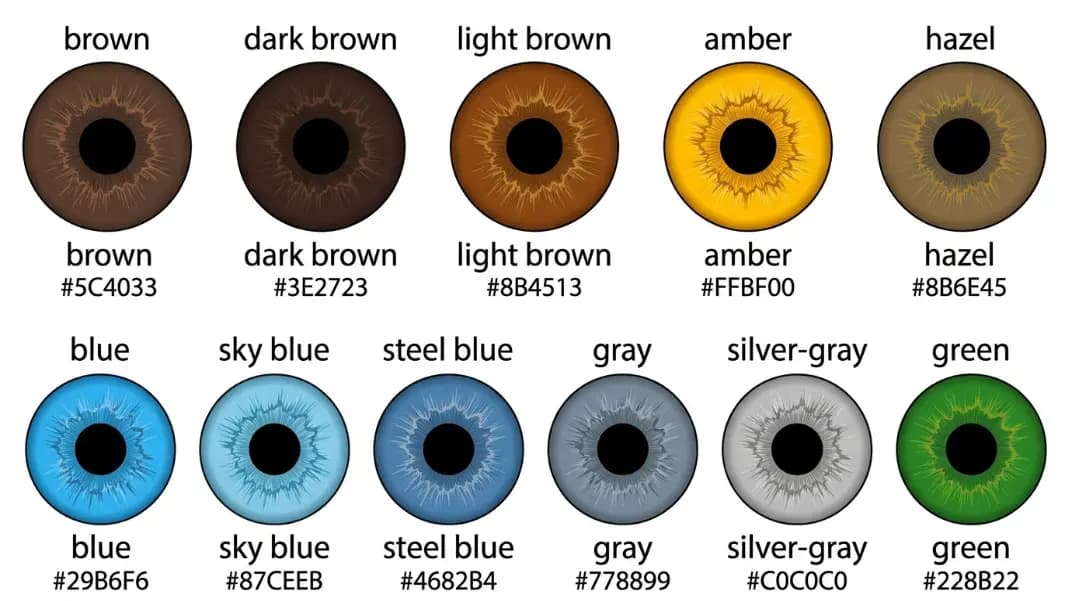
Human eye colors span a meaningful range even within a single named category. Brown eyes alone run from near-black espresso through warm medium brown to the golden tones of light brown that sits close to hazel. Blue covers sky blue, ice blue, cornflower blue, and steel blue. Understanding the specific eye color names, their hex equivalents, and what distinguishes each makes the color name finder useful for portrait work and makes written descriptions land more precisely. The same eumelanin and pheomelanin that determine eye color also govern hair color names and skin tone names, so all three are related outputs of the same genetic system.
This guide covers every named human eye color from the common to the rare, with hex codes, how to identify which category an eye falls into, and the vocabulary professionals and writers use to describe each.
How Eye Color Is Named and Classified
Eye color depends on the amount and type of melanin in the iris, the thickness of the stroma, and the way light scatters within the eye. Two types of melanin are involved: eumelanin (brown-black) and pheomelanin (red-yellow). The ratio determines whether eyes appear brown, amber, hazel, green, or blue.
Dark brown eyes have the highest eumelanin concentration. Amber eyes have high pheomelanin relative to eumelanin. Hazel eyes have moderate melanin with both types present. Green eyes have low eumelanin and rely on Rayleigh scattering for the blue-green component. Blue and gray eyes have the least melanin and are predominantly the result of light scattering rather than pigment.
In practice, eye color is rarely a single flat tone. Most eyes have a limbal ring (a dark outer edge), pupillary rings (rings around the pupil that are often lighter or darker than the iris midground), and subtle color gradients from the pupil outward. Naming eye color accurately means identifying the dominant midground tone.
Brown Eye Color Names: The Most Common Category
Brown eyes are the most common eye color globally and carry the widest range within a single named category.
Dark brown: Very high melanin concentration. The iris reads as near-black in normal lighting. Hex range: approximately #1A0900 to #3B1F0E. In low light, the pupil boundary is almost indistinguishable from the iris. Most common in East Asian, Southeast Asian, South Asian, African, and Latin American populations.
Medium brown: A clearly visible warm brown, the color most people picture when they say "brown eyes." Hex range: approximately #5C3317 to #7A4419. The most recognizable brown eye tone globally.
Light brown: A warm, clearly brown tone that approaches the amber-hazel boundary. Hex range: approximately #A0724A to #C19A6B. Light brown eyes often show amber or gold rings near the pupil, which creates ambiguity with amber classification.
Milk chocolate brown: A warm mid-brown with a slight orange warmth, approximately #7B4F2E. Common in Mediterranean and Middle Eastern populations.
Dark espresso: Near-black with a slight warm undertone. Approximate hex: #2C1008. The darkest end of the brown spectrum.
The warm undertone in brown eyes is the variable that matters most for portrait artists. Brown eyes that lean orange-gold near the pupil read differently from cool flat brown irises. Identifying whether a brown is warm (red-yellow lean) or cool (gray lean) should precede color mixing. The full naming vocabulary for browns from chocolate to caramel to tan is in the shades of brown color names guide.
Blue Eye Color Names: Pale Ice to Deep Steel
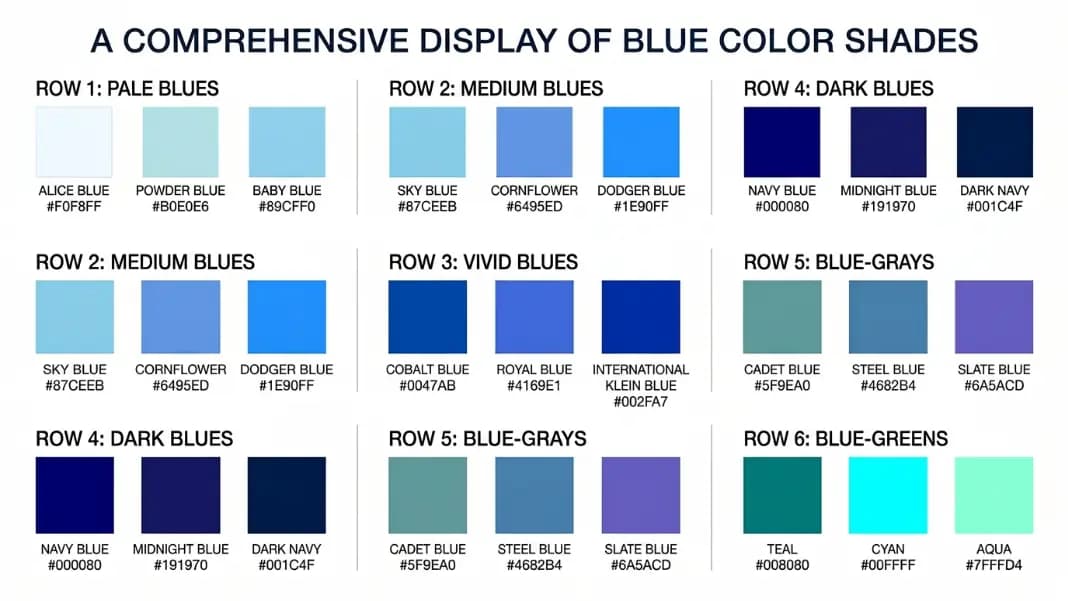
Blue eyes contain low melanin and appear blue through Rayleigh light scattering, the same optical mechanism that makes the sky appear blue. The actual amount of melanin and stroma thickness determines where in the blue range they sit. The shades of blue color names guide covers the full CSS and design vocabulary for blues that also apply to eye color description.
Ice blue: The palest blue eyes, almost transparent-looking. Approximate hex: #C8D8E8 to #D8E8F0. Ice blue eyes are common in Scandinavian populations and read as very light in photographs.
Sky blue: A clear, medium-light blue. Approximate hex: #89B4CC to #A2C4D0. Sky blue eyes sit in the mid-light range and are the blue most people picture when they imagine blue eyes.
Baby blue: Pale and slightly warm. Approximate hex: #8EC5D4 to #A8D1E0. Baby blue eyes are soft and lighter than cornflower blue.
Cornflower blue: A medium blue with a slight violet-cool quality. Approximate hex: #6D9BC3 to #7B9DCF. CSS cornflowerblue (#6495ED) is a close reference, though eyes in this range often appear more gray-blue than the pure CSS color.
Steel blue: A medium blue with a visible gray quality. CSS steelblue is #4682B4. Eye colors in this range read as blue-gray rather than pure blue. Approximately #5580A0 to #6A95B0 for most steel blue eye references.
Slate blue: A cooler, more gray-blue. Approximate hex: #5470A0 to #6080B0. Similar to steel blue but with a cooler, more blue-purple lean.
Periwinkle blue: A pale blue with a violet quality. Approximate hex: #9098C8 to #A0A8D8. Periwinkle blue eyes read as blue-purple or blue-violet and are sometimes described informally as violet even when they are not.
Green Eye Color Names: The Rarest Common Color
Green is considered the rarest common eye color, appearing in approximately 2 percent of the global population. Most common in Northern and Central Europe. Green eyes result from low to moderate melanin combined with Rayleigh scattering that creates the blue-green appearance. For a broader look at the green naming vocabulary, the shades of green color names guide covers the full range from lime to forest.
Pale green: A very light green with low saturation, approximately #7EB89A to #8AC4A6. These can appear blue-green or gray-green depending on lighting.
True green: A clearly readable medium green without strong yellow or blue lean. Approximate hex: #4E7C59 to #5D8A6A. True green eyes are uncommon even among people with green eyes; most lean toward a secondary color.
Olive green: Green eyes with a warm yellow-brown undertone. Approximate hex: #6B7C3D to #7D8B4A. Olive green eyes are common in Southern European populations and can be confused with hazel when the warmth is strong.
Forest green: A darker, more saturated green. Approximate hex: #3B6B46 to #4A7A55. Forest green eyes read as clearly dark green without the ambiguity of hazel or olive.
Blue-green: The most common green eye variant. Approximate hex: #4A7C89 to #5B8C9A. Blue-green eyes shift between blue and green depending on light and can be classified as either. Writers frequently describe these as "sea green" or "teal."
Gray-green: Green eyes with a gray quality that reduces their saturation. Approximate hex: #7A9080 to #8AA090. Gray-green eyes are sometimes misclassified as hazel or gray.
Gray Eye Color Names: Between Blue and Nothing
Gray eyes have extremely low melanin and appear gray through a combination of light scattering and the stroma's collagen structure. They are closely related to blue eyes and often shift between gray and blue in different conditions.
Light gray / Silver: Very pale, near-white gray. Approximate hex: #C4CAD0 to #CED4DA. Silver-gray eyes read as almost colorless in bright light.
Medium gray: The most recognizable gray eye tone. Approximate hex: #8E9BA8 to #9EA8B5. Medium gray eyes often shift toward blue in cool light and toward green-gray in warm light.
Steel gray: A medium-dark gray with a slight blue lean. Approximate hex: #5C6E7E to #6A7E8E. CSS slategray (#708090) is in this range.
Slate gray: A darker, cooler gray. Approximate hex: #4E5D6C to #5A6B7A. Slate gray eyes read as a cool dark neutral.
Stormy gray: A term used in writing and beauty contexts for medium gray eyes with a blue-green quality, approximately #6A808A to #7A909A.

Hazel Eye Color Names: The Two-Tone Category
Hazel is one of the most misidentified eye colors because it describes a pattern as much as a color: the combination of brown near the pupil and green (or sometimes blue) toward the outer iris, often with a gold or amber intermediate band.
Brown-hazel: The dominant tone is brown, but the outer iris shows clear green or gold. Approximate central hex: #7A5230, outer ring: #6B7A4A.
Green-hazel: The dominant tone reads as green or gold-green, with brown only near the pupil. Approximate central hex: #8B6940, outer ring: #5A7A4A. Green-hazel can be misclassified as green.
Golden hazel: A hazel dominated by golden-amber tones with some green. Approximate central hex: #9C7A30, outer ring: #8B7A4A. This is the most warmly colored hazel variant.
Gray-hazel: A cooler hazel with gray and green tones rather than brown and green. Approximate central hex: #7A8060, outer ring: #6A8070.
The key diagnostic for hazel versus other eye colors: if the inner and outer iris are measurably different in hue and you can see both brown-warmth and green-coolness, the eye is probably hazel.
Amber Eye Color: The Golden Brown Category
Amber eyes are caused by pheomelanin rather than eumelanin. They read as a warm golden-orange-brown without the green of hazel or the flat tone of brown. In animals, amber is a common eye color. In humans, it is comparatively rare.
Yellow-amber: The warmest end of amber, with a visible yellow quality. Approximate hex: #D4A017 to #FFBF00. These can be confused with hazel when seen in low resolution.
Orange-amber: A vivid warm orange-brown. Approximate hex: #CC7722 to #B8860B. CSS goldenrod (#DAA520) and darkgoldenrod (#B8860B) sit in this range.
Warm amber: The most common amber eye description, a balanced golden-orange-brown. Approximate hex: #B8860B to #C8960B.
Amber is distinct from light brown in one specific way: amber has a visible warm glow quality in light. Light brown can appear flat. If an eye looks like it has its own internal warmth when lit from the front, it is more likely amber than light brown.
Rare Eye Color Names: Violet, Red, and Heterochromia
Violet eyes: Violet or purple eyes are documented but extremely rare. They result from very low melanin and a specific combination of blue light scattering with red reflected from blood vessels or connective tissue. Approximate perceived hex: #8080C0 to #9090D0. What is described as violet is often a very pale blue eye in specific lighting.
Red or pink eyes: Occur in albinism when iris pigmentation is absent and the visible color comes entirely from the iris's blood vessels. Approximate hex: #B07070 to #CC8888. These are the literal color of the blood vessels as seen through a transparent iris.
Heterochromia iridum: Two different-colored eyes. This is not a color itself but a condition. It occurs in approximately 1 percent of humans. Each eye is named using standard eye color vocabulary.
Sectoral heterochromia: One eye has two distinct color sectors. The named colors within the eye are standard (brown, green, blue) but distributed unevenly within a single iris.
How Does Eye Color Appear to Change in Different Lighting?
Eye color shifts with ambient light temperature and surrounding colors. The underlying pigment does not change, but the way light reflects from the iris does. The same person's eyes can read as different named colors in a photograph taken outdoors versus one taken under warm indoor light.
Warm incandescent light (2700 to 3000K): Brown eyes shift toward amber and orange-brown. Hazel eyes show more golden warmth and the green component fades. Blue eyes shift toward a softer gray-blue rather than vivid blue.
Cool daylight (5000 to 6500K): Blue and gray eyes read at their most vivid and saturated. Green eyes appear more blue-green. Brown eyes cool slightly and show less of the warm amber ring near the pupil.
Overcast natural light: Gray eyes are most distinctly gray in diffuse overcast light. Hard shadows in direct sun can make them shift toward blue or blue-green. Hazel eyes often show their two-tone structure most clearly in overcast conditions because the even illumination reveals the inner and outer color difference.
Flash photography: Camera flash at close range desaturates iris color. Dark brown eyes can appear lighter, closer to medium brown, under flash. This explains why passport photos and ID photos often make eyes look a different shade than they appear in person.
For portrait painters: the same iris hex code needs warmer tonal variants under incandescent light and cooler variants under daylight. The tints and shades generator produces the full tonal range from any base eye color hex, which gives you the shadow, midtone, and highlight values needed for realistic iris work under different light sources.
Eye Color Hex Quick Reference
All named human eye colors in one table with approximate hex values and the nearest CSS named color. This is useful for designers building palettes from eye color references, and for portrait artists working in digital tools who need a starting hex to adjust from.
| Eye Color | Approximate Hex | Nearest CSS Color |
|---|---|---|
| Dark espresso | #2C1008 | black |
| Dark brown | #3B1F0E | maroon |
| Medium brown | #6A3C1A | saddlebrown |
| Light brown | #A0724A | peru |
| Milk chocolate | #7B4F2E | sienna |
| Orange-amber | #CC7722 | darkgoldenrod |
| Yellow-amber | #D4A017 | goldenrod |
| Brown-hazel (center) | #7A5230 | peru |
| Green-hazel (outer) | #6B7A4A | darkolivegreen |
| Golden hazel | #9C7A30 | goldenrod |
| Olive green | #7D8B4A | darkolivegreen |
| True green | #4E7C59 | seagreen |
| Blue-green | #4A7C89 | cadetblue |
| Gray-green | #7A9080 | darkseagreen |
| Sky blue | #89B4CC | lightblue |
| Ice blue | #C8D8E8 | aliceblue |
| Cornflower blue | #6D9BC3 | cornflowerblue |
| Steel blue | #5580A0 | steelblue |
| Periwinkle blue | #9098C8 | mediumpurple |
| Medium gray | #8E9BA8 | slategray |
| Steel gray | #5C6E7E | dimgray |
| Stormy gray | #6A808A | slategray |
| Violet (rare) | #8080C0 | mediumpurple |
| Red / pink (albinism) | #B07070 | rosybrown |
The CSS column is useful for web work and accessibility documentation. For the exact nearest CSS name for any specific hex, the color name finder returns the match in real time.
Eye Color Descriptions for Writers: The Vocabulary That Works
Writers face a specific challenge: the words "blue" and "brown" do not create images. More specific terms do.
For blue eyes, writers use: steel blue, ice blue, cornflower, storm-gray blue, winter blue, periwinkle, slate. For green: sea green, moss, sage, jade, forest green, gray-green. For brown: warm brown, dark chocolate, amber, honey, cognac, espresso, walnut. For hazel: gold-brown, brown-green, flecked, changeable. For gray: storm gray, silver, pewter, overcast, steel.
The color name finder converts any hex code to its nearest CSS named color, which is useful for grounding abstract eye color descriptions in precise vocabulary. For a hex that sits in the amber range, the tool identifies whether the nearest CSS name is goldenrod, darkgoldenrod, or peru, which helps calibrate both description and color mixing.
For portrait artists using digital tools, the tints and shades generator creates the full tonal range from any eye color hex, showing the shadow, midtone, and highlight values needed for realistic iris rendering. The complete color naming and conversion toolkit is in the color tools section.