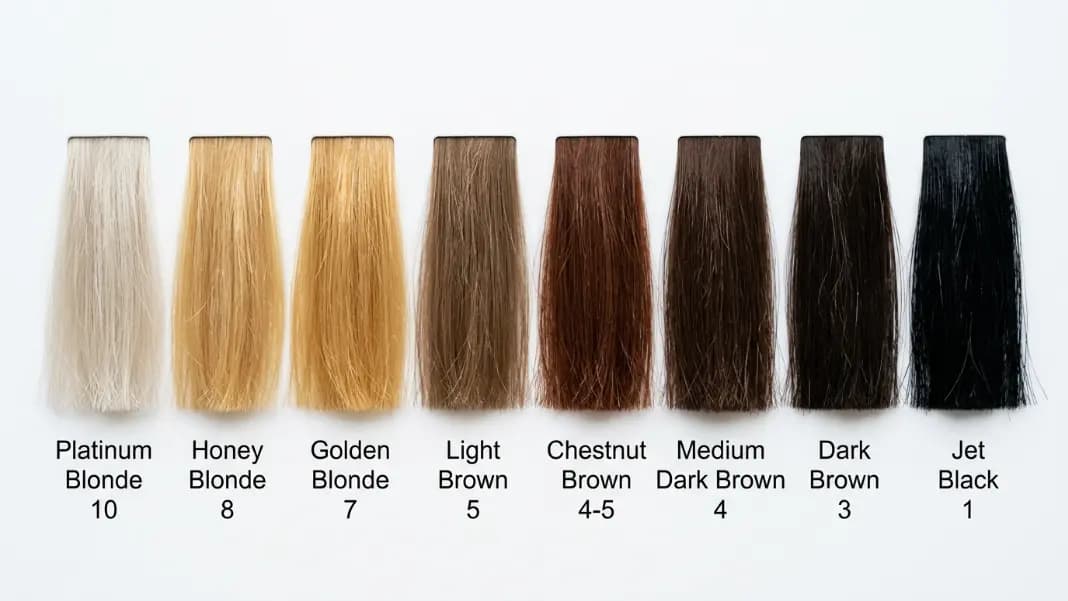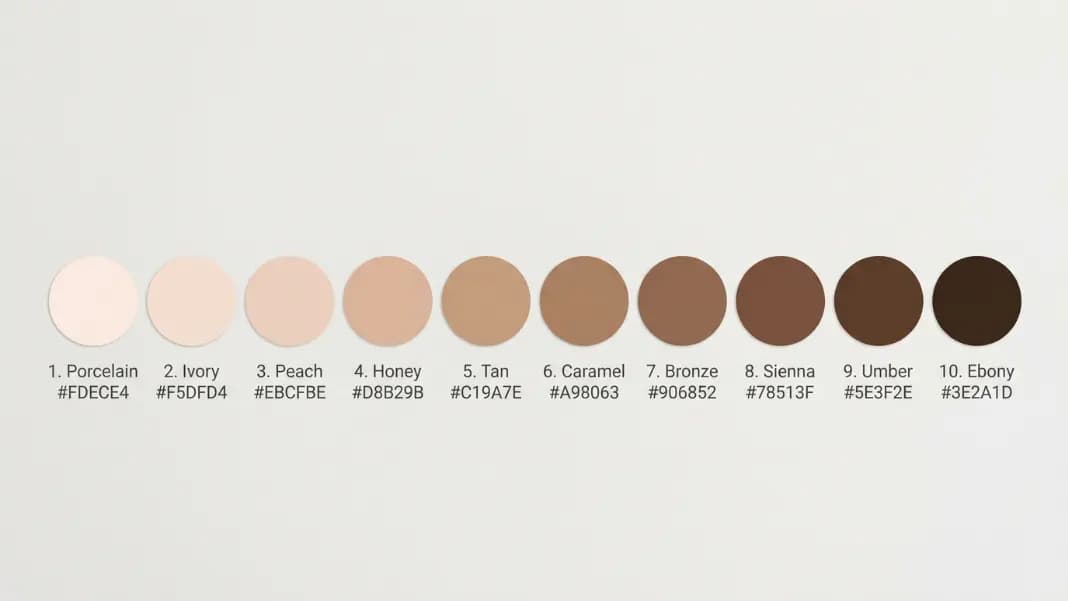
You are writing a character description and "medium skin tone" feels flat and imprecise. Or you are selecting foundation shades and the brand's chart uses names that do not match what you see in the mirror. Or you are building a digital illustration palette and need hex values that actually represent the range of human skin.
The vocabulary for describing human skin color is broader than most people realize, and it varies sharply by context. Makeup professionals, fiction writers, UI designers, and photographers each reach for different terms. What the beauty industry calls "warm beige" is what a novelist might call "honey-toned" and what a developer needs as a specific hex value. The terms in this guide are drawn from makeup industry shade charts, fashion and beauty editorial vocabulary, portrait and illustration communities, and South Asian beauty discourse, compiled into one cross-industry reference with hex code equivalents and the color name finder as the bridge to CSS named colors.
One useful starting point: CSS has a small set of named colors that touch the skin tone range. Bisque (#FFE4C4), peachpuff (#FFDAB9), and tan (#D2B48C) are the most commonly referenced. These cover only a narrow band of lighter skin tones, which is precisely why the broader vocabulary matters.
Why Light, Medium, and Dark Fail as Skin Tone Descriptors
Three-tier systems break down immediately in any real context. Light, medium, and dark are not descriptors, they are placeholders. They carry no information about undertone, warmth, depth, or hue. Two people described as "medium" can have skin tones with completely different warmth, pink cast, and reflectivity.
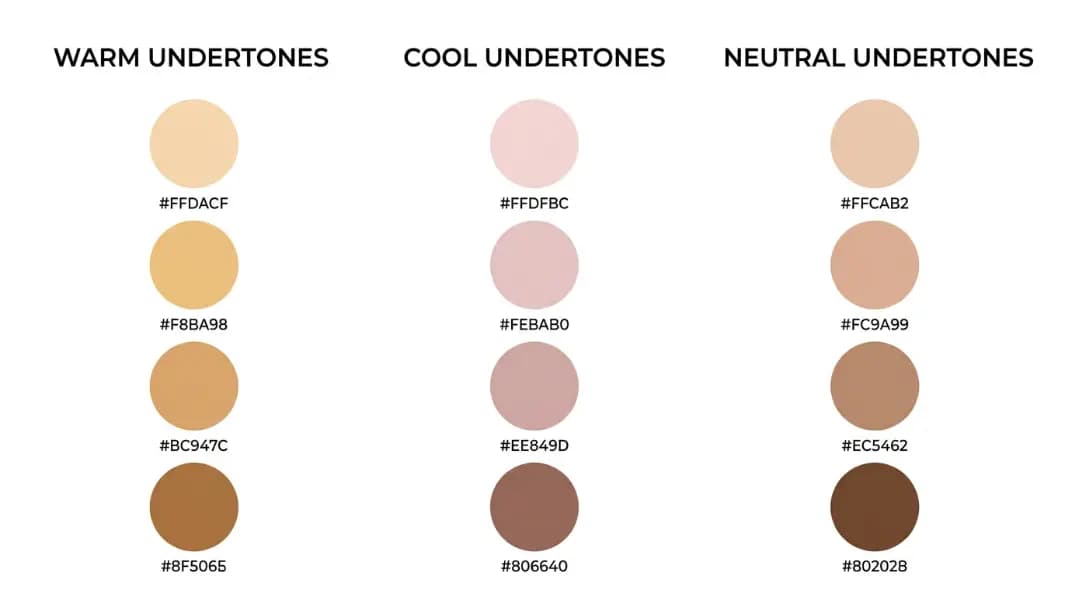
The useful information in any skin color description lives in two dimensions: depth and undertone. Depth tells you how light or dark the overall tone is. Undertone tells you whether the underlying color runs warm (yellow, peach, golden), cool (pink, red, blue), or neutral. A person can have deep skin with cool undertones or fair skin with warm undertones. Both dimensions together give enough information to be useful.
Professional naming systems, from makeup shade charts to photographic color profiles, use both dimensions. Understanding that structure makes the names easier to use correctly rather than memorizing them as a list.
Professional Names for Pale and Fair Skin Tones
The lightest skin tones have the most names in the beauty and fashion vocabularies, partly because the distinctions between them are more commercially significant in markets where lighter skin tones have historically been the default reference point.
Porcelain: The lightest skin shade category in most foundation ranges. Porcelain implies a smooth, almost translucent quality with cool or neutral undertones. Approximate hex range: #F8F0E8 to #FAE8DC. CSS bisque (#FFE4C4) sits slightly warmer and darker than true porcelain skin.
Alabaster: Very pale, cool-toned, with a matte or flat quality. Alabaster in skin terminology usually implies less warmth than porcelain. Approximate hex range: #F5EDE4 to #F0E0D0.
Ivory: A warm pale skin tone with a creamy, slightly yellow undertone. Ivory skin reads as pale but warm rather than cool and stark. Approximate hex range: #F5D5BE to #EED5C0. The CSS named color ivory (#FFFFF0) is much lighter than any skin described as ivory-toned in real usage.
Fair: A broad category covering light skin tones generally. In makeup, fair shades typically run from #EECFB5 to #E0C4A0. In writing, fair simply means light-complexioned without specifying undertone.
Peach: Light skin with a warm, peachy undertone. A peach skin tone sits in the warm-light range, roughly #F0C8A8 to #E8B89A. CSS peachpuff (#FFDAB9) is very close to the lighter end of this range.
Names for Light Brown and Olive Skin Tones
Beige: A neutral to warm light skin tone. In makeup, beige shades typically run from #E0BA90 to #D4A870. Beige implies a neutral warmth that works across many undertone variations.
Sand: A warm neutral, slightly more golden than beige. Sand skin tones run roughly #D8B080 to #CDA070. This term appears frequently in North American and European makeup shade naming.
Buff: A light warm yellow-beige, common in professional makeup vocabulary. Slightly more golden than beige. Approximate range: #D4AE7A to #C8A065.
Olive: A green-undertoned medium skin tone. Olive skin looks slightly gray or green-cast in cool light and warms up significantly in natural sunlight. Approximate hex range for olive: #B8956A to #A07545. The green undertone makes olive skin distinct from warm brown skin of similar depth.
Honey: A warm medium-light skin tone with golden undertones. Honey-toned skin reads as luminous and warm. Approximate hex: #D4A060 to #C8905A. One of the most flattering terms in skin color vocabulary because of its warmth implications.
Warm beige: A slightly more specific version of beige, explicitly naming the warm undertone. Runs roughly #D0A872 to #C09860.
Medium Brown and Tan Skin Color Names
Tan: A warm medium skin tone, one of the few CSS named colors that applies directly to skin. CSS tan is #D2B48C, which falls in the light-to-medium range and leans warm-neutral. In common usage, "tan" also describes skin that has darkened from sun exposure, which can mean a range of depths.
Caramel: A warm medium brown with golden or amber undertones. Caramel skin reads as rich and warm rather than neutral. Approximate hex range: #B07040 to #A06030. This is one of the most commonly used terms in contemporary makeup shade naming.
Bronze: A warm medium-to-medium-dark skin tone with orange and gold undertones. Bronze implies a specific kind of richness that suggests metallic warmth. Approximate hex: #9A6030 to #8A5020. As a makeup shade category, bronze typically covers the medium-dark warm range.
Sienna: Named after the raw and burnt sienna pigments, this refers to a medium-dark skin tone with reddish-brown warmth. CSS sienna is #A0522D. Sienna as a skin tone description implies warmth with a slight red or orange undertone. Approximate skin hex: #9A6040 to #884830.
Tawny: A warm golden-brown, used more often in descriptive writing than in makeup. Tawny skin has a slightly amber quality. Approximate hex: #A07040 to #906030. Common in fiction writing for characters with warm medium-to-medium-dark complexions.
Deep Brown and Dark Skin Color Names
Umber: A rich dark brown. Raw umber has yellow-brown warmth; burnt umber has red-brown warmth. As a skin color descriptor, umber implies deep brown with noticeable warmth. Approximate hex range: #6A3820 to #5A2E18. This term appears more often in artistic and literary contexts than in makeup shade naming.
Mahogany: A dark reddish-brown, one of the most commonly used shade names in foundation ranges for deeper skin. Mahogany implies depth with red or warm brown undertones. Approximate hex: #5A2818 to #4A2010.
Chestnut: A medium-dark warm brown. Chestnut skin has warmth similar to mahogany but sits slightly lighter. Approximate hex: #702A1A to #6A2818. Common in makeup shade naming and occasionally in descriptive writing.
Espresso: A very dark warm brown, named for the color of the coffee. As a foundation shade, espresso is typically in the deeper range with warm undertones. Approximate hex: #3A1C10 to #301808.
Ebony: One of the deepest skin color names in common use, implying very dark rich brown with blue or cool undertones. Ebony skin often has a reflective quality that lighter descriptors cannot capture. Approximate hex range: #28140A to #1C0E08.
Indian Skin Color Names: What the Terms Mean
South Asian and Indian skin color vocabulary uses a specific set of terms that do not map directly to Western makeup naming systems.
Fair: In South Asian usage, fair refers to lighter skin tones, roughly equivalent to what Western makeup would call light to light-medium. This approximately covers the #EDD5BE to #D4A872 range.
Wheatish: A term specific to South Asian beauty vocabulary. Wheatish describes a medium warm skin tone with a yellow-beige quality, like the color of wheat. Approximate hex: #C8965A to #BC8A4A. There is no direct Western equivalent for this term, which is why it persists as a distinct descriptor rather than being replaced by a translated version.
Dusky: A South Asian term for medium-to-dark skin with depth. Dusky does not have a single undertone implied. Approximate hex range: #9A6040 to #7A4828. The term carries both a color description and cultural context that varies by usage.
Dark: Used in South Asian contexts similarly to how Western systems use "deep" in foundation shade naming.
Skin Color Names for Writers: Words That Actually Work
Generic skin descriptors fail in fiction because they carry no sensory quality. "She had medium brown skin" tells you depth and nothing else. The professional and literary vocabulary offers terms that imply texture, warmth, and quality of light on skin.
For the palest skin: alabaster, porcelain, ivory, translucent. These carry coolness and fragility.
For warm light skin: peach, cream, honey, warm ivory. These imply warmth and softness.
For medium tones: tawny, golden, amber, warm beige, honey-brown. These suggest richness and warmth.
For medium-dark tones: bronze, caramel, sienna, chestnut, copper. These imply luminosity and depth.
For deep skin: mahogany, umber, ebony, rich brown, deep brown. These carry depth without diminishing warmth.
The practical advice for writers is to pair a color descriptor with one observation about light quality or undertone. "Her skin was dark amber, warm in the afternoon light" is more specific than any standalone color name. The combination tells readers both what the skin tone is and how it behaves in the scene.
Finding and Using Skin Tone Hex Codes
For design work, illustration, or digital reference, finding the right hex code for a specific skin tone requires moving beyond the CSS named color set. The color name finder tells you which CSS named color is closest to any hex you input, which is useful for documentation and cross-referencing. But for building a real skin tone palette, you need custom hex values.
If you have a reference image, the image color picker extracts the dominant colors from any uploaded photo as exact hex codes. Upload a portrait photo and it returns the specific hex values present in the skin tones, which you can then paste into the color name finder to identify the nearest CSS named color, or use directly in your design files.
For building a complete palette from a single skin tone anchor, the tints and shades generator produces 11 steps from white to black through any input hex. This gives you a complete tonal scale that covers highlights, midtones, and shadows from a single reference skin tone, which is how most digital illustration palettes are structured.
The full range of color tools for working with skin tone palettes, hex conversion, and color matching is in the color tools section. If you need to understand what specific hex codes are called in CSS more broadly, the hex code color names guide covers the most common hex values from design systems with their closest CSS named colors.
Skin tone, hair color, and eye color are produced by the same melanin system and are natural companions in portrait and character design references. The hair color names guide covers the professional Level 1–10 depth system and every dyed technique name with hex codes. The eye color names guide covers every human iris shade ranked by rarity with hex codes — the complete set for building accurate character palettes.